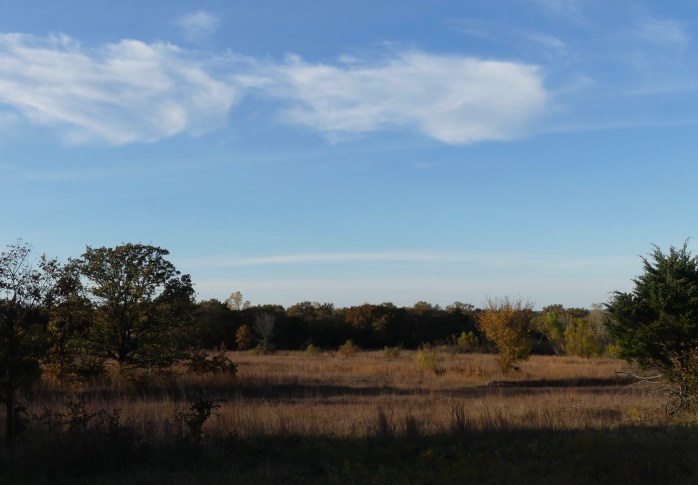
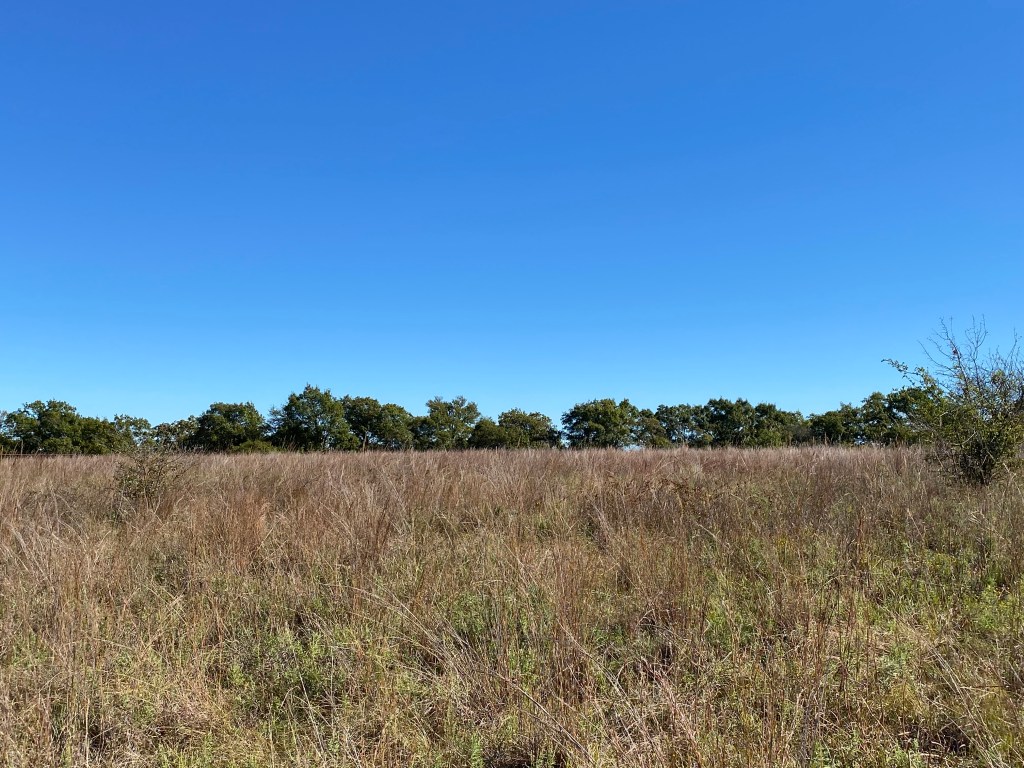
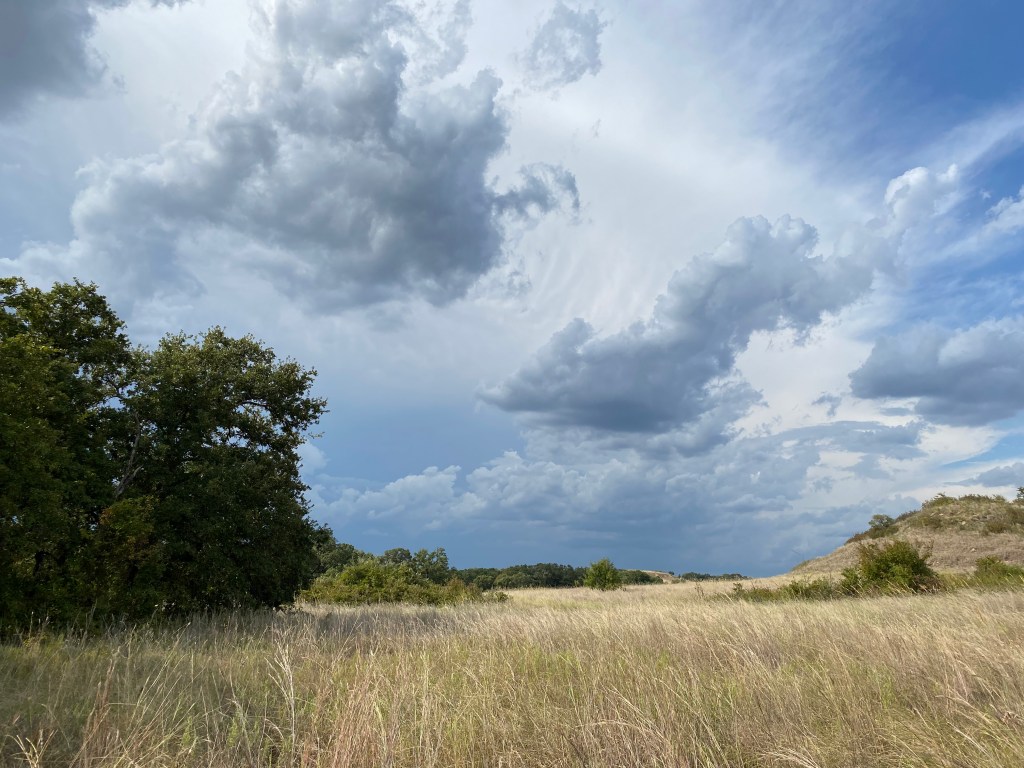
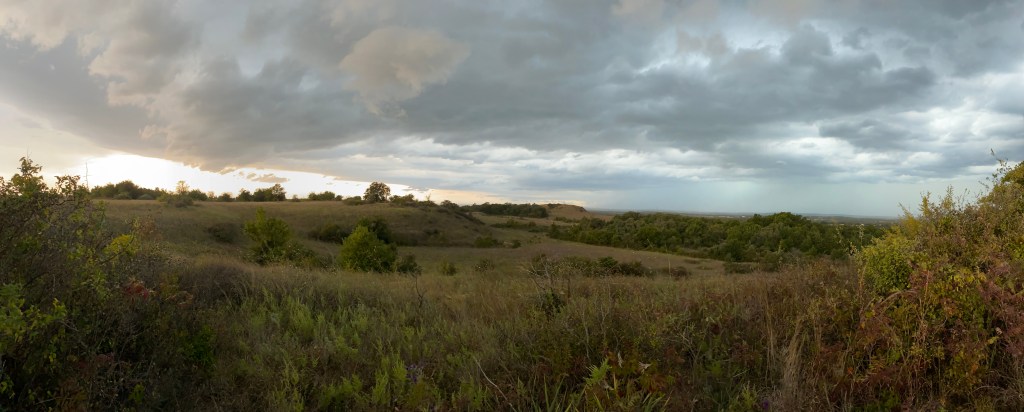
This is a day for shelter from the storm, and also for speaking up in resistance to that storm. Shelter so that the storm does not blow us away, and resistance so that one day the storm ends. We need the shelter of other people, and many of us find shelter in the quiet places of nature where we can let go of troubles and for a time simply be present to water and earth and sky.
Today the Russians escalated their invasion of Ukraine. The murderous gangster Putin, the “genius” as Donald Trump sees him, used lies and tanks to roll into an independent country to, in his terrible fantasy, take it back to revisit the glory of the good old Soviet days.
Yesterday the Texas Attorney General (who is under indictment for fraud and the subject of multiple ethics complaints) put out an opinion that gender-affirming medical care for teenagers is child abuse. The Governor promptly directed child protective services to look into such issues, potentially subjecting Texas kids, their families, and their doctors to investigation and criminal liability. The hard right keeps Texas’ culture wars going with appeals to ignorance, bullying and discrimination. Their ads are vomited out of our televisions nightly: “stop giving our money to illegals,” promotion of book bans, the destruction of public education, and denying that any harm ever came to a Black person, ever in the history of our country.
The storm is threatening and we need shelter, and we also must resist. We resist through our commitment to fellow humans even outside of our tribe, our determination to see that we are all cared for, and our insistence that we should all have a voice in how we live. We resist when we see compassion and empathy as strengths, not weaknesses. We resist by questioning why so many scorn “the common good.”
Shelter is necessary so that we are not burned up in constant resistance. We need a way to step outside the storm, in other words to spend some time (even a short time) in a nurturing and calm reality. This essentially requires on our part the mental ability to quiet our minds and for a time not live in an imagined “elsewhere” full of harm and conflict. If we can be fully present where we are, there is our shelter. Maybe we are in the comforting presence of another person. We might be listening to one of Beethoven’s late quartets (or the Rolling Stones!), or sitting outside, looking at the stars. We also could be walking through a woodland, with the sun filtered through tree branches and birds calling nearby. We could be in any of those places, but unless we can quiet our mind and step away from thoughts of the past or future, we will not really be sheltered from the storm.
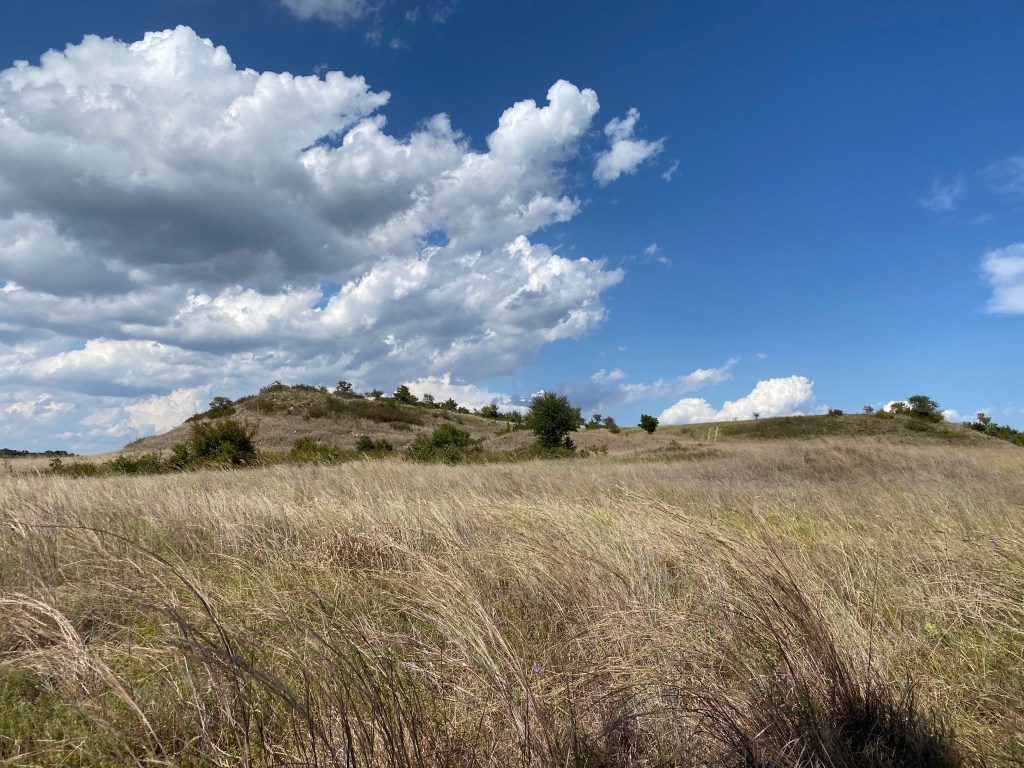
Now more than ever we can see how nature is always there for us. When it seems that everything else is in chaos, usually that tree is still there, that prairie still the same comforting place it was last time. My wish for all of us is to have the shelter we need, and also the energy and courage to resist.
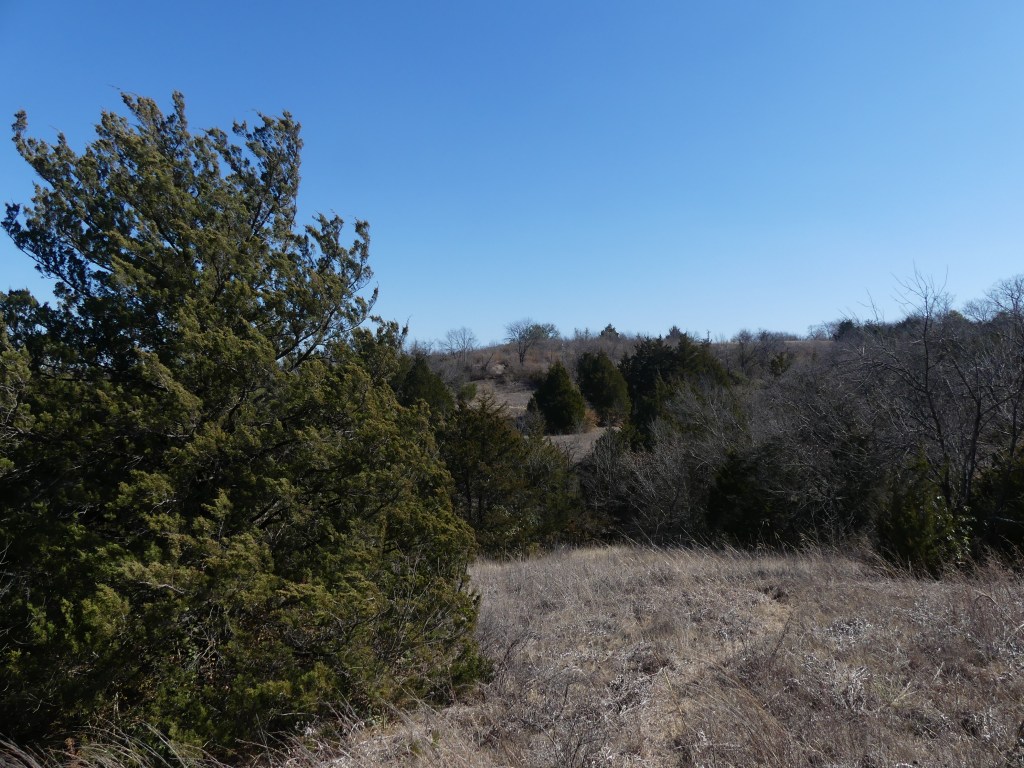
On a bright February afternoon, Tandy Hills Natural Area was a great place to walk through the prairie. A couple of hours of mindful awareness of limestone ridges, junipers, crows and compass plants was just what I needed. I put my phone away and, when my mind strayed, I brought it back to this moment with these grasses and these junipers. The afternoon here was valuable; it deserved my full attention.
Really, any afternoon (and morning, too) deserves our full attention. That is one of the messages of the practice of mindfulness, a discipline that can help us go through our days awake to what is happening around us and within us. In contrast, if I walked through the prairie while looking at my phone or thinking about something coming up tomorrow, I would be on a sort of autopilot and would hardly notice what happened on my walk.
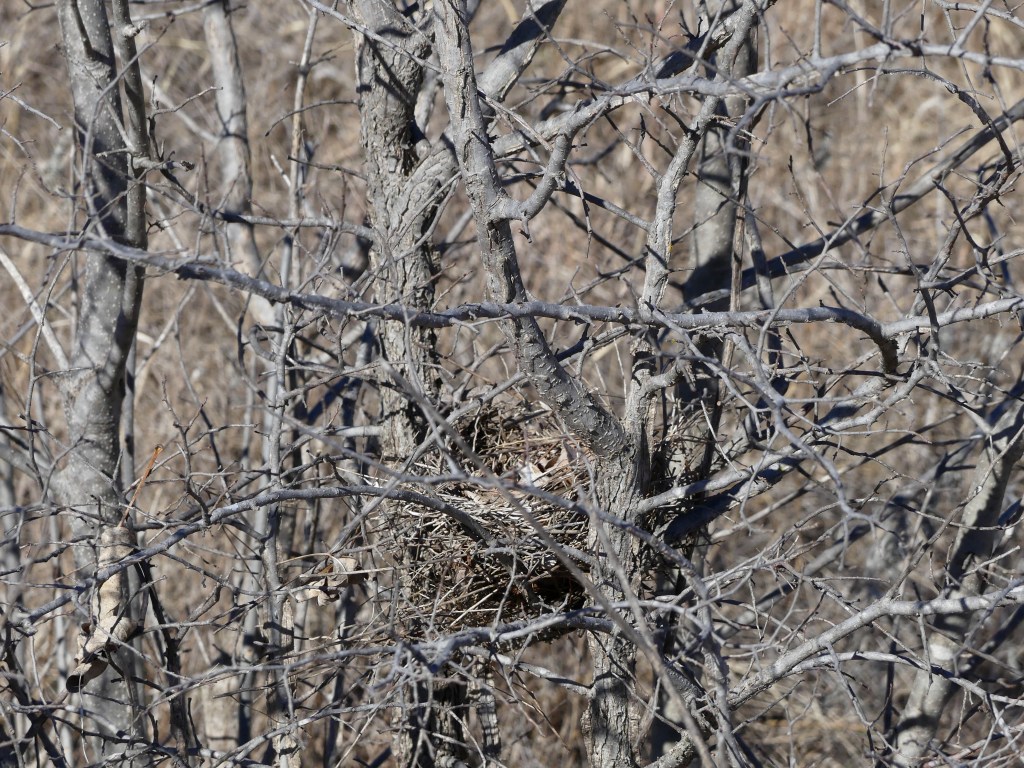
There was a lot to notice in the more than 200 acres of prairie and savannah in east Fort Worth. Wandering along the trail, I noticed a small bird nest in a young tree, only a couple of feet off the ground. Last year, a little bird chose this tangle of branches as the safest spot for her family. I thought of the amazing ability of that avian brain and nimble wings to coordinate a landing within those branches. Routinely coming and going from the nest would have required an Olympian athletic ability.
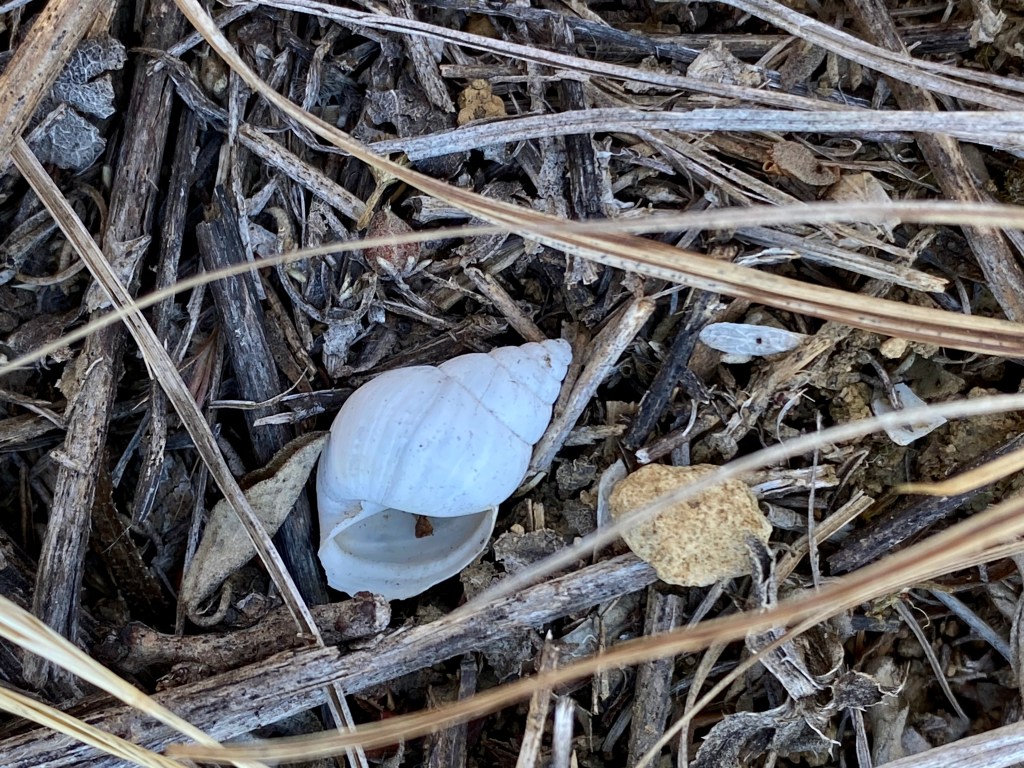
The shell of a Rabdotus snail
Sometimes my pace resembles what Suzanne Tuttle calls “walking at the speed of botany.” Being unhurried and shifting between the wide view of the landscape and the narrow view of small patches of ground, you find wonders hidden in plain view. For example, there were the small gleaming white shells tucked away in the thatch of last year’s grass. The land snail called Rabdotus generates a beautiful spiral shell, growing bigger as the curve expands below its conical tip.
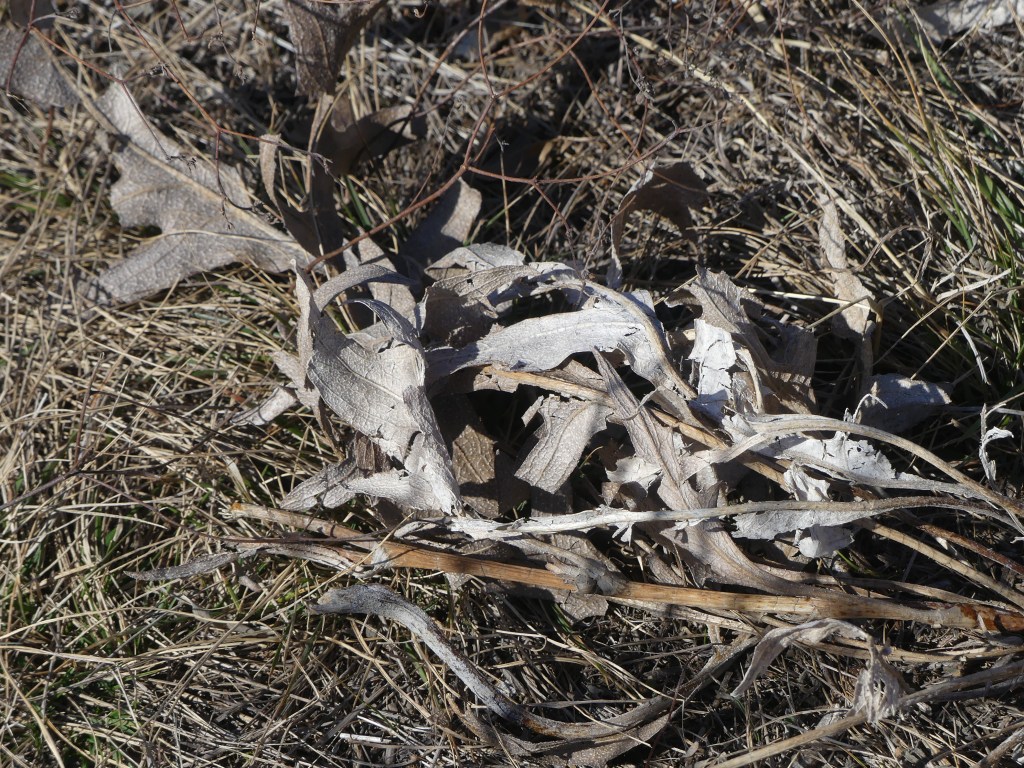
There are some spots within open patches of prairie where the sun exposure, drainage, and surrounding community of species is just right for the compass plant. Its name reflects the tendency for the leaves to grow facing north and south. Not that the plant cares much for cartography, but when the leaves grow in this way, they do not absorb so much of the sun’s heat in summer. And what leaves! Compass plant leaves are big and deeply cut into lobes, and the leaf is very stiff and sandpapery. Even in winter when the plant is dormant, the dead leaves persist on the ground as pale ghosts of their summer selves. They are brittle but still stiff and gritty.
One of last year’s compass plants
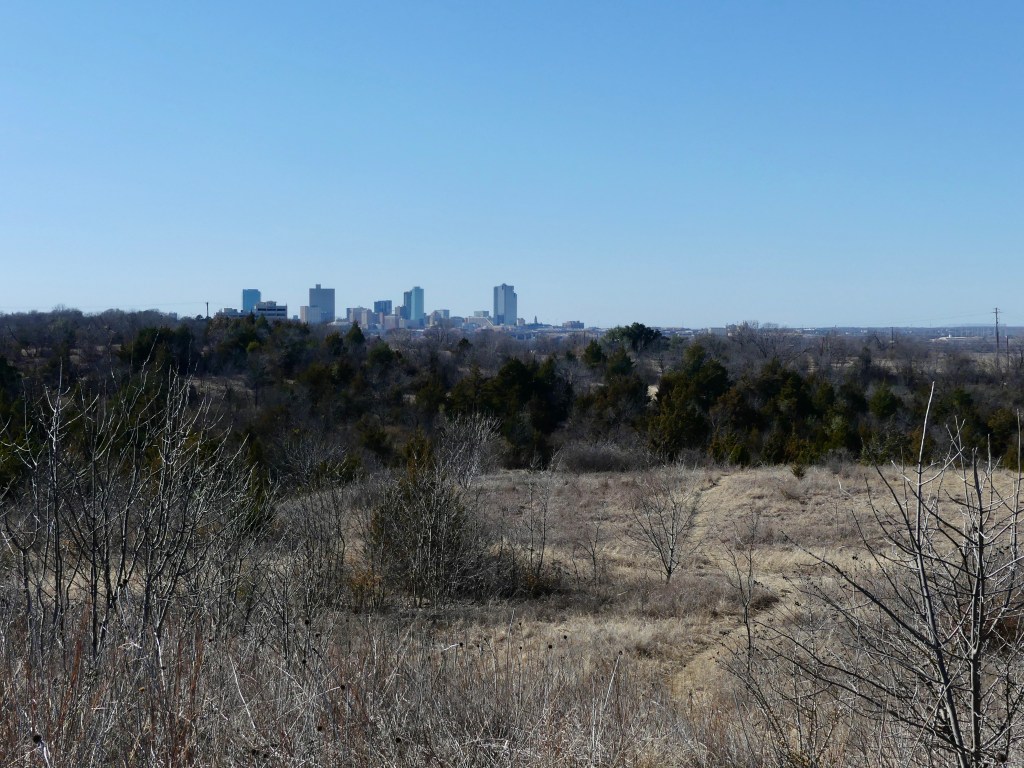
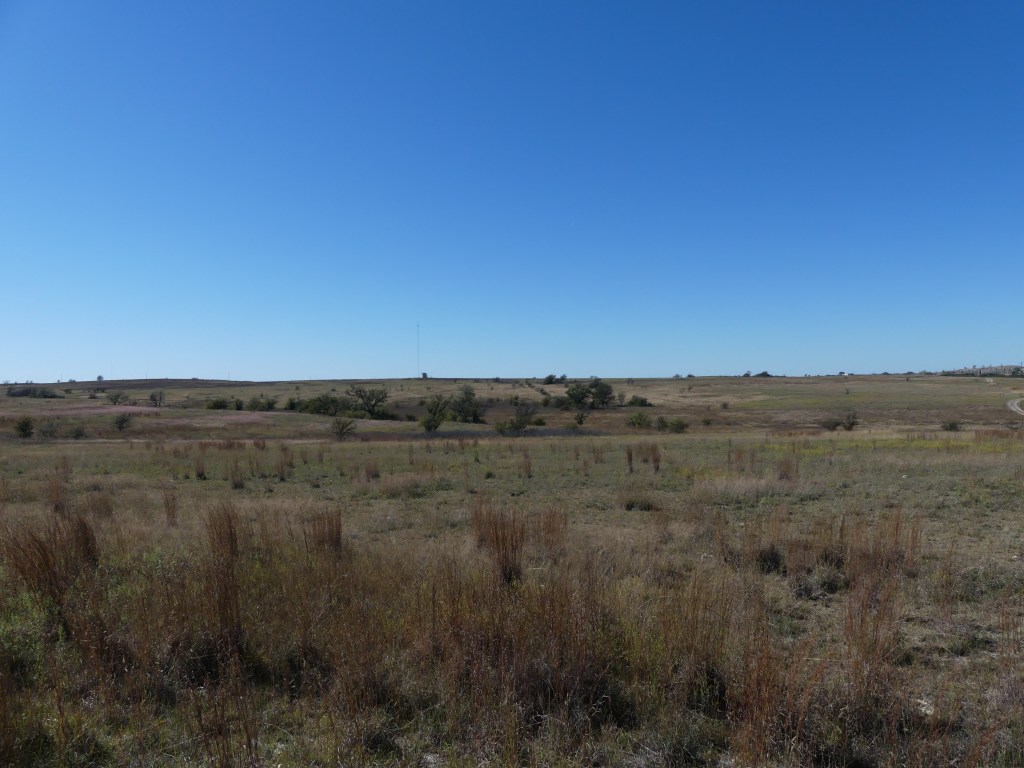
I walked the trails down to the boundary of the place, just south of I-30. At that point, the traffic noise is pretty distracting to me, and I am ready to head for quieter places. To the east is Broadcast Hill with more rolling prairie added to Tandy Hills in 2020, and beside it is a tall broadcast tower. Looking around, it is clear that this remnant prairie is an island of nature surrounded by the “built world” of freeways, technology, and houses. It is all the more a treasure because outside of its boundaries, all the grasslands, meadows full of flowers, and woodlands are gone.
Tandy Hills without the “built world’
The challenge for me is to fully accept all the wonders together with the freeways, the 1500-plus species of plants growing on beautiful limestone ridges along with the views of houses and streets. My camera is a snitch that blurts out my denial of the full reality of the place. I focus on some grasslands with a stand of juniper in the background and I shift the camera so that the broadcast tower is not in the view. I frame a photo so that the buildings beyond the preserve are not visible.
I will be better off when I can accept that Tandy Hills lives here, among the freeways and houses, a stubborn, wonderful survivor where children can learn about the beautiful spiral shells of land snails and the amazing leaves and beautiful white flowers of compass plants. Perhaps I will progress past the denial phase of my grief at the loss of so much that is wild and natural in Texas.
Beyond the boundaries
Mindfulness will help with this because it depends on an attitude of acceptance. To practice mindfulness is to work on being open to what we experience, non-judgmentally. That does not mean that I should not work to support conservation of what is left, or to encourage rules that keep off-road vehicles from tearing up the place. However, on a walk like this one, this afternoon, the full appreciation of the place needs me to accept the sound of trucks and the view of the city just past the nearby hills.
Butterflies appear to accept Tandy Hills just as it is. As I looked over a patch of dormant prairie grasses, a small yellow butterfly bounced across the field. This little sulphur had survived the recent temperatures in the teens and emerged with boundless energy, flying among the little bluestem and Indiangrass and disappearing over the ridge.
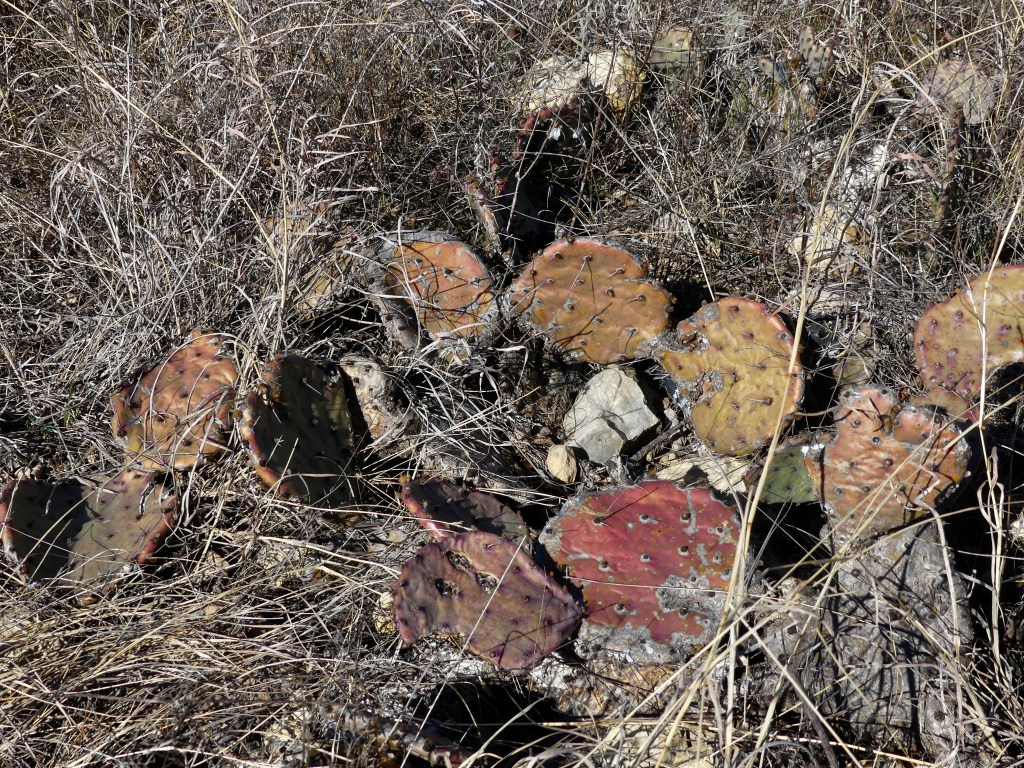
Prickly pear in an array of soft colors
Somewhere along the way was a clump of prickly pear cactus, its pads weakly standing up to the winter and the lack of rainfall. But those pads were the loveliest shades of terra cotta and pale green shading into gold. Walking at the speed of botany brings so many beautiful things into view.
Eventually I sat on a bench on one side of a ridge and looked across junipers and oaks to a small tree or shrub around a hundred yards away. It had a smear of reddish color, perhaps leftover autumn leaves or a possumhaw with clusters of red berries. I wanted to focus my awareness on my breathing and on this one spot in the distance. Bringing attention to each breath is a way, in mindfulness practice, to let go of distractions and focus on moment-to-moment experience.
In my greater stillness and openness, I was more aware of the depth and distance to the next ridge and the green and reddish-gold junipers swaying in the breeze. The hills seemed a little quieter; cars were still moving and somewhere there was an airplane, but they seemed more in the background, more distant.
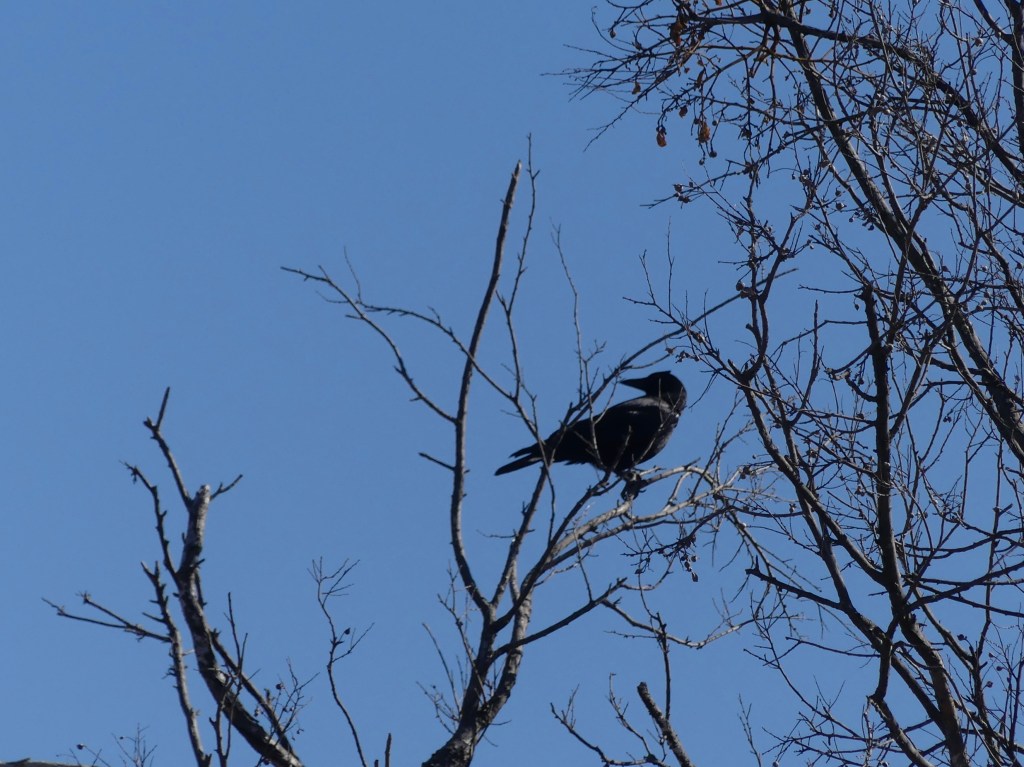
A crow flew between the ridges on broad black wings, pulling up to rest on the branches of a skeletal oak tree. Then two more crows flew in from another direction, perching in nearby trees. After a minute of silence there were a couple of rounds of crow-talk, “caw-caw-caw-caw.” The afternoon deepened and the shadows grew longer as I listened to the comings and goings of crows. There was a sense of peace and belonging here with the crows and butterflies and everything else that lives at Tandy Hills. We are all fortunate to be able to spend some time in this patch of prairie.
We want you to spend time in nature and come away in love with the place. We want your kids to love the grasses, ponds and woods. “We” are the LBJ Grasslands Project, and so far that is Michael Smith and Kayla West. We think time spent in nature is important, and we’ll meet you out there and show you around.
Why is it important? We value your experiences of wonder and fascination, as well as the sense of relatedness, empathy and peace that can come from time spent in nature. In addition, our world needs as many people as possible who have a strong connection with nature. Without that connection, we do not care for the earth around us, and the land, water, and all living things suffer as a result.
The suffering of the earth – the climate, the loss of species, the oceans choking on plastic and carbon, and other issues – is a moral challenge to us and ultimately it threatens human survival. The only answer to it is for us to live in a healthy relationship with all the lives around us. What would such a relationship look like? It would not require us to return to a primitive existence, but it would ask us to weigh our priorities differently. Taking less and giving back are things we do only when we truly care about someone or something.
Meeting people somewhere in nature, introducing them to the community of animals and plants, and finding ways to make the visit playful, memorable, inspiring – that might be a gift to you, but it is surely a gift to ourselves. Sharing places like the LBJ National Grasslands brings considerable joy. It was especially fulfilling to read what Jessica wrote in a letter to the grasslands: “I don’t think any of us play outside enough, and your beauty and diversity inspired such curiosity and creativity in my kids yesterday. I’m grateful.”
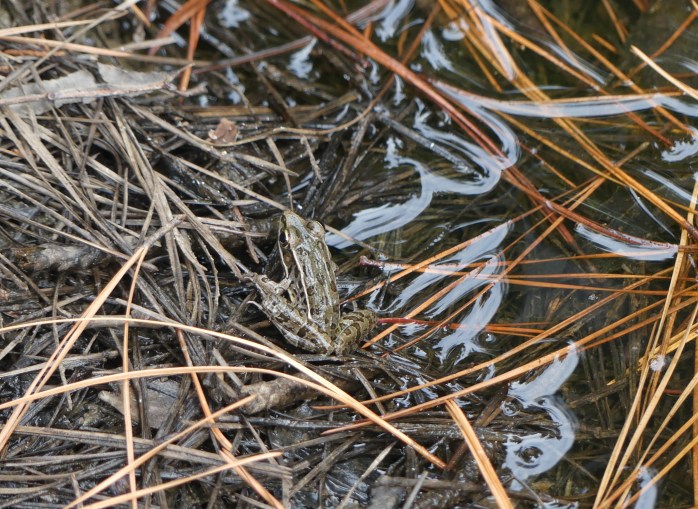
Leopard frog
Let me spell out a little more about what we are doing. The two of us are naturalists, and that means we know something about living things and places like grasslands and woodlands. We are also really interested in how people benefit from nature and how they can spend time “soaking in” all the details of a wild place, paying attention to sights, sounds, smells, even the touch of the land and water. Some folks get outside because it is a pleasant setting for a picnic or outdoor sports, but when we walk in these places we are focused on any or all of the thousands of things we find – trees, birds, mosses and ferns growing on a shady embankment, clouds, a spider tucked away in tree branches, and so on.
Kayla and I have specialized interests in some species, and you’ll find us documenting some of what we see on the iNaturalist app. However, adding to a big list of species that we have seen is not the main point. You don’t have to have any special knowledge of things like geology or botany to walk with us. The walks we want to lead in the LBJ Grasslands Project are for spending time in the prairies and woodlands and following our curiosity wherever it leads us. Sometimes the emphasis might be on understanding the plants and animals and how they live. At other times we might be interested in practicing mindfulness, with little talking and an emphasis on the direct experience of being present.
Our walks are fairly slow and pretty quiet, with the goal of taking time to really see and hear the place, think about what is going on around us, and cause as little disturbance as possible. A big group would scare the birds, frogs, and other wildlife off, and we might not get much individual interaction with you. Instead of bringing a class with a bunch of people, we go in very small groups, maybe just two to five people. (In the pandemic that we are still struggling with, small groups allow for more distance between participants, too.)
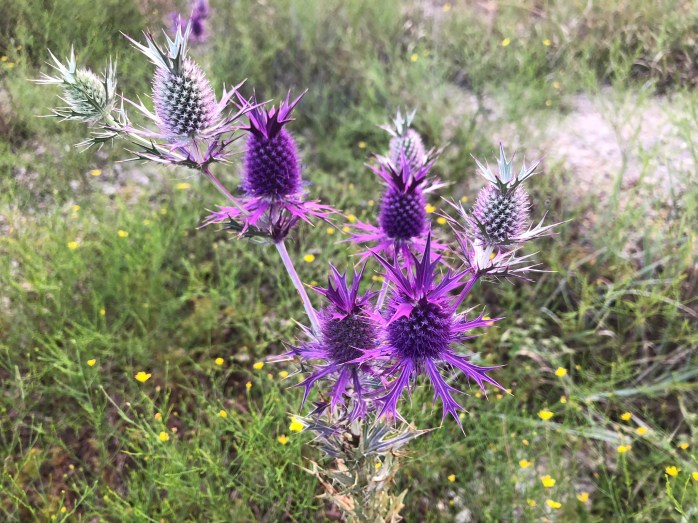
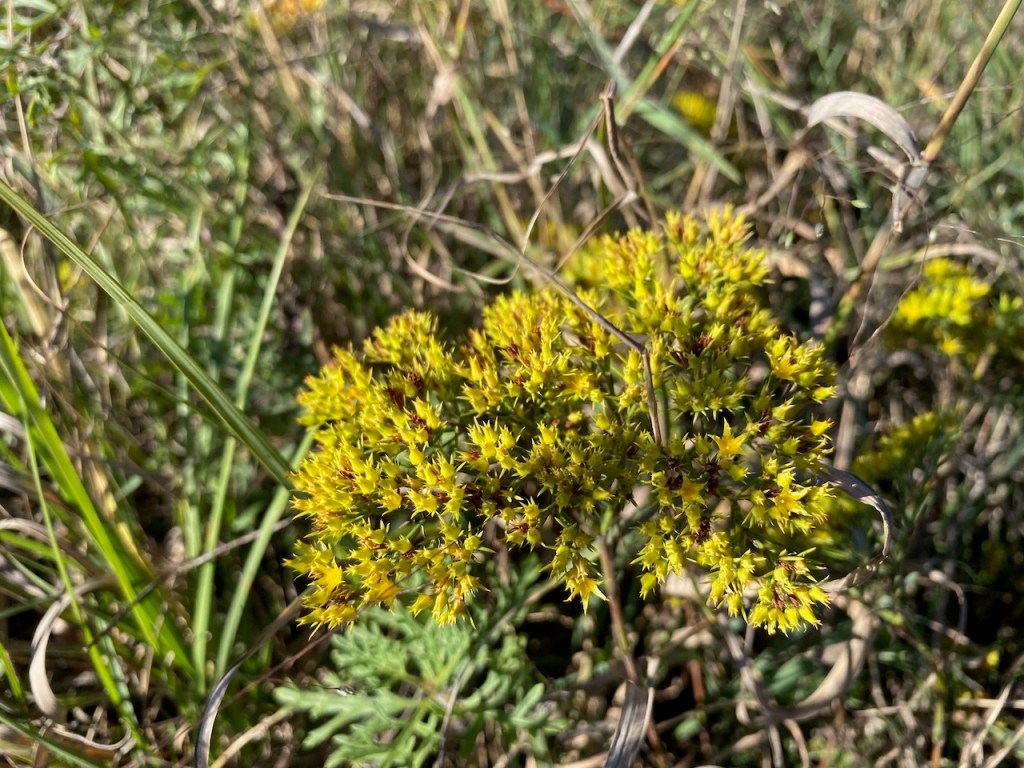
Leavenworth’s eryngo
Kids are welcome, as long as they are a pretty good match for the kind of walks I just described. That means that children nine or ten and older are the best fit. Fourteen-year-old Abbey wrote, “I loved the hike, I learned so many things that I wouldn’t learn in school.” If you are interested in bringing younger children, please talk with us and perhaps we can arrange something that will engage them and be meaningful for everyone.
I should also mention that we do not charge for these walks, which we do just because they needed doing and because we get intangible rewards for doing them. If this interests you, please join the Facebook group for the LBJ Grasslands Project, https://www.facebook.com/groups/lbjgrasslandsproject, where we talk about these things and plan future outings. If you don’t do Facebook, I would be happy to hear from you if you email livesinnature@outlook.com.
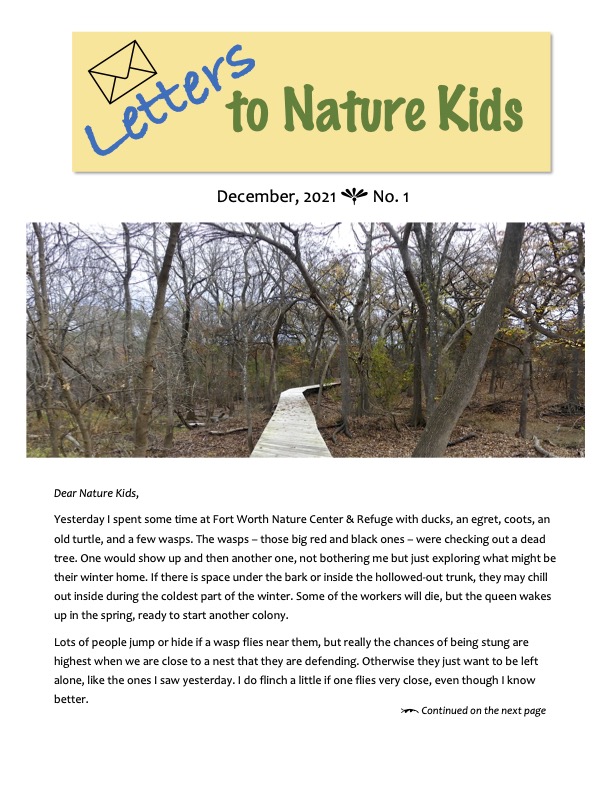
I’m adding something new: free, downloadable “Letters to Nature Kids” that I will write from time to time. As I noted on the page for this publication, we “don’t send letters so much any more, but a good letter can feel like part of a long-distance conversation, informal and personal.” The first issue is only a few pages of text and photos, that includes a little information about wasps, egrets, turtles, and trees, without getting in-depth. The idea is for the natural history facts to be incidental to the telling of a story about something (in this case, about a walk I took at Fort Worth Nature Center & Refuge).
We will see how future letters go; they probably will not all be about future walks I’ll take. They might be about a particular kind of animal or plant, or something about how people and nature are related. In each one my purpose will be to “send” a letter to anyone who enjoys nature and would like to share a little bit of it. Readers might be around ten or older – including adults who, like me, can be “nature kids” at any age.
I hope you or someone you know will enjoy it. And I hope you’ll let me know what works and doesn’t work, what topics would be good. Please – write back to me!
Hardly anything is finer than a green Forest Service gate opening onto trails that lead through the grasslands and oak woodlands of LBJ National Grasslands. Those meadows and woods change throughout the seasons, and each of those changes is beautiful. If I had to pick a favorite, it would be autumn (but ask me again in the spring). The low-angled sun highlights details of light and shadow, the colors of leaves and grasses are wonderful, and afternoons can be sun-warmed but cool at the same time.
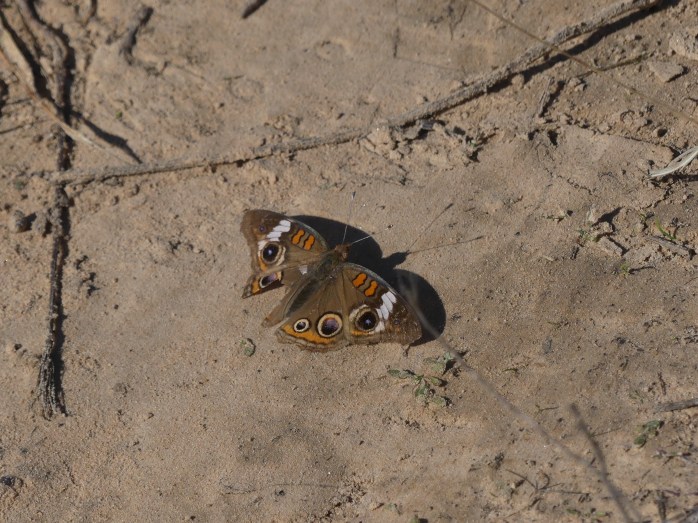
A common buckeye
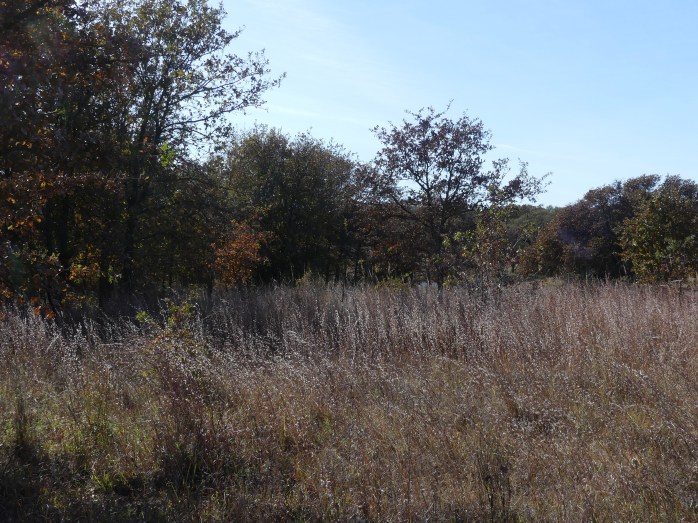
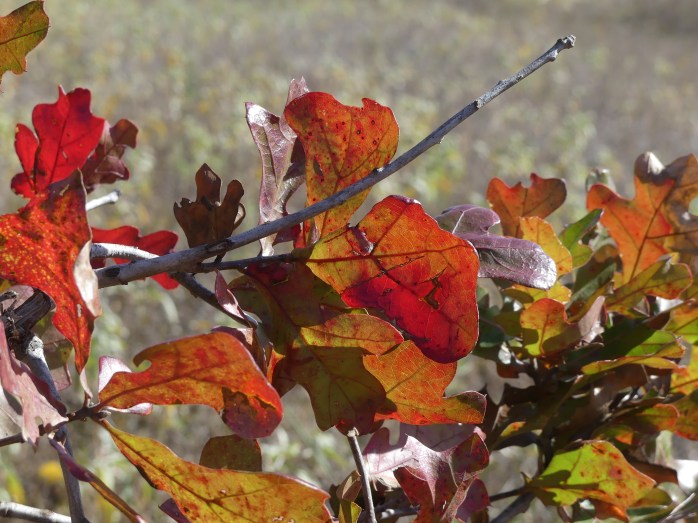
Yesterday I opened one of those green gates that was new to me and walked a trail back through rust-colored little bluestem grasses and oaks with leaves now tinged with yellow and caramel, and a little red here and there. Much of it was familiar, like the way the sun makes little bluestem sparkle when it shines through the little tufted seeds tucked away along the stems. What made it wonderful was that it was more of the things that are always on the verge of being lost. Ranches are sold and turned into houses and lawns, and so a walk through a new patch of Cross Timbers felt reassuring.
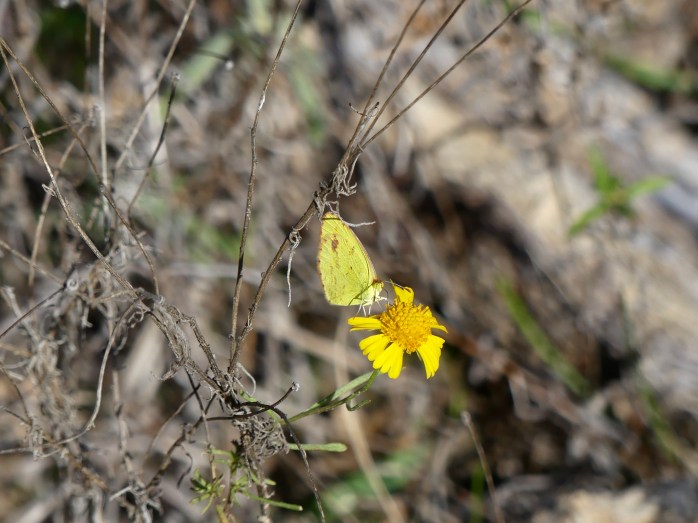
Croton and bitterweed along the trailA sulphur visiting a bitterweed flowerA small pond
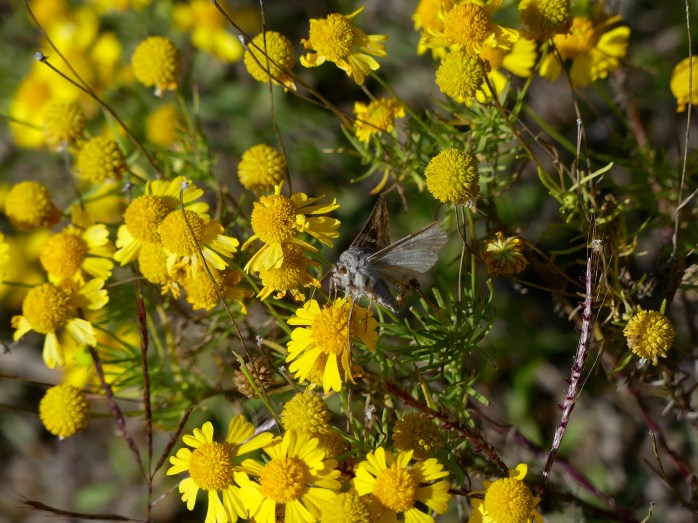
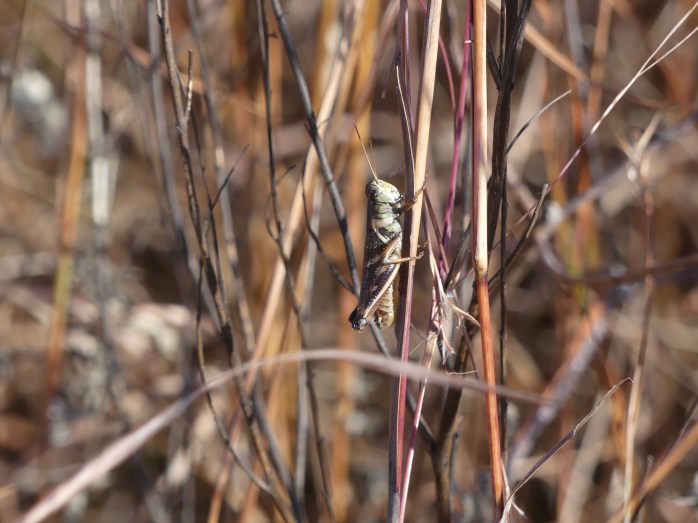
Along with the taller prairie grasses were areas with lots of croton (“prairie tea” for some folks), western ragweed, and bitterweed. I love this last plant, whose yellow flowers bloom so late in the year. Clusters of yellow bitterweed blooms were visited by bees and butterflies. Grasshoppers jumped in front of every step I took, taking advantage of these last warm days to nibble at the remaining vegetation.
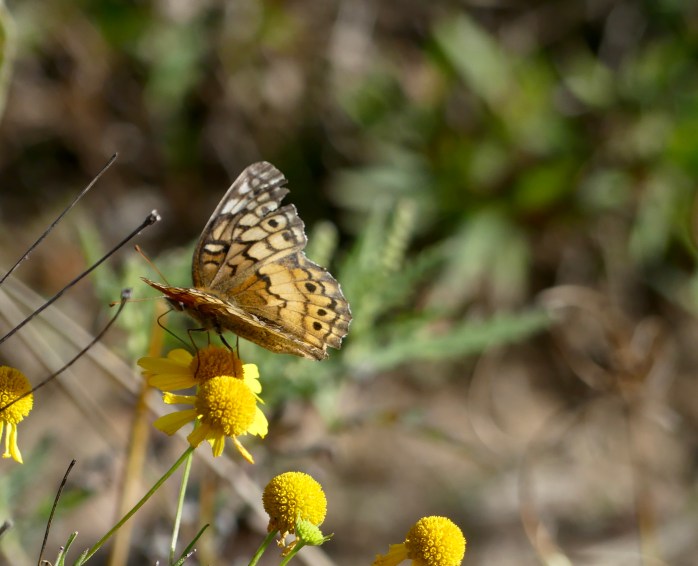
A skipper visiting the bitterweedA variegated fritillarySunlight through bluestem seeds
“Me and my shadow.” A harvestman (daddy longlegs) and its shadow, wandering the prairie
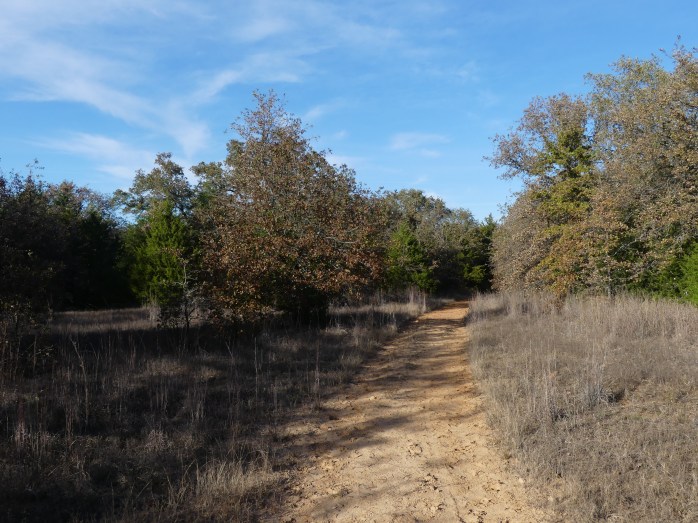
After about an hour, I went down the road to another of those green gates, this one opening onto a trail that Meghan Cassidy and I walked a year and one week ago. After crossing a nice patch of prairie that very gradually slopes down to a line of trees, the trail turns and traces its way through oaks, junipers, and prairie openings.
I stopped at the same post oak where we had stood and watched leaves drop, the air so quiet that I could sometimes hear a leaf bump into a branch on the way down. And then we would hear a wave of breeze approach through the treetops, stirring the top branches and releasing a few more leaves to pinwheel down to the growing carpet of leaves on the ground. Although not many leaves were falling from that tree yesterday, there was some of that sense of solitude and peace in the quiet of the woodlands.
Further down the deep sandy trail some of the same young oaks were turning, with leaves glowing scarlet when backlit by the sun. The woods were full of shade behind the trees which really had yet to lose many leaves. In other places the low mid-afternoon sun struck grasses and leaves with bright, warm light. The sunlight seemed that much brighter for the contrast with the shaded and darkened places deep among the trees.
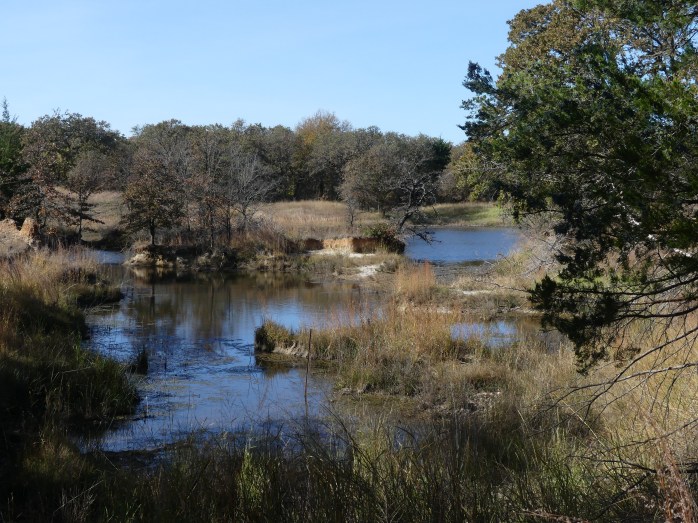
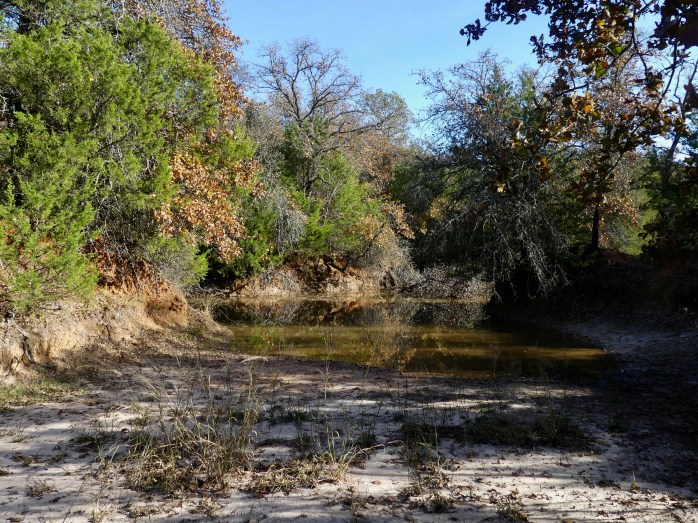
The pond
I reached a place where the soil is cut by erosion and drops, exposing red and pale sandy soil in an irregular set of steps and furrows down to a small pond. Meghan and I sat here a year ago on a stretch of slightly damp sand tilting down to the water. I was entranced by a play of the light in which the late afternoon sun was reflected by ripples, sending squiggles of light up onto a shaded bank under a juniper. The very same thing was happening yesterday, with a tiny light show playing on the shaded bank of the pond. It was a very small thing, and also an example of something that seems important to me: Nature is so often a consistent, stable presence in a world that can seem chaotic. Places in nature can be anchors in our lives to which we can return over and over for reassurance that some good things persist in spite of all the changes around us.
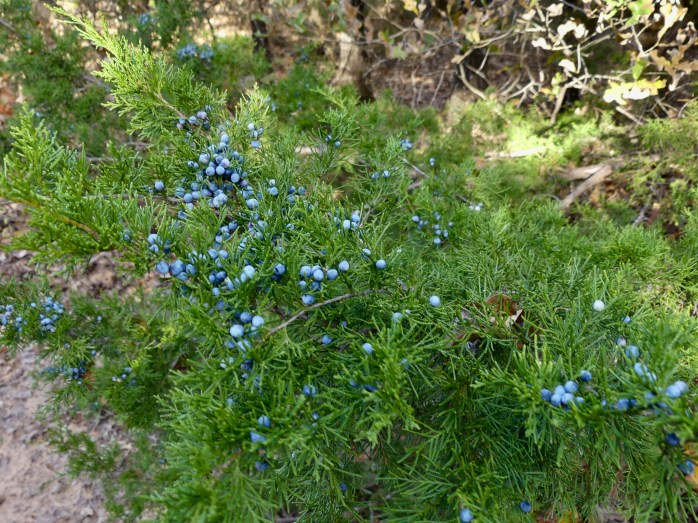
Juniper berries!
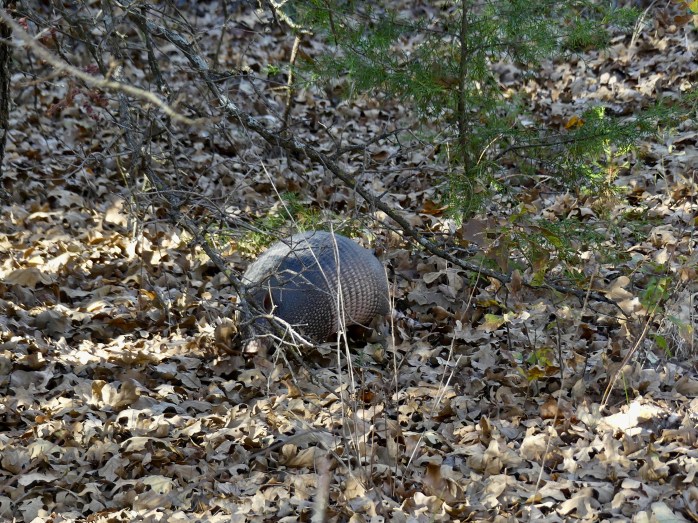
On the way back there was movement in the leaf litter a small distance off the trail. It was a nine-banded armadillo, snuffling along the woodland floor, oblivious to the human standing nearby. Once again last autumn’s walk was being repeated, as we saw an armadillo on the return walk on that day, too. This one kept searching for insects and grubs to eat while I took a couple of photos. I shifted and made a little noise and the little armored one stood up to look around and sniff the air. I coughed, and he crashed off through the brush.
The armadilloTiny asters blooming along the trailGrasshoppers were everywhereMore prairie
It was getting near sunset, and my walk was done. It is hard to put into words just what this time of year, this quality of light, this quiet woodland feels like to me. In the “Autumn” section of the book Meghan and I have been working on, I wrote this: Things come to an end / Be still in the golden autumn light / And consider how to make a good end of the year / With affection and acceptance. This season does feel like an ending of the year, and it seems like a good idea to spend some time being still and quietly reflecting on all that the year contained. This November walk at the LBJ National Grasslands had been perfect for that.
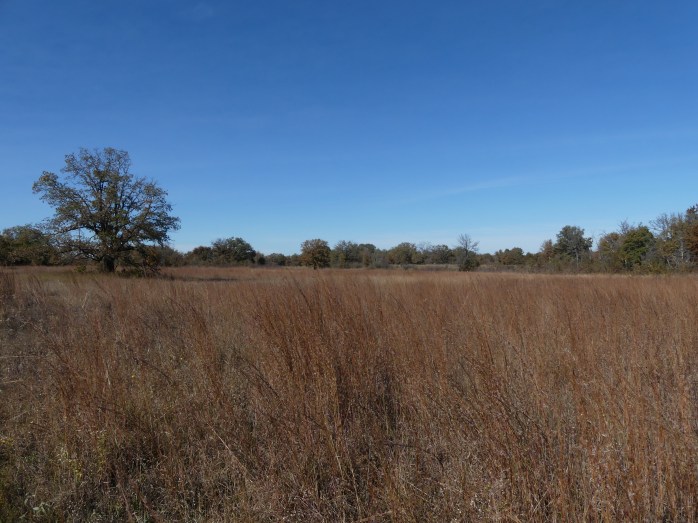
Fields of grasses and flowers stretching into the distance pull me into some sort of enchantment. In late autumn and winter their colors and textures could keep me wandering for hours, with the sun glinting through the tufted seeds of little bluestem and the inflorescences of Indiangrass waving at the tops of tall and slender stalks.
On October 30th, I had the opportunity to learn more about prairies and how they work, by attending the Prairie Seekers training provided by the Native Prairies Association of Texas (NPAT), in conjunction with the Dixon Water Foundation. The group of us met at the Dixon Water Foundation’s Leo Ranch, located northeast of Decatur in a portion of the Grand Prairie (the ecoregion, not the city). It is an area where grasses and forbs (flowering plants that are not grasses and not woody) grow in fairly shallow soil with limestone below it. Because of the limestone near the surface, the trees around creek corridors often include escarpment live oak.
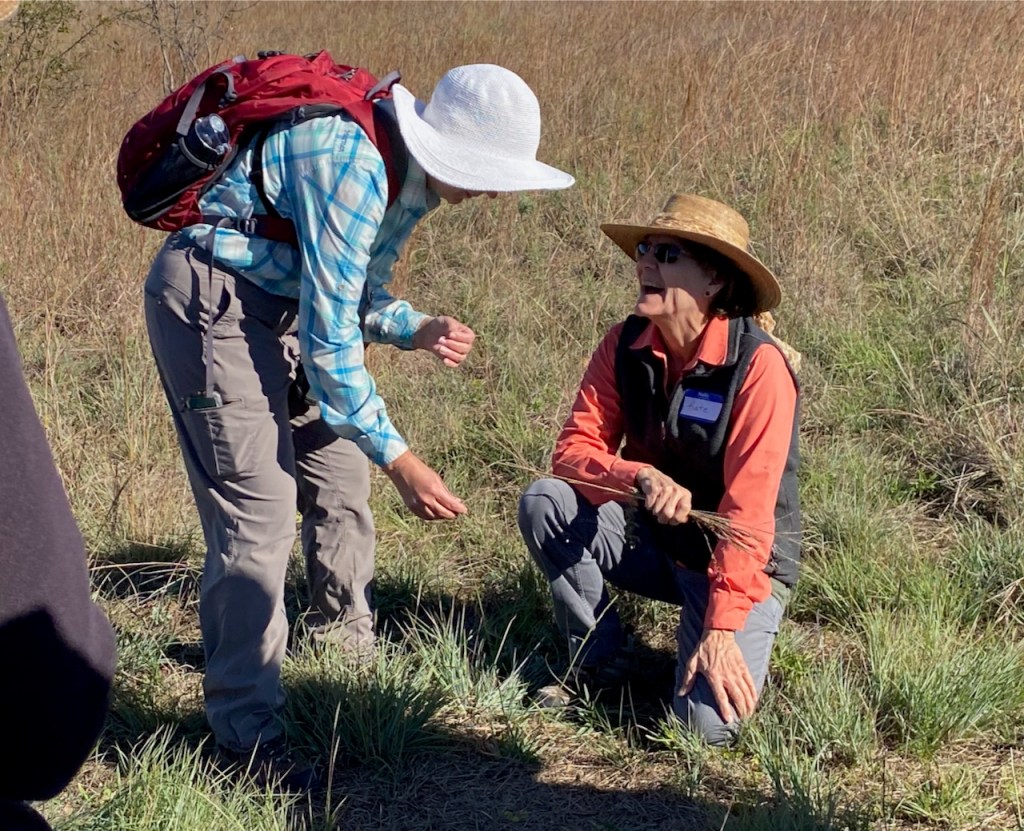
Suzanne Tuttle (L) and Kate Morgan (R) share a laugh
Many thanks to Dr. Carly Aulicky, North Texas Outreach and Stewardship Director of NPAT, for her role in organizing the event and helping teach us. Others who taught us on walks through the prairie included Suzanne Tuttle, Kate Morgan, Michelle Villafranca, Mary Curry and others. Each of them is a priceless source of prairie wisdom. We were lucky to be able to spend the day with them.
A prairie is a constantly shifting community of plants and animals, changing or renewing in response to things like rainfall, the grazing of animals like bison, and occasional fires. Shrubs and trees are constantly looking for an opportunity to get started, and without grazing and/or periodic fire, woody plants will gradually take over and the prairie will disappear.
A healthy prairie has many different species of grasses and forbs living together. There is diversity in any square yard of prairie, but prairies may also have patches where different plants predominate. This may be the result of dips in the land or swales that are wetter because they collect more rainfall, areas of shallower or deeper soil, and so on. That mosaic of different plants makes the prairie stronger and more resilient.
Whitlow-wort
We started the walk with examples of big bluestem and Indiangrass, two grasses characteristic of north Texas and among the tallest. Soon we came across a low-growing plant with mats of yellow flowers, identified as Whitlow-wort. Our prairie experts considered it a great plant, associated with healthy prairies.
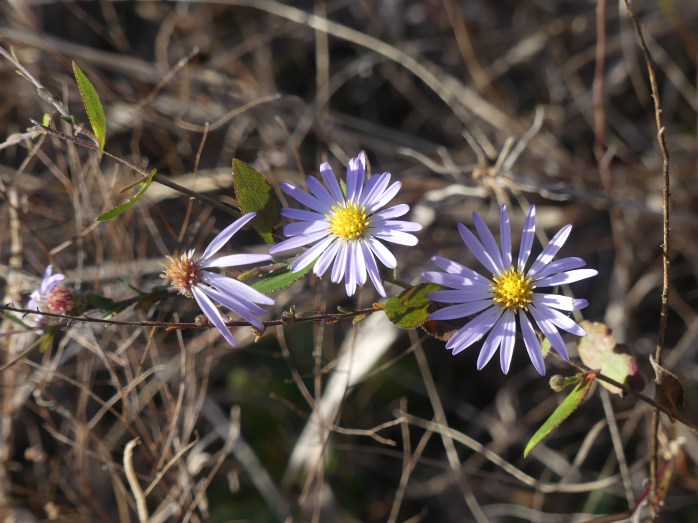
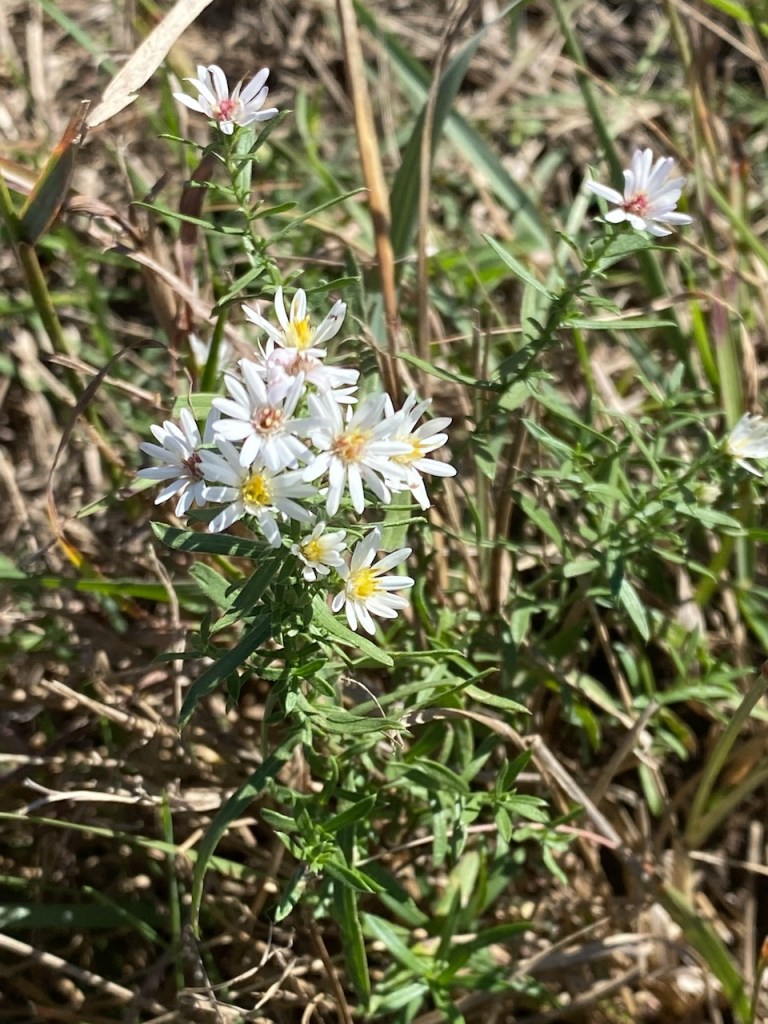
There were many other grasses pointed out: little bluestem (a favorite of mine), and side-oats grama, the state grass of Texas, with seeds hanging off one side of the stem like little flags. There were low-growing clumps of heath aster with beautiful white flowers. And there was the invasive KR (King Ranch) bluestem and a bit of Johnson grass in a few places. Exotic grasses such as these have been imported to Texas from time to time and promoted as being good forage for cattle. It generally does not end well, with the imported grass tending to crowd out the native species.
Heath aster
Many other topics were covered, such as how a disturbed area or bare soil is colonized by species that can grow quickly and prepare the way for later plants, which eventually give way to later ones, in what is known as succession. We visited other places, including a small grotto where an intermittent stream has created a cool, wet place where maidenhair ferns grow beneath a limestone shelf. There was a lot to see and learn.
And all of that brought me more deeply under the spell of prairie magic, which does include natural history facts but beyond that it involves being drawn to the beauty and complexity of prairies. The experience of being in a prairie seems to nurture some part of me that needs to walk through a sea of flowers and waving grasses. All those Prairie Seekers at the NPAT/Dixon Water Foundation event are like the extended family members who will help keep that magic alive.
We need nature. Flowing water, plants, sunshine or clouds, the simple sounds of birds and breezes.
Research is confirming the substance of what most of us intuit: we are better when we spend time in nature – happier, healthier, freer from the darkness that clings to us when we are closed within our own contraptions.
Some people benefit from playing in nature, and some benefit from the quiet focus of mindfulness. Some embrace the study of animals or plants, or how their lives are entwined to make ecological communities, and others draw, paint, or write about it. There is certainly more than one way to spend time in nature and be renewed and nurtured by it.
I love quiet periods of mindful attention, and also taking the time to write about it while sitting at the edge of a meadow or prairie. Studying nature is also important to me. Someone else might want to play music in some open spot in the woods or spend the afternoon fishing. Is nature good for us regardless of what we do while we’re there?
I have some educated guesses about how we may get the most benefit from our time in nature. These are informed by what I’ve read and what I know about psychology and the research on the benefits of nature.
Taking time to notice and reflect. Whether it’s play, study, meditation or art, taking time to notice details and enjoy the experience is likely to be an important part of how nature benefits us. Related to noticing is pausing to reflect on it. In general the ability to reflect, to be aware of what we are perceiving and feeling, is beneficial.
Presence. If we are playing in the creek, we genuinely feel our connection with the rocks and water. You don’t have to read that in any mystical way; it is simply a kind of awareness of, and intentional interaction with, where you are at that moment. You are present in that creek. It is not just a “stand in” for every other stream – it is not a generic experience, like a creek video on an exercise machine.
Quiet mind. Except in some kinds of mindfulness practice, we don’t have to be silent. In a walk in the woods, people often talk with each other, and when we write in a nature journal, words come to us. A few comments and questions about what we are experiencing do not take us far from where we are, in the way that other thoughts and conversations do. In other words, “I think this is Glen Rose Yucca” keeps us in nature, while “What movie should we see tonight” separates us from it. When it comes to our busy, worried, chatty minds, quieter is probably better.
Acceptance and kindness. The more open and accepting we are towards what we are experiencing, the better off we are. The less we see something through the lens of our preferences and wants (and the more we can see it as it is), the more we benefit. This goes hand-in-hand with kindness, the wish for ourselves and everything around us to live in wellness and peace, with as few struggles as possible. These attitudes are closely connected with the practice of mindfulness. I think they are beneficial in visits to nature and in any other context.
The Texas Hill Country is a beautiful region, and Meghan Cassidy and I finally got around to visiting it in mid-October. In our work on a forthcoming book on mindfulness in Texas’ nature, we have been to a lot of places around the “edges” of Texas but not the central region, dominated by the massive uplift known as the Edwards Plateau. We were never going to leave it out, though, because that would mean missing out on lovely and important places.
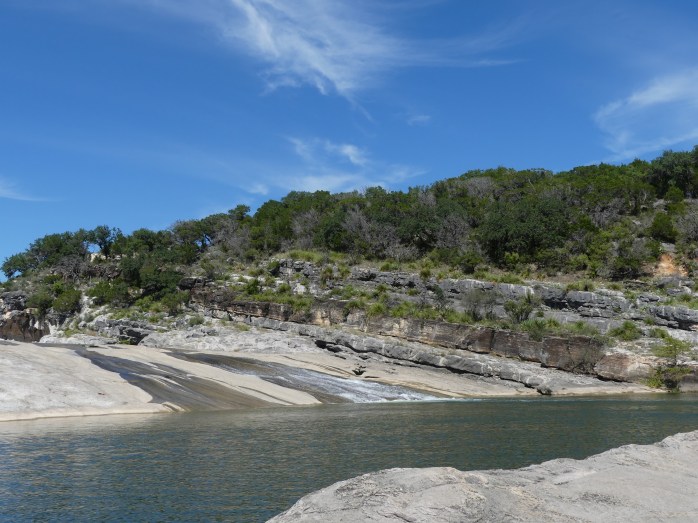
Water slides over rock and into a pool
The eastern part of that plateau has limestone ridges and canyons formed when water dissolved the rock and created caves and underground waters that emerge in springs and grottos. Such places may be ringed by maidenhair fern and lush vegetation, with crystal clear pools and streams flowing over stone. This is the Hill Country, with rocky hillsides covered with Ashe juniper, small prairies and pockets of grassland, and beautiful rivers.
Our friend Ruthann Panipinto nominated Pedernales Falls State Park as the right place to spend the limited time we had. I’ve known Ruthann for years as someone whose knowledge and interest has, like mine, expanded from herpetology into an even broader love of natural history. Her choice of Pedernales Falls was perfect.
Traveling to Pedernales Falls, one of the first questions that occurred to me was how Texans came to pronounce it as “Purdenales.” Spelling and ways of speaking are sometimes out of sync, and English-speakers don’t always have a good track record when dealing with some Spanish words. As it turns out, the Spanish word “pedernal” means “flint,” and the Pedernales River got its name from the flinty stone in its riverbed. Much of the Edwards Plateau rests on layers of limestone, some of which is Cretaceous (66-144 million years ago). Some of the rocks exposed by the Pedernales go back unimaginably earlier, to the Ordovician (438-505 million years ago)[i].
Pedernales Falls
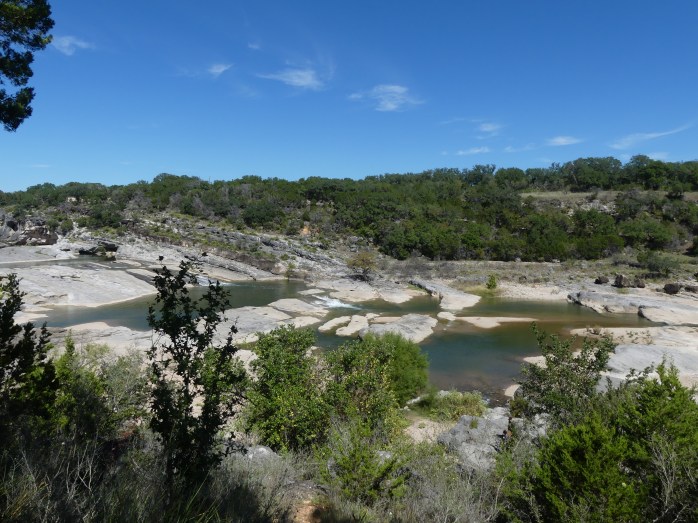
We arrived and walked down to an overlook from which we could see a beautiful river cascading over the top of a huge apron of gray rock into a pool, and then pouring over a small gap into lower pools. The water then worked its way through a line of boulders and on downstream. We followed a long series of stone stairs down to the river and sat down to watch and listen.
It was a surround-sound experience of flowing water. From a small tributary on one side was the sound of riffles, shallow water tumbling over small stones and gravel. Behind us was the upper falls, with the main part of the river sliding down a long expanse of stone. In the middle was the spot where the water pours several feet from one pool to the next, with a deep, thunderous sound reminding me of surf breaking at the seashore.
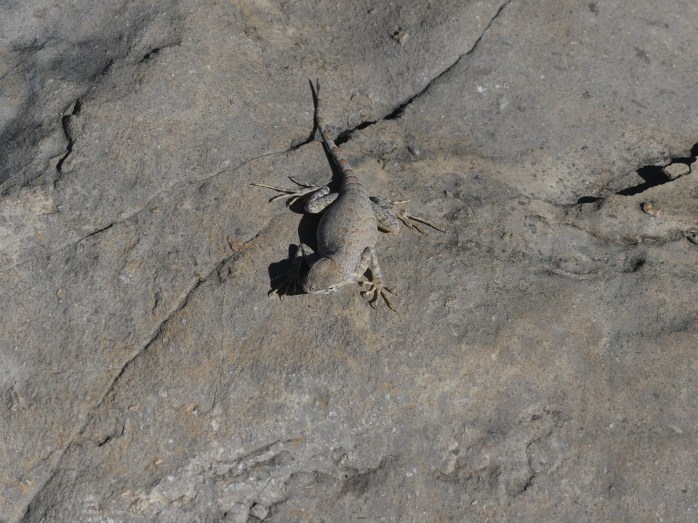
Above us there were long wisps of clouds as if the upper winds stretched water vapor across the sky in white calligraphy. The sun was warm and intense but the air was cool in just the way you would expect on a mid-October day. Texas earless lizards basked in the sunshine, taking notice if we got too close and scampering away to wave their tails in the air, exposing the black-and-white bars underneath.
Texas earless lizard
It was fairly busy, but did not really feel crowded, as couples and families and even a geology class made their way down to the river to walk, sit, and sometimes wade. The voices of people were masked by the falls and (thankfully) no one brought a boom box. Visitors came and went, and there were times when you could look across a substantial area without seeing people. And in the next part of the visit, we had the river to ourselves.
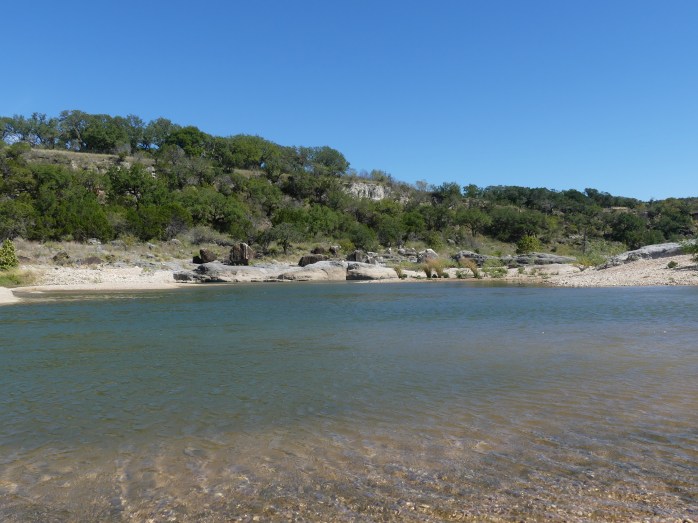
Ruthann led us further downstream, over boulders and across gravel bars to a place where a huge cypress tree stands like a sentinel, roots wound around the rocks to create something like a tiny peninsula or island in the river. The almost-clear water passed over large rocks, heaved up in places and then falling into small troughs. It flowed among the boulders and between grassy banks and broke into noisy whitewater in shallower places.
Along the course of the river were more cypress trees, their feathery leaves beginning to show a bit of rusty yellow in the low afternoon sun. Autumn might be slow to take hold, but it was beginning.
[i] Spearing, D. 1991. Roadside Geology of Texas. Missoula, MT: Mountain Press Publishing Co.
A few weeks ago, it was back to the Big Bend region with Meghan Cassidy for one of the last trips for the book on mindfulness in nature. I’ve made a number of trips there during the past twenty years, and my attachment to and fascination with that region keeps growing. I felt really fortunate to introduce Meghan to the Chihuahuan Desert and the mountains out there.
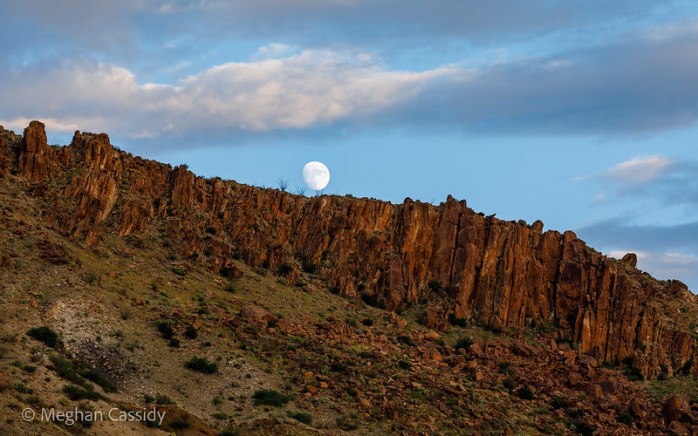
We stayed in a cabin at Wild Horse Station, just a little bit north of Study Butte near the Christmas Mountains. There are extruded columns of lava and thin soil where scattered desert plants grow. It is a strange and beautiful place, and that cabin on the hillside has a broad porch that looks out toward more hills and mountains to the west. This trip included some times for sitting on that porch, watching rainstorms or sunsets, and writing. I’m very grateful for that porch and for those moments.
A ridge just behind our cabin, at moonrise. Photo by Meghan Cassidy
In the early years, my visits to this region were very focused on finding snakes and other reptiles, although my companions and I always knew this was a place to be savored and soaked in. We rarely took much time to do it, and whatever we gained in total snakes seen, we lost in really getting to know the region. Each year has brought a broader interest in the ecoregion and a willingness to slow down and pay attention to more of it. This trip was a combination of mindful attention to the mountains and desert and some very fine observations of snakes.
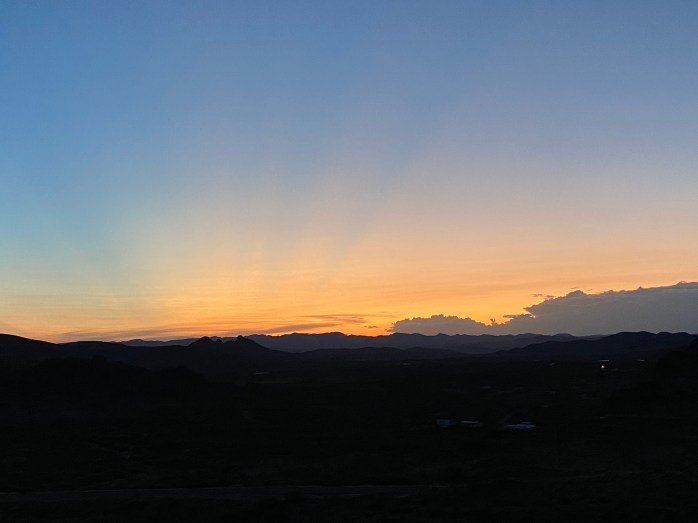
Sunset (photo by M.Smith)
Our arrival at the cabin was interesting. Darkness had just fallen when we walked across the porch to find the front door open and, inside the dark cabin, the television was on. We did the ‘police knock’ standing to the side of the open doorway, and when there was no response – human, javelina, or otherwise, we turned on the inside light and began to check the rooms. I glanced to the side to see Meghan holding a knife, and I knew I had a capable partner out here where there is little phone service and self-reliance is important. Everything was fine; I like to think that a coyote – not the human trafficker but Canis latrans, the trickster of Native American legends – had let himself in, watched a show, and left the place open for us.
In the morning there was coffee, the shadows of nearby mountains with rosy light growing overhead, and that wonderful porch overlooking it all. After a beautiful sunrise, we got ready and headed into Big Bend National Park.
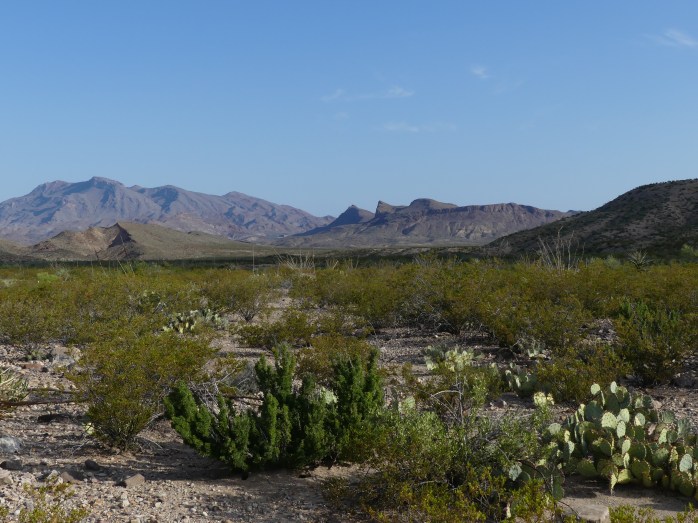
Chihuahuan Desert within Big Bend National Park (photo by M.Smith)
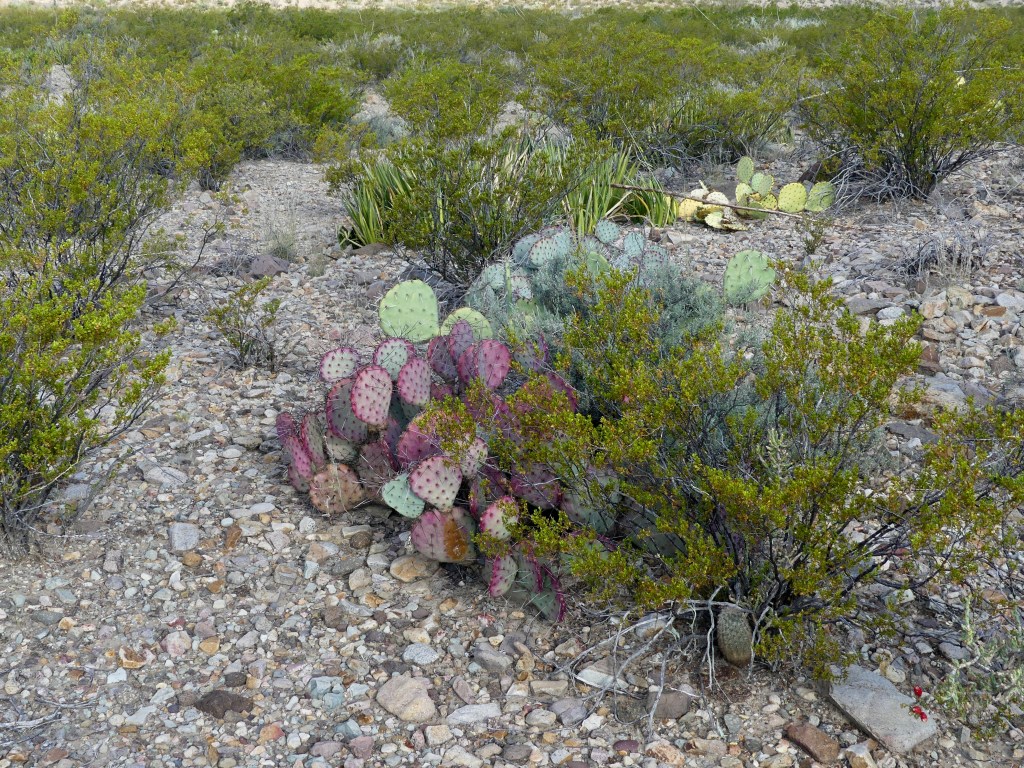
We walked around on the hot, gravelly desert floor, around prickly pear, creosote bush, and other characteristic desert plants. Lechuguilla, an indicator plant of the Chihuahuan Desert, grew in patches of upright succulent leaves. Many had remnants of the tall stalk they send up in late summer with clusters of flowers. The leaves are often described as like an upside-down bunch of green bananas, partly because they often curve inward a little. However, no bananas ever dreamed of having two rows of sharp recurved hooks on leaves tapering to a hard, sharp spine that can even puncture a car tire!
Creosote bush and prickly pear (including the purplish variety) in the foreground, with a patch of lechuguilla behind them (photo by M.Smith)
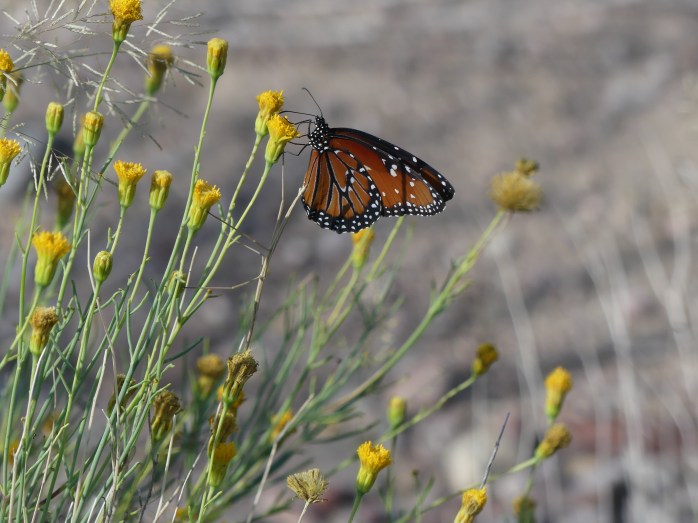
We walked a small dry arroyo as a couple of big black birds flew past. We weren’t experienced enough to call them as Chihuahuan ravens, but from the overall size and chunkier neck, they seemed more likely to be ravens than crows. There were a few places in the arroyo where the sandy soil had piled up and grew a small garden of flowers. Those flowers attracted butterflies. Perhaps they would seem out of place in the desert, particularly if we made the mistake of thinking of the desert as barren. The desert is a harsh place, by our standards, and it requires adaptation to extremes of heat and limited rainfall – but it is full of life.
Queen butterfly in a desert arroyo (photo by M.Smith)
We came back to the cabin during the hottest part of the day, and the shade of the porch and the breeze at the top of our hill made the perfect place for reflecting on our morning and writing about the desert plants, butterflies, and the value of long vistas in which nature has free reign.
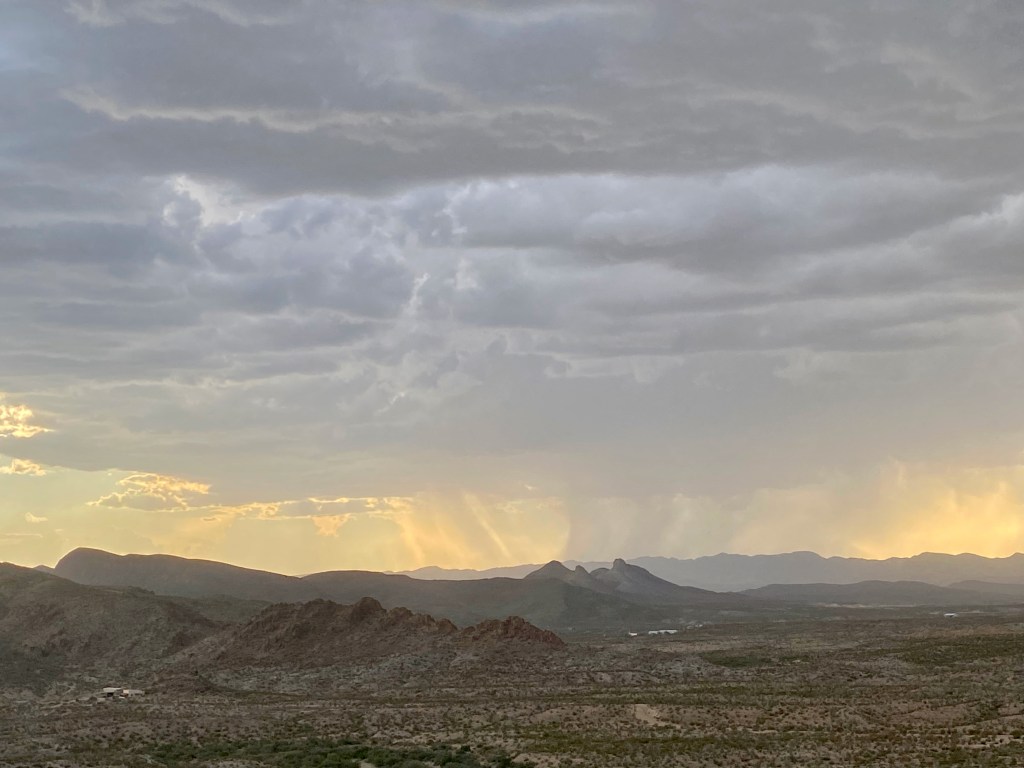
The clouds were building in the west, and under dark clouds were blurs of falling rain. The low rumble of thunder rolled in, and as the system marched toward us, bright lightning was visible as the power of the storm reached down to touch the earth. Announcing the storm’s arrival, the outflow winds were strong and I had to stop for a moment and think how many times this little cabin perched on the edge of the hill had withstood storms just like this. I needed that reassurance as raindrops began to slam into the porch and torrents of rain blew by outside our windows. This is how the monsoon season works in the Trans-Pecos: It’s hot and sunny, then clouds build into storms, the thunderstorms dump a lot of rain (and maybe hail) in a short time, and then they move on and it’s done.
The storm approaching (Photo by M.Smith)
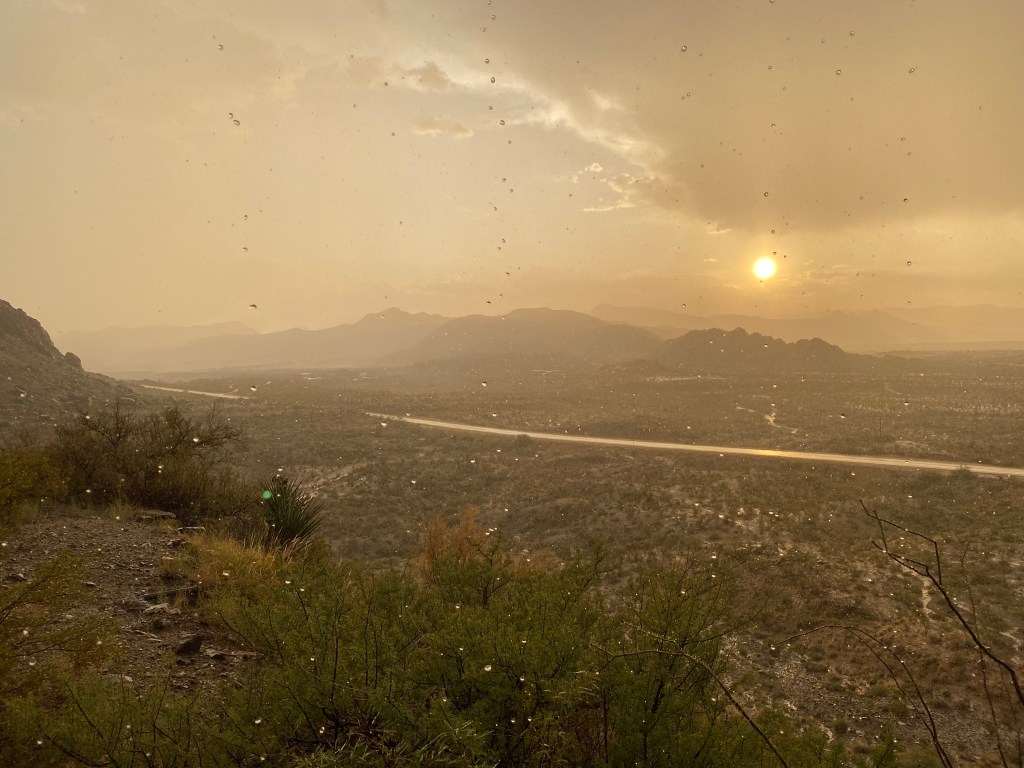
When we walked out onto the porch, the cool air was laden with the smell of rain and creosote. The desert here is full of creosote bush, a shrub with very small green leaves with an aromatic resin and waxy coating that helps protect the plant from drying out. If you crush the leaves, the resin has the familiar, vaguely tar-like smell of treated railroad ties or telephone poles. After a heavy rain, the resin is released into the air and the aroma is strong, fresh and wonderful.
At the end of the storm (Photo by M.Smith)
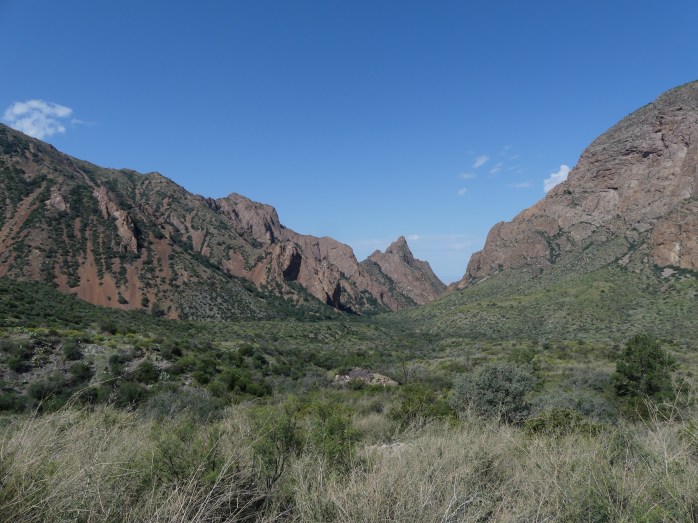
The next day, September 17, was our day to be in the Chisos Mountains. The Chisos is the only mountain range entirely contained within one national park. Driving up into “The Basin” within the mountains, the vegetation changes, reflecting slightly cooler temperatures and a little more rainfall. As you begin the climb into the mountains, you enter a woodland of small oak trees, junipers and pinyon pine. Tall slabs and columns of reddish igneous rock stretch toward the sky.
In The Basin (Photo by M.Smith)
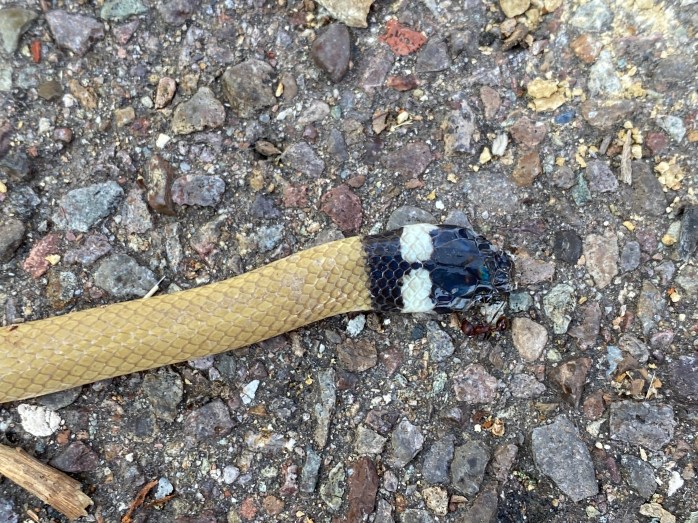
The previous day, driving around the Chisos Mountains Lodge, in The Basin, we had come across a sad, significant find. There was a small snake on the pavement that had been run over some time earlier that morning. There was a dark head with an interrupted white collar behind it, and the body of the snake was a pale tan. This was the first Trans-Pecos black-headed snake that I had come across, and it was a real shame that it was dead. It belongs to a group of snakes with enlarged rear teeth and a salivary toxin to help subdue its prey (but is harmless to humans), and it is the largest species within that genus, Tantilla. It’s still a small snake, often growing no longer than about a foot. It is listed by Texas as a threatened species, but neither that nor its presence in a national park had kept it from being run over.
Trans-Pecos black-headed snake, Tantilla cucullata (Photo by Meghan Cassidy)
Now it was time to climb the Lost Mine Trail up past the Casa Grande peak, to a point where the view opens to the south. The climb is fairly gentle, through mountain woodlands and small grassy openings dotted with beargrass, sotol, and Havard agave. This latter species, also known as “century plant,” sends up a fast-growing stalk at the end of its life with short branches bearing clusters of yellow flowers. The base of the plant is a rosette of thick, stiff, bluish leaves with sharp hooks along the leaf edges and a hard black spine at the leaf tip.
At this elevation it is cooler and there is greater rainfall. In the shade of the mountain there are ferns and beautiful flowers including mountain sage, the red starburst blooms of mountain catchfly, goldenrod, and penstemon. It is easy to stop along the way, on a bench or a boulder, and be still for a while, taking it all in.
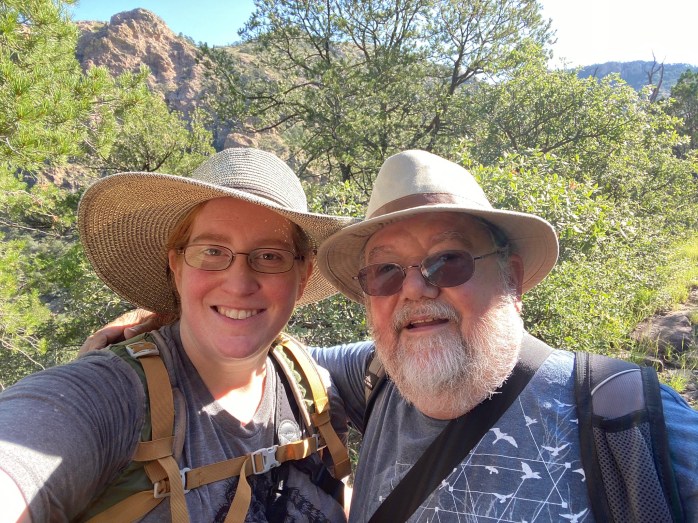
Meghan and Michael on the Lost Mine Trail
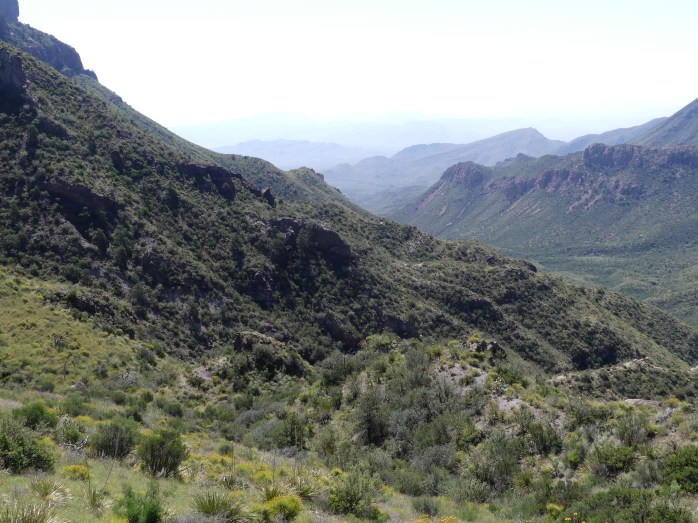
This trail in these mountains means a great deal to me, and I’ve written before about what it is like to be here in its quiet and beauty. And when we reached the place where we could look far away to the south, I spent a while under a pinyon pine looking at what I think is one of the great places within Big Bend.
On the Lost Mine Trail, looking south (Photo by M.Smith)
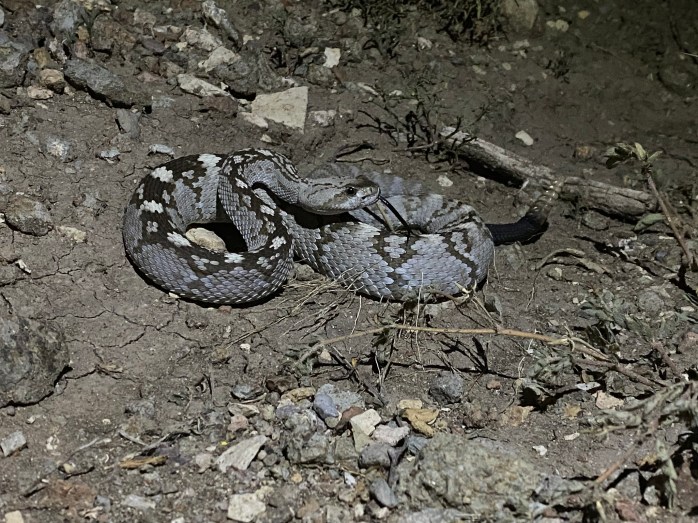
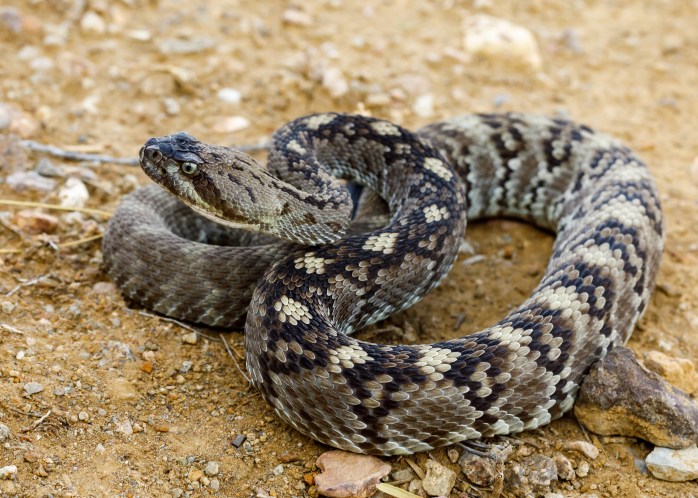
That night, our thoughts shifted away from the book and toward the variety of wonderful snakes that can be found in this area. We stayed along Highway 118 north of Study Butte up through the Christmas Mountains and along the desert flats. Our first snake was a black-tailed rattlesnake that, as I walked up to it, seemed to be ‘periscoping’ up to look around. It turned out to be blind in one eye, and was trying its best to figure out what was going on as we approached on its blind side. Like many black-tailed rattlesnakes, it was slow to get frightened or aroused, and it never rattled or threatened us in any way as we used snake hooks to move it away from the road so that it would not be run over.
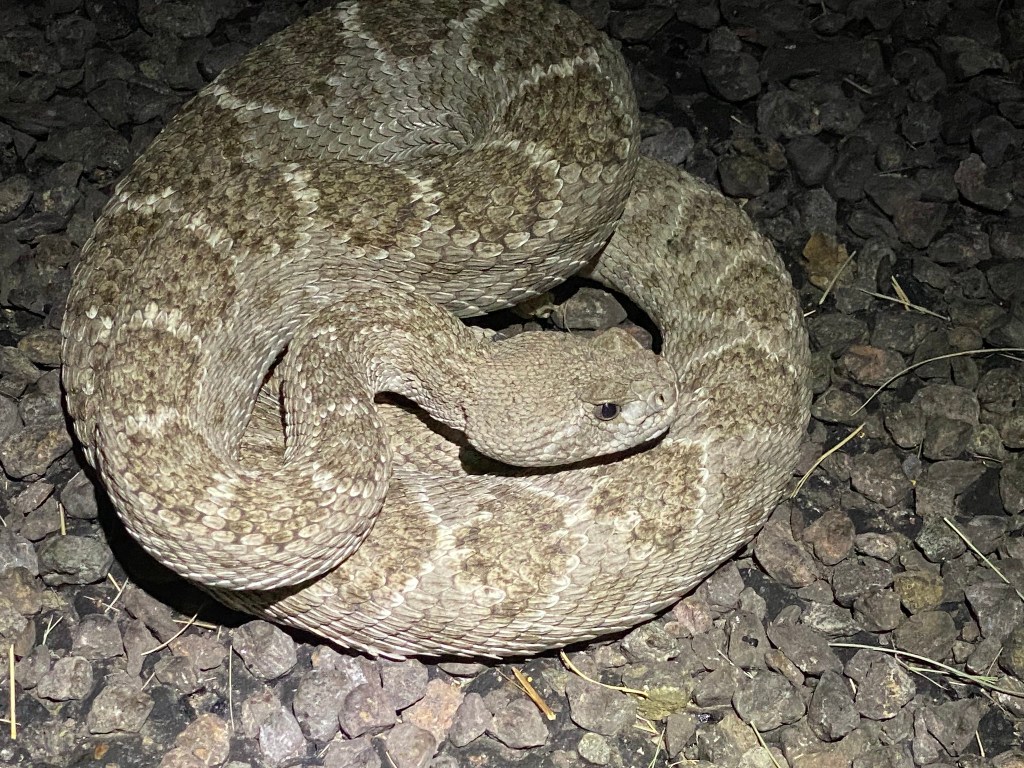
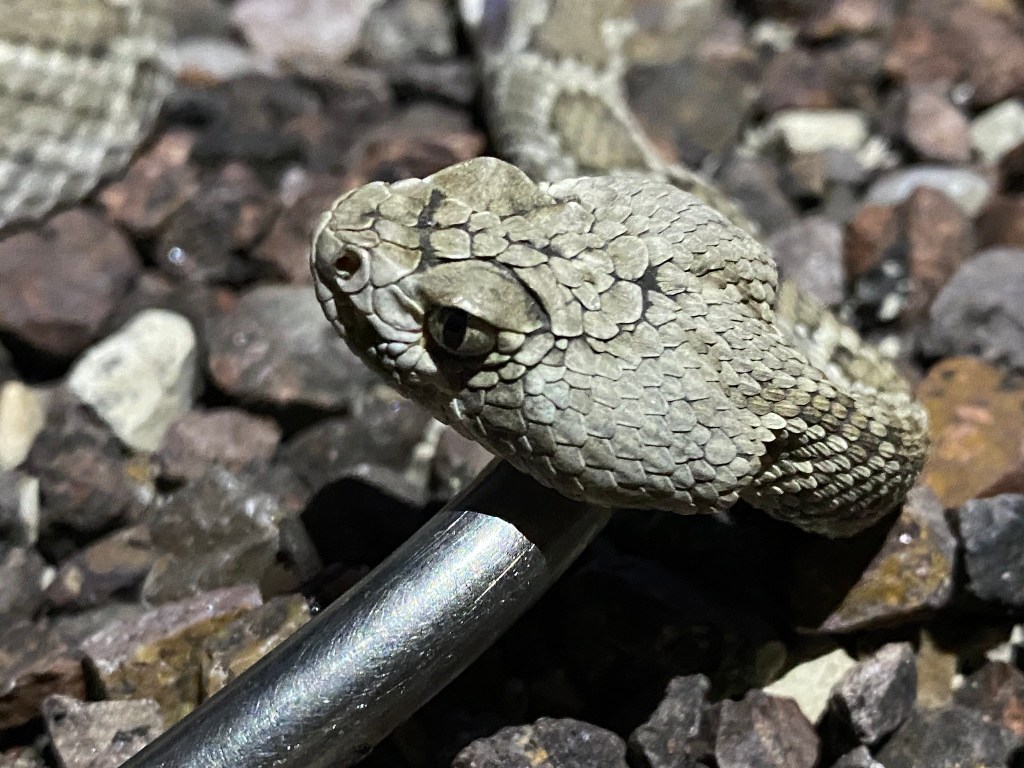
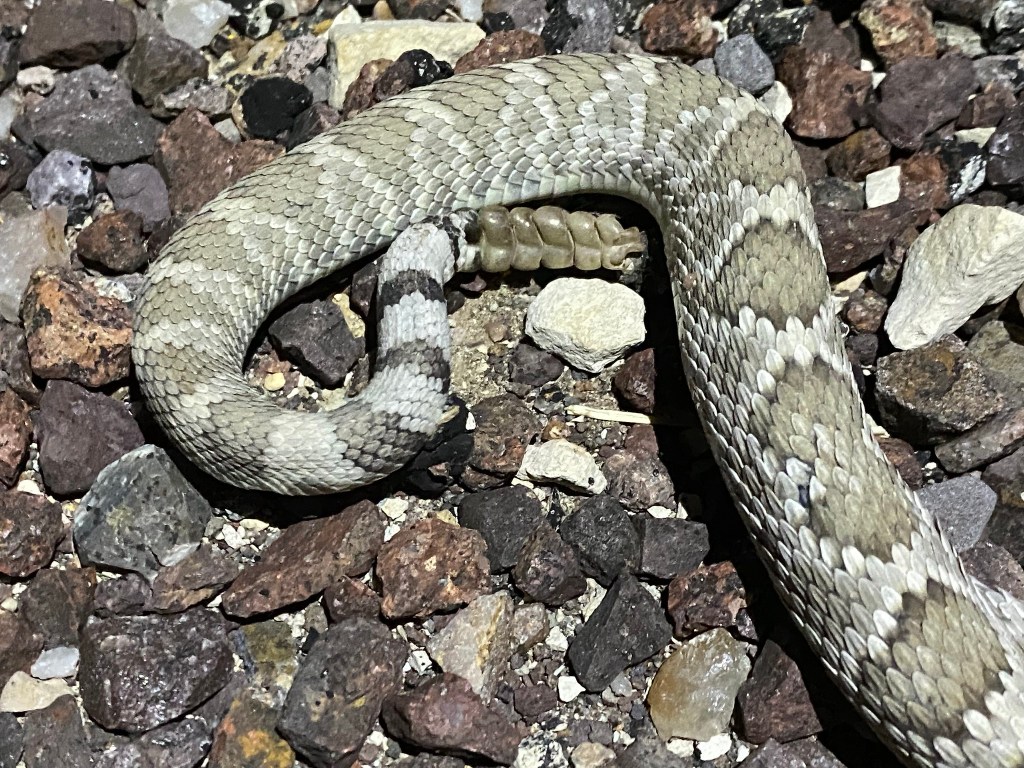
We were on the lookout for Mojave rattlesnakes (Crotalus scutulatus). Meghan wanted to see up close the distinction between this species and the similar-looking western diamond-backed rattlesnake (Crotalus atrox). The immediate visual differences have to do with the width of the black-and-white bands on the tail, the pattern on individual scales, the light diagonal marks on the face, and the size of the scales on top of the head. The rings on the tail of the western diamondback are of roughly equal width, while those of the Mojave emphasize white, with black rings spaced more widely. Both snakes have roughly diamond-shaped blotches down the back, but each scale on the Mojave rattlesnake tends to be mostly one color (resulting in a crisp pattern almost like a mosaic), whereas the colors may transition and almost smear on the diamondback’s scales. The two diagonal lines on the western diamondback’s face both end at the mouth. In contrast, the diagonal stripe behind the Mojave’s eye bends and continues back behind the jaw line. Finally, the scales on the top of the western diamondback’s head (between the eyes and toward the snout) are small. A Mojave rattlesnake has larger scales on top of the head.
Western diamond-backed rattlesnake (Photo by Meghan Cassidy)Mojave rattlesnake, showing larger head scales (Photo by Meghan Cassidy)Mojave rattlesnake, roughly the last third of the body showing the pattern of the scales and the wide white areas on the tail (Photo by Meghan Cassidy)
The one Mojave rattlesnake that we found had been run over, unfortunately. We positioned the head and tail for photos to illustrate these differences. This is the snake that folks in the Big Bend may be most concerned about, because populations of this species in Texas and elsewhere have venom with high neurotoxic activity. A bite might produce less swelling and bruising but more systemic effects, including respiratory problems. My experience with living Mojave rattlesnakes is that their temperament varies and, like other rattlesnakes, they would prefer to be left alone and are not especially aggressive.
That sort of peaceable behavior was true for every living snake we found that night. Every live western diamondback or black-tail greeted us with inquisitive tongue-flicks or attempts to get away, but none attempted to bite. One snake rattled, but the rest did not even become nervous enough to do that. Meghan is good at using a hook to move a venomous snake, and we both do so gently and without presenting a threatening target to the snake, and this may have contributed to their laid-back behavior. However, Meghan was looking for more examples of hooking defensive (or even irate) rattlesnakes, and she wasn’t getting to see any of that. (She did, at least a little bit, the following evening near Black Gap Wildlife Management Area, where the diamondbacks quickly rattled even if they did not strike at us.)
One of the black-tailed rattlesnakes at night (Photo by Meghan Cassidy)
It was getting late. As we drove back up the hillside to our cabin, there was one more black-tailed rattlesnake for us, a beautiful adult. We decided to ‘bucket’ her for good photos in the morning. Once again, this snake was simply curious about what we were doing, and tolerated Meghan’s hooking her and placing her in the snake bucket with little reaction.
(A couple of side-notes. First, the ‘snake bucket’ is a five-gallon bucket with a screw-on lid with air holes drilled in such a way that a venomous snake could not get close enough from the inside to get a fang through the hole. It is essentially snake-proof, so that we could sleep comfortably with a rattlesnake in the front room of the cabin. Second, part of being a safe, competent herper is constantly maintaining awareness of yourself and your surroundings when interacting with venomous snakes, even those who are being complete sweethearts. Neither Meghan nor I took these snakes’ temperaments for granted, because a moment’s slip-up with a “sweet” rattlesnake – especially in the isolation of the Big Bend at night – can be incredibly serious.)
Morning photo of the black-tailed rattlesnake (Photo by Meghan Cassidy)
The next morning, Meghan took a series of photographs of this black-tailed rattlesnake, and we released her. We were happy to have her as a neighbor during our stay!
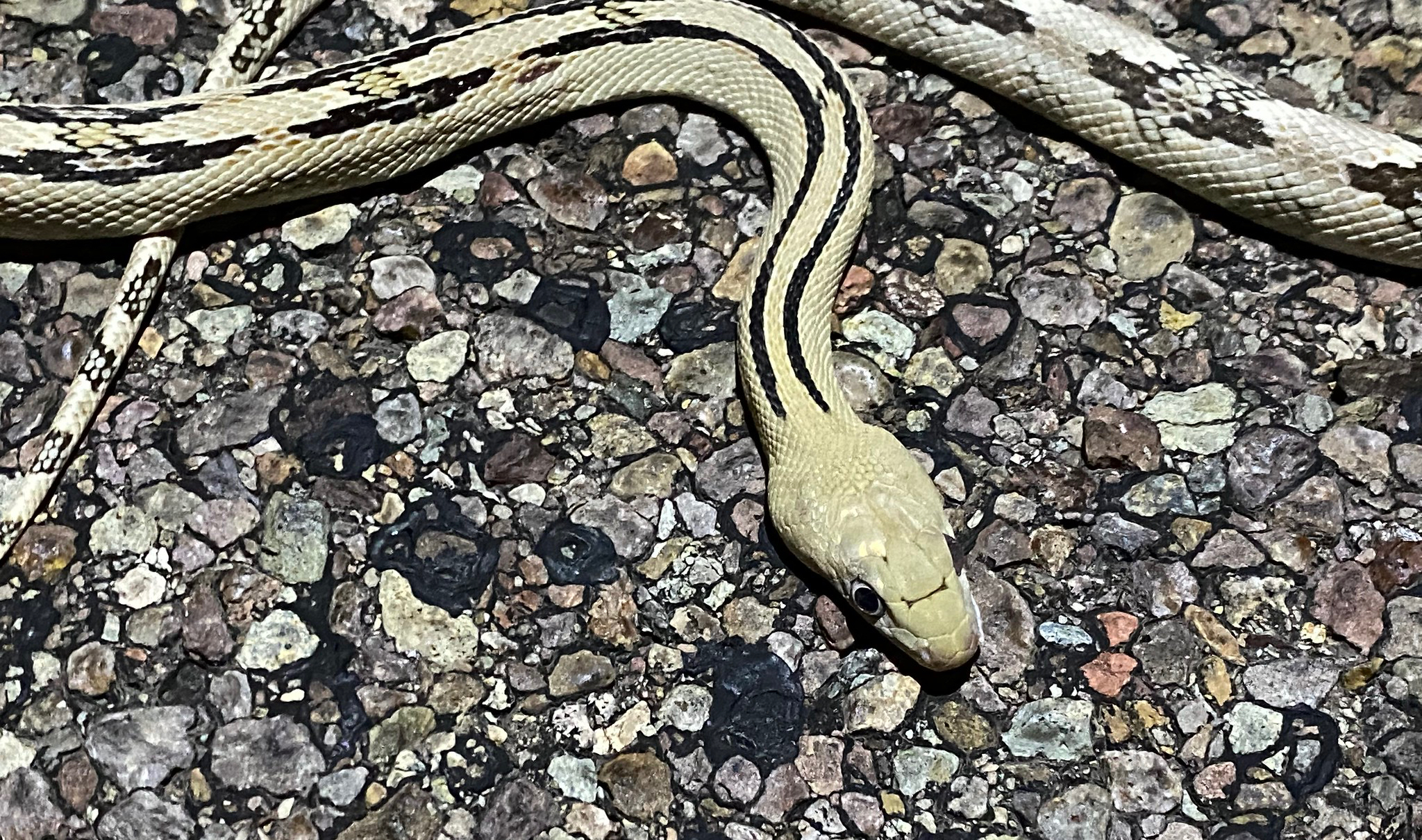
The following night, we were able to see a couple of Trans-Pecos ratsnakes, a favorite for both of us. One had been hit, but the second was wonderfully alive and gentle as we got it off the road so that it would not be run over. These slender, harmless snakes are pale yellowish (almost like the inside of a banana, leading Meghan to playfully call it a ‘banana snake’) or straw color with black markings. Two lines down the neck separate into something like blotches connected across the back in an “H” shape. They are nocturnal wanderers with big eyes to gather as much light as possible.
Trans-Pecos ratsnake (Bogertophis subocularis) – Photo by Meghan Cassidy
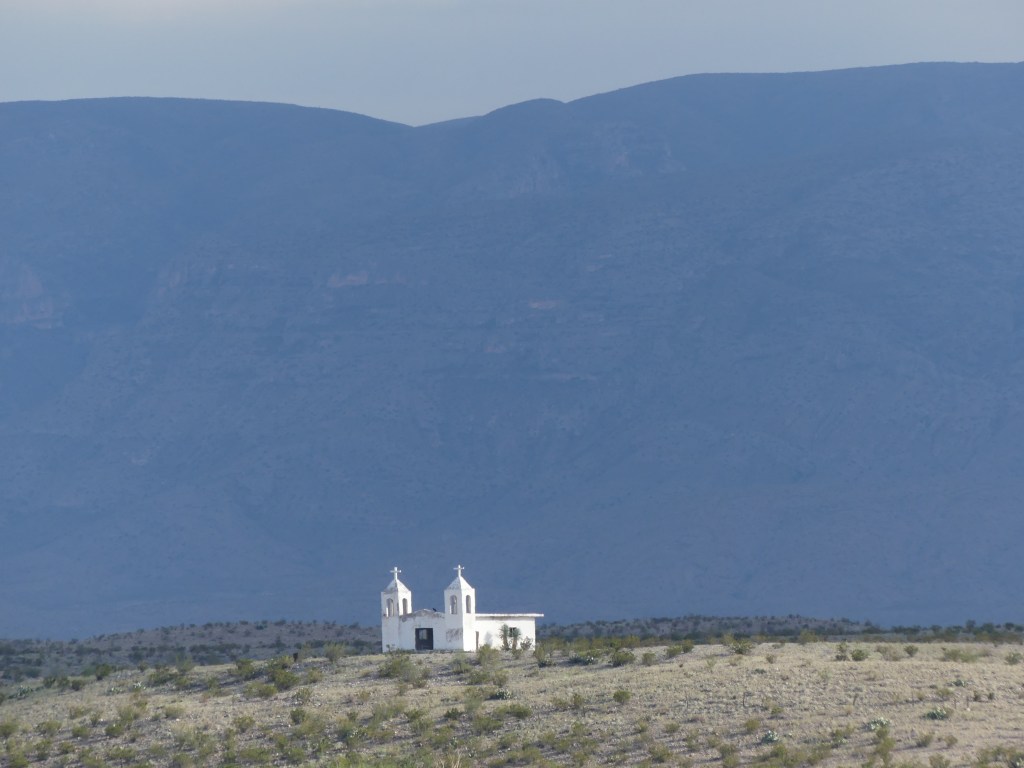
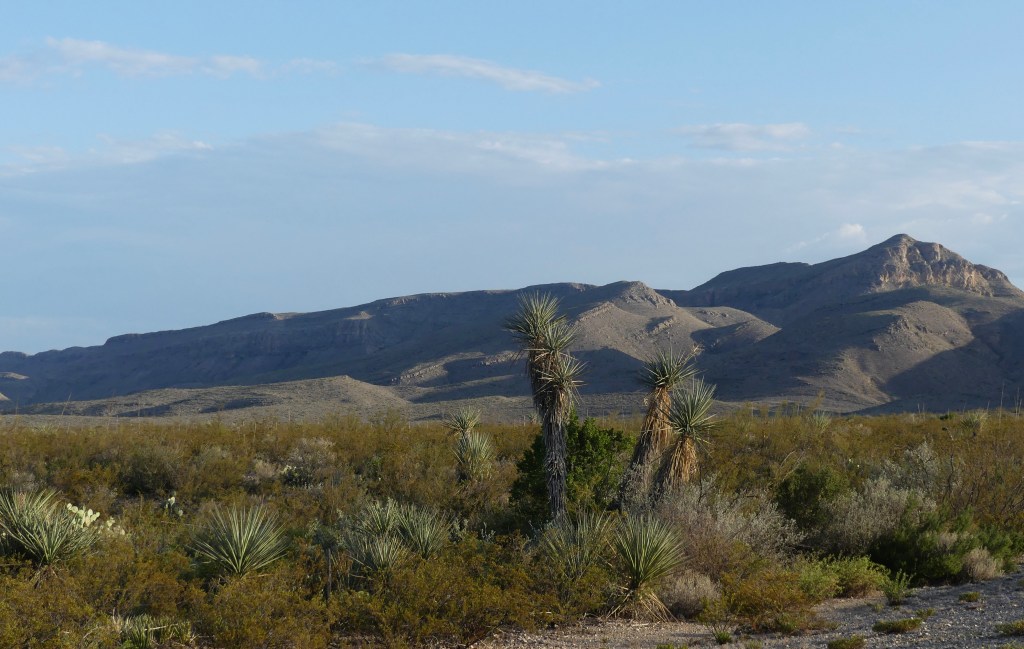
The final day in the Big Bend included a drive down FM 2627 past Black Gap WMA to the La Linda international crossing into Mexico (the bridge is barricaded, though crossing the Rio Grande at that point looked like it would not be difficult). The landscape and nearby mountains were beautiful, but it was virtually all private property and so we could not walk around and explore.
A church, looking across into Mexico at La Linda (Photo by M.Smith)Near FM 2627 (Photo by M.Smith)
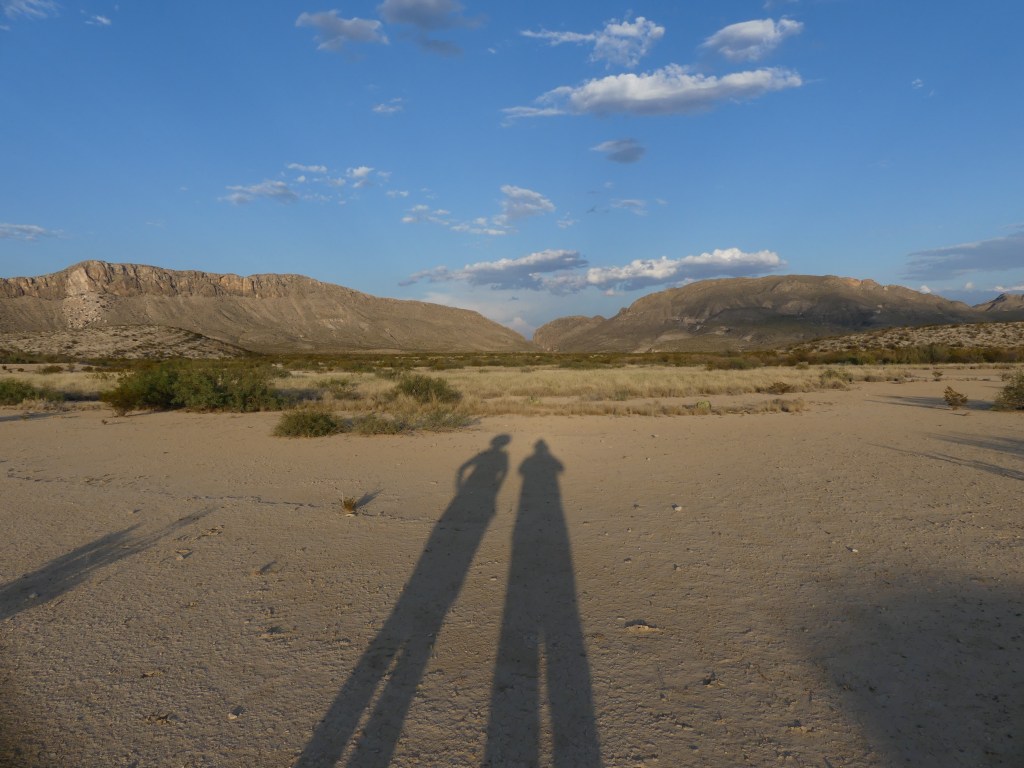
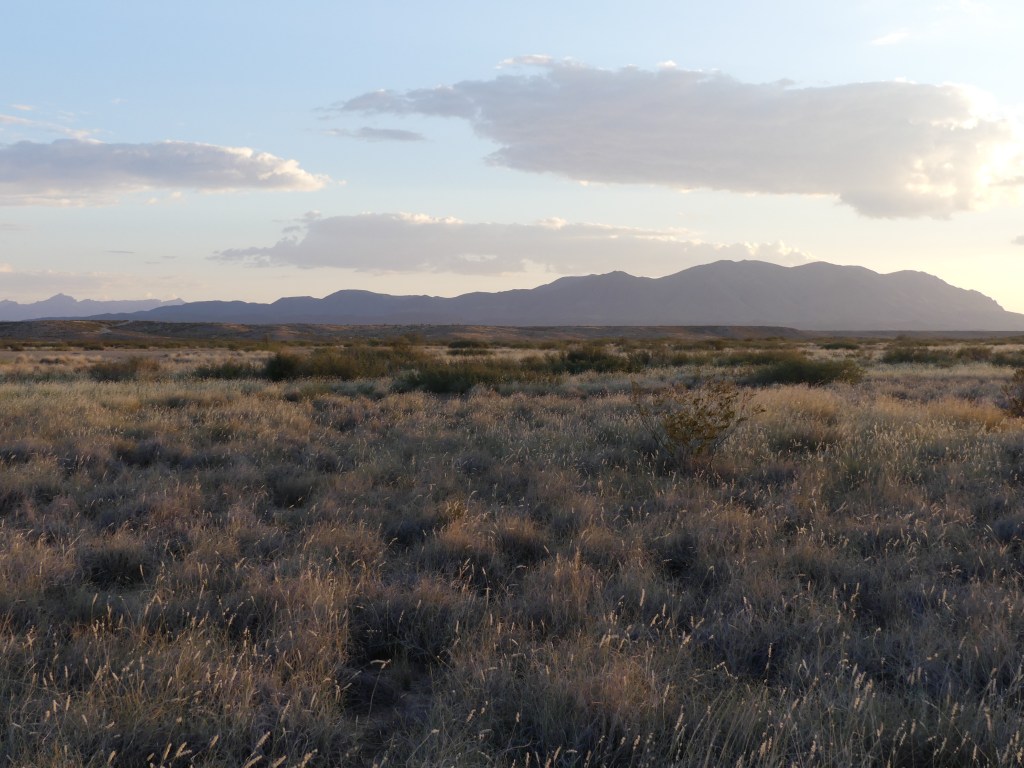
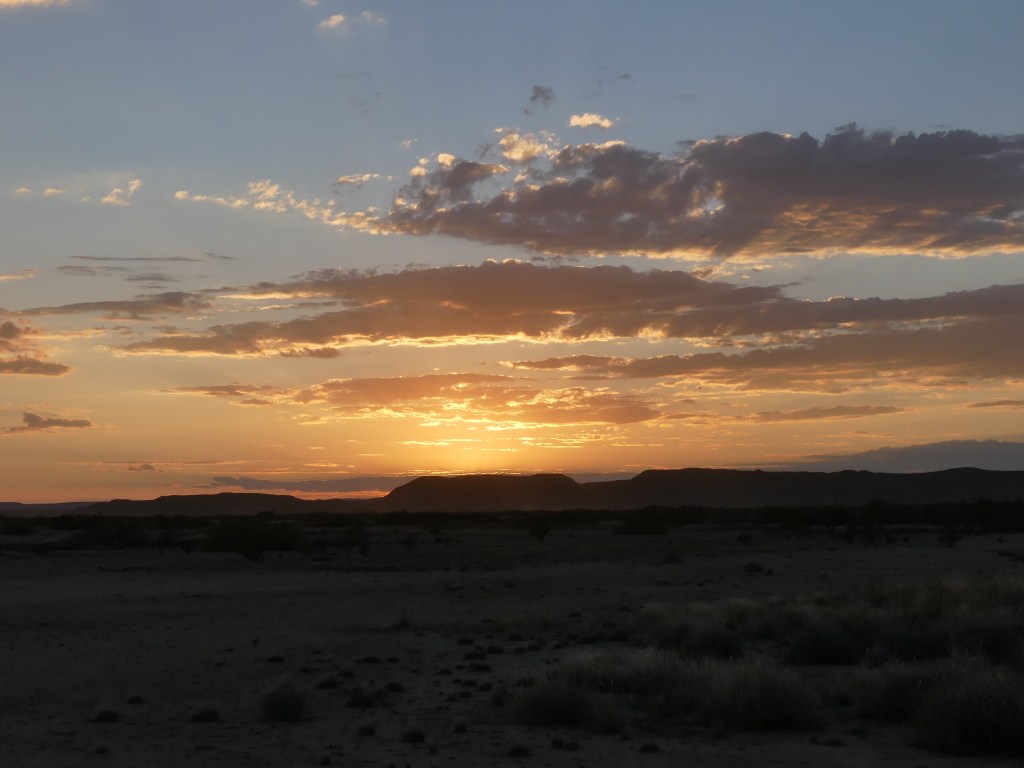
Back within the park we walked part of the trail leading to Dog Canyon, in the Dead Horse Mountains, and also westward in some sparse grasslands looking toward the Rosillas Mountains. I wrote about this later, about the long shadows toward sunset and the sense of solitude and even isolation there, as the sun was setting.
Long shadows, looking toward the Dead Horse Mountains (Photo by M.Smith)Sparse grasslands and the Rosillas Mountains (Photo by M.Smith)Sunset on our last day (Photo by M.Smith)
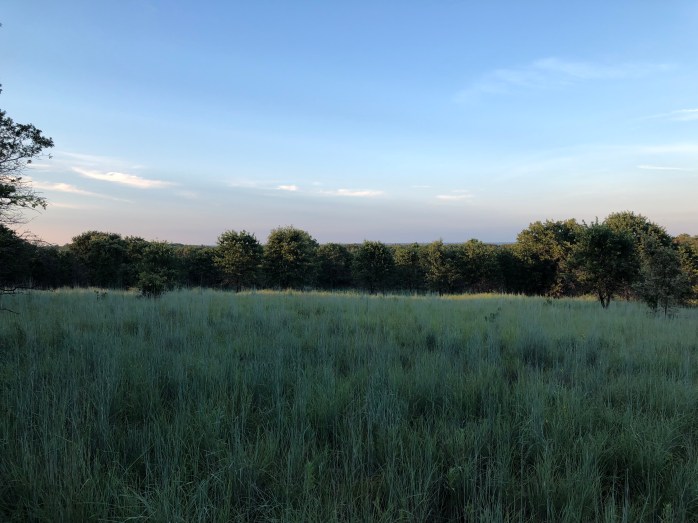
At 3:30pm I was sitting in a chair in the shade, looking out at a field of little bluestem and Indiangrass waving in the gentle breeze. Scattered in with the grasses were a few violet spikes of dotted gayfeather, a smallish prairie plant whose flowers grow in clusters along upright stalks. A little further away were some little white puffs on thin, gangly stems, the flowers of false gaura. A couple of butterflies visited the area.
The sky was powder blue toward the horizon and a deeper shade of blue overhead, and cumulus clouds floated by. They were just big and dense enough to be flattened and gray along the bottom. Their puffy cauliflower tops were bright in afternoon sunshine that brought the temperature up to 90ºF on the shaded ground at the edge of a stand of post oak.
It was, for the most part, very quiet in this spot. There was the occasional passing airplane, but usually there was nothing to mask the sound of grasses moving in the breeze. It was wonderful to be out in a patch of prairie with no roads, no buildings visible, but what brought real solitude was the ability to hear breezes, birds and insects in a sound field with nothing else present. Real immersion in nature involves multiple sensory modalities, not just a pretty view.
I’m not the only one who needs occasional doses of solitude, or for whom absence of mechanical sound is important. In temperate rainforests and other remote places, Gordon Hempton has been championing – and recording – places where there is the least man-made noise and therefore the clearest experience of natural sounds1. Probably nowhere in North Texas is free of noise completely or for long, but this day in the LBJ National Grasslands was close enough.
From the west, a hazy line of clouds approached, darker near the northwest horizon and much higher than the clouds I had been watching. The breezes picked up a little and the sun was filtered through the clouds. There was the potential for rain and lightning, at least toward the north. I decided to shift to a nearby ridge where I could watch the storm come it. This had the additional advantage of getting up a steep caliche and gravel incline while it was dry.
I got to the ridge, and by this time the high cloud deck brought the temperature down, helped by a fairly steady breeze. I sat looking through the waving stems of big bluestem at a western horizon that was enveloped in rain. About three feet in front of me, a bumblebee was visiting the purple spikey flower heads of Leavenworth’s eryngo, that prickly plant that people often mistake for thistle. At this time of year the leaves and flowers are a beautiful purple color.
So I sat and watched the dark blue-gray bruise of a thunderstorm that spanned nearly half the horizon. There were places where the smudged gray of heavy rain connected cloud and ground. Distant thunder was somewhere between soothing and invigorating. As low rumbles, thunder’s effect on me is soothing, but now it was part of a nearby heavy storm with occasional bolts of lightning dropping from the sky. It was powerful and fascinating, and I was grateful to be able to sit and watch this storm system progress toward the north. The outer clouds streamed blue-gray across the sky, with a tinge of blue-green behind them. The clouds were like dark cream that someone started to stir, pulled across the bowl of the sky in long, thick streaks in front of the main part of the storm.
Suddenly, what was breeze became wind – steady and strong, cooler and smelling of rain. This was the outflow from the storm, putting me on notice that although the storm seemed mainly to be tracking north, it was also spreading out and coming to me. Blowing across the dry grasslands, the wind picked up a little stinging dust and carried cool little droplets from the rain. I stood for a little longer, wondering if I might see a curtain of rain march across the treeline toward this ridge. That didn’t happen, but the cool wind became laden with big, cold drops of rain as I walked back to the car at 6:00pm. According to the car’s thermometer, it was now a much cooler 67ºF.I was thankful for whatever rain fell on the grasslands where the end of summer has been very dry, and for the chance to experience the transition from sunny afternoon to revitalizing storm.