Spring is fully underway and it’s not yet April. Things are green and growing, and the insects – the beetles, flies, dragonflies, damselflies, skippers, and butterflies – are busy. On March 27 I wandered the trails at Sheri Capehart Nature Preserve, up the hill to the bluff and over to the boulders. There were filmy high clouds but it felt sunny and the breeze was cool. A nearby weather station reported that it was 65 degrees and felt like 74.
Spiderwort
Many of the oaks were leafed out and a few stragglers were still putting out small leaves tinged in red. Along the trail’s edge there were some spiderworts with their deep blue flowers, three petals surrounding a cluster of yellow anthers. And everywhere I looked in the sandy soil of the hillside, it seemed that I saw Texas toadflax. I’ve really looked forward to this!
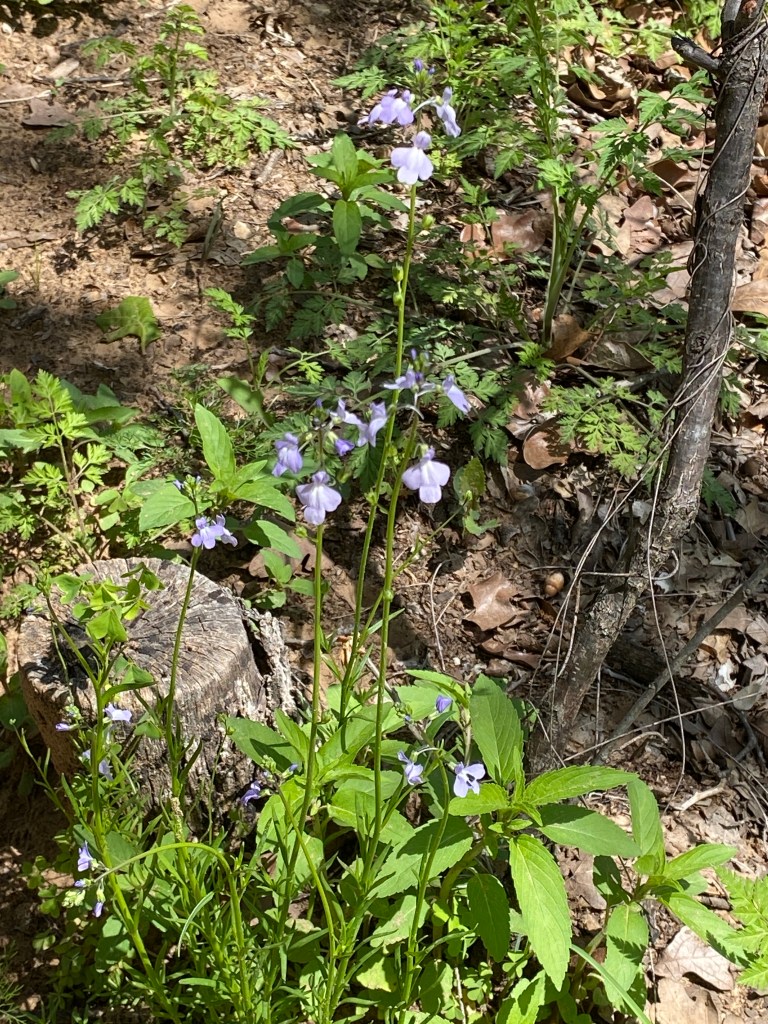
Texas toadflax
Last year, toadflax really captured my imagination. I wrote:
“To tell the truth, part of the reason I’ve focused on them … is that name – “toadflax” – which immediately made me think of The Wind in the Willows. A plant with such a name surely belongs in an old children’s tale centered on the English countryside with animals such as the toad.”
Even if it had a completely unimaginative name, I would think this delicate-looking plant was worth paying attention to with its tall stems and pale violet flowers.
Near the top of the hill there is an area with plenty of southern dewberries, and on one of the flowers was a pretty black-and-white moth called the “mournful thyris.” That’s just the kind of name that gets me wondering about how it was named, and an internet search or two did not yield much. Thyris is part of the name of the family – the group of moths – to which this one belongs. The word is said to be a Greek reference to “window,” and they have a spot on the wing that is translucent, like a sort of window. But why is this one mournful? I looked for a window into its grief but could find nothing. If any readers know the origin of the name, please share with us in the comments.
Mournful thyris moth on southern dewberry
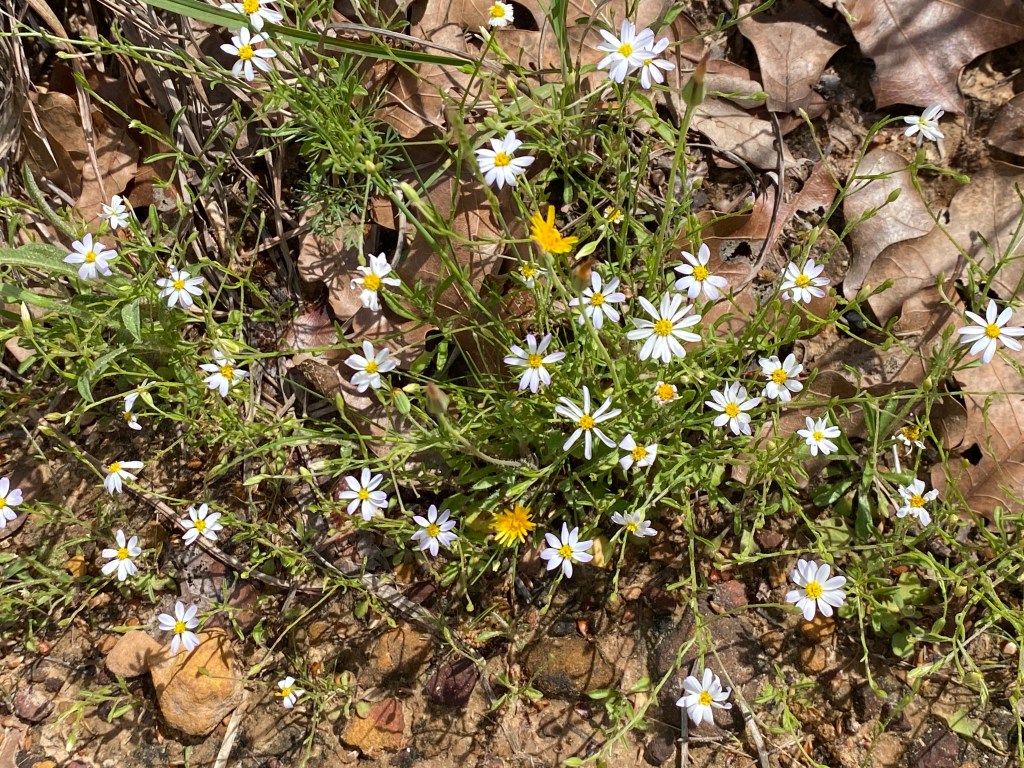
I walked the rest of the way to the bluff, along the way seeing beautiful yellow woodsorrel in a few places, with leaves reminding me of clover. Up on the bluff there were places with groups of what appeared to be leastdaisy, with tiny white flowers. It can be so rewarding to pay attention to little things like this, just stopping and maybe getting on hands and knees to get to know something small and magical.
Some leastdaisies at the bluff
There were plenty of butterflies – skippers, sulphurs, and a couple of beautiful tiger swallowtails. And the soundtrack to this lovely spring day was provided by a Carolina wren’s calling, with a blue jay heard in the distance. There were cardinals, too, and it sounded like an ideal spring day. I’m waiting for that first Texas spiny lizard on a tree trunk, which will add that perfect touch to a delightful day. I’m sure I’ll see one soon.
“A sudden encounter with a large, angry bull snake in the wild can be an awesome, even frightening experience for the uninitiated. Almost everything about the reptile’s defensive behavior looks or sounds menacing.”
– John Werler and James Dixon, Texas Snakes
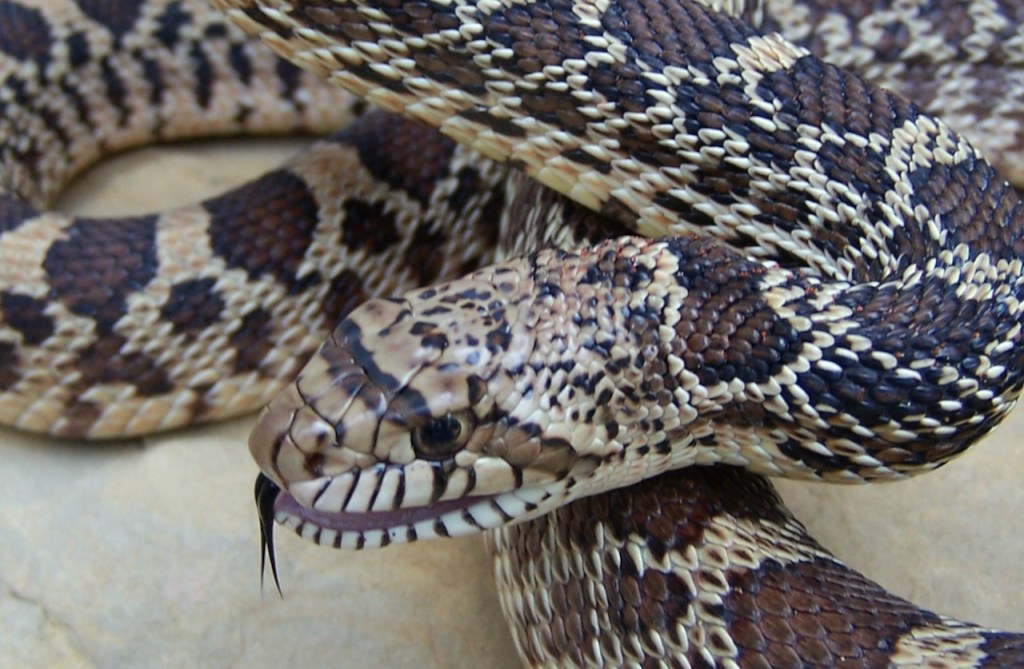
A defensive bullsnake from near Menard, TX. The vertical flap of tissue (epiglottis) can be seen toward the back of the mouth.
The bullsnake is a large snake, growing to lengths greater than five feet and occasionally approaching nine feet, according to Werler & Dixon. When threatened, this large snake generally pulls itself into a coil, vibrates its tail, and with head and neck held high and ready to strike, it hisses loudly. The snake’s mouth is open at least partly. A vertical flap of cartilage at the opening of the windpipe amplifies that hiss so that it is loud and has a little rattling quality, suggesting the high buzz of a defensive rattlesnake.
If the source of threat is very close, the bullsnake will then strike at the offending animal or human with a dramatic hiss. Occasionally it is just a bluff; Clint King and I picked one up off a road one time to keep it from being hit by a car, and it hissed but never tried to bite. More often, bullsnakes are willing to bite. Their rows of sharp teeth leave nothing more than scratches, as the teeth are small and the snake has no venom.
A few bullsnakes have more timid or calm temperaments, especially those bred in captivity. Knowing how intimidating they can be when frightened, a calm bullsnake can seem like a gentle giant as its big, powerful body moves across your arms or shoulders. A snake like that is my favorite choice for educational presentations, hopefully adding to participants’ appreciation for native species.
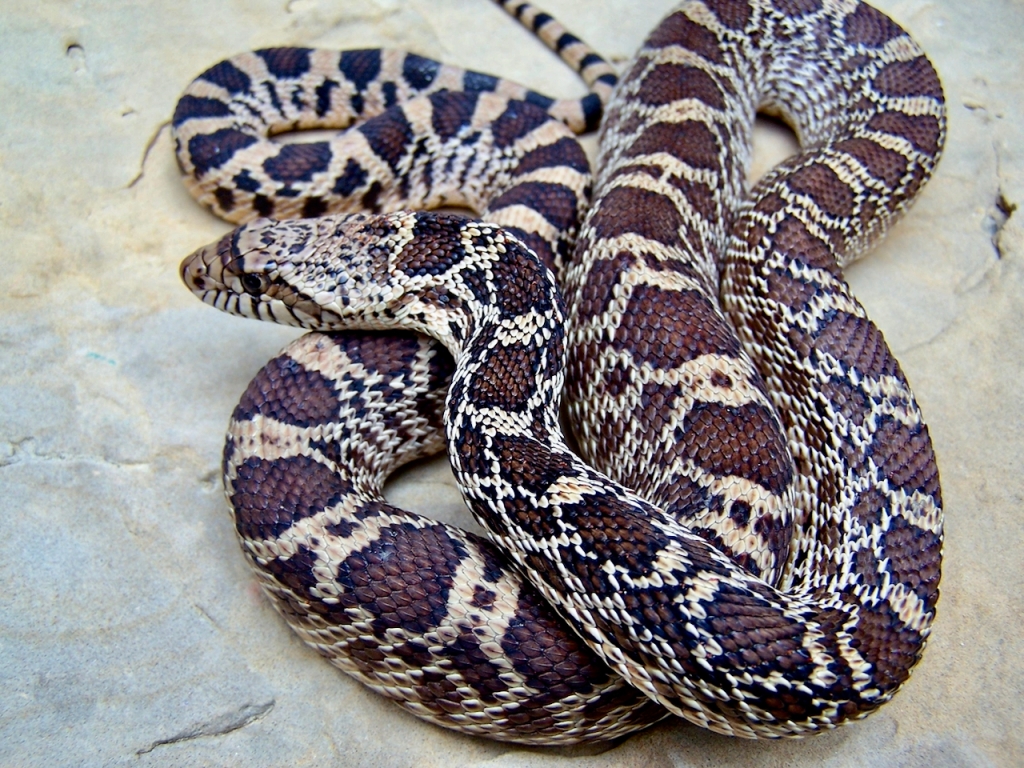
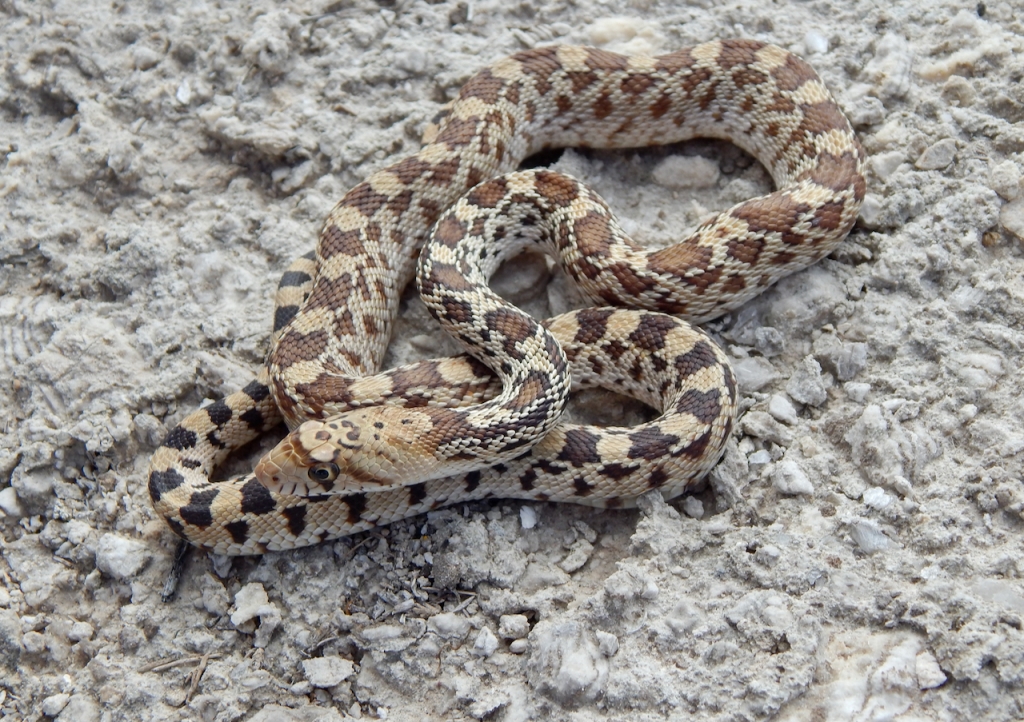
A young bullsnake from near Weatherford, TX.
A bullsnake’s neck has dark brown rounded or irregular blotches which gradually become spaced further apart. There are dark blotches and spots on the side of the body as well, on a sandy or yellowish-brown ground color. Near the tail, the dorsal blotches become darker and the tail is nearly ringed by these dark blotches on a yellowish-tan ground color. The head is a light caramel or yellowish color with some dark freckles, and a darker brown band crosses the snout just in front of the eyes and runs diagonally through each eye and back toward the jaw line. Where most of our nonvenomous snakes have two prefrontal scales on the top of the head just in front of the eyes, the bullsnake (and the pine and gopher snakes) have four.
The four prefrontal scales can be seen just at the front of that dark band across the head.
Let’s talk just for a moment about that name for the genus – Pituophis. Where does that name come from? A book from 1974, Snakes of the American West, claimed that this name translated to “phlegm serpent,” but this appears to be an error. I’ve seen a similar claim made in a self-published book on Amazon. I went looking for the real etymology of the word.
The second part of the genus (“-ophis”) means snake, but the first part derives from a Greek word for pine (“pitys”). An earlier synonym for the genus was spelled “Pityophis,” but you have to look through the research literature from many years ago to see that spelling. No matter how much the hiss sounds wet and rattling, it is not a “phlegm serpent.”
Where are they found?
The bullsnake is one of several species of Pituophis in the U.S. that range from coast to coast and from Canada to Mexico. In the eastern U.S., they are called pine snakes, and in the western U.S. they are gopher snakes. In the middle, reaching from northern Mexico up through central and west Texas, stretching out in the Plains states and up to southern Canada, is the bullsnake.
In Texas, the bullsnake is found west of a line that runs approximately through the DFW metroplex down through San Antonio to around Victoria, according to Dixon. Around the Pecos River, it transitions into another subspecies, the Sonoran gophersnake.
A juvenile Sonoran gophersnake (perhaps an intergrade with the bullsnake) from near the Guadalupe Mountains in Texas.
Natural history accounts of the bullsnake usually mention their preference for prairies and grasslands. A study from southwestern Wisconsin showed that they preferred bluffs with open spaces between trees and did not use closed canopy forest or agricultural lands (Kapfer and others, 2008). Werler & Dixon mention the bullsnake’s fondness for agricultural fields containing rodent prey. I don’t know how to reconcile the statements about agricultural lands.
What do they eat?
Most of the bullsnake’s diet is made up of small mammals such as mice, rats, gophers, and ground squirrels. They spend considerable time exploring burrows and tunnels to find their prey, according to Werler & Dixon. The snake is very well adapted for such behavior. The bones in the snout are more rigid than those of most snakes so that in sandy soil it can use its head to dig. The bullsnake’s skills as an excavator were described by Carpenter, who tested eight bullsnakes in an enclosure with sand substrate. The snakes generally began prodding the sand next to a stable object and began digging sand with sideways movements of the head. Then, the snake bent its head to the side to scoop loosened sand and move it away. A loop of the neck continued to push the sand backward. In further testing, bullsnakes were seen to excavate tunnels up to a meter long. Additionally, Carpenter examined whether bullsnakes would recognize pocket gopher mounds, and showed that these snakes actively explore and excavate pocket gopher burrows in attempt to eat the gophers.
Once they locate a gopher or other prey animal, the bullsnake grabs and constricts it with powerful coils. What about rodents discovered in burrows? There may not be space to wrap around the rodent, and so the bullsnake uses a portion of its body to press the animal against the side of the burrow, ultimately having similar effect to constriction.
Bullsnakes are also reported to be fond of eating eggs, raiding the nests of ducks and other birds.
How do they reproduce?
Bullsnakes mate “soon after they leave hibernation,” according to Werler & Dixon, in “late April or May” (page 235). A study by Iverson and others in the sandhills of Nebraska found courtship and mating to occur in May and egg-laying to occur in June or July. Bullsnakes lay very big eggs in protected, moist locations and they hatch around two months later. The babies are a little over a foot long.
As our climate changes, winter dormancy may end earlier. Could this result in a shift in reproductive timing? And will hatchlings emerge into a hotter, drier environment here in Texas and find it difficult to thrive? I suppose we do not know.
What conservation challenges do they face?
In the Iverson study in Nebraska mentioned above, the authors stated, “At the most intensive site of removal, where every bullsnake observed along a 1,100-m drift fence was removed or relocated for 8 consecutive years (Gimlet Lake), number of snakes captured during the same period each year did not decrease” (p. 59). That may be encouraging news about the potential for these snakes to withstand collection. It is not clear whether they can withstand other threats like habitat loss.
NatureServe shows the bullsnake as a species of “special concern” in Canada because of habitat loss and road mortality, while it is “secure” in the U.S. The International Union for Conservation of Nature (IUCN) considers bullsnakes and gophersnakes (Pituophis catenifer) a species of “least concern.”
Carpenter, C.C. 1982. The bullsnake as an excavator. Journal of Herpetology, 16(4), Pp. 394-401.
Dixon, J.R. 2013. Amphibians and Reptiles of Texas, 3rd Edition. College Station: Texas A&M University Press.
Iverson, J.B., Young, C.A., Akre, T.S.B., & C.M. Griffiths. 2012. Reproduction by Female Bullsnakes (Pituophis catenifer sayi) in the Nebraska Sandhills. Southwestern Naturalist, 57(1), 58-73.
Kapfer, J.M., J.R. Coggins and R. Hay. 2008. Spatial ecology and habitat selection of bullsnakes (Pituophis catenifer sayi) at the northern periphery of their geographic range. Copeia 2008(4), Pp. 815-826.
Shaw, C.E. & S. Campbell. 1974. Snakes of the American West. NY: Knopf.
Werler, J.E. & J.R. Dixon. 2000. Texas Snakes: Identification, Distribution, and Natural History. Austin: University of Texas Press.
— “Crawling Kingsnake,” John Lee Hooker (and The Doors & others)
Speckled kingsnake from southeast Texas
Even among people who don’t like snakes, kingsnakes get a certain respect and even liking. They are able to eat rattlesnakes and have considerable immunity to the venom, and some people assume that the kingsnake prefers to hunt them down. Most people recognize that the kingsnake is not venomous, and so they may grudgingly call it a “good” snake.
Kingsnakes constitute a big group, found across the U.S. from coast to coast. They are medium-sized to fairly big snakes with muscular bodies and relatively small heads. Here in Texas you can find the speckled kingsnake, the desert kingsnake, and the prairie kingsnake.
A fully grown speckled kingsnake may be three or four feet in length, but a few individuals reach greater lengths. Speckled kingsnakes are black or very dark brown with yellow to cream-colored speckles down their backs. As you travel across Texas from east to west, the speckled pattern gradually shades into the desert kingsnake’s pattern in which a series of dark blotches runs down the snake’s back. Those blotches interrupt the otherwise speckled pattern of the desert kingsnake. The scales are smooth and often give the snake a glossy appearance.
On the belly, the scales of speckled and desert kingsnakes may be yellow with black blotches or (especially in desert kingsnakes) mostly black with some areas of yellow.
Where are they found?
Speckled kingsnakes often choose habitat that is near water and has plenty of low vegetation and ground cover. Along the upper Texas coast, speckled kingsnakes may live in coastal prairie and on barrier islands near marshes, according to Werler & Dixon. In other parts of east and central Texas, they may be found in woodlands, prairies, and old fields as well as in the vicinity of marshes and other wetlands. In Arkansas, Plummer studied a population in an area that included irrigation ditches and levees, bottomland forest, and agricultural fields. The snakes mostly used shrubby areas on the levees and did not make use of agricultural areas. The kingsnakes were radio-tracked and when found they were usually concealed or underground (such as in an old mammal burrow).
What do they eat?
Speckled kingsnakes make use of a wide variety of prey, including small mammals, lizards and other snakes, frogs, reptile eggs, and the occasional bird. The kingsnake bites the prey to get hold of it and then wraps several coils around the animal’s body. Kingsnakes are powerful constrictors, and the pressure of those coils kills not just by making breathing impossible but apparently also by stopping circulation. Researchers studying boa constrictors found that constriction quickly and dramatically reduced blood flow and heart rate.
In at least one study, mice were the principal prey, but these kingsnakes are able to subdue and eat our native venomous snakes as well as nonvenomous ones. A snake that is as long as the kingsnake is swallowed and becomes kinked or folded in order to fit in the kingsnake’s lengthy stomach.
Other reports show that kingsnakes in this group are very fond of turtle eggs and have even been observed watching and waiting while a female turtle laid eggs (reported in Werler & Dixon).
How do they defend themselves?
These snakes cannot make an especially fast escape and they have no venom and only small, recurved teeth. Their best defense is to avoid being seen, and most of their time in spent concealed in low vegetation and leaf litter, under tree stumps or flat rocks, or underground. These places not only offer concealment, they are great places for them to look for prey. As temperature increases, speckled kingsnakes become more nocturnal.
If confronted or captured, however, speckled kingsnakes often pull back in a striking position and will bite, often hanging on and chewing with strong jaws. If grabbed, the snake thrashes and expels feces as well as a bad-smelling musk, making it an unpleasant experience for a human captor and maybe taking away from the appeal of the snake as a meal for a raccoon or coyote. It must be emphasized that for a human who discovers a speckled kingsnake and simply observes it, there is no danger whatsoever.
How are they related to other kingsnakes?
For years, speckled kingsnakes were part of a group called “common kingsnakes” that ranged across the southern U.S. from coast to coast. They are generally dark snakes with some sort of pattern – for example, black and white bands or stripes in California, the speckles of the desert and speckled kingsnakes, and a light chain-like pattern along the east coast. The snake was scientifically known as Lampropeltis getula, with different subspecies. The speckled subspecies was (or is) Lampropeltis getula holbrooki.
In recent years, researchers using genetic analysis proposed that these snakes are not all one species, and only the most eastern form is the species getula. The speckled kingsnake was said to be its own species, Lampropeltis holbrooki. The desert kingsnake is L. splendida.
Most readers will not want to go into the biology and genetics of these decisions, but let’s just say that not all biologists agree, and have pointed out flaws in the methodology used to split these snakes into their own species (such as relying too much on mitochondrial DNA rather than nuclear DNA and failing to consider how they are not reproductively distinct – where their ranges meet, they breed and produce intermediate forms). If you are interested, read the 2020 paper by David Hillis.
Speckled kingsnake seen at Anahuac National Wildlife Refuge on the Texas coast
How do they reproduce?
When male speckled kingsnakes search for females in the spring, they may engage in combat with other males. It is termed “combat” but it really does not result in harm to either snake; it is more like wrestling in which the dominant snake forces his opponent’s upper body to the ground. Kingsnakes mate in spring and females lay a clutch of eggs in early summer. Werler & Dixon report that there may be 2 to 17 eggs, laid in a moist location such as within rotting vegetation or in an abandoned burrow. Within 2 to 2.5 months, the eggs hatch. The babies are a little under a foot long and the speckles are initially fused across the back into squiggly crossbars.
What conservation problems do they face?
NatureServe rates the speckled kingsnake as “secure” in Texas. While habitat loss may reduce some populations, overall there are no major threats listed.
It is worth adding that as a group, our reptiles and amphibians are in serious trouble, with some species in greater decline than others. Several factors are serious threats to both reptiles and amphibians: habitat loss, pollution, climate change, invasive species, overcollection, and disease or parasitism, as described by Gibbons, et al.
Plummer, M.V. 2010. Habitat Use and Movements of Kingsnakes (Lampropeltis getula holbrooki) in a Partially Abandoned and Reforested Agricultural Landscape. Herpetological Conservation and Biology 5(2), 214-222.
Werler, J.E. & J.R. Dixon. 2000. Texas Snakes: Identification, Distribution, and Natural History. Austin: University of Texas Press.
We may feel big, like the most important thing in the Universe, re-shaping the planet and living in worlds of technology and invention. We have been to the moon and back; we could, in a fit of international rage, make the planet unlivable (we came close during my lifetime, and might again). We have created an industrial system that is currently making the planet unlivable, but being like gods, we are sure that we can continue to live anyway.
But some of us don’t feel so big, at least on a collective level. Sure, we sometimes make the mistake of grandiosity as individuals, but we aren’t convinced that we have special rights to convert our world into the exclusive garden of Homo sapiens. We feel a relationship with the living things around us that includes respect and relatedness. We may be consumers, but we’d rather it not be in the industrial sense of consumer and product.
Many of us seek connection with something bigger than we are. Sometimes we sit and look at the heavens and see something so big that it reminds us of our true size. We might experience awe and gratitude. At such times, we might have a desire to relieve suffering or add to the goodness of the world. Could we describe those feelings and that intentionality as prayer?
Practitioners of forest therapy sometimes ask the woods for permission to enter a particular spot. Treating trees, rocks, or rivers as sentient, as beings whose wishes need to be considered, also appears in some Native American cultures and in ancient Japanese Shinto practices. A person might wade into a stream and say “thank you for your cool, clear water.” They might silently say, “May my presence here cause no harm.”
Are such things prayers? I don’t know the answer, but I do greatly value our experiences of awe, of gratitude, of stepping outside of ourselves to connect with something greater. I wish that those things, along with humility and acceptance of the limits of our understanding, were more common.
Like many of us in the U.S. I grew up periodically attending a Christian church and learning the basic stories. I was of course taught it as outright history, not as myth and metaphor. No one questioned how Noah collected pairs of all the world’s animals or got them all on a handmade boat. We learned that praying was talking to God, imagined as an old man like in the Renaissance paintings. Maybe talking but usually asking – for forgiveness or for rescue from danger and disease. Or maybe for stuff we wanted.
I’m not promoting that, and I would go along with those critics who point out that throughout the ages, organized religion has been a great source of misery for many (and a malignant source of personal power and enrichment for quite a few). Jesus’ teachings described a radical love for all, envisioning a society turned upside-down, with the high and privileged brought low and the poor and humble elevated. All this was quickly transformed into a religion in which the right beliefs allowed us to escape eternal torture. Popes dressed in splendor and wielded immense power; so much for the privileged being brought low.
And now we have prosperity gospels claiming that being rich is a reward from God (and therefore being poor must be a sign of failure). So much for elevating the poor. Christian Nationalism is a movement seeking essentially to turn the U.S. into a theocracy, welding the beliefs of the church onto the power of the state. No wonder Christianity is losing ground. A Pew Research Center study finds that fewer people in the U.S. identify as Christian, and 29% say that they are atheist, agnostic, or “nothing in particular.”
So should we throw away the idea of prayer, along with the rest of religion? Even when the prosperity preachers and dominionists have gone away, our capacity for awe and our tendency to believe that there is something bigger than us will remain. Many of us will still seek a connection beyond ourselves.
Some might consider prayer to be very abstract, a process of opening oneself to the beauty and symmetry of a flower or the immense dome of the sky overhead. There is awe and gratitude in those moments, transcending oneself and feeling a part of such things, of all of creation.
Others may pray in a very direct and personal way, such as Willie Nelson describes in one of the songs from the album, Spirit:
“Remember the family, Lord?
I know they will remember You
And all of their prayers, Lord
They talk to You just like I do”
– Willie Nelson, “Too Sick to Pray”
A famous prayer of St. Francis, the “Canticle of the Sun,” expresses gratitude to the Lord for Brother Sun and Sister Moon, as well as for the wind and air, the water, and Mother Earth. There is also gratitude for those people who forgive and endure trials in their lives. He saw all of creation as a wonderful gift, and all the parts of it – including ourselves – related like siblings.
That brings to mind the Thanksgiving Address of the Onondaga Nation of Native Americans. Some of us first encountered it in Robin Wall Kimmerer’s book Braiding Sweetgrass. Is it a prayer? (Kimmerer says it is not.) From the descriptions I have read, it is a powerful way to affirm the group’s identity and values, its gratitude and the relationship of reciprocity between the people and the rest of nature. Participants in a meeting or students in a classroom recite words beginning with these:
“Today we have gathered and we see that the cycles of life continue. We have been given the duty to live in balance and harmony with each other and all living things. So now, we bring our minds together as one as we give greetings and thanks to each other as people. Now our minds are one.”
Subsequent portions of the Address express thanks to the Earth, to the waters, the plants, animals, and ultimately “to the Creator, the Great Spirit.” Each time, there is the refrain, “Now our minds are one.”
Chanting, singing, or reciting something in unison can be a powerful way of transcending oneself. Joining our voice with those of others, we are more than just our individual selves, and perhaps we become something greater. And perhaps that is like prayer.
“To whom do you pray,” some might ask, wanting to know what deity we recognize. But there is more than one way to conceive of the divine. One can have a spiritual life without personifying God as a human-like figure modeled after fathers and kings. Neither does God have to be personified as a mountain or a flower; maybe the Creator need not be personified at all. Maybe it’s all much more abstract than that, and maybe it’s unknowable.
It’s not like I have answers. I’m just thinking out loud, into the keyboard, pulling in the bits and pieces that I’ve read and heard and imagining that prayer is broader than what most of us heard in church as we grew up.
I have been walking a lot at Sheri Capehart Nature Preserve lately, and maybe it is still winter, but everything that is alive seems to know that it is spring. Some count the beginning of spring according to months, starting with March. Others mark the start of spring when the length of days and nights becomes equal (the “vernal equinox,” March 19th). For wild things that grow and breathe, spring is about temperatures and the length of daylight, and it is also about everything else around them. Spring is a team effort, so that new plant growth and flowering, the awakening of insects, the migration of birds, and lots of other things need to happen together for everything to work right.
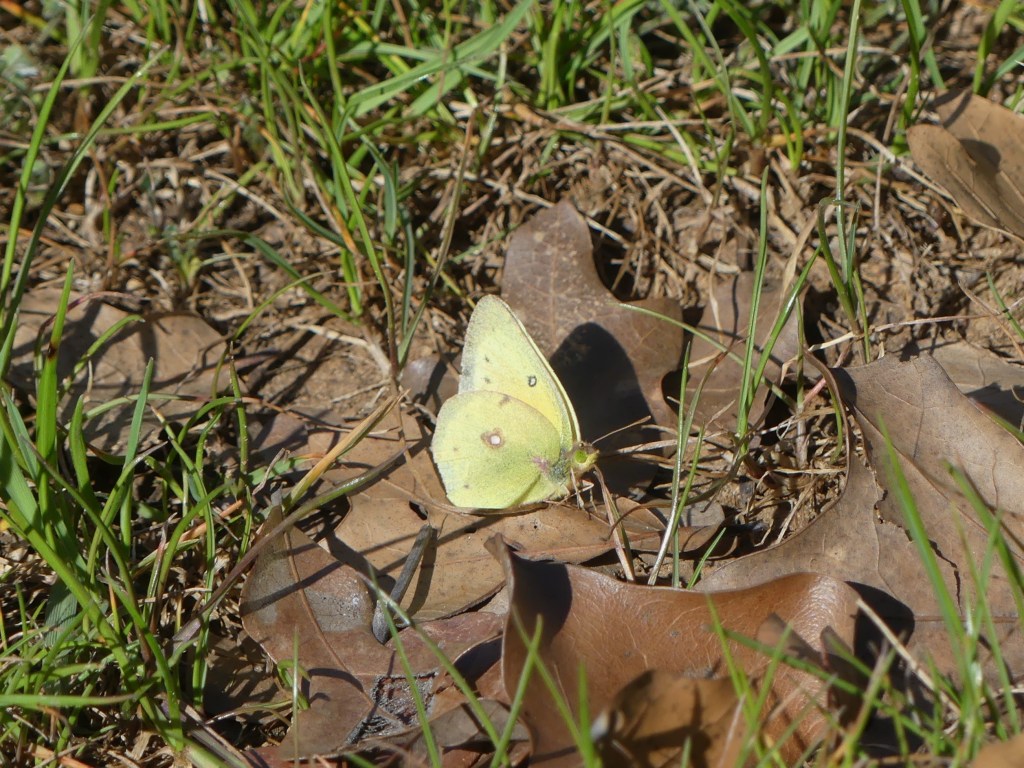
A sulphur, probably the clouded sulphur
In the middle of the day on February 20th at the preserve, it was 81.1F in the shade, and insects were on the move, including grasshoppers, wasps, and butterflies. As I walked down the trail, a small sulphur butterfly flew ahead of me to a new place to land among the emerging green plants. It found another sulphur and together they rose, circling each other, and flew away above the treetops. Along the boulder trail I could see six or eight of them at any one time. One would encounter another and they would briefly chase each other in a twirling pattern before separating.
The white flowers of crowpoison, also called “false garlic.” It may be toxic to people, and maybe to crows as well?
On the 26th at midday it was 92.8F in the shade near the north pond, and I heard a few cricket frogs calling for the first time in months. Turtles basked in the sun. High above me, altocumulus clouds were arranged like balls of cotton in a patch of sky. Birds called from nearby trees – Carolina wrens, northern cardinals, Carolina chickadees, and a white-throated sparrow. Further along the trail was a spot with scattered white flowers of crowpoison and the yellow blooms of a plant called golden corydalis. Sometimes people call it “scrambled eggs.”
Golden Corydalis, sometimes called “scrambled eggs”
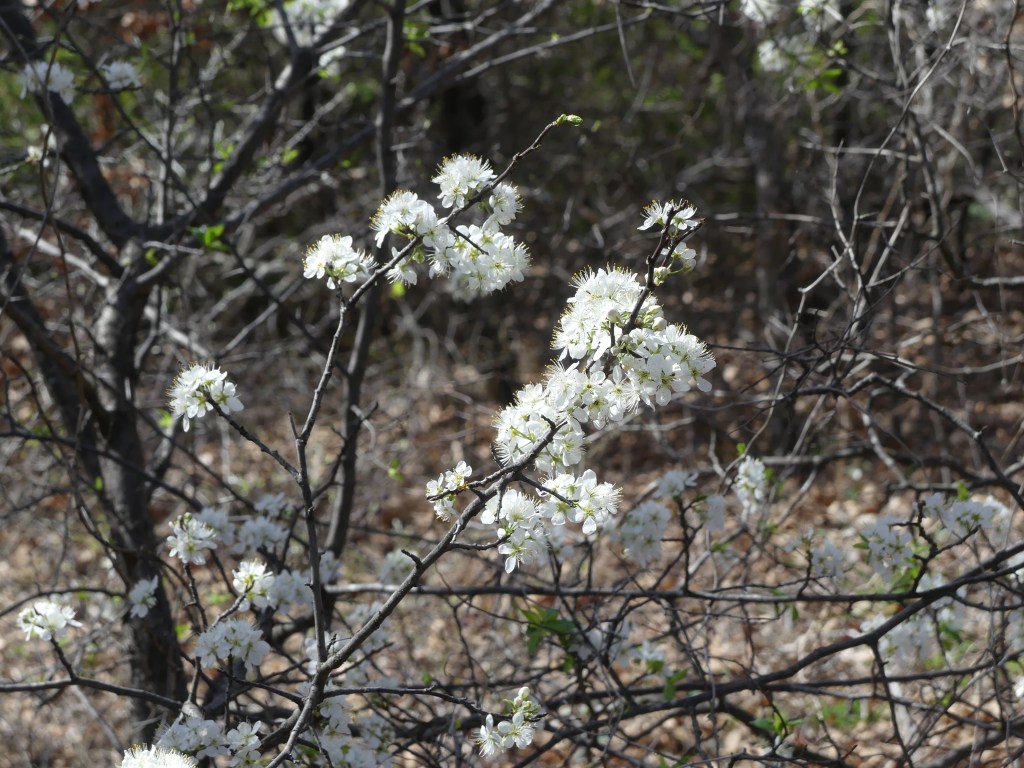
And then March arrived, and suddenly the plum trees were covered in clusters of white flowers. From a distance, other tree branches mostly looked gray and bare, but here and there you could see a slight green haze of budding leaves. Elbowbush was flowering. On the way to the north pond, when I looked closely I could see that most of the trees and shrubs were budding.
Clustered flowers on a plum tree at the preserve
On March the 2nd according to the calendar it could barely be spring, could it? I sat in my back yard and made a few notes:
Here in this false spring, the tree blossoms are bright white. The winter sun, still low in the sky, makes the day look like perpetual morning. The sun-warmed air moves and is a soft breeze against the skin. It is the morning of the year, the beginning. The flowers and bees know it, and the birds announce it in the trees. What does the chickadee and the cardinal know that the calendar does not?
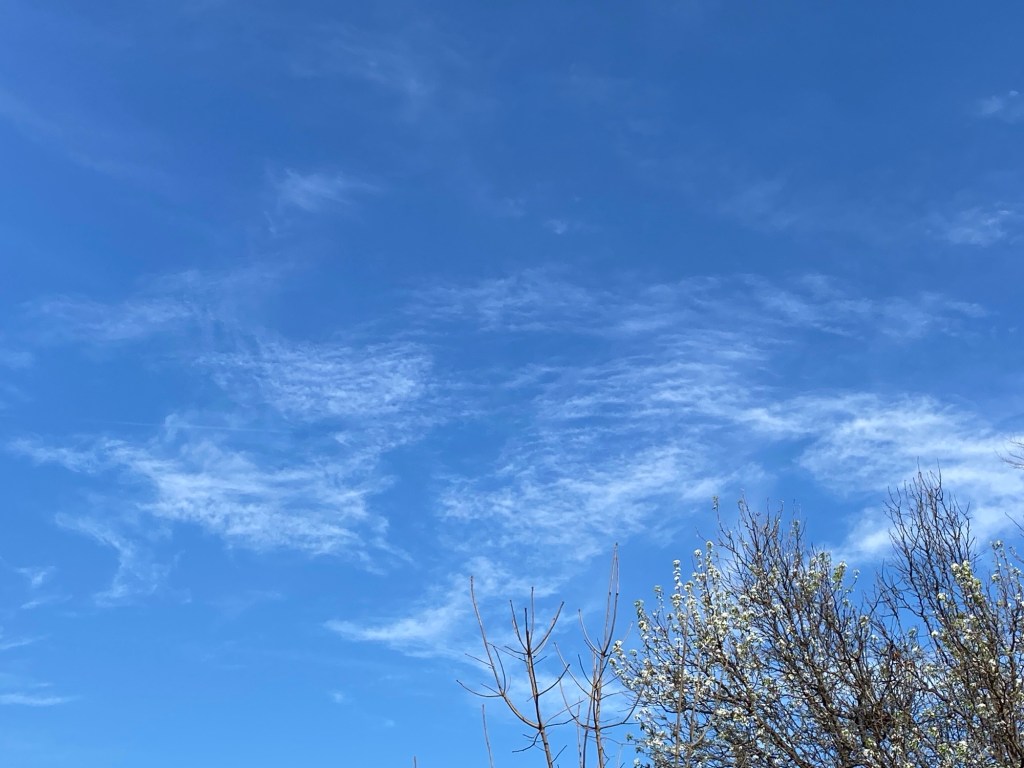
I sit and look at the sky, the blue canvas where wind, sun, and water scribble and paint. There are dabs, streaks, and lines, white images and symbols in a language familiar but still a bit mysterious. Thin brush strokes make a big heart with a few lines of text, maybe wishing us peace and well being. And then the wind moves it to the east and the canvas is cleared.
In my yard, when I looked down, I found a forest of little blue flowers among leaves of various shapes. In the midst of this two- to four-inch “forest,” the yellow sun of a dandelion shone. A honeybee visited the flower; dandelions are among the first flowers to feed the hive.
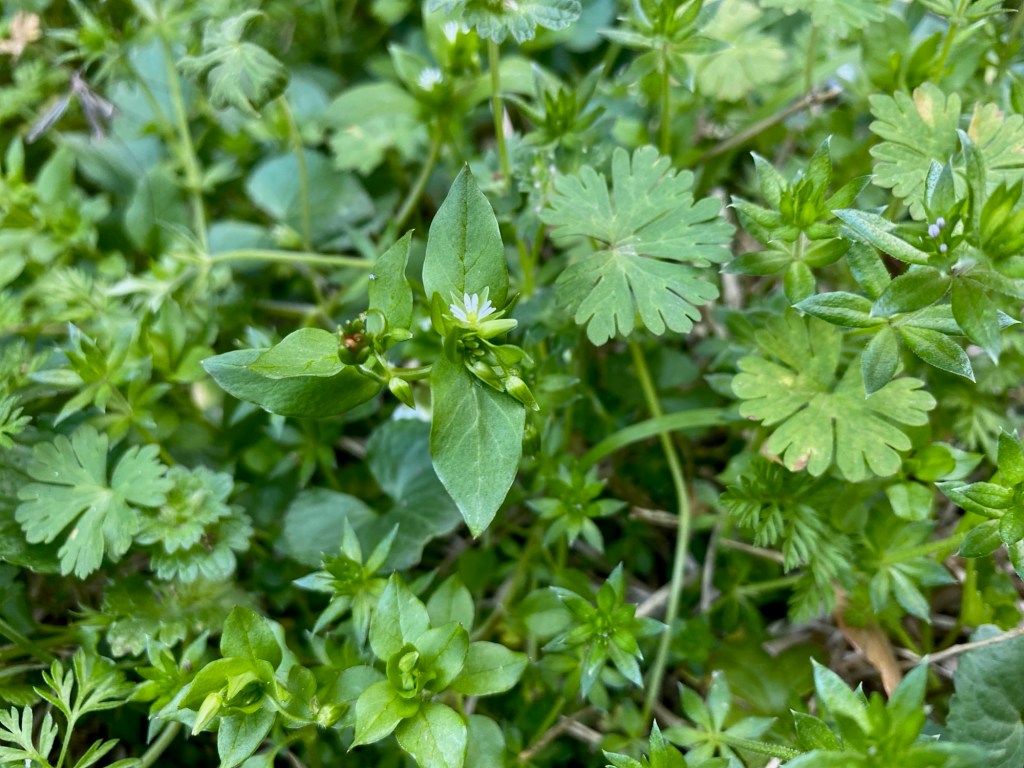
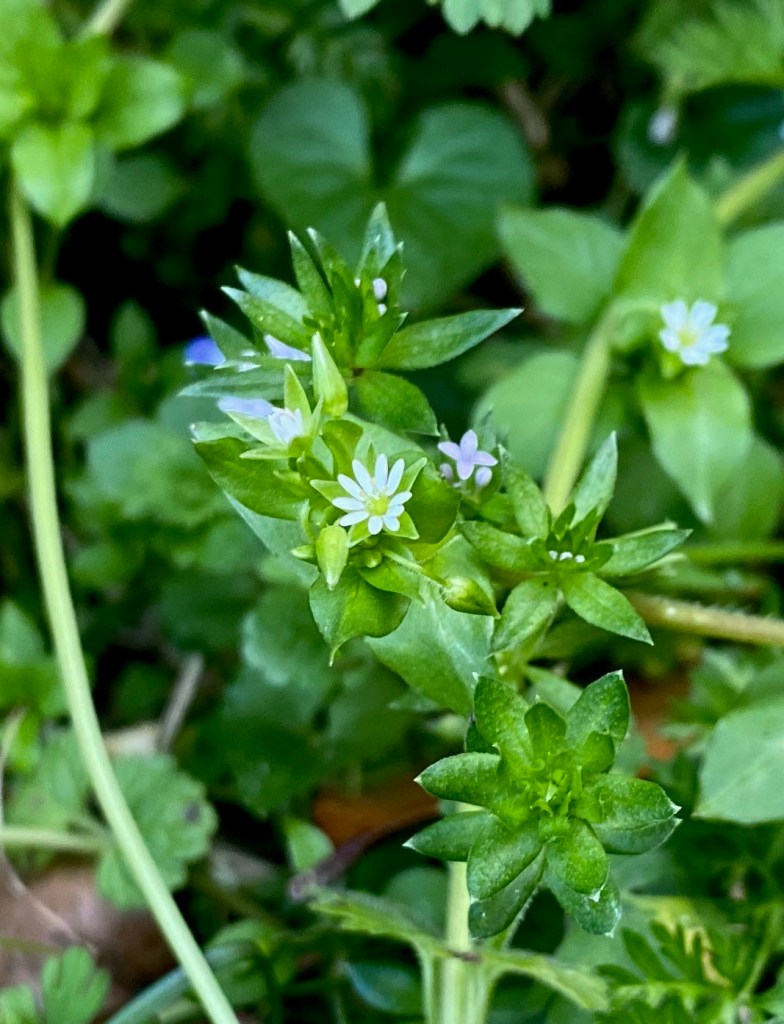
The ground was filled with such a beautiful jumble of green shapes. There were bigger, taller ones with leaves like umbrellas with notches and fingers. The appeared to be clusters of about four frilly leaves right at the top of the stem. There was chickweed with long, branching stems and arrow-shaped leaves. Nearby were plants with delicate stems with leaflets off to each side, in the way we think of ferns.
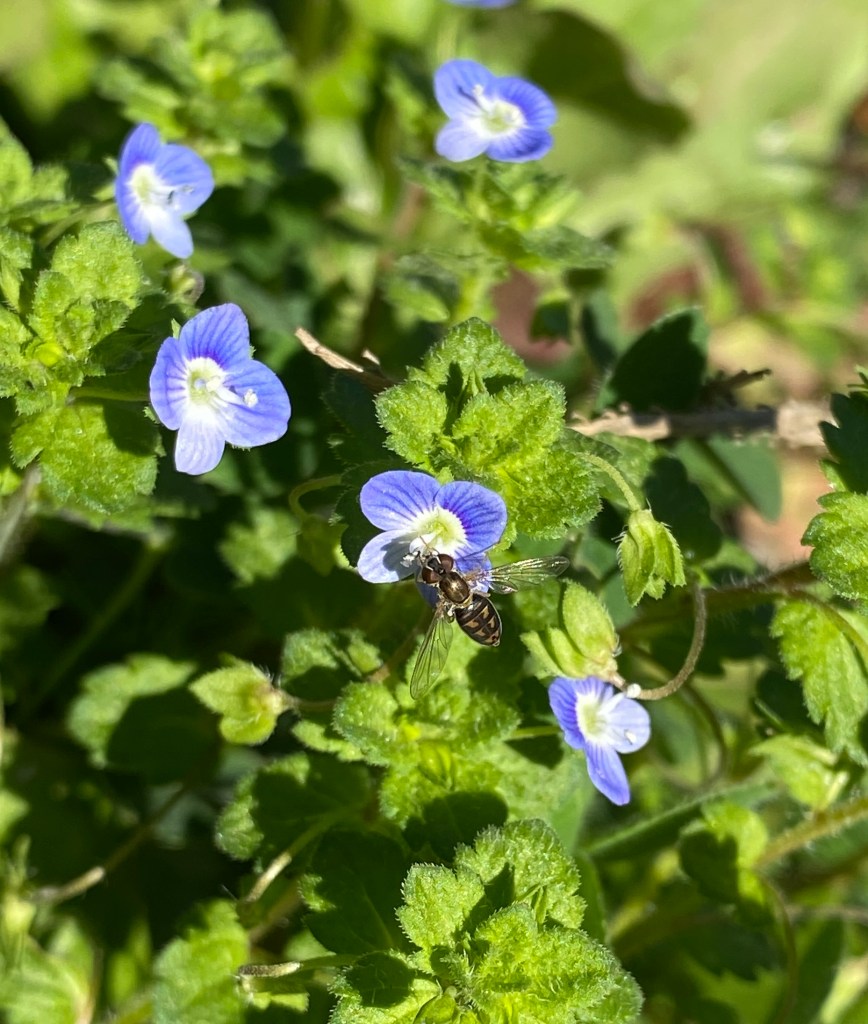
Bird’s eye speedwell
Scattered among these was bird’s eye speedwell, a beautiful little flower that some say was considered a lucky charm, speeding travelers on their way. The flowers are white in the center and have four baby-blue lobes with tiny darker blue pinstripes. Another little plant is called “henbit deadnettle,” with tubular purple flowers. Some of these plants have amazing names, don’t they?
HenbitCommon chickweed in the center, with a four-lobed flower of field madder just to the right
All these leaves and flowers made a tiny jungle inviting us to lie in their softness and explore smells and colors as if it was a tiny world all of its own, separate from streets and sidewalks and the things we normally notice.
And so, never mind the calendar – it is spring. Good morning! May the year treat us well.
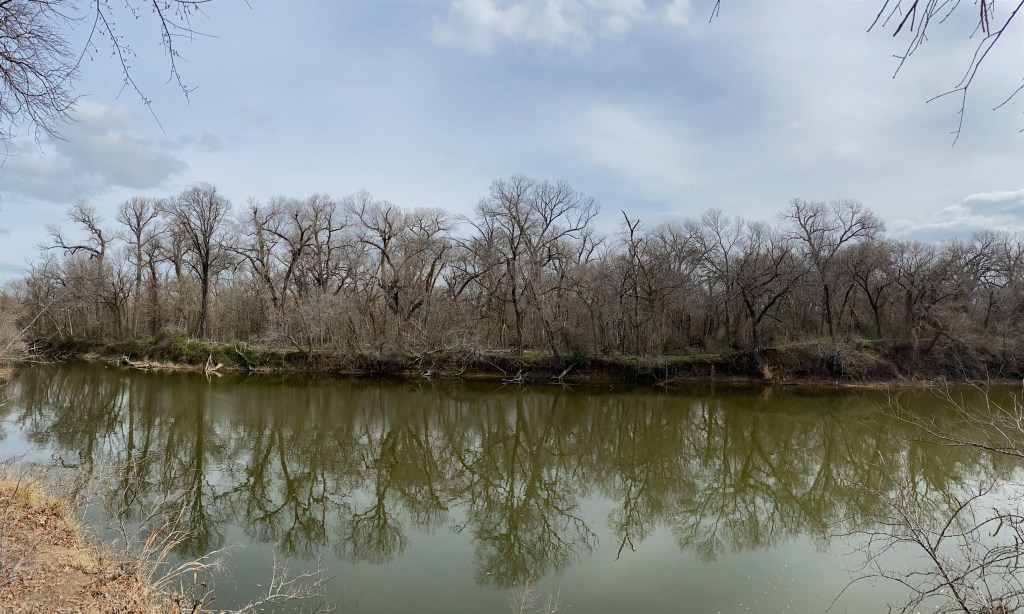
Sitting beside the Trinity River, on the Crosstimbers Trail, I wrote, “The place is so big that it makes the voices of the occasional human visitors seem small.” On a warm Friday in February, there were quite a few people at the Fort Worth Nature Center and Refuge, making bigness an important quality if the trail was going to live up to the name “refuge.”
This is a big place, as nature centers go. Its 3,621 acres are loved by many, and that is partly because it is big enough for a little solitude. The Crosstimbers trail borders the river for the first half-mile or so, and that’s a popular walk for people who want to see the water and maybe hope to see a ‘gator. Once the trail bends back into the woods, there are fewer people, and once you get pretty far back on that loop trail, you might be on your own for a good while.
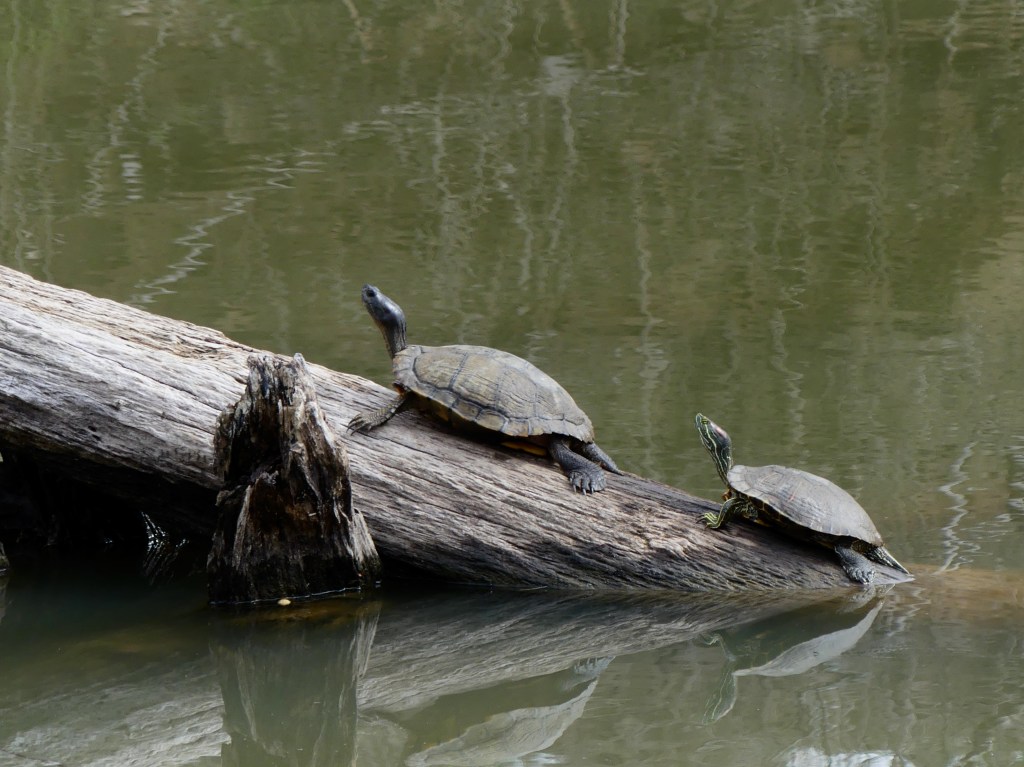
Two red-eared sliders – an old melanistic male and a younger one on the log below him
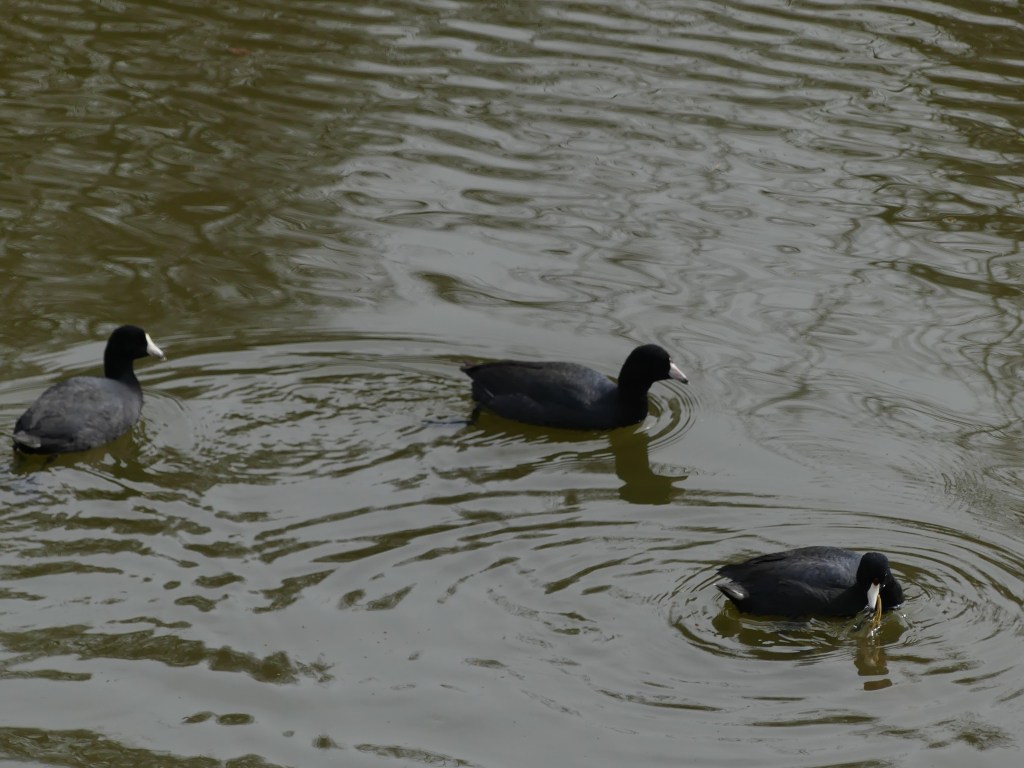
I got started at 10:40am on a day when thin clouds could not hide the sun and you could walk comfortably in a t-shirt. I watched a great blue heron fly over the nearby marsh and said hello to the cooters and sliders basking on fallen logs and branches in the water. There were plenty of American coots swimming nearby.
Three American coots swimming in the river
The bottomland forests beside the river were full of stately old trees – cottonwoods and other species – and they are often entwined with one or another climbing vine including poison ivy. One old cottonwood tree has huge vines braiding around its trunk.
Bare woody branches of shrubs frequently contained a spray of bright red berries where a kind of holly called possumhaw grows. And around me in the woods were the calls of many birds, including Carolina chickadee, tufted titmouse, and northern cardinal (identified by the Merlin bird ID app). My thermometer showed that it was 71.8F at 11:25am.
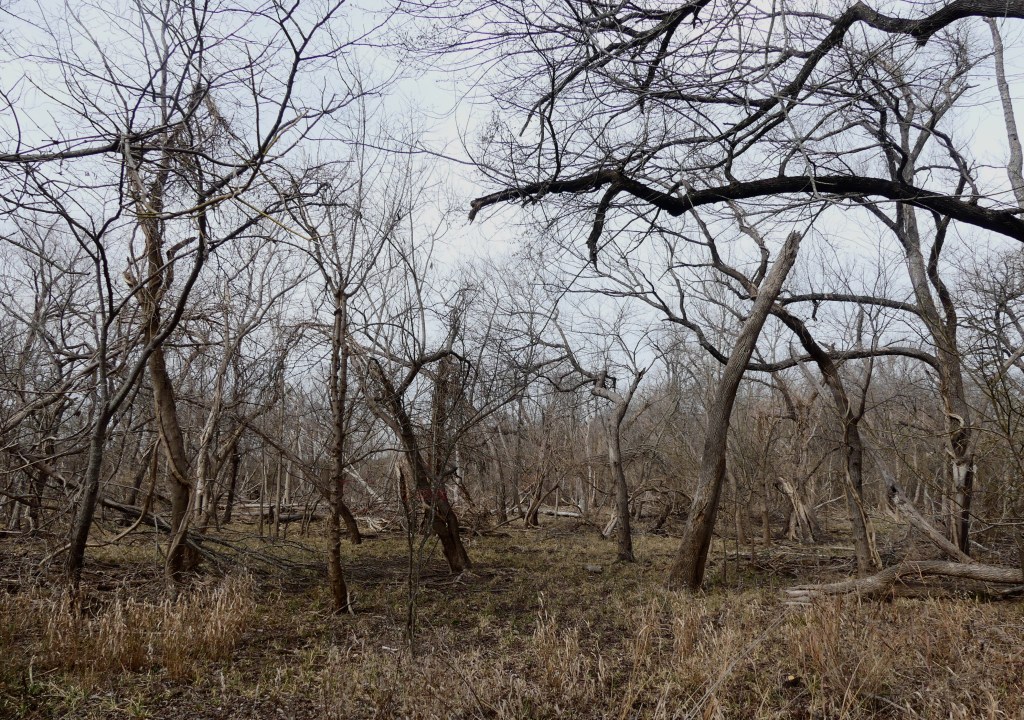
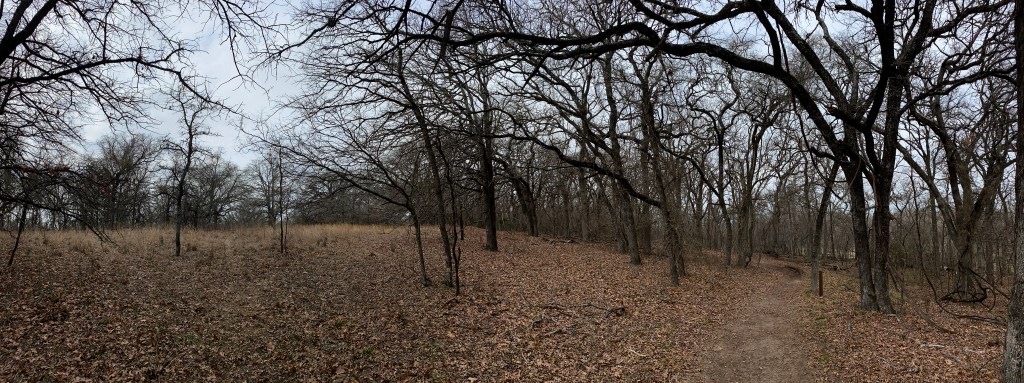
Then it was time to follow the trail back into the woods. There are plenty of oaks; big bur oaks with big notched leaves and the post oaks that are a signature species of the Cross Timbers region. There is ash, cedar elm, and some hackberry trees. Here and there the woodland opens up to a little glade or pocket prairie with native grasses. I took a few photos on the “pano” setting because today the place seemed so big that only a very wide photo might do it justice.
The trail leads through galleries of old trees and the land slopes away to the north toward a wetland. On the other side, the woodlands and open grassy patches gently climb toward a high place. On my walk, the winds seemed to shift around 11:35am and become cooler.
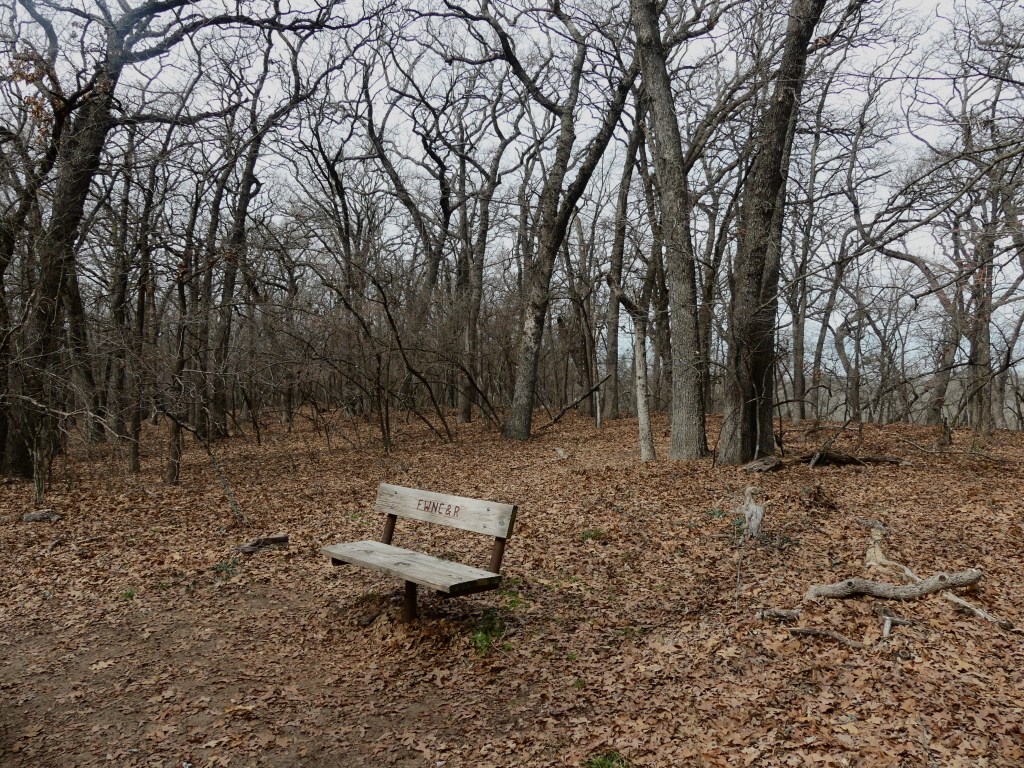
At what seems to be the highest point, there is a bench, perfect for sitting and taking in the wonderful forms of the trees, the carpet of dropped leaves, and the birds. Today it was very quiet and peaceful.
I started back, and as I walked the breeze scattered leaves ahead of me on the trail. That breeze was strengthening and making its voice heard through the tangle of trees. The branches shredded the current of air. Sometimes it was a whoosh and sometimes a soft roar, falling away to silence.
As I got further along, at one point I looked down the trail to see two deer looking back at me. They were silent and still as statues, sizing me up and deciding if I was a source of trouble. After a moment, the group took off, with those white tails flashing a warning to the rest of the group.
Two white-tailed deer froze on the trail as I came into view
When I reached the river and sat on a bench, there was the chatter of a belted kingfisher somewhere nearby (though I could not see it). Merlin also identified the call of a northern flicker. The thin clouds were pulling apart, and when the sun shone down it felt warm. The temperature had fallen a little to 67.6F, but in the little nook where I sat on my bench, the sunshine felt good.
The kingfisher clattered persistently. Another bird came in for a dramatic fast landing, wingbeats skimming the surface of the river. The bird then paddled around as if nothing had happened, sometimes diving down into the water. With the lens on my camera I got a good enough look to see that it was a pied-billed grebe.
Pied-billed grebe
The relatively thick bill with a dark ring around it was a giveaway. The Cornell website gave more information about what I observed about its diving: it was hunting. This bird likes crayfish and also eats small fish, dragonfly larvae, and it would not mind a leech or a small frog.
In that last hour I was grateful to have seen no one along the trail, and was happy to be by myself. I do like walking with others, but on some days like today, the solitude was peaceful. I am so thankful that Fort Worth has one of the biggest urban preserves in the country – and that it “feels” big.
I’ve just uploaded a “Letters to Nature Kids” issue. These are free, short pdf documents written for young people and anyone else who is still a little bit in touch with that kid they used to be. Most of them focus on some place or some species worth learning about, and some of them have a bit of a holiday theme. This one touches on Groundhog Day, National Send a Card to a Friend Day (obscure, but we should try it!), and of course Valentine’s Day and the various ways that love graces our relationships with friends, spouses, or even nature. I hope you’ll go have a look at it here.
Mild winter days are a gift, one that can make us uneasy and yet grateful for the soft warmth of sunshine in midwinter woods. The uneasiness comes when we recognize that the gift often comes from climate change. A recent Texas Monthly article reported that this past December was 4 to 5 degrees warmer than average, and that January of last year was the sixth warmest ever seen in Texas. In winter, our off-the-rails warming climate can feel good, but it is still brought to us by the worsening climate catastrophe.
Let’s get to the gratefulness part; while some days I try to wrap my head around climate issues and see what I can do, on other days I want to accept the wonder and joy that nature gives. On those days I’ll live in today, not next year or last year. Even as I sit under a blue sky, surrounded by the sheltering oaks, some part of me knows where the gift comes from, but that will not spoil the day. And so here are a couple of slightly edited entries from my journal, reflecting solitude and time in the woods at my favorite preserve.
On February 1st I made my way to the top of the hill under a sunny sky with no clouds. The local weather service said that it was 73F. I was on a little-used trail and the traffic noise was in the background. There was a sense of quiet because the noise seemed distant and subdued. I noticed a little chatter of crows. Nearby it was quiet and peaceful, warmed by the afternoon sun and surrounded by oaks reaching their bare branches up into the blue sky.
It was as if I had a distant memory of sleeping outside on such a day, in a peaceful place with all noise far away. Being lulled to the edge of sleep with a warm sun and soft breeze, in the close company of trees. Or perhaps it just seemed like a perfect place to drift away.
And then a strong breeze blew through, dislodging a remaining leaf or two. “Rock-a-bye baby, in the tree-tops…” Will the bough break? The cradle fall? What a strange lullaby.
A fungus in delicate and beautiful concentric rings
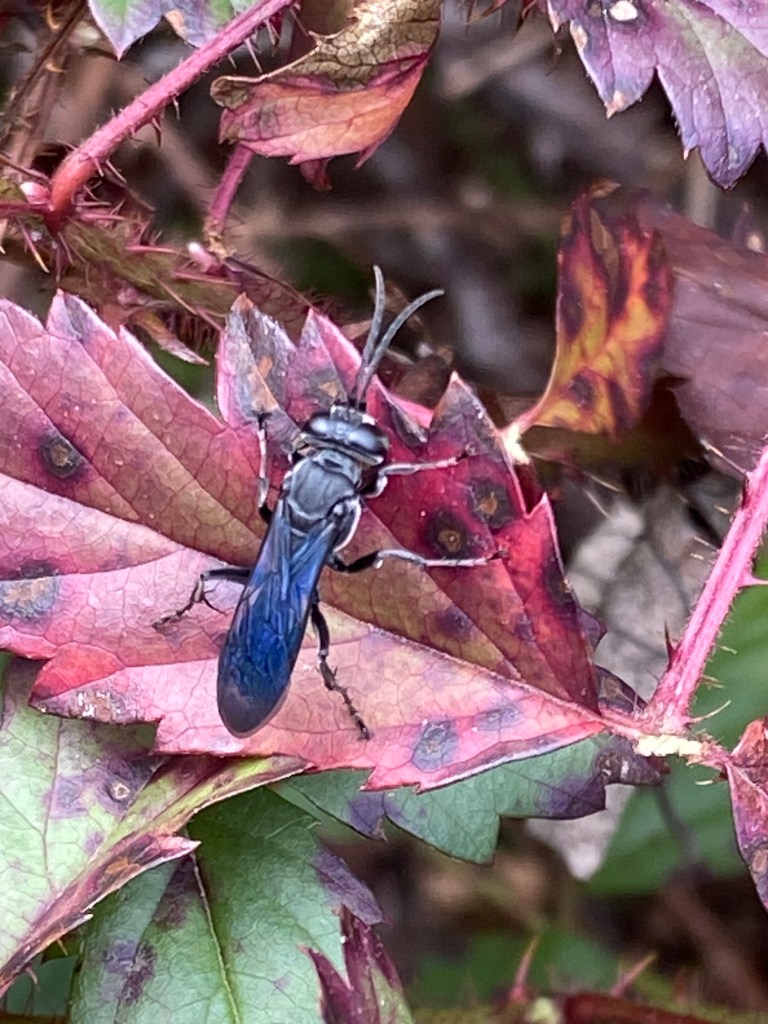
On February 4th it was partly cloudy and a little less warm (61F, reportedly) but at the start of the walk it was mostly sunny. The clouds that moved through were low, thick and heavy, slipping eastward and sometimes hiding the sun. After making my way up to the boulders, I wandered down the trail past lots of small sulphur butterflies and found a small wasp in a tangle of dewberries. Nearby, a Carolina chickadee called from low branches. Blue jays fussed somewhere as the breeze came and went, blowing a few loose leaves.
A small wasp that survived the recent freeze
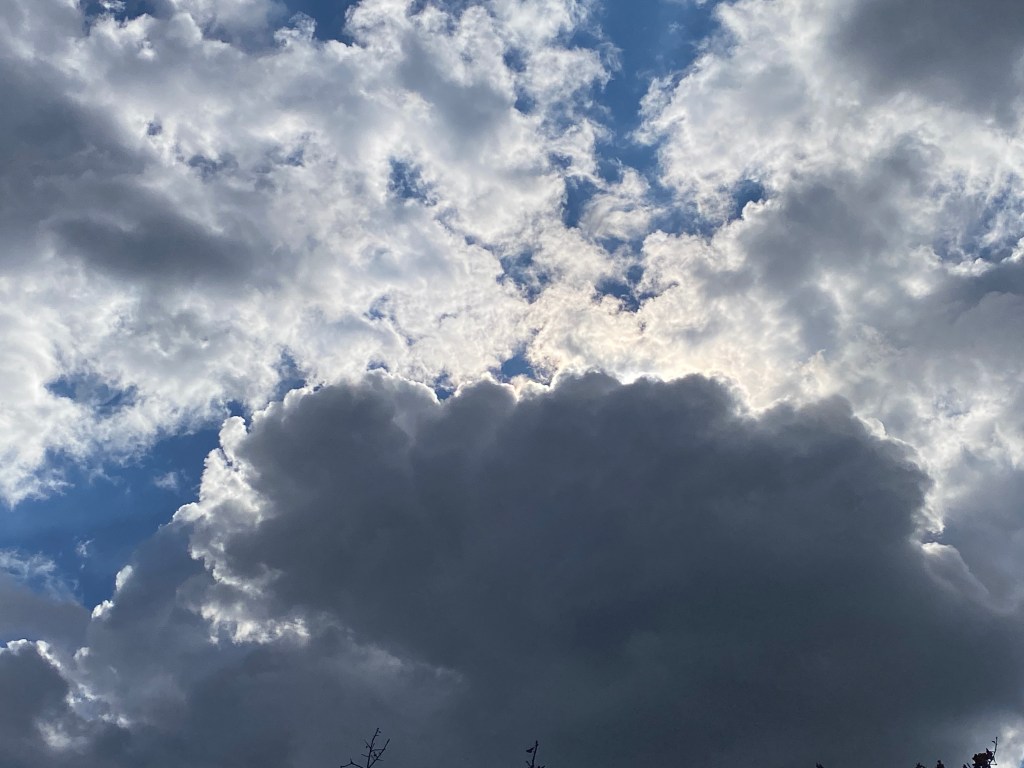
I came back to the sandstone bluff, and the movement of clouds was putting on a delightful show. Using my shoes as a pillow I lay on the rocks and watched those clouds. Sometimes the thicker gray clouds obscured the sun, and I was glad for my jacket, and then the sun re-emerged with wonderful radiant heat.
Looking up at clouds
There were low clouds still sliding to the east, sometimes wispy and light, and other times wet and gray. High above those, a layer of clouds slowly crept in from the north. Some of those were thin and feathered in intricate bands, but others were ropy and white. The edges of the low, gray clouds were rimmed in bright white from sunlight and almost too bright to look at. As always, the slow graceful movement of clouds was mesmerizing.
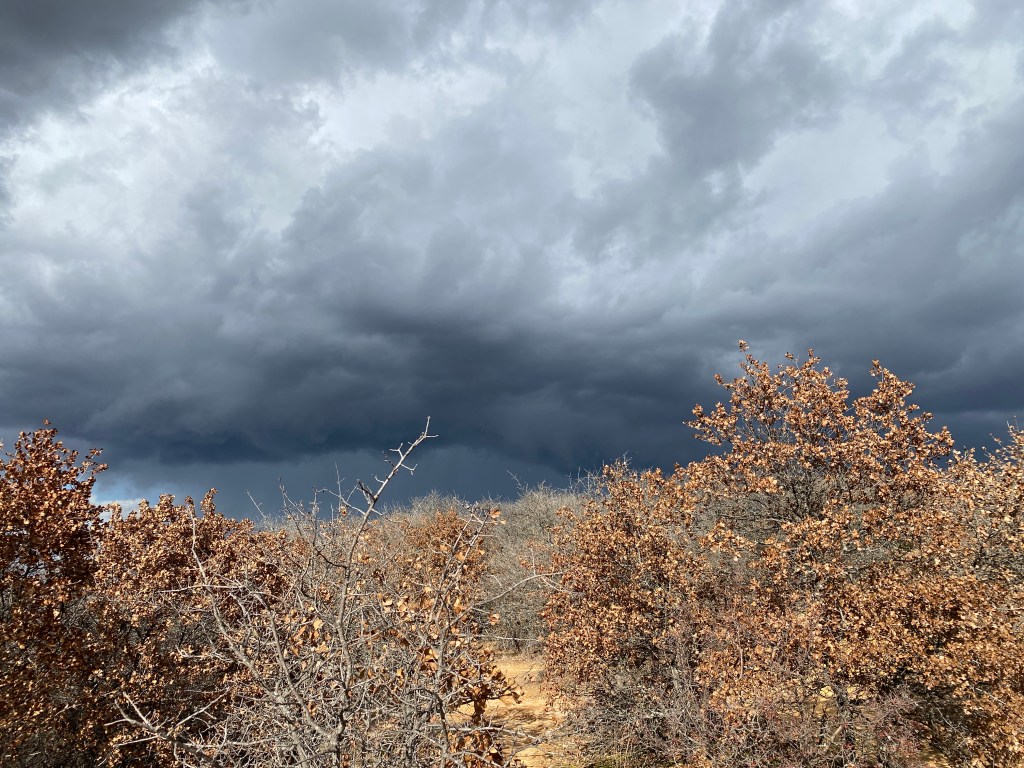
Darker clouds were massing nearby, and I started my walk down the hillside. Somewhere along the way I heard thunder, and rain began to fall as I reached the car.
Rain clouds visible from the bluff
I hope you are able to get outside sometimes on days like this. I’d love to hear in the comments whether you feel the same as I do about these warmer winter days, or if you prefer days when winter has a little bite and maybe brings some snow.
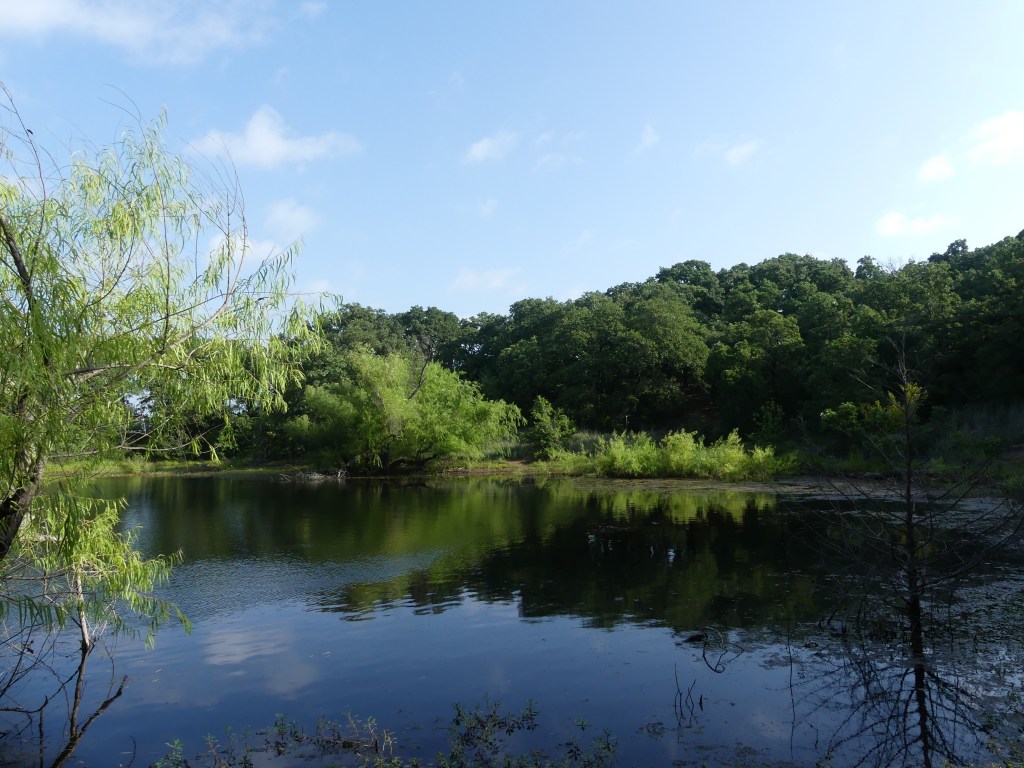
A pond at Sheri Capehart Nature Preserve, Arlington, TX
In recent years, many articles have appeared with titles saying that we are “loving nature to death.” Most of the ones I have read pertain to national parks and wilderness, but the issue applies equally to small preserves and urban parks. During the first year or so of the Covid pandemic, people lost jobs or worked from home and had extra time on their hands with fewer things to do because we were trying to practice social distancing. Many discovered – or rediscovered – getting outside.
For those of us who recognize the benefits of time spent in nature and hope for a reconnection between people and nature, more people outside is good news. But the amount of public space available for wildlife refuges, preserves, and nature parks did not increase. Neither did the budgets for taking care of such places. As a result, public natural areas have to contend with more traffic and the accompanying litter and the impact of our camping spaces, fires, new “rogue” trails, and other wear and tear.
There’s a little preserve in Arlington where I volunteer. (And my comments here are my own and do not necessarily reflect the thoughts of the group that I am affiliated with.) I spend a lot of time there because it is near my house. I have walked its trails, sat watching and listening, and become very familiar with its ponds, woods, and meadows. It is a resilient place, but these days it is contending with lots of traffic. That results in rogue trails, soil compaction and erosion wherever people walk off-trail, litter, issues with dogs and horses, dirt bikes and mountain bikes (which are not allowed), discarded or lost fishing tackle, and the occasional improvised shelter although no camping is allowed.
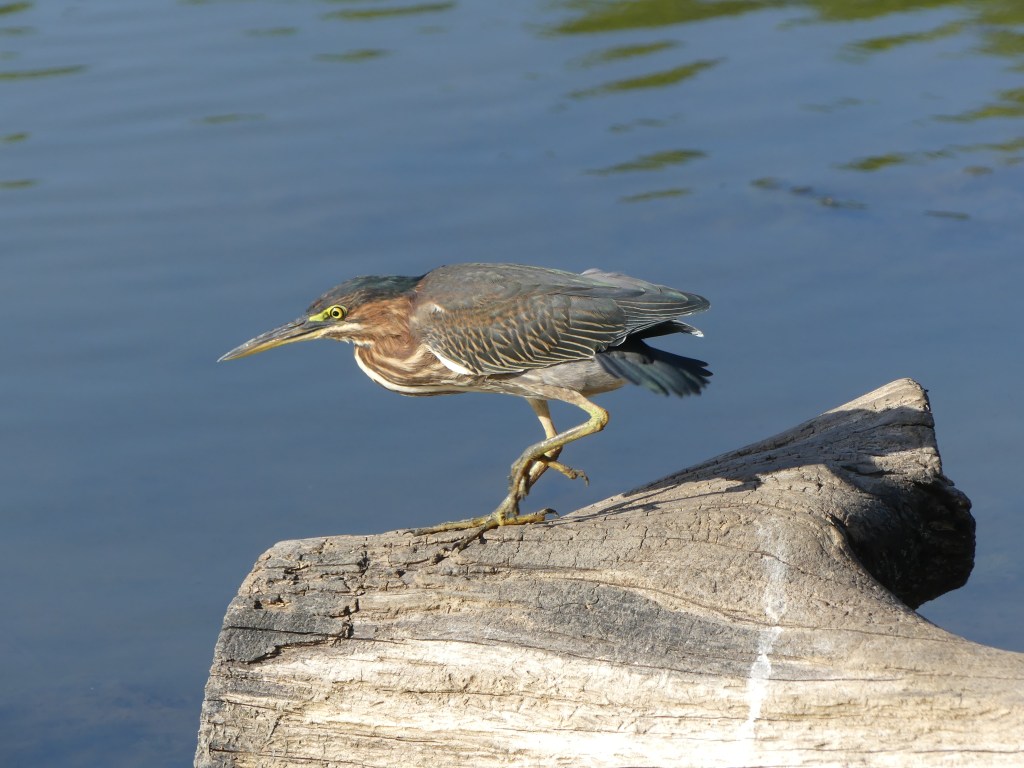
Green heron seen at Sheri Capehart Nature Preserve
Urban nature preserves and urban parks share some similarities, but they are also fundamentally different. The preserve is land set aside and protected in a nearly natural state, so that people can see how the surrounding land once was and can enjoy some of the communities of flowers, trees, and wildlife that are part of our heritage. You can see it as a living museum of natural history, letting us experience the place like it once was, at least to a degree. At the same time, you can see it as our wild neighbors, the plants and animals that are our companions who deserve a chance to live alongside us at least somewhere.
Urban parks, lovely as they may be, are usually modified for human use so that little of the original nature remains. There may be lawns, sidewalks and soccer fields, jungle gyms and ponds with domestic ducks. We need such parks, but they are not nature preserves. We might be urged not to leave litter, but hardly anyone feels the need to say, “leave no trace” of our visit there.
By contrast, many of us would urge each other to leave no trace when we visit wild places and nature preserves. There is an important movement that promotes this idea, and one organization, Leave No Trace, promotes seven principles that will help us. “Leave no trace” is a plea for us to visit nature in the spirit of cooperatively and respectfully sharing a space where many of our wild neighbors live and where other humans will visit. Yes, it is there for our enjoyment and learning, but it is not ours alone, and its purpose is not really entertainment.
The first Leave No Trace principle is to Plan Ahead and Prepare. In a small urban preserve that might mean taking the time to review the preserve’s rules, seeing when it opens and closes, and getting a copy of a trail map. Many preserves allow your dog to come if they are on a leash. Almost all prohibit motorized vehicles.
Another principle is to Travel (and camp, if allowed) on Durable Surfaces. In small preserves this translates to “stay on the trail.” Wandering off-trail means trampling plants, compacting soil, and creating conditions where rainfall will erode the soil away. When a place gets trampled, others assume it is a trail, and soon there is a “rogue” trail. When a small preserve gets criss-crossed by lots of such trails, serious damage is done. From wildlife’s perspective, there is no safe place away from people. The habitat that these animals use is of much lower quality, and when rain comes, there will be much more erosion.
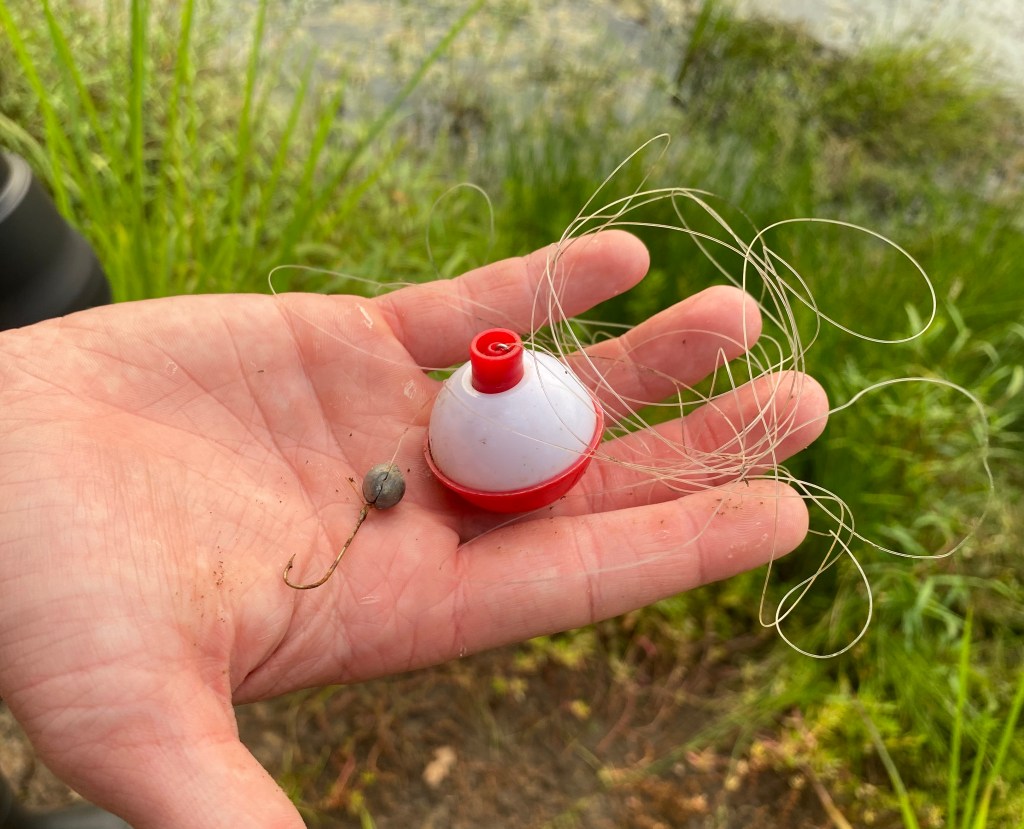
Next is Dispose of Waste Properly, and simply put, it means everything you pack in should be packed out. It’s easy to bring a small bag in your backpack or even your back pocket so that you don’t leave litter. Snack wrappers, water bottles, fishing gear, even Kleenex should be bagged and taken with you. I know that when fishing line snags and breaks, it can be difficult to retrieve it. However, hooks, lines, and lead sinkers are responsible for many wildlife injuries , and hooks can cause human injuries. And here’s another difficult but important thing: use the bags provided to pick up your dog’s waste. If it is left in the preserve, not only is it unpleasant, it is potentially a source of new parasites for wildlife. (The waste from the resident wildlife contains stuff that’s already found in the preserve, things the residents are already adapted to.)
Trash near a pond’s edgeFishing tackle abandoned at the pond
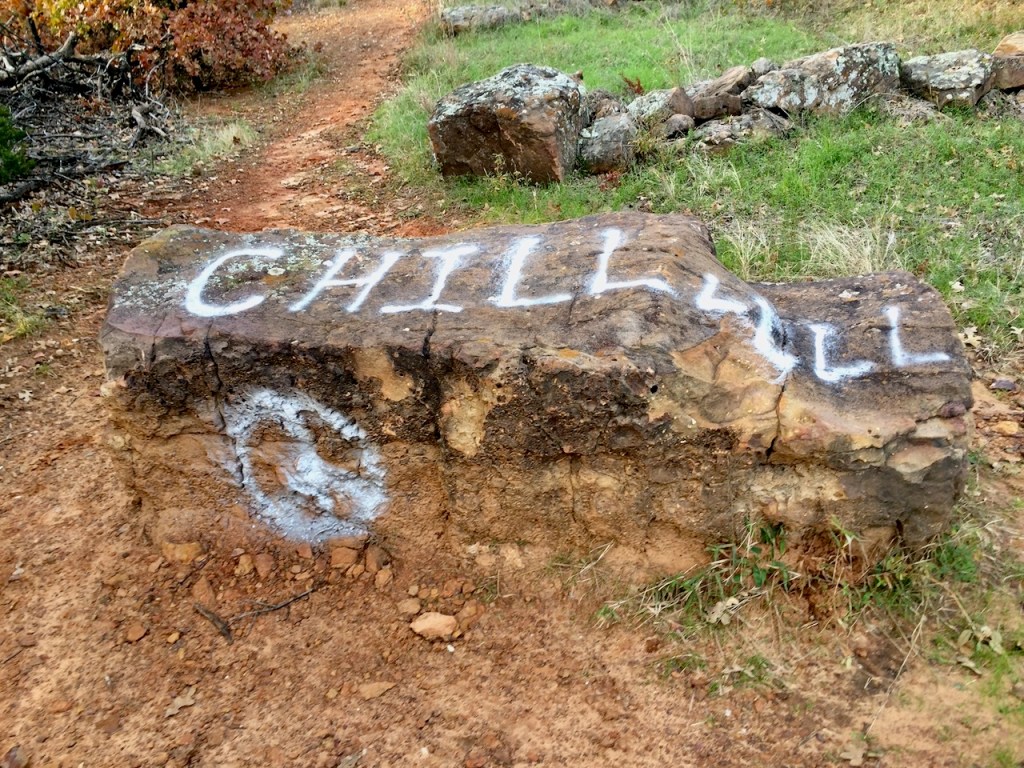
The Leave What You Find principle means leaving the living things how you found them, and don’t introduce non-native species. It also means not collecting artifacts like arrowheads and not “tagging” or carving initials into rocks and trees. We all have a tendency to think, “It’s just this one little thing, it won’t hurt anything.” But if you dig up a few plants, you won’t be the only one, and the losses add up. It’s the same with animals. That lizard might look cute, but don’t catch it! And please do not add things that did not come from the preserve. We’ve seen raccoons relocated and dumped at our preserve, and once at one of our national grasslands I found someone had released goldfish into a pond. They probably thought they were doing the fish a favor. When we add things or take things away from a natural community, the negative consequences might not be easy to foresee.
A boulder with graffiti at the preserve
Minimize Campfire Impacts, in small urban preserves, really means “don’t,” because making a fire is almost certainly prohibited. There is the risk of a fire spreading and also the gathering of firewood and tinder removes homes and hiding places for small wildlife.
The next principle is to Respect Wildlife. Every time we see a photo of someone taking a selfie with a bison, we are reminded of how much people misunderstand wildlife. In general, if we are far enough away they may ignore us but if we get too close they may respond in self-defense and we (or they) may be hurt. Or our getting too close may disturb nesting, courtship, hunting, or other important activity. We should not only be aware of how we may affect wildlife, but also how our pets may do so. One reason our dogs should remain on-leash is to keep them from running ahead and investigating the nooks and crannies that small wildlife shelter in.
“Admire me from a distance and please don’t take me home”
Finally there is Be Considerate of Others. People have different ways of enjoying a small preserve, and we can try to see to it that everyone has a good experience. Some of this involves little courtesies such as stepping a little off the trail to let people pass and minimizing noises (ear buds will let you listen to music without others having to do so). If dogs are allowed in small preserves, it is crucial to keep them on-leash and do not let them threaten other dogs or people.
When you think about it, all this follows pretty naturally when we visit a small preserve with respect for what it represents and gratitude for what it provides us. I hope if you visit one of our small, urban preserves, you will keep these principles in mind. That way, those living museums of natural history can continue to thrive.
New Year’s Eve, 2022, at LBJ National Grasslands(Michael, Jo, Meghan & Carly)
Sometimes people come into your life and, if you are really lucky, they become permanently and inextricably part of who you are. For Jo and me, over the last five years or so Meghan and Carly have become family.
Meghan and I met in July of 2019 at what was then Southwest Nature Preserve in Arlington. Meghan brought her love and knowledge of spiders and other invertebrates, along with a desire to learn more about herps. I brought my residual bit of arachnophobia and all those years of experience with reptiles and amphibians. For both of us, nature was deeply ingrained.
Before the end of the year, we decided to do a book together, with me as author and her as photographer. It would be one that would combine a mindfulness-based way of being in nature with descriptions of the natural history of places across the state. Let me quote from the Acknowledgements in the book:
Without Meghan Cassidy’s energy and enthusiasm in the field, her friendship and encouragement, and especially her skill at seeing the potential for a really good photograph and capturing it in the field, this book wouldn’t have happened. At some later date, when we sat at a computer deciding which photos really worked, she was right every time. Meghan was the ideal companion for adventures such as the late-night police chase in the East Texas forests that nearly ran us off the road, or the sudden storm that battered the cabin on the hillside in the Trans-Pecos.
Mindfulness in Texas Nature (expected later this year)
Meghan, taking photos for the book at Sea Rim State Park
I remember when Meghan first told me about Carly and how wonderful she was. As in most things, Meghan was right. Carly’s knowledge of birds and ecology is matched by a quiet wisdom and insight (see my comments about our 2021 trip, “Grief and Hope on the Rolling Plains“). And, like Meghan, she is just a deeply good person.
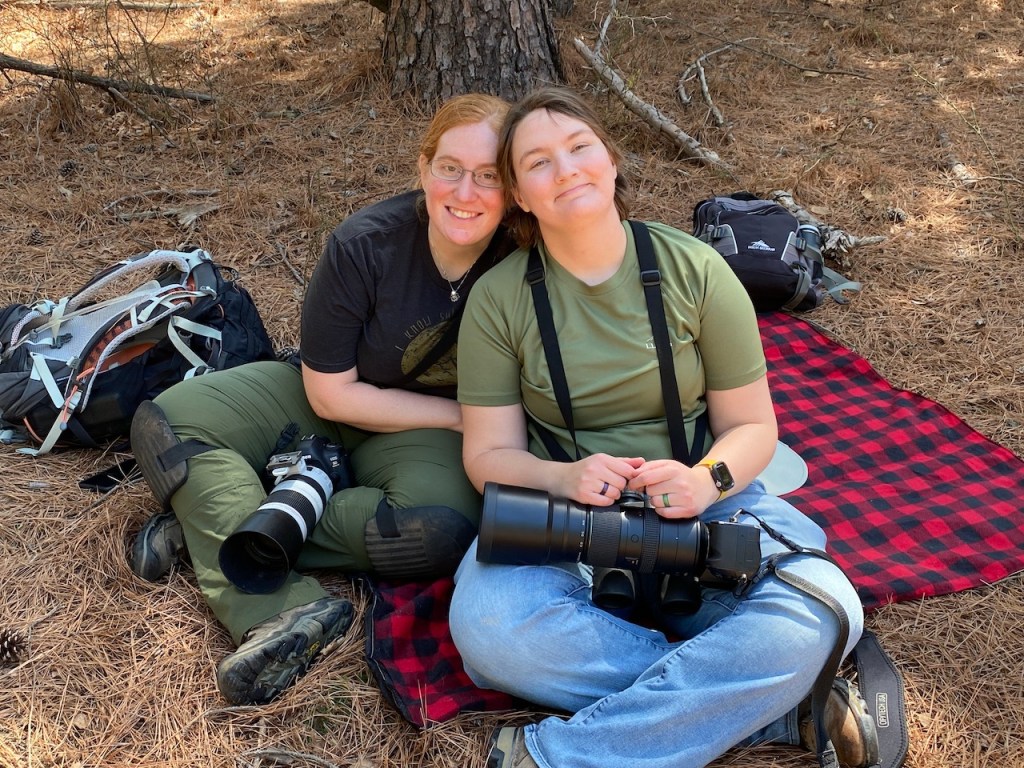
Meghan and Carly at LBJ National Grasslands
Meanwhile the travels for the book continued, with time for mindful walking and sitting as well as finding and photographing many examples of Texas wildlife and wild places. On other occasions I visited prairies with Meghan and Carly and we hung out at our beloved LBJ National Grasslands.
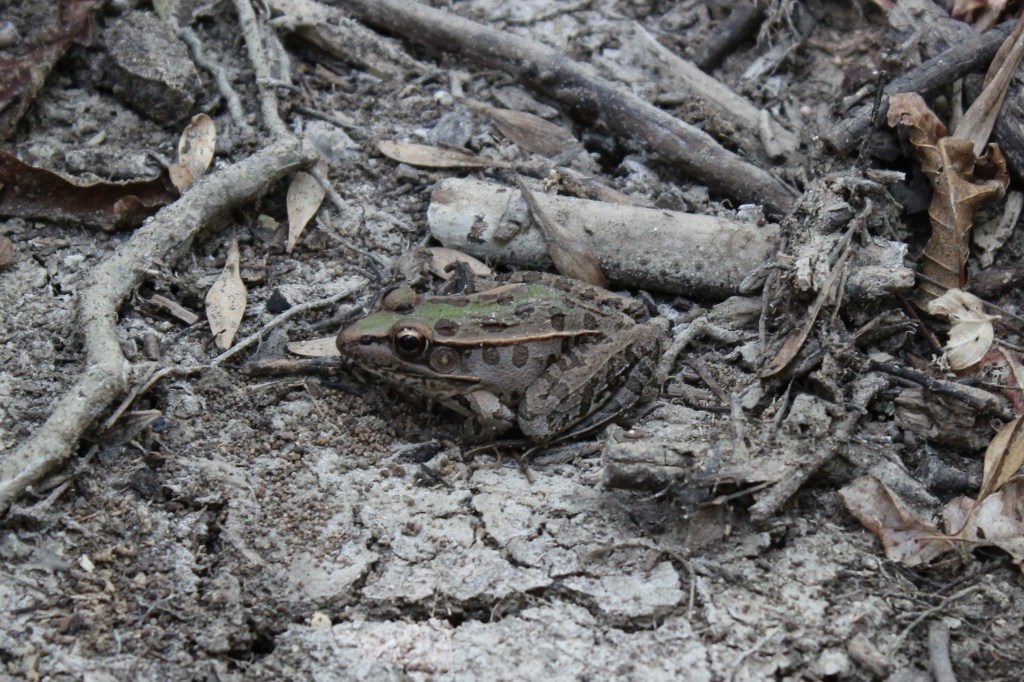
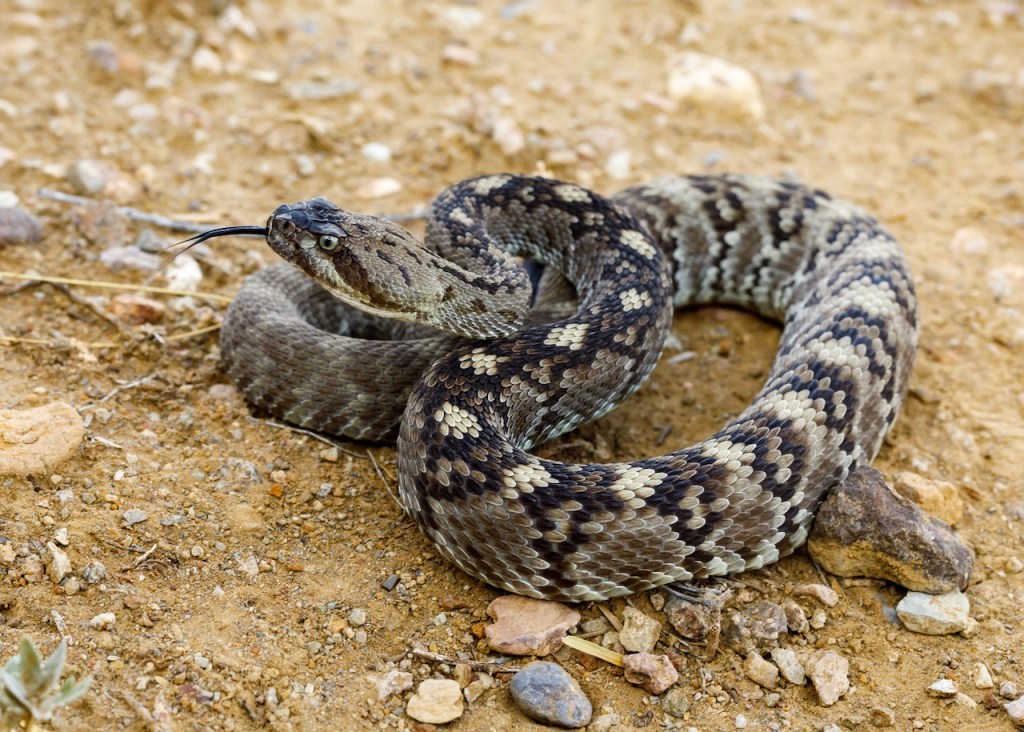
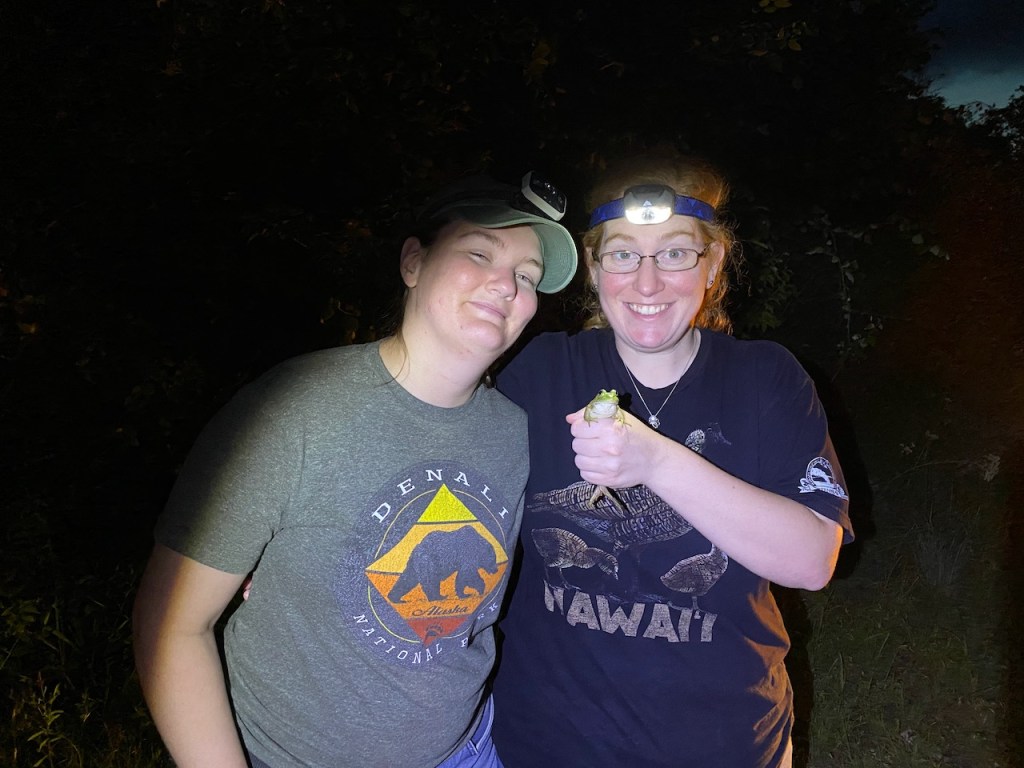
Black-tailed rattlesnake in the Trans-PecosWhile photographing green tree frogsNight herping at LBJ GrasslandsOn a prairie visitA Great Plains ratsnake at LBJ Grasslands
Jo may not have been in the field so much of the time, but she joined us when she could, and dinners and games at each of our homes have been wonderful for the four of us. We’ve been through hard things together, too, and we’ll always be there for each other.
JoMeghan with our granddaughter Lilly
And circumstances change, though our closeness with each other will not. A job change means that Meghan and Carly are moving to Minnesota, leaving in the next couple of days. Two in Texas and two practically in Canada, the four of us will be making frequent use of FaceTime and similar technologies to stay virtually together.
It will be a long drive, so stay safe. I keep being reminded of “The Four of Us,” John Sebastian’s wonderful extended song about two couples who “drew a smile across the states” and took a road trip across the U.S. In this case one beloved couple.
So here’s a little travelling song Of talk that comes from dusk till dawn So go and see and pass it on Lest you miss it, lest it’s gone Every lover keep your driver on the road and laughing


























 Our Lives in Nature