(I wrote the following as I was working on a book on mindfulness in nature that is now in the editorial process at Texas A&M University Press. I wound up not using it, but I do think it has some useful things to say.)
Before there was agriculture there was hunting and fishing, and there are still communities whose food primarily comes from the fish they can catch and animals they hunt. For many other people, hunting and fishing are not necessary for subsistence but are activities that provide a break from everyday life and an opportunity to spend time in nature. While the number of sport hunters may be falling, in Texas there were 1.25 million hunting licenses issued in 2017,1 and ranchers still make money off deer leases. Fishing and hunting can reflect a very wide range of motivations, attitudes, and relationships with the natural world. As a result, hunting in particular elicits a polarized range of views. A 2014 nationwide survey of U.S. residents found that 87% of respondents agreed with hunting as a way of obtaining food, but only 37% agreed that trophy hunting was acceptable.2
Catching fish and hunting game can be done sustainably and honorably, according to a set of informal guidelines drawn from Native American beliefs and practices. Robin Wall Kimmerer describes the Honorable Harvest as guidelines that are not written down but are simply acted upon in daily life. Her listing of the guidelines is as follows:
“Know the ways of the ones who take care of you, so that you may take care of them. Introduce yourself. Be accountable as the one who comes asking for life. Ask permission before taking. Abide by the answer. Never take the first. Never take the last. Take only what you need. Take only that which is given. Never take more than half. Leave some for others. Harvest in a way that minimizes harm. Use it respectfully. Never waste what you have taken. Share. Give thanks for what you have been given. Give a gift, in reciprocity for what you have taken. Sustain the ones who sustain you and the earth will last forever.”
Robin Wall Kimmerer, 2013, Braiding Sweetgrass, P. 183
Imagine if these ideas of the Honorable Harvest were printed within each year’s Outdoor Annual, published by Texas Parks & Wildlife Department, to promote a sustainable and respectful harvest in which each angler or hunter comes into the field as a member of a community, rather than as a stranger with neither kinship nor responsibility to that community.
Many already approach these activities with a strong emphasis on respect and sustainability, including many middle-aged and older hunters. An example is Brad Chambers, a friend who is a naturalist and a hunter who only shoots what he plans to eat. He told me about the intensity of his attention and focus when he is hunting, saying that at those times he notices much more than when he is just walking in the woods. While in a blind with his binoculars he’s watching all the wildlife, not just game species. Brad, who shares my interest in reptiles, remembered a time he was sitting very quietly on a log while hunting. A brightly-ringed coralsnake emerged from that very log and foraged for food while Brad no doubt sat in amazement and delight. Coralsnakes are secretive and shy, and an opportunity to watch one in this way is a rare treat.
Harry Greene is another hunter, also a retired professor and acclaimed author and researcher, who thoughtfully explores the implications of being a “born-again predator” in a chapter of his book, Tracks and Shadows: Field Biology as Art (2013, University of California Press) He came to subsistence hunting during retirement after studying rattlesnakes and other predators during a long career in the field. Spending hours in a blind near a pond in central Texas, carefully waiting for an opportunity for a shot that will kill a deer quickly and with minimal suffering, he thought of the ambush predators he has studied. “Can I be as effective as the natural-born killers who have long held my interest, let alone carry out the task with equal grace?” (Pp.106-107). To be an omnivore – to eat meat at least sometimes – involves either subsidizing an industrial meat production that Greene finds repulsive or else taking on the role of predator.
Now we have a younger generation of hunters who may not have grown up in hunting families and might at first have had no interest in hunting. Like Harry Greene, many of them are deeply concerned about industrial meat production, with its antibiotics, crowding of livestock, pollution of nearby land and water, and the energy required to transport animals for processing and then shipping of products.3 For them, it is more environmentally friendly and healthier to eat what they hunt. And these hunters, like some in the older generation, are likely to have a close connection to the land, appreciating and caring for the whole community of plants and animals, not just the game that they hope to bring home. Perhaps they will be among those who carry on the tradition of the Honorable Harvest.
This is a day for shelter from the storm, and also for speaking up in resistance to that storm. Shelter so that the storm does not blow us away, and resistance so that one day the storm ends. We need the shelter of other people, and many of us find shelter in the quiet places of nature where we can let go of troubles and for a time simply be present to water and earth and sky.
Today the Russians escalated their invasion of Ukraine. The murderous gangster Putin, the “genius” as Donald Trump sees him, used lies and tanks to roll into an independent country to, in his terrible fantasy, take it back to revisit the glory of the good old Soviet days.
Yesterday the Texas Attorney General (who is under indictment for fraud and the subject of multiple ethics complaints) put out an opinion that gender-affirming medical care for teenagers is child abuse. The Governor promptly directed child protective services to look into such issues, potentially subjecting Texas kids, their families, and their doctors to investigation and criminal liability. The hard right keeps Texas’ culture wars going with appeals to ignorance, bullying and discrimination. Their ads are vomited out of our televisions nightly: “stop giving our money to illegals,” promotion of book bans, the destruction of public education, and denying that any harm ever came to a Black person, ever in the history of our country.
The storm is threatening and we need shelter, and we also must resist. We resist through our commitment to fellow humans even outside of our tribe, our determination to see that we are all cared for, and our insistence that we should all have a voice in how we live. We resist when we see compassion and empathy as strengths, not weaknesses. We resist by questioning why so many scorn “the common good.”
Shelter is necessary so that we are not burned up in constant resistance. We need a way to step outside the storm, in other words to spend some time (even a short time) in a nurturing and calm reality. This essentially requires on our part the mental ability to quiet our minds and for a time not live in an imagined “elsewhere” full of harm and conflict. If we can be fully present where we are, there is our shelter. Maybe we are in the comforting presence of another person. We might be listening to one of Beethoven’s late quartets (or the Rolling Stones!), or sitting outside, looking at the stars. We also could be walking through a woodland, with the sun filtered through tree branches and birds calling nearby. We could be in any of those places, but unless we can quiet our mind and step away from thoughts of the past or future, we will not really be sheltered from the storm.
Now more than ever we can see how nature is always there for us. When it seems that everything else is in chaos, usually that tree is still there, that prairie still the same comforting place it was last time. My wish for all of us is to have the shelter we need, and also the energy and courage to resist.
On a bright February afternoon, Tandy Hills Natural Area was a great place to walk through the prairie. A couple of hours of mindful awareness of limestone ridges, junipers, crows and compass plants was just what I needed. I put my phone away and, when my mind strayed, I brought it back to this moment with these grasses and these junipers. The afternoon here was valuable; it deserved my full attention.
Really, any afternoon (and morning, too) deserves our full attention. That is one of the messages of the practice of mindfulness, a discipline that can help us go through our days awake to what is happening around us and within us. In contrast, if I walked through the prairie while looking at my phone or thinking about something coming up tomorrow, I would be on a sort of autopilot and would hardly notice what happened on my walk.
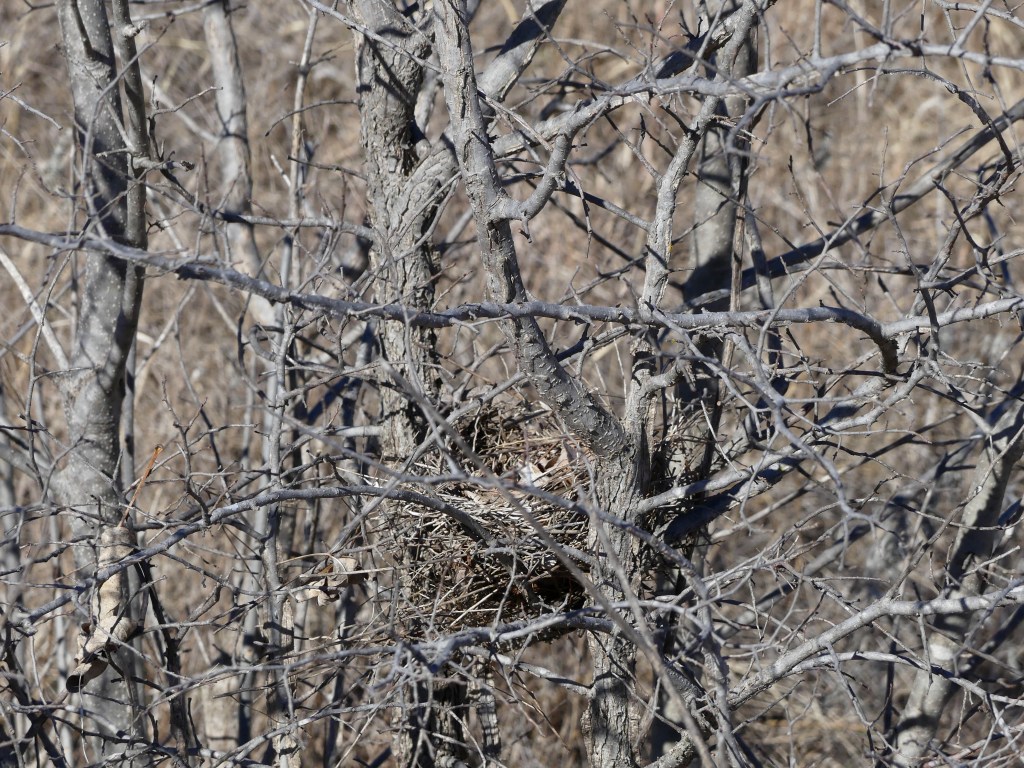
There was a lot to notice in the more than 200 acres of prairie and savannah in east Fort Worth. Wandering along the trail, I noticed a small bird nest in a young tree, only a couple of feet off the ground. Last year, a little bird chose this tangle of branches as the safest spot for her family. I thought of the amazing ability of that avian brain and nimble wings to coordinate a landing within those branches. Routinely coming and going from the nest would have required an Olympian athletic ability.
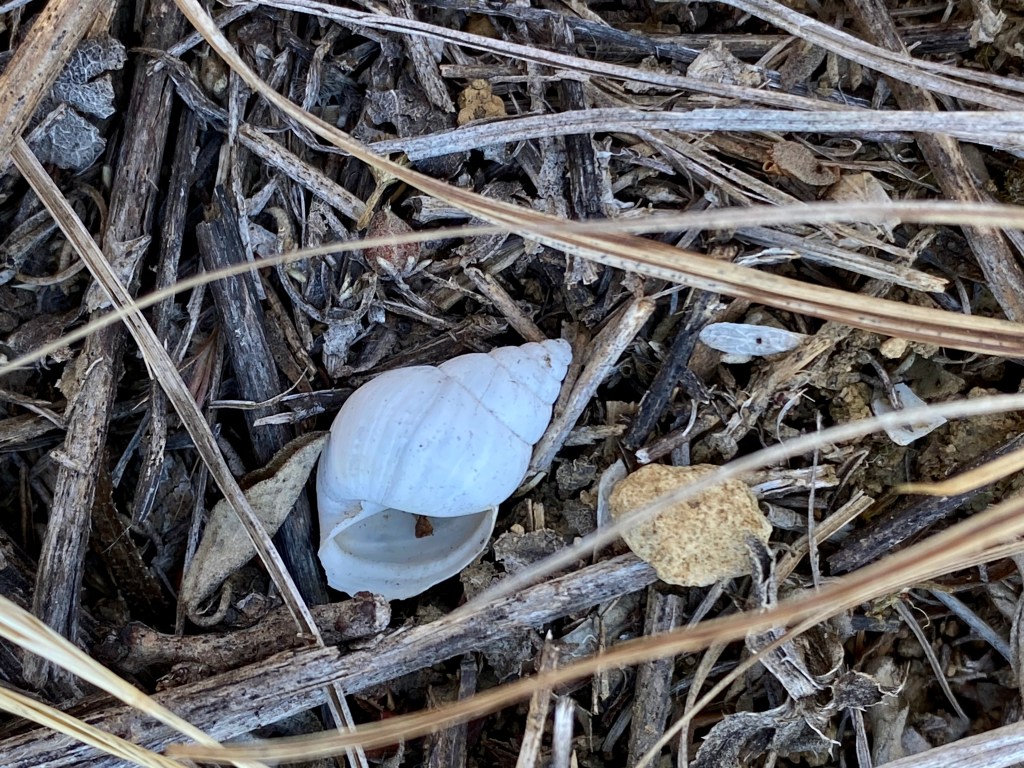
The shell of a Rabdotus snail
Sometimes my pace resembles what Suzanne Tuttle calls “walking at the speed of botany.” Being unhurried and shifting between the wide view of the landscape and the narrow view of small patches of ground, you find wonders hidden in plain view. For example, there were the small gleaming white shells tucked away in the thatch of last year’s grass. The land snail called Rabdotus generates a beautiful spiral shell, growing bigger as the curve expands below its conical tip.
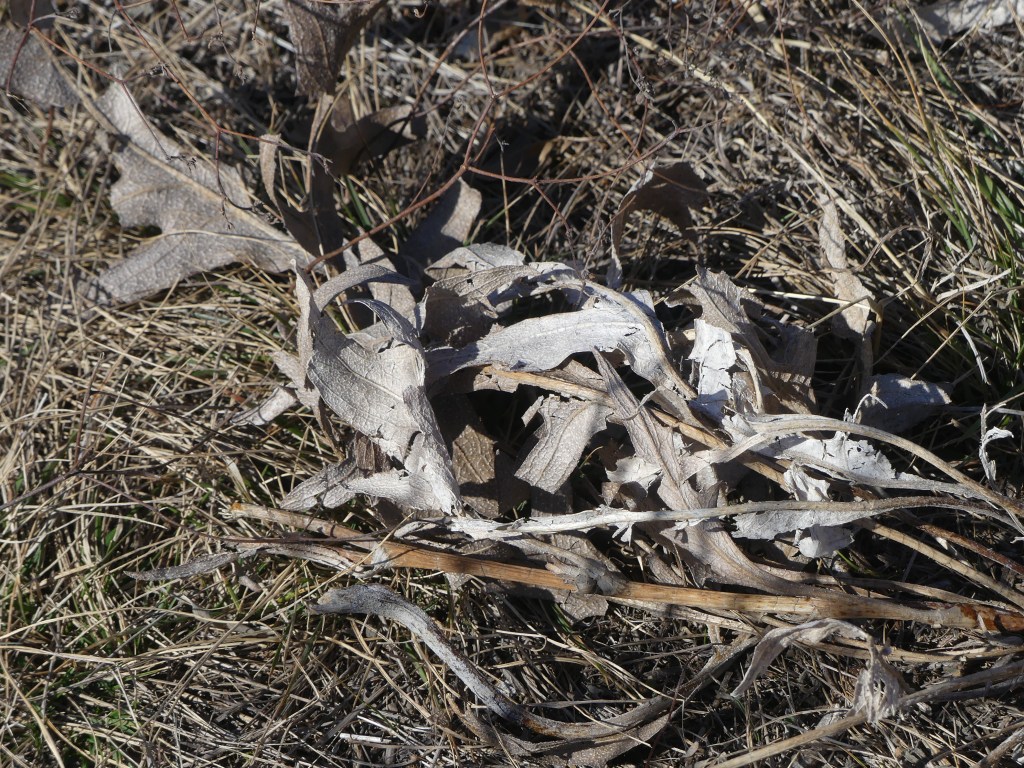
There are some spots within open patches of prairie where the sun exposure, drainage, and surrounding community of species is just right for the compass plant. Its name reflects the tendency for the leaves to grow facing north and south. Not that the plant cares much for cartography, but when the leaves grow in this way, they do not absorb so much of the sun’s heat in summer. And what leaves! Compass plant leaves are big and deeply cut into lobes, and the leaf is very stiff and sandpapery. Even in winter when the plant is dormant, the dead leaves persist on the ground as pale ghosts of their summer selves. They are brittle but still stiff and gritty.
One of last year’s compass plants
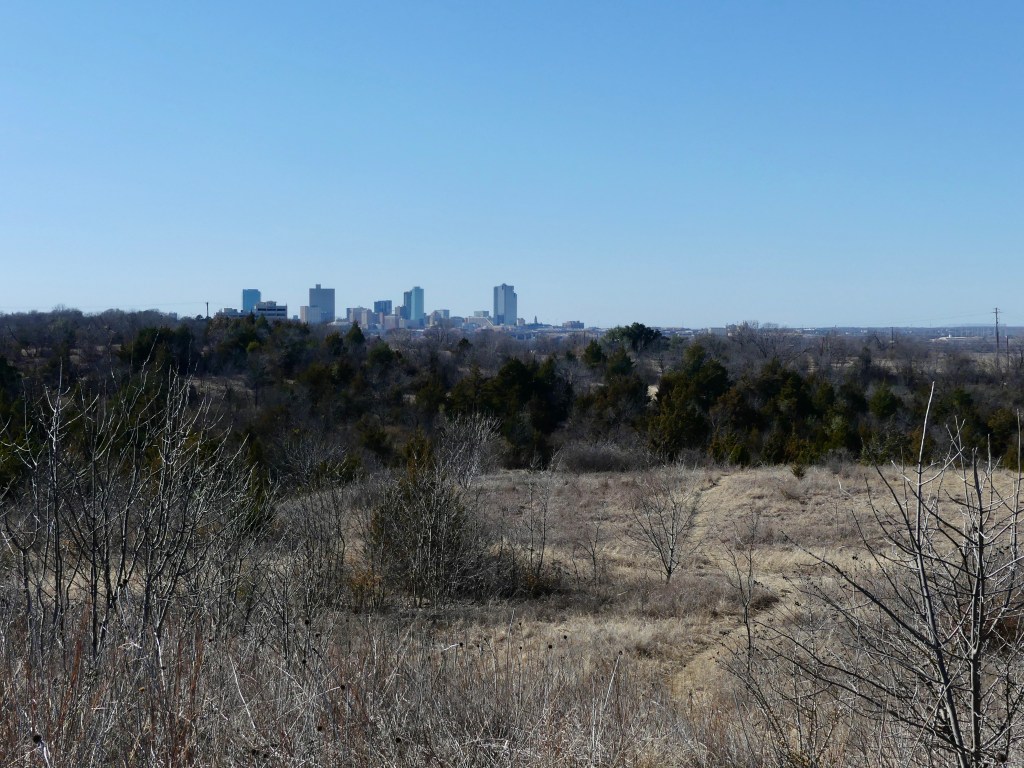
I walked the trails down to the boundary of the place, just south of I-30. At that point, the traffic noise is pretty distracting to me, and I am ready to head for quieter places. To the east is Broadcast Hill with more rolling prairie added to Tandy Hills in 2020, and beside it is a tall broadcast tower. Looking around, it is clear that this remnant prairie is an island of nature surrounded by the “built world” of freeways, technology, and houses. It is all the more a treasure because outside of its boundaries, all the grasslands, meadows full of flowers, and woodlands are gone.
Tandy Hills without the “built world’
The challenge for me is to fully accept all the wonders together with the freeways, the 1500-plus species of plants growing on beautiful limestone ridges along with the views of houses and streets. My camera is a snitch that blurts out my denial of the full reality of the place. I focus on some grasslands with a stand of juniper in the background and I shift the camera so that the broadcast tower is not in the view. I frame a photo so that the buildings beyond the preserve are not visible.
I will be better off when I can accept that Tandy Hills lives here, among the freeways and houses, a stubborn, wonderful survivor where children can learn about the beautiful spiral shells of land snails and the amazing leaves and beautiful white flowers of compass plants. Perhaps I will progress past the denial phase of my grief at the loss of so much that is wild and natural in Texas.
Beyond the boundaries
Mindfulness will help with this because it depends on an attitude of acceptance. To practice mindfulness is to work on being open to what we experience, non-judgmentally. That does not mean that I should not work to support conservation of what is left, or to encourage rules that keep off-road vehicles from tearing up the place. However, on a walk like this one, this afternoon, the full appreciation of the place needs me to accept the sound of trucks and the view of the city just past the nearby hills.
Butterflies appear to accept Tandy Hills just as it is. As I looked over a patch of dormant prairie grasses, a small yellow butterfly bounced across the field. This little sulphur had survived the recent temperatures in the teens and emerged with boundless energy, flying among the little bluestem and Indiangrass and disappearing over the ridge.
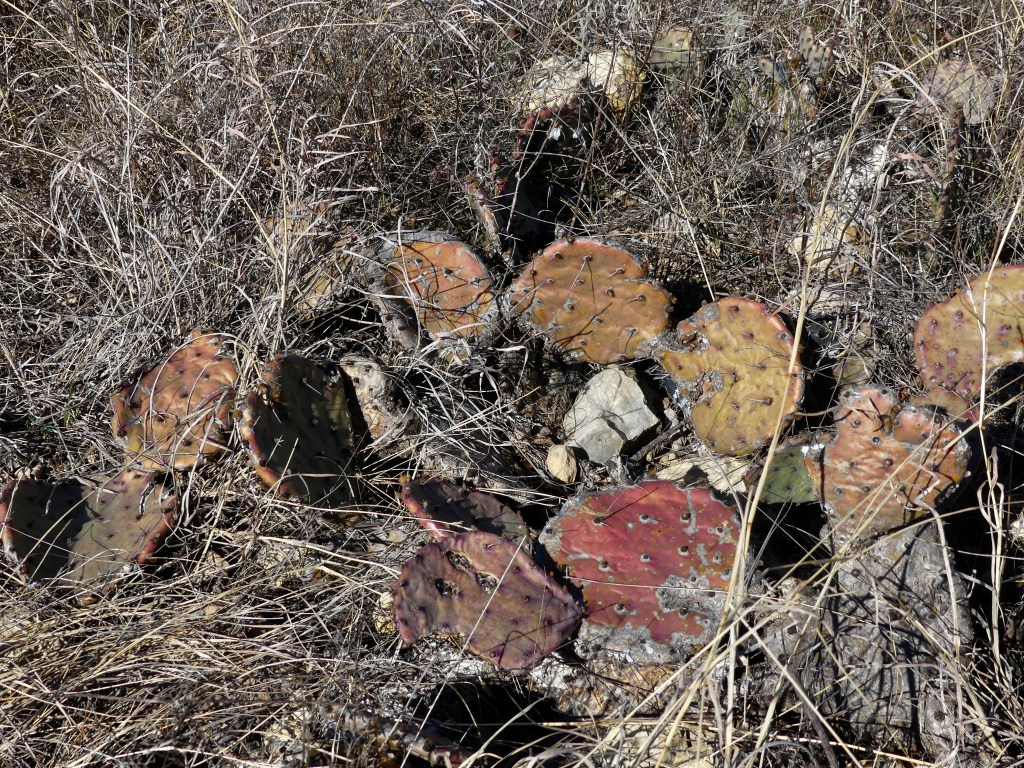
Prickly pear in an array of soft colors
Somewhere along the way was a clump of prickly pear cactus, its pads weakly standing up to the winter and the lack of rainfall. But those pads were the loveliest shades of terra cotta and pale green shading into gold. Walking at the speed of botany brings so many beautiful things into view.
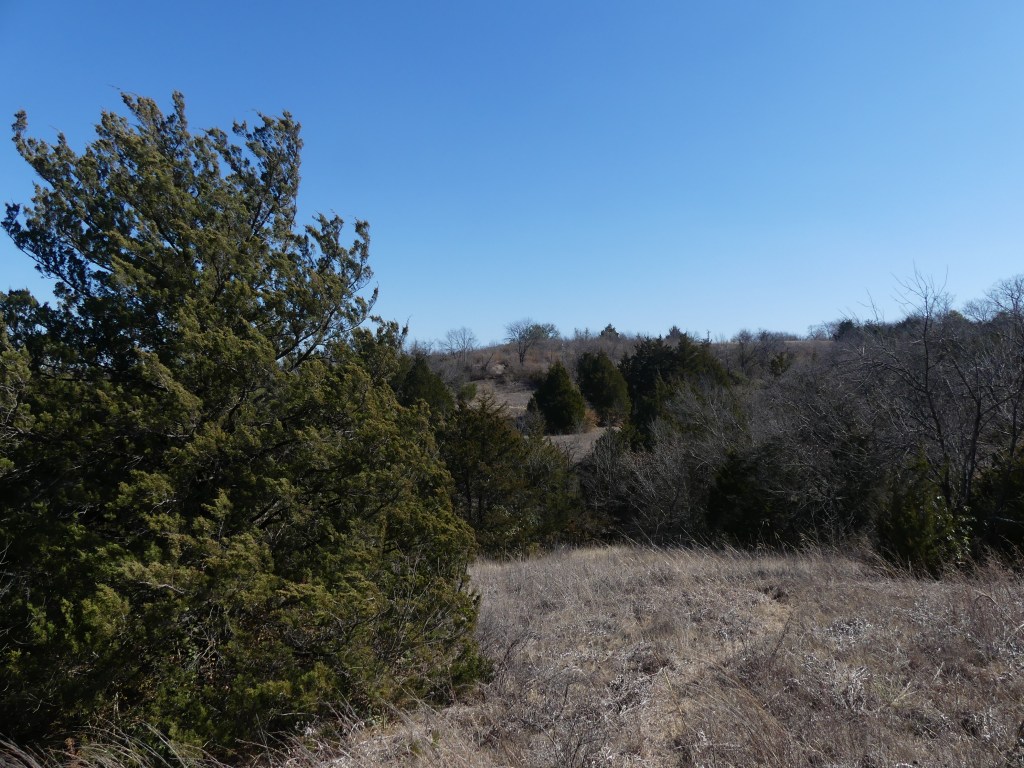
Eventually I sat on a bench on one side of a ridge and looked across junipers and oaks to a small tree or shrub around a hundred yards away. It had a smear of reddish color, perhaps leftover autumn leaves or a possumhaw with clusters of red berries. I wanted to focus my awareness on my breathing and on this one spot in the distance. Bringing attention to each breath is a way, in mindfulness practice, to let go of distractions and focus on moment-to-moment experience.
In my greater stillness and openness, I was more aware of the depth and distance to the next ridge and the green and reddish-gold junipers swaying in the breeze. The hills seemed a little quieter; cars were still moving and somewhere there was an airplane, but they seemed more in the background, more distant.
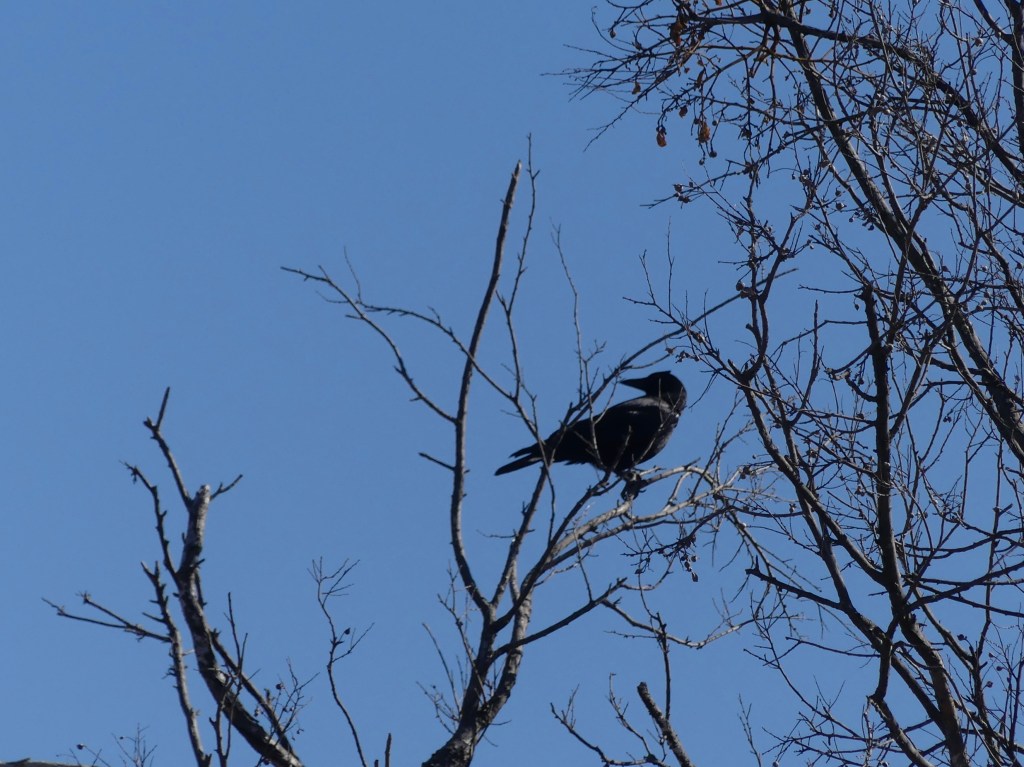
A crow flew between the ridges on broad black wings, pulling up to rest on the branches of a skeletal oak tree. Then two more crows flew in from another direction, perching in nearby trees. After a minute of silence there were a couple of rounds of crow-talk, “caw-caw-caw-caw.” The afternoon deepened and the shadows grew longer as I listened to the comings and goings of crows. There was a sense of peace and belonging here with the crows and butterflies and everything else that lives at Tandy Hills. We are all fortunate to be able to spend some time in this patch of prairie.
We need nature. Flowing water, plants, sunshine or clouds, the simple sounds of birds and breezes.
Research is confirming the substance of what most of us intuit: we are better when we spend time in nature – happier, healthier, freer from the darkness that clings to us when we are closed within our own contraptions.
Some people benefit from playing in nature, and some benefit from the quiet focus of mindfulness. Some embrace the study of animals or plants, or how their lives are entwined to make ecological communities, and others draw, paint, or write about it. There is certainly more than one way to spend time in nature and be renewed and nurtured by it.
I love quiet periods of mindful attention, and also taking the time to write about it while sitting at the edge of a meadow or prairie. Studying nature is also important to me. Someone else might want to play music in some open spot in the woods or spend the afternoon fishing. Is nature good for us regardless of what we do while we’re there?
I have some educated guesses about how we may get the most benefit from our time in nature. These are informed by what I’ve read and what I know about psychology and the research on the benefits of nature.
Taking time to notice and reflect. Whether it’s play, study, meditation or art, taking time to notice details and enjoy the experience is likely to be an important part of how nature benefits us. Related to noticing is pausing to reflect on it. In general the ability to reflect, to be aware of what we are perceiving and feeling, is beneficial.
Presence. If we are playing in the creek, we genuinely feel our connection with the rocks and water. You don’t have to read that in any mystical way; it is simply a kind of awareness of, and intentional interaction with, where you are at that moment. You are present in that creek. It is not just a “stand in” for every other stream – it is not a generic experience, like a creek video on an exercise machine.
Quiet mind. Except in some kinds of mindfulness practice, we don’t have to be silent. In a walk in the woods, people often talk with each other, and when we write in a nature journal, words come to us. A few comments and questions about what we are experiencing do not take us far from where we are, in the way that other thoughts and conversations do. In other words, “I think this is Glen Rose Yucca” keeps us in nature, while “What movie should we see tonight” separates us from it. When it comes to our busy, worried, chatty minds, quieter is probably better.
Acceptance and kindness. The more open and accepting we are towards what we are experiencing, the better off we are. The less we see something through the lens of our preferences and wants (and the more we can see it as it is), the more we benefit. This goes hand-in-hand with kindness, the wish for ourselves and everything around us to live in wellness and peace, with as few struggles as possible. These attitudes are closely connected with the practice of mindfulness. I think they are beneficial in visits to nature and in any other context.
The Texas Hill Country is a beautiful region, and Meghan Cassidy and I finally got around to visiting it in mid-October. In our work on a forthcoming book on mindfulness in Texas’ nature, we have been to a lot of places around the “edges” of Texas but not the central region, dominated by the massive uplift known as the Edwards Plateau. We were never going to leave it out, though, because that would mean missing out on lovely and important places.
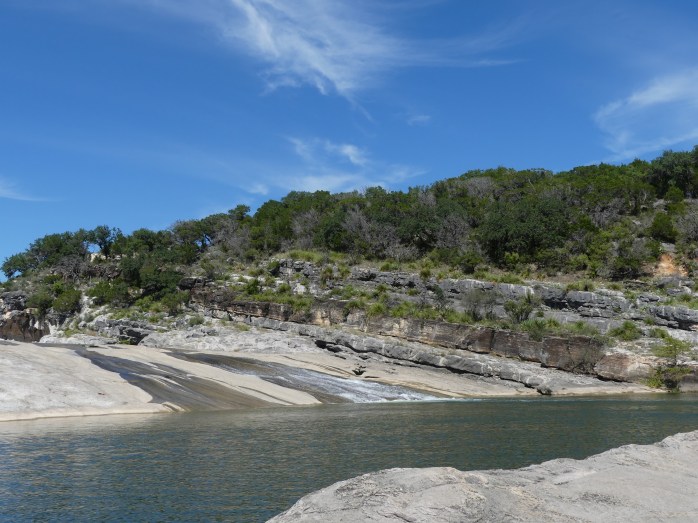
Water slides over rock and into a pool
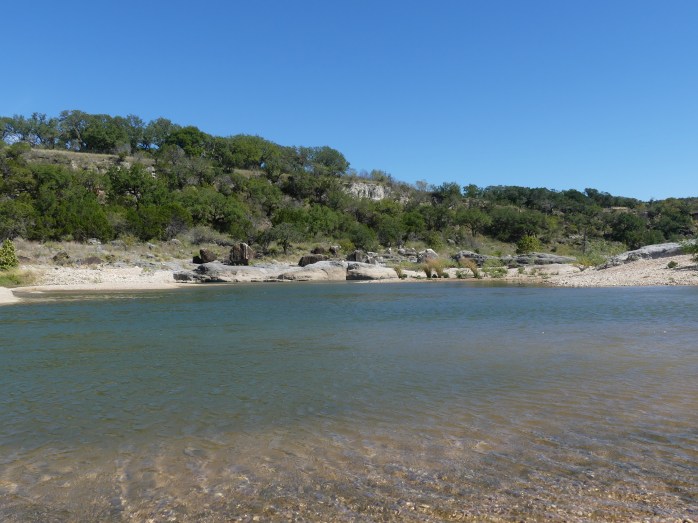
The eastern part of that plateau has limestone ridges and canyons formed when water dissolved the rock and created caves and underground waters that emerge in springs and grottos. Such places may be ringed by maidenhair fern and lush vegetation, with crystal clear pools and streams flowing over stone. This is the Hill Country, with rocky hillsides covered with Ashe juniper, small prairies and pockets of grassland, and beautiful rivers.
Our friend Ruthann Panipinto nominated Pedernales Falls State Park as the right place to spend the limited time we had. I’ve known Ruthann for years as someone whose knowledge and interest has, like mine, expanded from herpetology into an even broader love of natural history. Her choice of Pedernales Falls was perfect.
Traveling to Pedernales Falls, one of the first questions that occurred to me was how Texans came to pronounce it as “Purdenales.” Spelling and ways of speaking are sometimes out of sync, and English-speakers don’t always have a good track record when dealing with some Spanish words. As it turns out, the Spanish word “pedernal” means “flint,” and the Pedernales River got its name from the flinty stone in its riverbed. Much of the Edwards Plateau rests on layers of limestone, some of which is Cretaceous (66-144 million years ago). Some of the rocks exposed by the Pedernales go back unimaginably earlier, to the Ordovician (438-505 million years ago)[i].
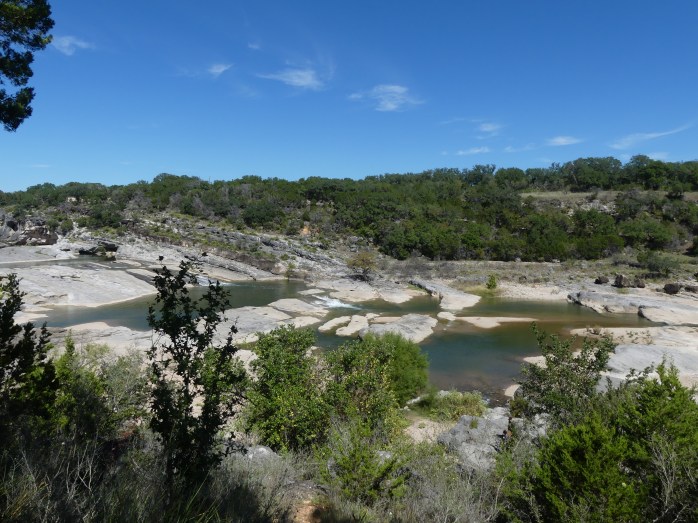
Pedernales Falls
We arrived and walked down to an overlook from which we could see a beautiful river cascading over the top of a huge apron of gray rock into a pool, and then pouring over a small gap into lower pools. The water then worked its way through a line of boulders and on downstream. We followed a long series of stone stairs down to the river and sat down to watch and listen.
It was a surround-sound experience of flowing water. From a small tributary on one side was the sound of riffles, shallow water tumbling over small stones and gravel. Behind us was the upper falls, with the main part of the river sliding down a long expanse of stone. In the middle was the spot where the water pours several feet from one pool to the next, with a deep, thunderous sound reminding me of surf breaking at the seashore.
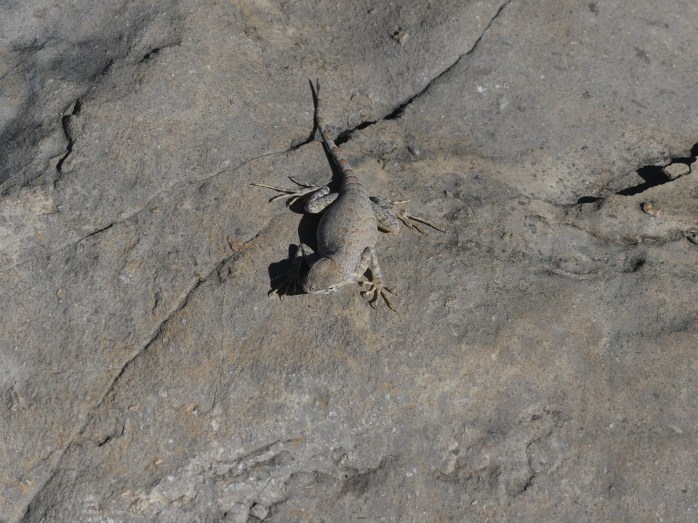
Above us there were long wisps of clouds as if the upper winds stretched water vapor across the sky in white calligraphy. The sun was warm and intense but the air was cool in just the way you would expect on a mid-October day. Texas earless lizards basked in the sunshine, taking notice if we got too close and scampering away to wave their tails in the air, exposing the black-and-white bars underneath.
Texas earless lizard
It was fairly busy, but did not really feel crowded, as couples and families and even a geology class made their way down to the river to walk, sit, and sometimes wade. The voices of people were masked by the falls and (thankfully) no one brought a boom box. Visitors came and went, and there were times when you could look across a substantial area without seeing people. And in the next part of the visit, we had the river to ourselves.
Ruthann led us further downstream, over boulders and across gravel bars to a place where a huge cypress tree stands like a sentinel, roots wound around the rocks to create something like a tiny peninsula or island in the river. The almost-clear water passed over large rocks, heaved up in places and then falling into small troughs. It flowed among the boulders and between grassy banks and broke into noisy whitewater in shallower places.
Along the course of the river were more cypress trees, their feathery leaves beginning to show a bit of rusty yellow in the low afternoon sun. Autumn might be slow to take hold, but it was beginning.
[i] Spearing, D. 1991. Roadside Geology of Texas. Missoula, MT: Mountain Press Publishing Co.
A few weeks ago, it was back to the Big Bend region with Meghan Cassidy for one of the last trips for the book on mindfulness in nature. I’ve made a number of trips there during the past twenty years, and my attachment to and fascination with that region keeps growing. I felt really fortunate to introduce Meghan to the Chihuahuan Desert and the mountains out there.
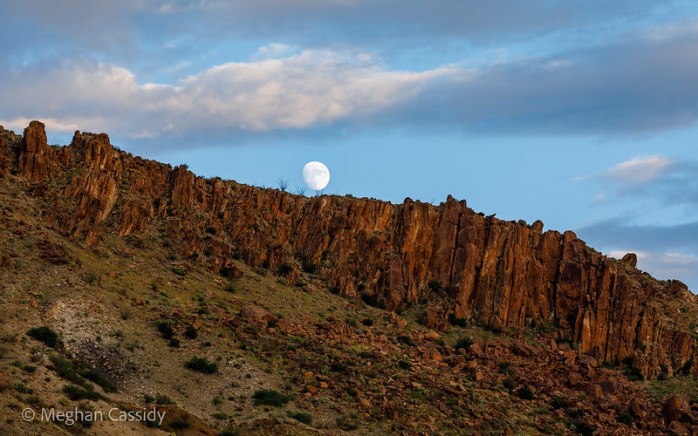
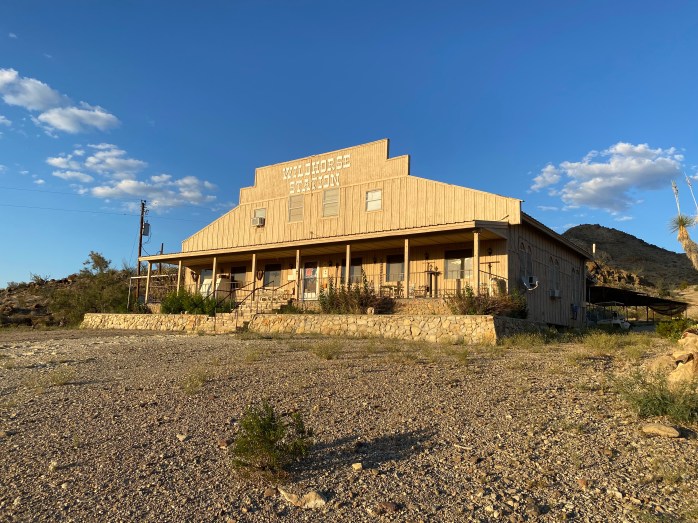
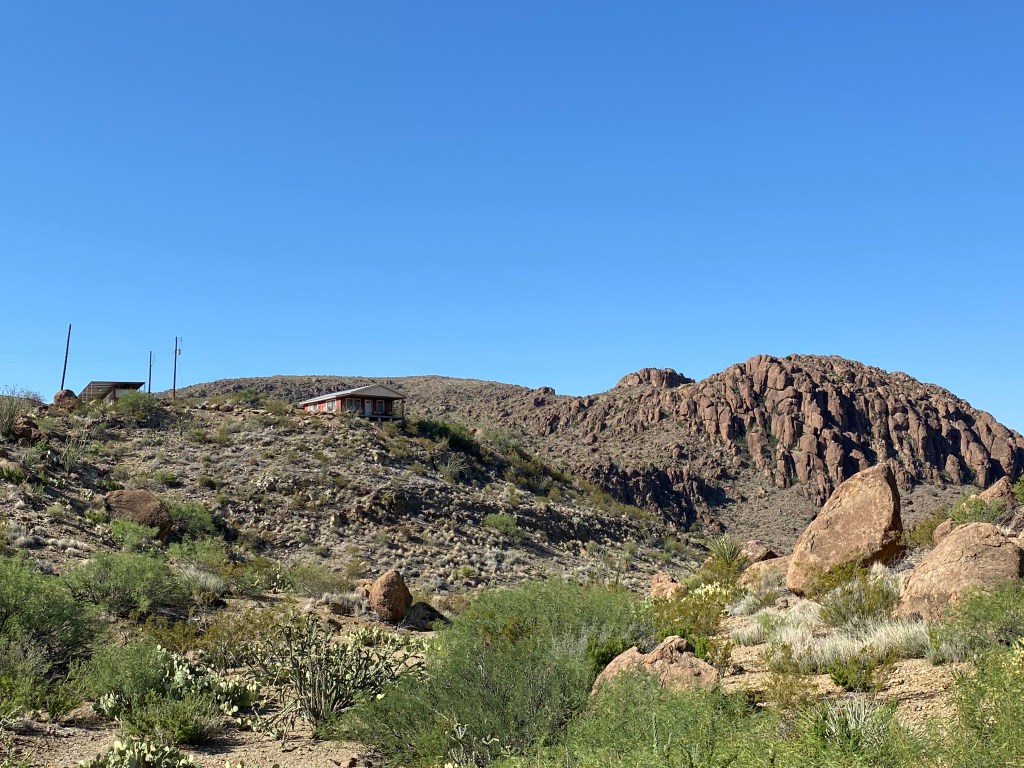
We stayed in a cabin at Wild Horse Station, just a little bit north of Study Butte near the Christmas Mountains. There are extruded columns of lava and thin soil where scattered desert plants grow. It is a strange and beautiful place, and that cabin on the hillside has a broad porch that looks out toward more hills and mountains to the west. This trip included some times for sitting on that porch, watching rainstorms or sunsets, and writing. I’m very grateful for that porch and for those moments.
A ridge just behind our cabin, at moonrise. Photo by Meghan Cassidy
In the early years, my visits to this region were very focused on finding snakes and other reptiles, although my companions and I always knew this was a place to be savored and soaked in. We rarely took much time to do it, and whatever we gained in total snakes seen, we lost in really getting to know the region. Each year has brought a broader interest in the ecoregion and a willingness to slow down and pay attention to more of it. This trip was a combination of mindful attention to the mountains and desert and some very fine observations of snakes.
Sunset (photo by M.Smith)
Our arrival at the cabin was interesting. Darkness had just fallen when we walked across the porch to find the front door open and, inside the dark cabin, the television was on. We did the ‘police knock’ standing to the side of the open doorway, and when there was no response – human, javelina, or otherwise, we turned on the inside light and began to check the rooms. I glanced to the side to see Meghan holding a knife, and I knew I had a capable partner out here where there is little phone service and self-reliance is important. Everything was fine; I like to think that a coyote – not the human trafficker but Canis latrans, the trickster of Native American legends – had let himself in, watched a show, and left the place open for us.
In the morning there was coffee, the shadows of nearby mountains with rosy light growing overhead, and that wonderful porch overlooking it all. After a beautiful sunrise, we got ready and headed into Big Bend National Park.
Chihuahuan Desert within Big Bend National Park (photo by M.Smith)
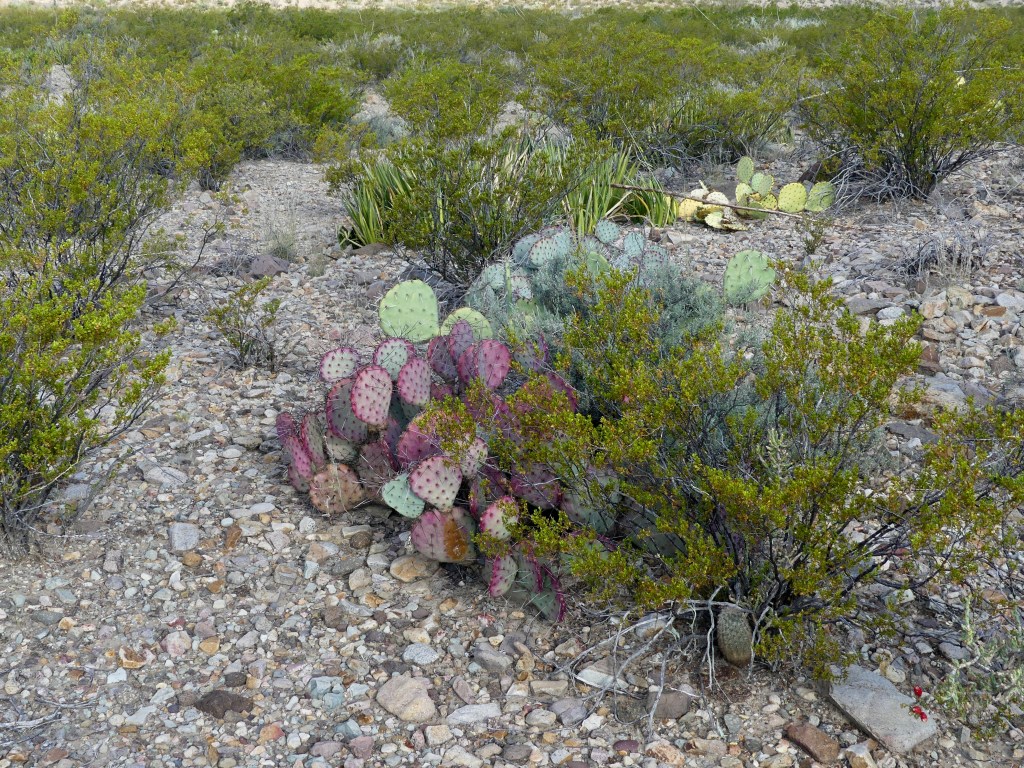
We walked around on the hot, gravelly desert floor, around prickly pear, creosote bush, and other characteristic desert plants. Lechuguilla, an indicator plant of the Chihuahuan Desert, grew in patches of upright succulent leaves. Many had remnants of the tall stalk they send up in late summer with clusters of flowers. The leaves are often described as like an upside-down bunch of green bananas, partly because they often curve inward a little. However, no bananas ever dreamed of having two rows of sharp recurved hooks on leaves tapering to a hard, sharp spine that can even puncture a car tire!
Creosote bush and prickly pear (including the purplish variety) in the foreground, with a patch of lechuguilla behind them (photo by M.Smith)
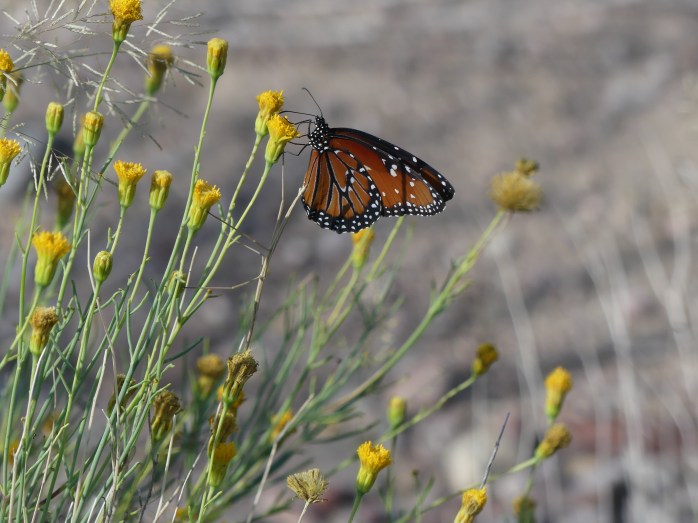
We walked a small dry arroyo as a couple of big black birds flew past. We weren’t experienced enough to call them as Chihuahuan ravens, but from the overall size and chunkier neck, they seemed more likely to be ravens than crows. There were a few places in the arroyo where the sandy soil had piled up and grew a small garden of flowers. Those flowers attracted butterflies. Perhaps they would seem out of place in the desert, particularly if we made the mistake of thinking of the desert as barren. The desert is a harsh place, by our standards, and it requires adaptation to extremes of heat and limited rainfall – but it is full of life.
Queen butterfly in a desert arroyo (photo by M.Smith)
We came back to the cabin during the hottest part of the day, and the shade of the porch and the breeze at the top of our hill made the perfect place for reflecting on our morning and writing about the desert plants, butterflies, and the value of long vistas in which nature has free reign.
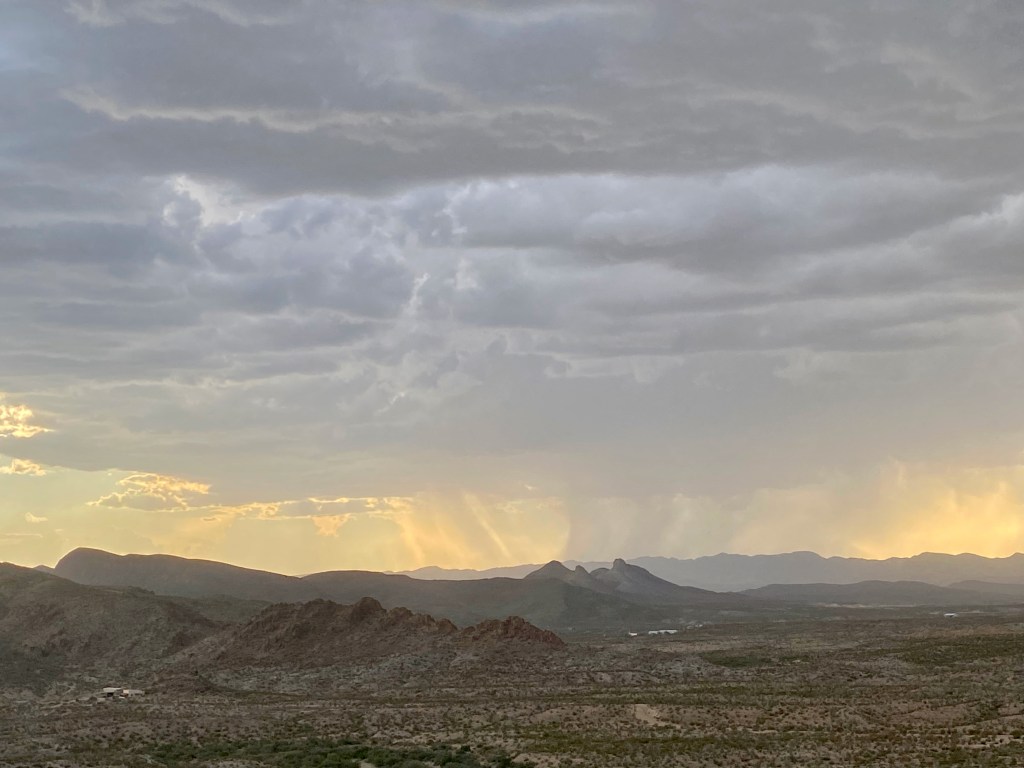
The clouds were building in the west, and under dark clouds were blurs of falling rain. The low rumble of thunder rolled in, and as the system marched toward us, bright lightning was visible as the power of the storm reached down to touch the earth. Announcing the storm’s arrival, the outflow winds were strong and I had to stop for a moment and think how many times this little cabin perched on the edge of the hill had withstood storms just like this. I needed that reassurance as raindrops began to slam into the porch and torrents of rain blew by outside our windows. This is how the monsoon season works in the Trans-Pecos: It’s hot and sunny, then clouds build into storms, the thunderstorms dump a lot of rain (and maybe hail) in a short time, and then they move on and it’s done.
The storm approaching (Photo by M.Smith)
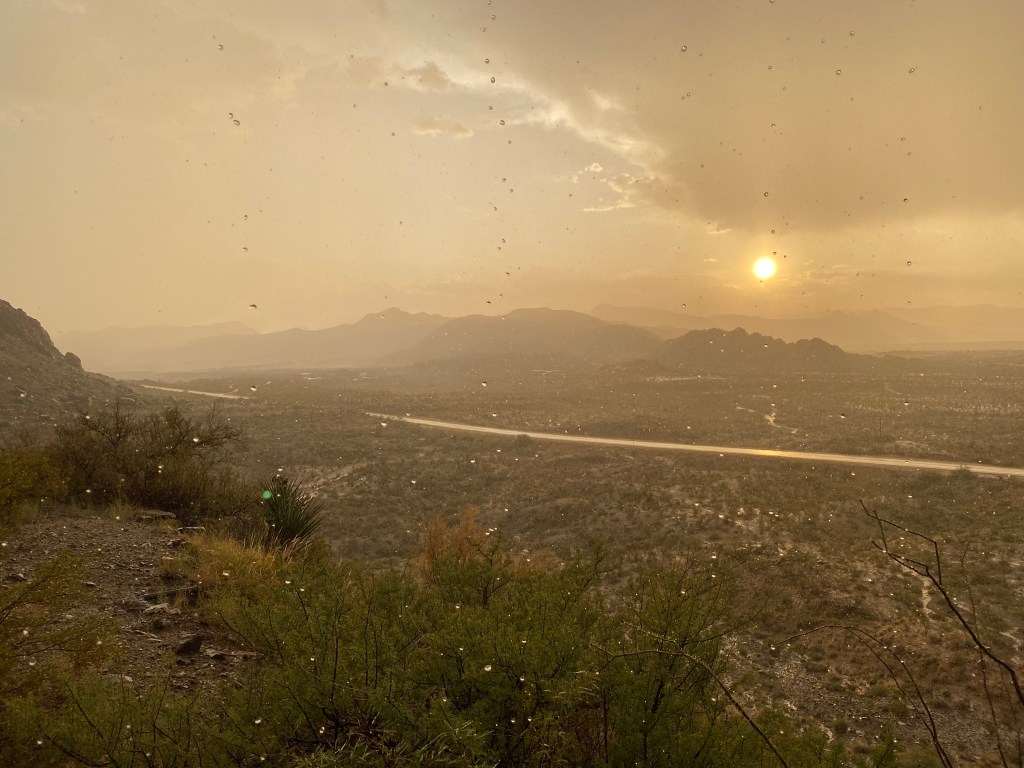
When we walked out onto the porch, the cool air was laden with the smell of rain and creosote. The desert here is full of creosote bush, a shrub with very small green leaves with an aromatic resin and waxy coating that helps protect the plant from drying out. If you crush the leaves, the resin has the familiar, vaguely tar-like smell of treated railroad ties or telephone poles. After a heavy rain, the resin is released into the air and the aroma is strong, fresh and wonderful.
At the end of the storm (Photo by M.Smith)
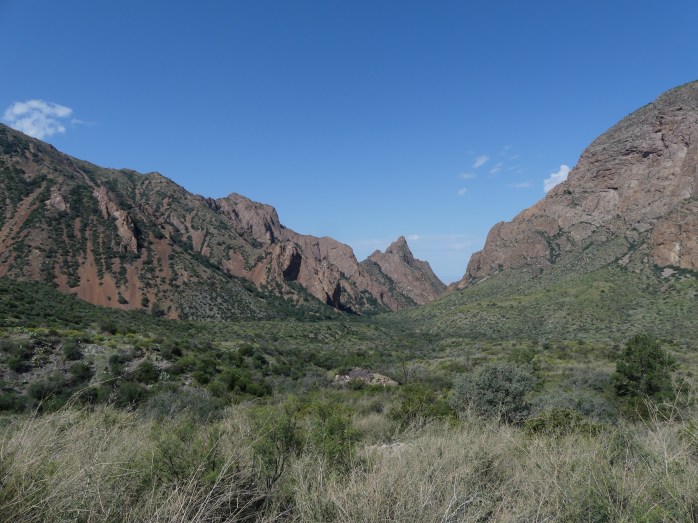
The next day, September 17, was our day to be in the Chisos Mountains. The Chisos is the only mountain range entirely contained within one national park. Driving up into “The Basin” within the mountains, the vegetation changes, reflecting slightly cooler temperatures and a little more rainfall. As you begin the climb into the mountains, you enter a woodland of small oak trees, junipers and pinyon pine. Tall slabs and columns of reddish igneous rock stretch toward the sky.
In The Basin (Photo by M.Smith)
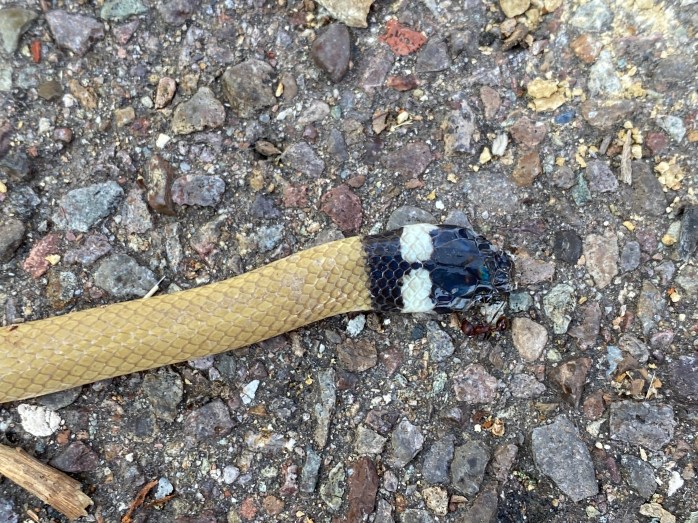
The previous day, driving around the Chisos Mountains Lodge, in The Basin, we had come across a sad, significant find. There was a small snake on the pavement that had been run over some time earlier that morning. There was a dark head with an interrupted white collar behind it, and the body of the snake was a pale tan. This was the first Trans-Pecos black-headed snake that I had come across, and it was a real shame that it was dead. It belongs to a group of snakes with enlarged rear teeth and a salivary toxin to help subdue its prey (but is harmless to humans), and it is the largest species within that genus, Tantilla. It’s still a small snake, often growing no longer than about a foot. It is listed by Texas as a threatened species, but neither that nor its presence in a national park had kept it from being run over.
Trans-Pecos black-headed snake, Tantilla cucullata (Photo by Meghan Cassidy)
Now it was time to climb the Lost Mine Trail up past the Casa Grande peak, to a point where the view opens to the south. The climb is fairly gentle, through mountain woodlands and small grassy openings dotted with beargrass, sotol, and Havard agave. This latter species, also known as “century plant,” sends up a fast-growing stalk at the end of its life with short branches bearing clusters of yellow flowers. The base of the plant is a rosette of thick, stiff, bluish leaves with sharp hooks along the leaf edges and a hard black spine at the leaf tip.
At this elevation it is cooler and there is greater rainfall. In the shade of the mountain there are ferns and beautiful flowers including mountain sage, the red starburst blooms of mountain catchfly, goldenrod, and penstemon. It is easy to stop along the way, on a bench or a boulder, and be still for a while, taking it all in.
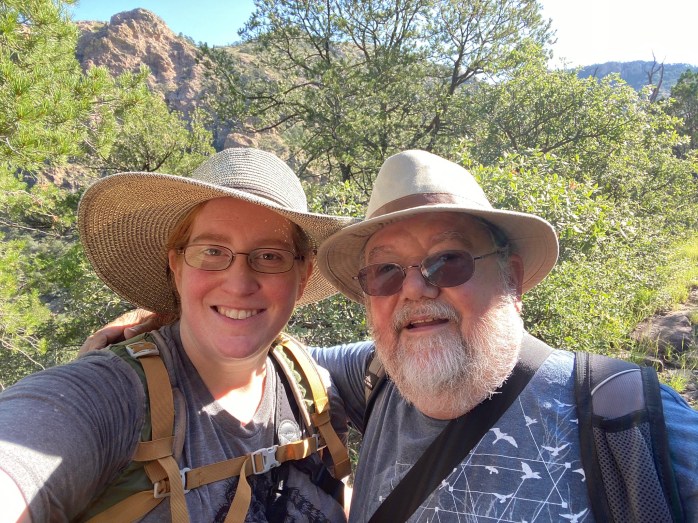
Meghan and Michael on the Lost Mine Trail
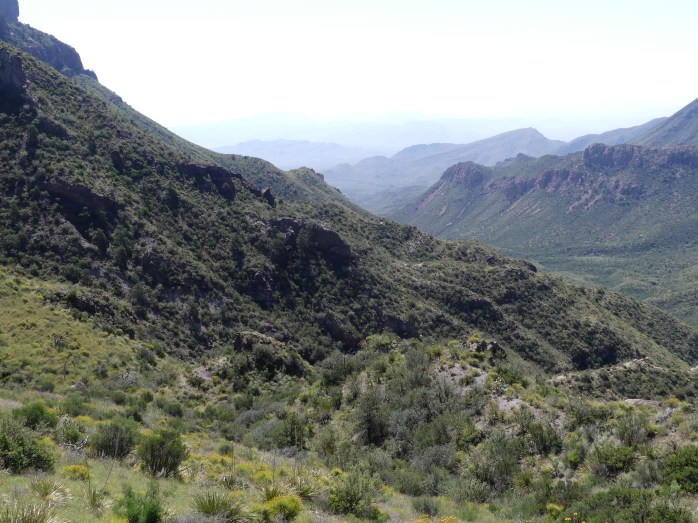
This trail in these mountains means a great deal to me, and I’ve written before about what it is like to be here in its quiet and beauty. And when we reached the place where we could look far away to the south, I spent a while under a pinyon pine looking at what I think is one of the great places within Big Bend.
On the Lost Mine Trail, looking south (Photo by M.Smith)
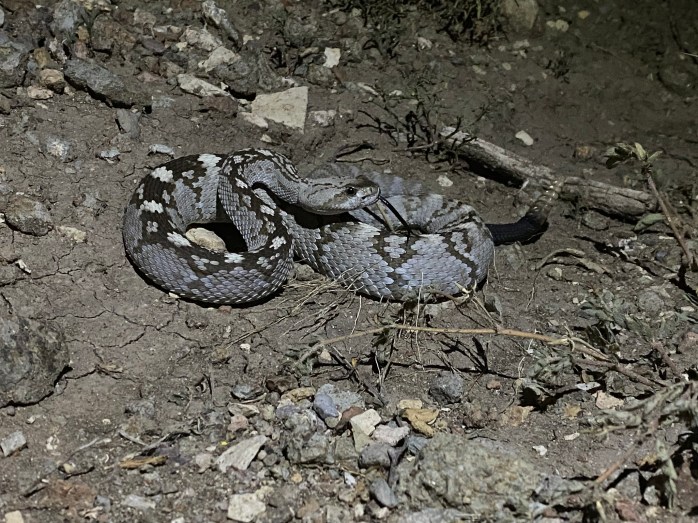
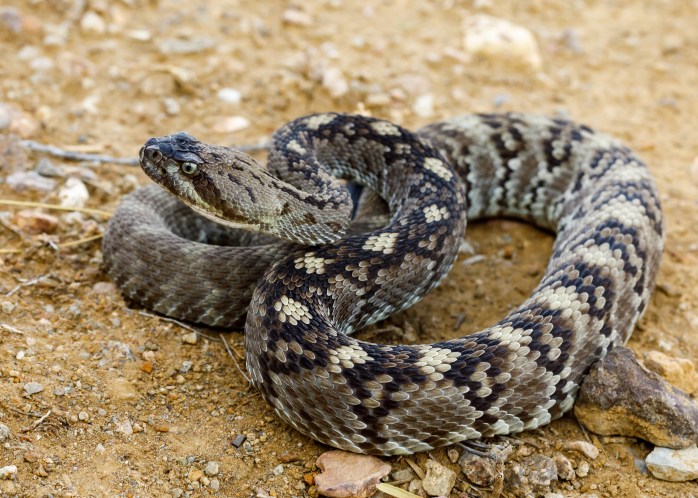
That night, our thoughts shifted away from the book and toward the variety of wonderful snakes that can be found in this area. We stayed along Highway 118 north of Study Butte up through the Christmas Mountains and along the desert flats. Our first snake was a black-tailed rattlesnake that, as I walked up to it, seemed to be ‘periscoping’ up to look around. It turned out to be blind in one eye, and was trying its best to figure out what was going on as we approached on its blind side. Like many black-tailed rattlesnakes, it was slow to get frightened or aroused, and it never rattled or threatened us in any way as we used snake hooks to move it away from the road so that it would not be run over.
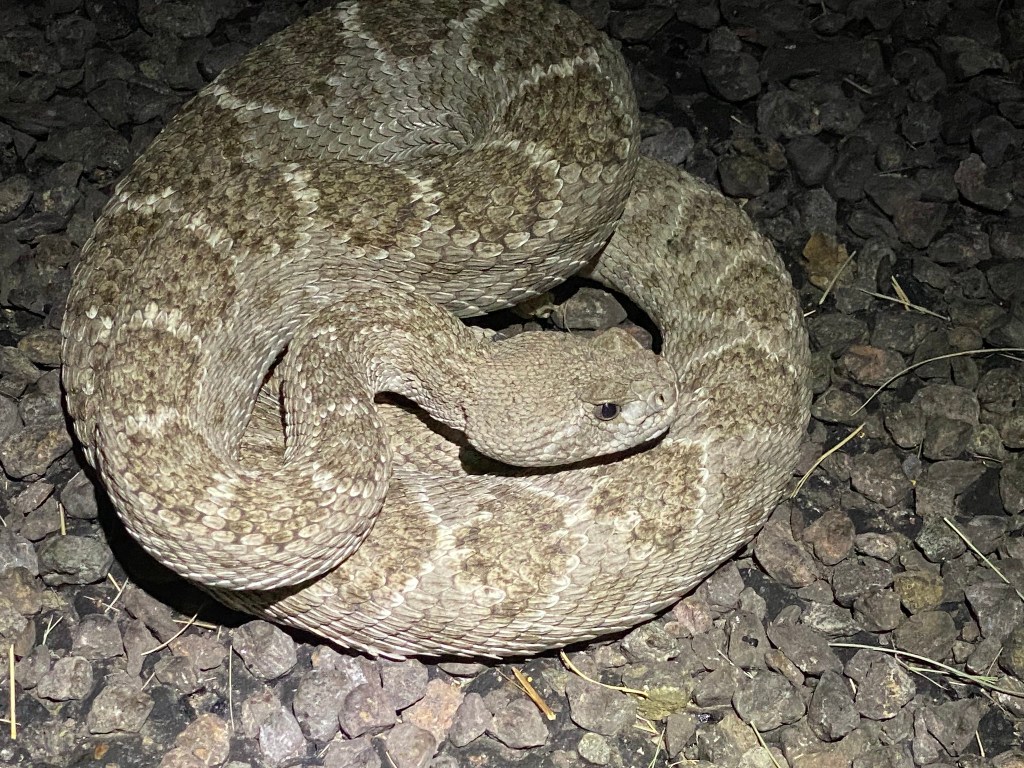
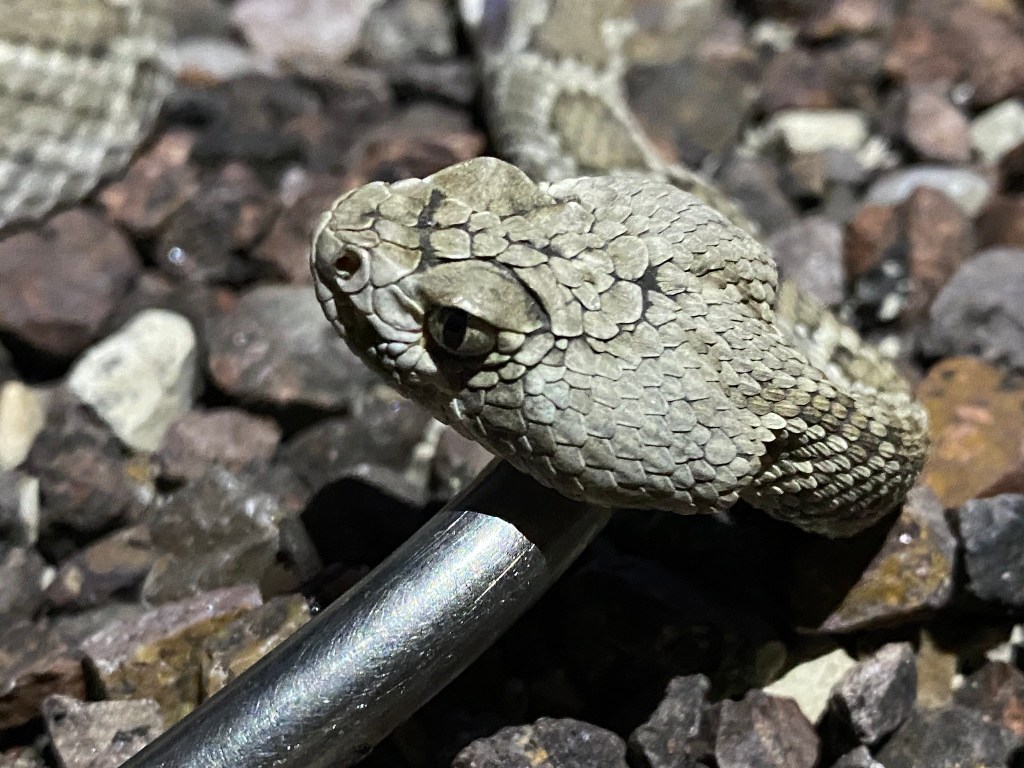
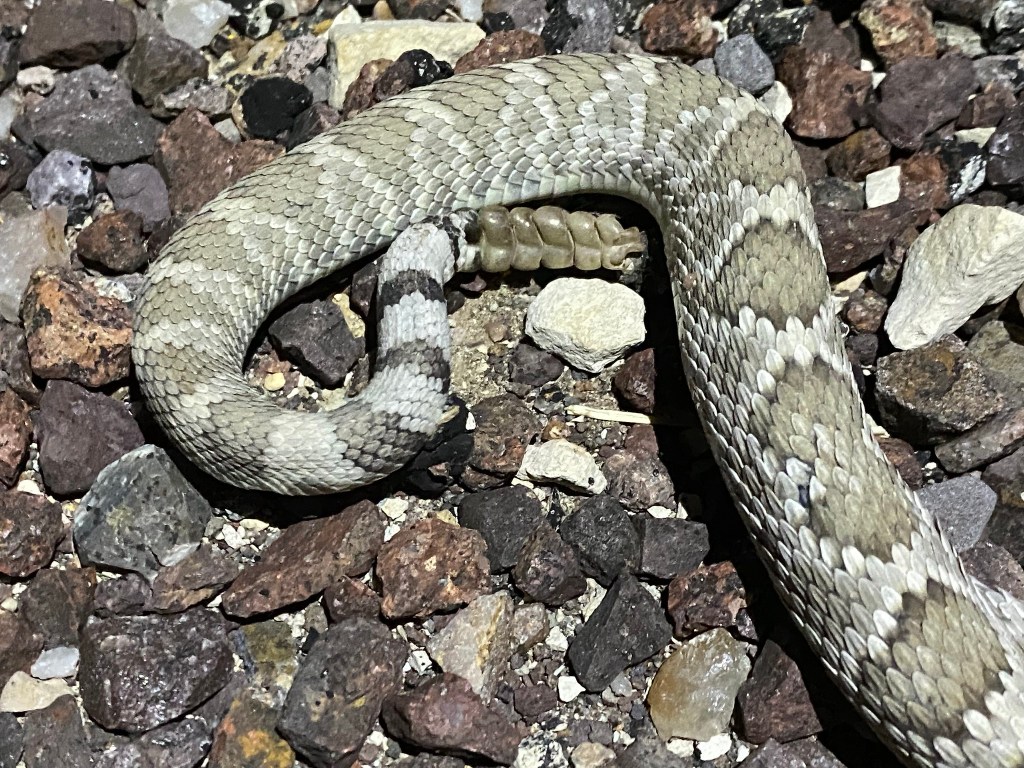
We were on the lookout for Mojave rattlesnakes (Crotalus scutulatus). Meghan wanted to see up close the distinction between this species and the similar-looking western diamond-backed rattlesnake (Crotalus atrox). The immediate visual differences have to do with the width of the black-and-white bands on the tail, the pattern on individual scales, the light diagonal marks on the face, and the size of the scales on top of the head. The rings on the tail of the western diamondback are of roughly equal width, while those of the Mojave emphasize white, with black rings spaced more widely. Both snakes have roughly diamond-shaped blotches down the back, but each scale on the Mojave rattlesnake tends to be mostly one color (resulting in a crisp pattern almost like a mosaic), whereas the colors may transition and almost smear on the diamondback’s scales. The two diagonal lines on the western diamondback’s face both end at the mouth. In contrast, the diagonal stripe behind the Mojave’s eye bends and continues back behind the jaw line. Finally, the scales on the top of the western diamondback’s head (between the eyes and toward the snout) are small. A Mojave rattlesnake has larger scales on top of the head.
Western diamond-backed rattlesnake (Photo by Meghan Cassidy)Mojave rattlesnake, showing larger head scales (Photo by Meghan Cassidy)Mojave rattlesnake, roughly the last third of the body showing the pattern of the scales and the wide white areas on the tail (Photo by Meghan Cassidy)
The one Mojave rattlesnake that we found had been run over, unfortunately. We positioned the head and tail for photos to illustrate these differences. This is the snake that folks in the Big Bend may be most concerned about, because populations of this species in Texas and elsewhere have venom with high neurotoxic activity. A bite might produce less swelling and bruising but more systemic effects, including respiratory problems. My experience with living Mojave rattlesnakes is that their temperament varies and, like other rattlesnakes, they would prefer to be left alone and are not especially aggressive.
That sort of peaceable behavior was true for every living snake we found that night. Every live western diamondback or black-tail greeted us with inquisitive tongue-flicks or attempts to get away, but none attempted to bite. One snake rattled, but the rest did not even become nervous enough to do that. Meghan is good at using a hook to move a venomous snake, and we both do so gently and without presenting a threatening target to the snake, and this may have contributed to their laid-back behavior. However, Meghan was looking for more examples of hooking defensive (or even irate) rattlesnakes, and she wasn’t getting to see any of that. (She did, at least a little bit, the following evening near Black Gap Wildlife Management Area, where the diamondbacks quickly rattled even if they did not strike at us.)
One of the black-tailed rattlesnakes at night (Photo by Meghan Cassidy)
It was getting late. As we drove back up the hillside to our cabin, there was one more black-tailed rattlesnake for us, a beautiful adult. We decided to ‘bucket’ her for good photos in the morning. Once again, this snake was simply curious about what we were doing, and tolerated Meghan’s hooking her and placing her in the snake bucket with little reaction.
(A couple of side-notes. First, the ‘snake bucket’ is a five-gallon bucket with a screw-on lid with air holes drilled in such a way that a venomous snake could not get close enough from the inside to get a fang through the hole. It is essentially snake-proof, so that we could sleep comfortably with a rattlesnake in the front room of the cabin. Second, part of being a safe, competent herper is constantly maintaining awareness of yourself and your surroundings when interacting with venomous snakes, even those who are being complete sweethearts. Neither Meghan nor I took these snakes’ temperaments for granted, because a moment’s slip-up with a “sweet” rattlesnake – especially in the isolation of the Big Bend at night – can be incredibly serious.)
Morning photo of the black-tailed rattlesnake (Photo by Meghan Cassidy)
The next morning, Meghan took a series of photographs of this black-tailed rattlesnake, and we released her. We were happy to have her as a neighbor during our stay!
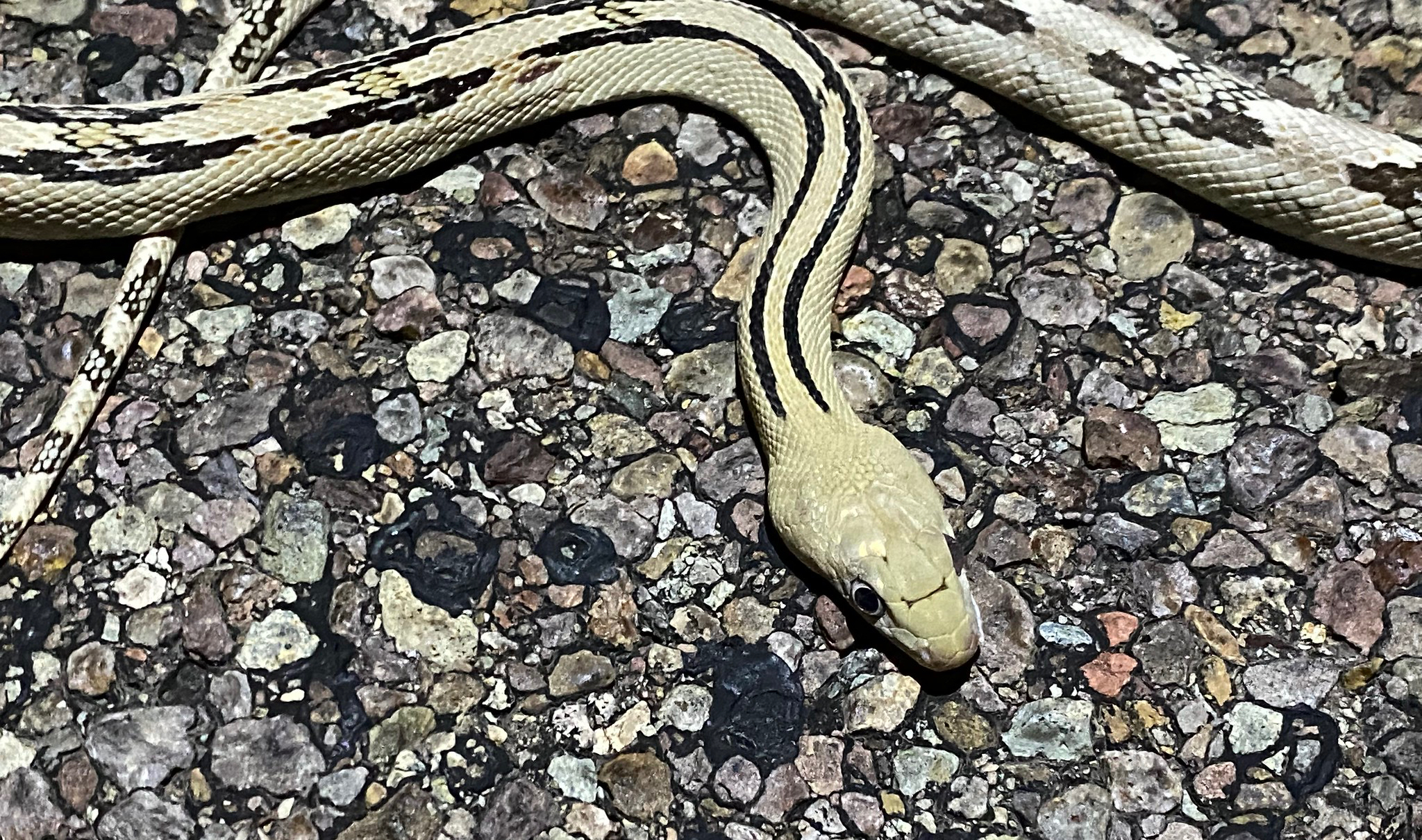
The following night, we were able to see a couple of Trans-Pecos ratsnakes, a favorite for both of us. One had been hit, but the second was wonderfully alive and gentle as we got it off the road so that it would not be run over. These slender, harmless snakes are pale yellowish (almost like the inside of a banana, leading Meghan to playfully call it a ‘banana snake’) or straw color with black markings. Two lines down the neck separate into something like blotches connected across the back in an “H” shape. They are nocturnal wanderers with big eyes to gather as much light as possible.
Trans-Pecos ratsnake (Bogertophis subocularis) – Photo by Meghan Cassidy
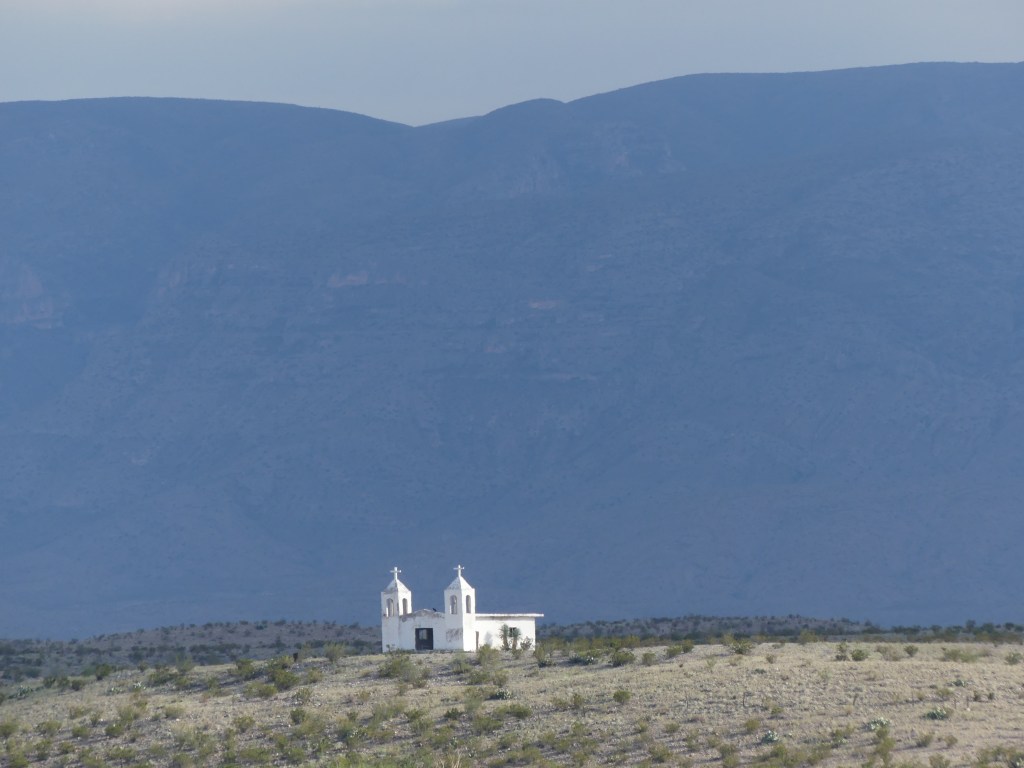
The final day in the Big Bend included a drive down FM 2627 past Black Gap WMA to the La Linda international crossing into Mexico (the bridge is barricaded, though crossing the Rio Grande at that point looked like it would not be difficult). The landscape and nearby mountains were beautiful, but it was virtually all private property and so we could not walk around and explore.
A church, looking across into Mexico at La Linda (Photo by M.Smith)Near FM 2627 (Photo by M.Smith)
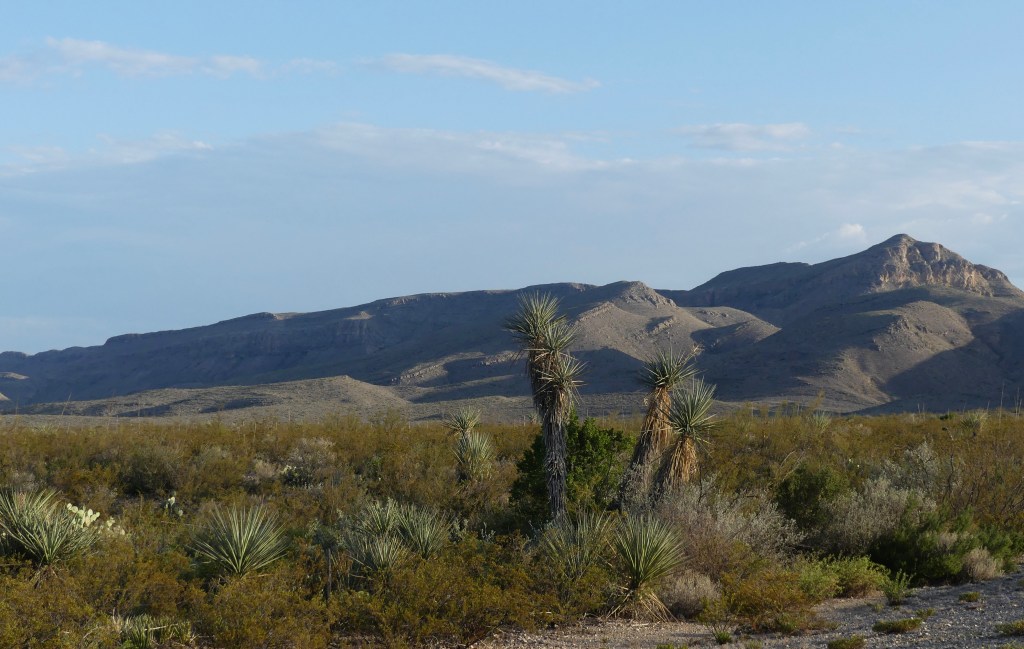
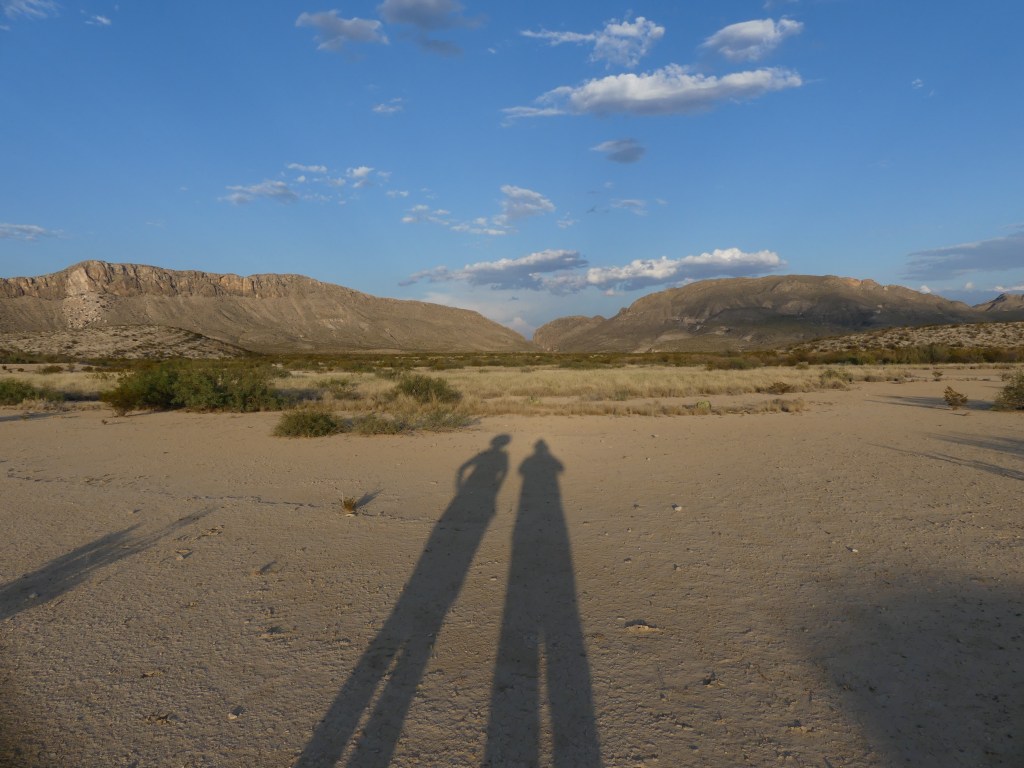
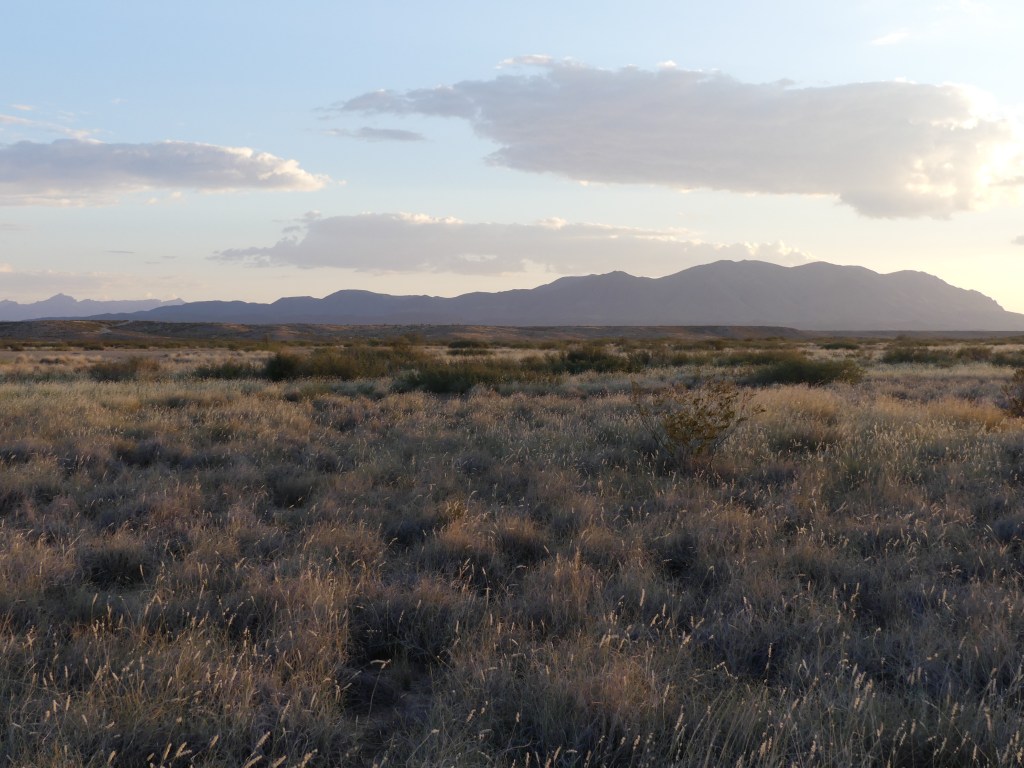
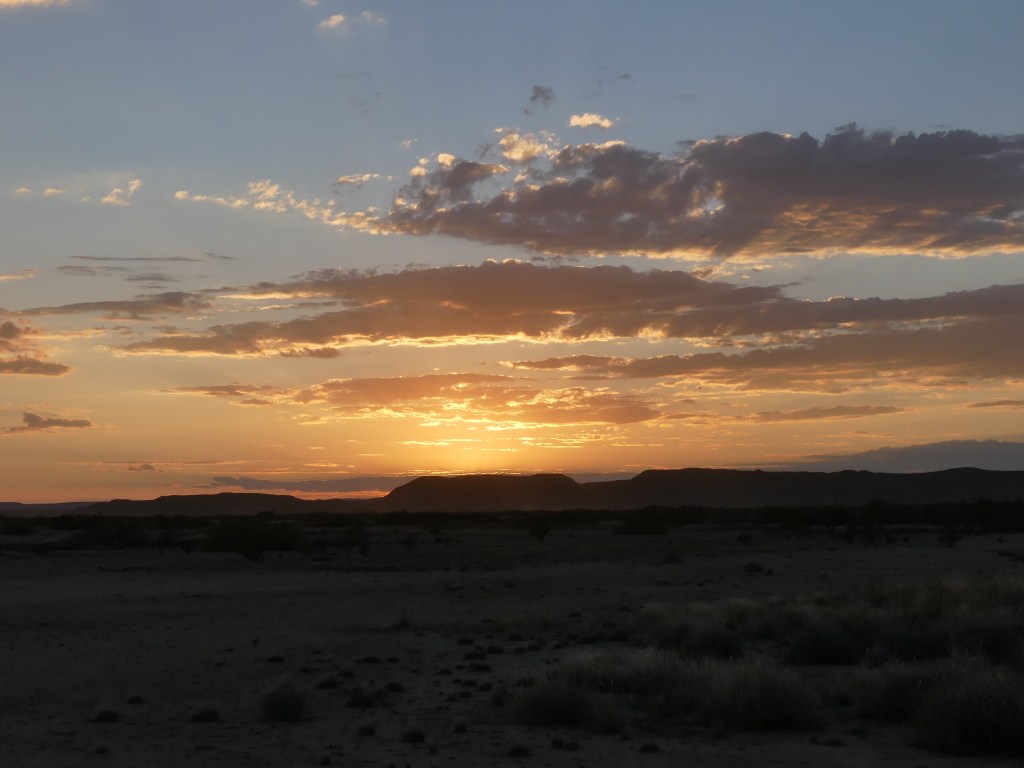
Back within the park we walked part of the trail leading to Dog Canyon, in the Dead Horse Mountains, and also westward in some sparse grasslands looking toward the Rosillas Mountains. I wrote about this later, about the long shadows toward sunset and the sense of solitude and even isolation there, as the sun was setting.
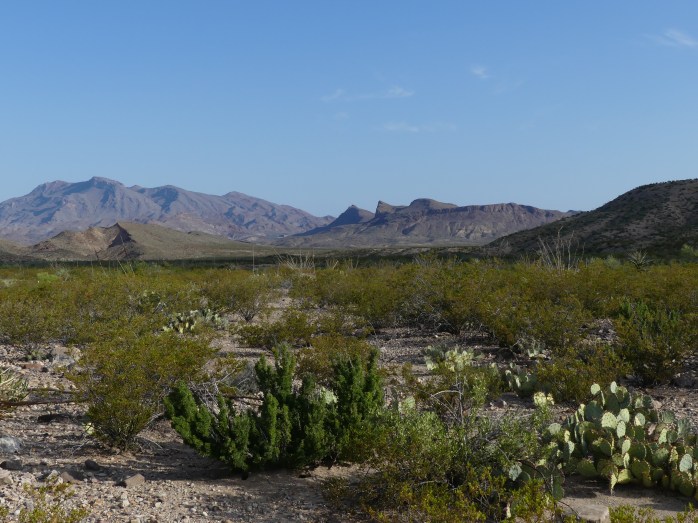
Long shadows, looking toward the Dead Horse Mountains (Photo by M.Smith)Sparse grasslands and the Rosillas Mountains (Photo by M.Smith)Sunset on our last day (Photo by M.Smith)
At the end of 2019, I wanted to write a book about practicing mindfulness in nature. I wanted to describe what it was like to let go of the background noise and pay attention fully to the present moment, while exploring the woods, the desert, and other places in Texas. I also wanted to include information about the place and its plants and animals, just enough to bring the stories to life.
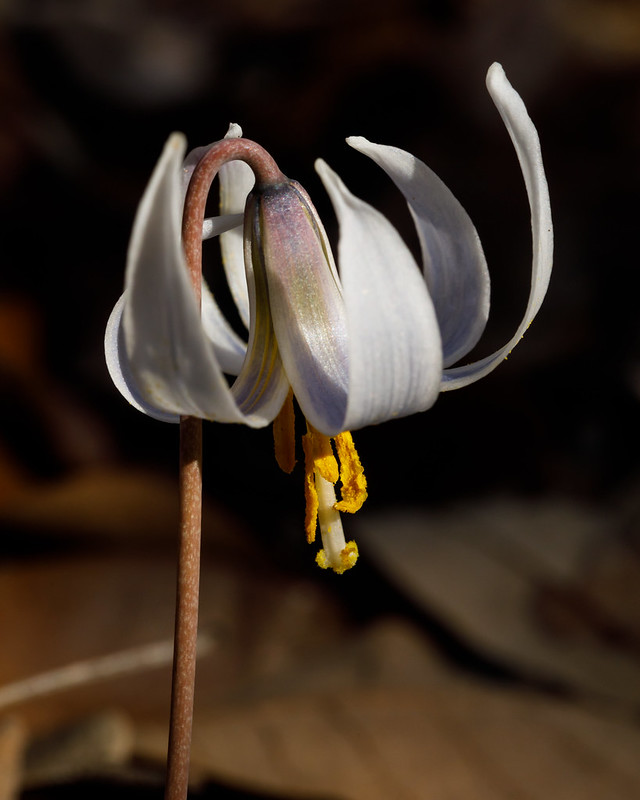
Trout Lily (photo by Meghan Cassidy)
Texas A&M University Press was on board with the idea, as was my best pal, photographer and partner in natural history exploration, Meghan Cassidy. We got started at Muleshoe National Wildlife Refuge in January of 2020, and then the pandemic arrived. That slowed us but did not stop us last year, and this year we have done lots of traveling, masked and socially distanced as needed. Only a few more trips to go (but do we really want those trips to end?).
There have been lots of memorable experiences – alligators at Anahuac National Wildlife Refuge, listening in on the chatter of hundreds of sandhill cranes at Muleshoe National Wildlife Refuge, and becoming lost in reflections in quiet water slipping through the forest in the Big Thicket.
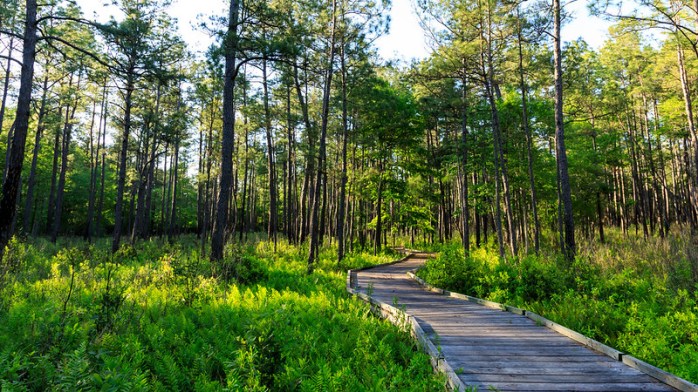
In the Big Thicket (photo by Meghan Cassidy)
The first part of the book will lay the groundwork. How does time spent in nature benefit us, physically and otherwise? What is mindfulness, really, and how does it work? What are all these places in Texas, from the High Plains to the Piney Woods? And how do you prepare for an outing like this?
Sundew Trail, Big Thicket (photo by Meghan Cassidy)
The second part contains the photographs and stories from all over Texas. Meghan’s photos always bring home the landscapes as well as the close-up studies of little wonders. I always look forward to sitting down with her to go through photos (although it is hard to limit ourselves to just a few for each section). There are panoramic views of habitats, with subtle colors and textures. There are also macro shots with wonderful detail.
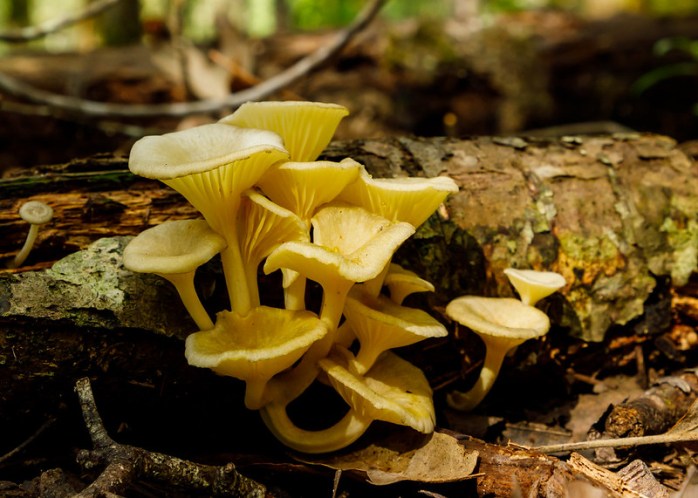
Fungi in East Texas (photo by Meghan Cassidy)
We hope you will watch for this book and read it when it comes out. With its detailed photos, the guidance for practicing mindfulness, and natural history of the places we visit, it will be unlike any of the other books on exploring Texas’ nature.
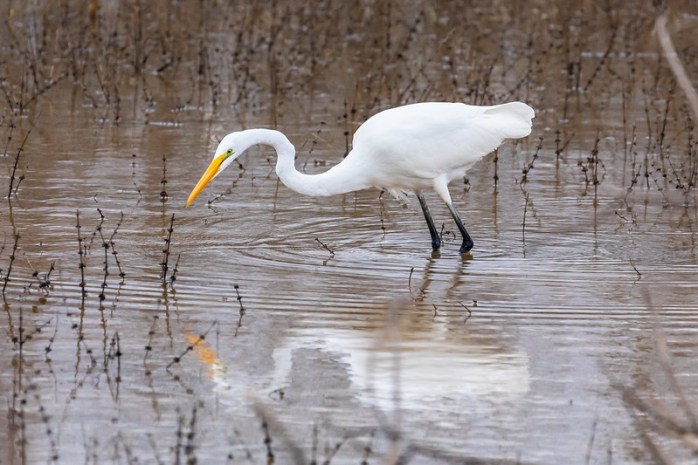
An Egret at Hagerman National Wildlife Refuge (photo by Meghan Cassidy)
The day-long drive set the stage for our arrival in the Big Bend country. The land became flatter and more arid, and the stretches between towns lengthened. We began to see dust devils spinning across short distances among the mesquite and cactus. Somewhere south of Pecos, the shadowy line of the Davis Mountains gradually emerged from the haze. We were now far from the big cities, and we were leaving the desolate world of Permian Basin oil and gas extraction. Our travels from here would bring us into the Chihuahuan Desert, passing through mountain ranges and dropping down into desert basins.
Finally, south of Alpine, the two-lane road cut through a landscape with no town ahead for nearly a hundred miles. The sun was sinking toward distant mountains and buttes, and the road threaded through hills and rocky ridges that gradually flattened into huge expanses of gravelly desert dotted with creosote bush and yucca. Here was wildness and remoteness such as you rarely find in the United States, and opportunities to be unplugged from the modern world.
There was no way to fully prepare Barbara and her kids for this place and its disconnection from the rest of the world. There was no phone service and little traffic. For nearly a hundred miles there are no gas stations, no stores, no fast food. There are occasional small structures – a cabin or a trailer – scattered among the brush and cacti or nestled at the foot of a hill, and occasionally a car or a pickup truck passes you. Nothing else disturbs the sense of being completely alone from one horizon to the other.
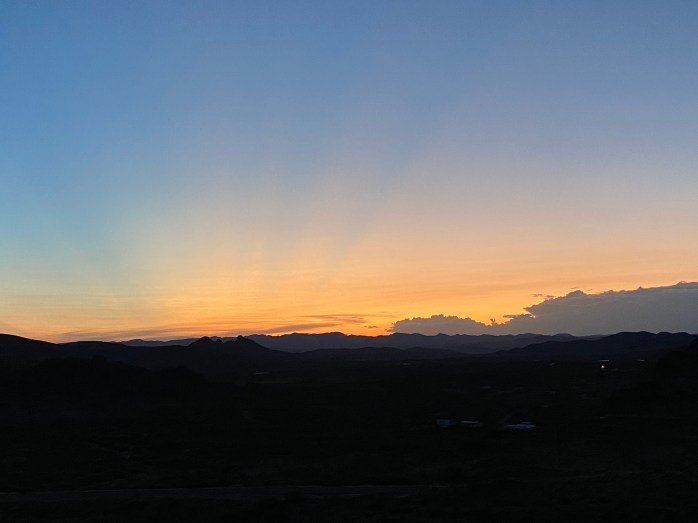
Sunset, south of Alpine
We stopped to photograph the sunset, and the deepening orange behind the layered mountains and hills was beautiful. For me it was a welcome return to a place whose openness and enormous scale has always offered peace and endless fascination. The isolation was probably a plus for fifteen-year-old Dani, who is often seeks out quiet moments with a little distance from others. Nicholas, who just turned thirteen, is outwardly an easygoing guy with an infectious smile. Barbara is an artist and media designer whose attention was drawn to this beautiful sunset, while at the same time her attention is never far from Dani and Nicholas. We were all filled with anticipation of the wildlife we hoped to see and hear, and as long as Barbara could get a text to the kids’ dad, telling him that we were OK, she would be fine.
We stayed at Wild Horse Station, a collection of several cabins and mobile homes perched in different places on a hillside. I knew that cabin number one at the top of the ridge would be a good place to stay, but to get there we had to climb a rutted dirt road up the hill in the dark. There were sharp turns and a section where the path dropped off sharply to our right, but we made it.
It was dark, despite the light from this night’s nearly half moon. This part of Texas has traditionally had little light pollution and the dark skies make it a good place for the McDonald Observatory, in the Davis Mountains. With no blazing lights from cities and limited traffic, the nights are often clear and very dark. When there is no haze, the Milky Way stretches overhead just as it might have looked when it spanned some prehistoric landscape, and the sky seems like a limitless depth of black, with an infinity of stars. This was a moment to shake car-cramped muscles free and let go of thoughts and plans about tomorrow. It was a time for standing quietly under the night sky, surrounded on this hilltop by miles of desert, cool night air, and little else but a few friends and a welcoming shelter.
In mindfulness terms, it would seem to be easy to stop doing something on this night and in this place. How natural to just be still and notice the quiet, correct? But with darkness hiding much of what would catch the eye and hold our attention during the day, sometimes our internal thoughts, judgments and plans push the door open and insist on being heard. To practice mindfulness while the mind tries to smother our awareness under a thousand different things, we must observe ourselves having the thought, decide to let go of it rather than get caught up in it, and return our attention to that dark night in the desert as well as to our internal feelings and perceptions. It does take discipline to keep our attention in the present moment!
If we have enough of that discipline, what can result is a longer and deeper immersion in that night sky and the quiet desert around us. Any of us could stand there outside the cabin and notice the vast scale and the depth of the dark night, getting a short peek into that experience before the mind carried us off somewhere else. Mindful attention lets us live in those moments longer, continuing to be present for the full story of the stars, the sense of height on the hilltop, the soft breezes, the dimly seen desert plants around us, and much more.
A desert kingsnake with a stubbed tail, found later that night, photographed the next morning and released the next night.
We made this trip to introduce friends to the Big Bend region, to look for and photograph reptiles, and find some opportunities for mindfulness. More to come!
Or, in Plain English, a Visit to Muleshoe National Wildlife Refuge
Long perspectives and flat horizons (photo by the author)
Last month, Meghan Cassidy, Paul Mendoza and I visited the Muleshoe National Wildlife Refuge for two days, a brief trip in search of open skies, prairie, and Sandhill Cranes. It was part of a project in which I am writing about mindfully spending time in nature and Meghan is photographing the places we visit and the wildlife that we see.
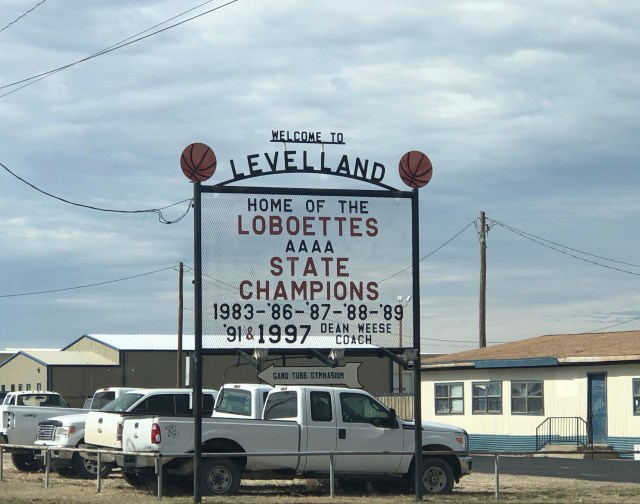
Muleshoe is northwest of Lubbock, and one way to get there is to go through Levelland, a community that is proud of the high school girls basketball team, the Loboettes. You can be sure that James McMurtry’s unforgettable song about sitting outside with his mom, watching the stars and dreaming of being gone from Levelland, was playing as we drove past.
“Welcome to Levelland” (photo by the author)
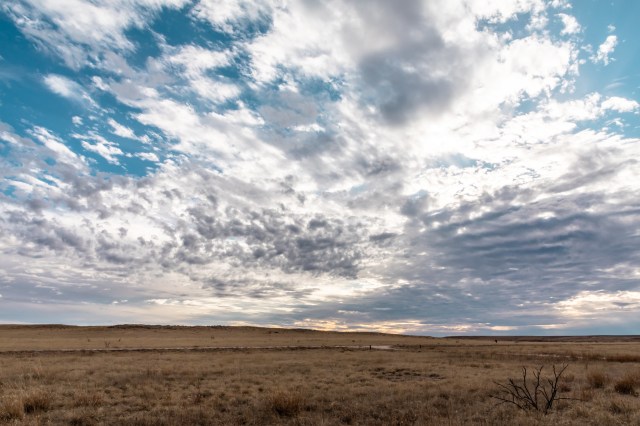
We arrived at the refuge, getting out of the car into an open expanse of grass, a broad flat prairie set between two ridges. Above us, the sky was bigger than I had ever seen it before. Clouds passed in an infinite field of blue. It was hard to judge where the horizon was, but it felt like we could see all the way to Montana. Above us the clouds were big masses of puffy white with gray underneath, but nearer the horizon they overlapped and formed a fantasy landscape of floating islands and castles. Standing there and absorbing all this felt wonderful, resetting my frame of reference from the human scale of houses and yards to the High Plains scale in which we can take our place with a little awe and humility.
Grassland and clouds at Muleshoe NWR (photo by Meghan Cassidy)
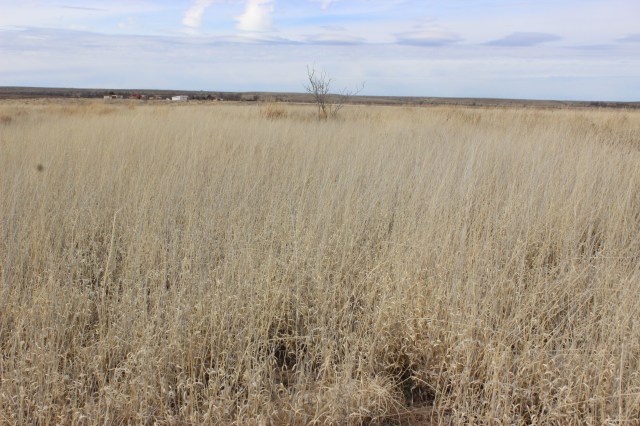
Dry, winter-dormant grasses covered the gently rolling fields and ridges that stretched into the distance to meet the sky. Here and there a spindly cholla cactus or a sage plant grew, but the only visible trees were in the distance where rainfall drained toward White Lake. The land was ruled by grasses. We could make out several species, one of which sent up tall, slender stalks about waist-high, with leaves nearer the ground that were like curled ribbons.
(photo by the author)
Once again I thought about how much I am attracted to grasslands. I love walking through fields of grass and taking in the amazing but subtle variety of colors and textures. Here on the High Plains, the sense of openness and space was bigger than anywhere I have been except in the Trans-Pecos. Here was more prairie than I could walk through in a day, grass as far as my eye could see.
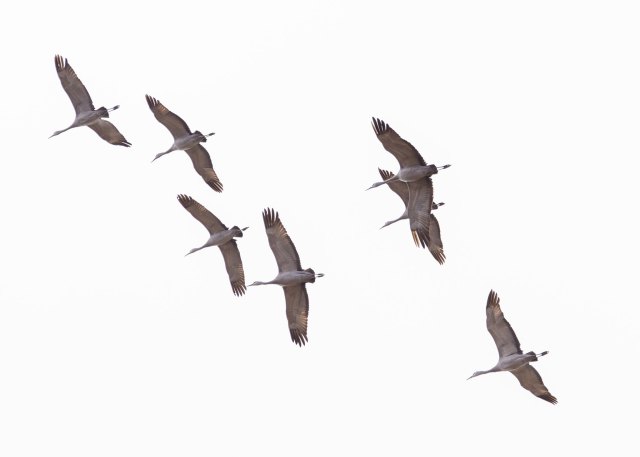
It turned out that much of the refuge property was off-limits to protect the winter population of Sandhill Cranes. A refuge staff member told us that people had been approaching much too closely, so they had taken action to protect the birds. We were able to see some of them, from a distance, in the northern part of the refuge around Paul’s Lake. Across the lake, the shore was dotted with well over a hundred big pale Sandhill Cranes. We watched and listened, though the birds were too far away for a good photo. Their calls and conversations came across the lake’s surface clearly when the wind was not blowing. The cranes were calling in a sort of low, stuttering whistle, repeated over and over again. Occasionally a squawk of protest came through, but mostly it was that short rattling call at a low pitch but with a higher whistling overtone. I found a spot of bare ground among the burned clumps of grass and settled in to watch and listen. The streaks of clouds were mirrored in the motionless surface of the lake, with some pastel blue and rose among the white and gray. Everything was still, and I could imagine that time was not moving forward or was only moving in slow motion.
Sandhill Cranes, flying overhead (photo by Meghan Cassidy)
Sandhill Cranes calling (video by the author)
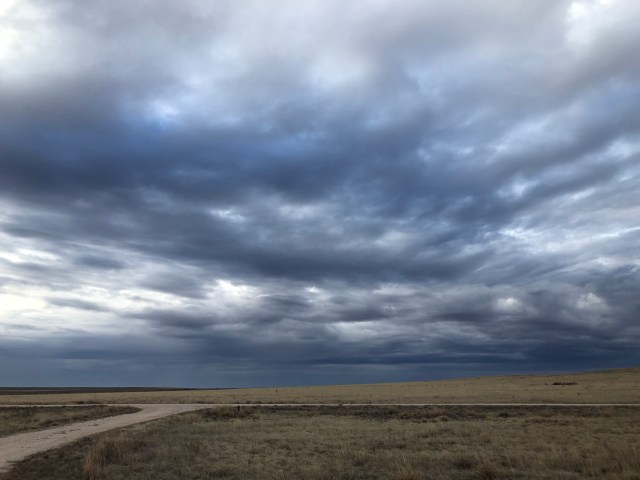
The next morning started with a cold rain, but by the time we headed back to the refuge, the rain was moving out of the area. Arriving before 8:00am, we saw a sky with clouds gathered in dark blue-gray masses and in some places stretched thin enough to be cottony white or even admit a patch of blue sky. In some places around us there were dark curtains of rain. Once again I was struck by the giant scale of this place. From horizon to horizon there was nothing to obstruct the sky, no trees and no buildings. All those clouds, all those mountains of water vapor, dark blue and dense or brightly illuminated where the sun struck them, slid across the sky on currents of wind. I meandered across the grassland, thinking of nothing as the clouds passed, trying to be empty of internal mental chatter so that I could absorb this experience in as raw and direct a way as possible. Standing here might have felt vulnerable, alone and uncovered to the sky, because in everyday life we rely on buildings, roads, signs, or even trees as cues for what is normal and safe. Instead I felt completely open and connected with the land and sky, without distraction.
Rain clouds at Muleshoe (photo by the author)
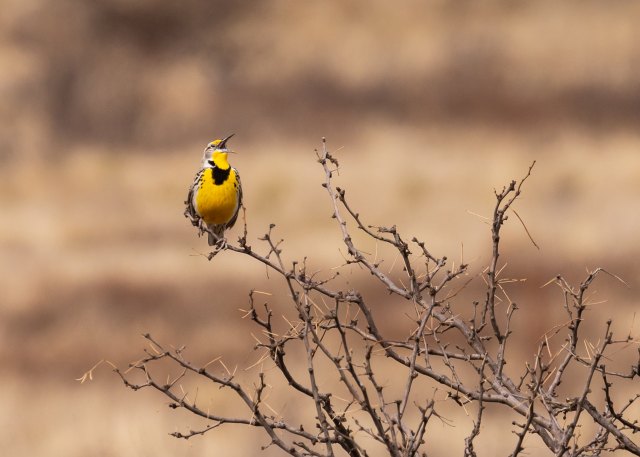
We saw a number of grassland birds, including meadowlarks. The Western Meadowlark prefers open grasslands and prairies, feeding as well as nesting on the ground. The Cornell Lab website indicates that they are still numerous but have declined about 1% per year over a period of nearly 50 years. It had been a while since I had seen one, but here they really were numerous, though quick to fly off when we approached. Our best observations happened when we used the car as an improvised bird blind. From the open window we watched and listened as a male sang his heart out while perched high on a thorny shrub, his musical whistling notes rising and falling. The call has been described as flute-like, with high notes dropping, coming back up and falling into a low warble. If we did not love this grassland already, we would have after listening to the meadowlarks singing spring into existence here at the end of winter.
Meadowlark (photo by Meghan Cassidy)
Meadowlark singing (video by the author)
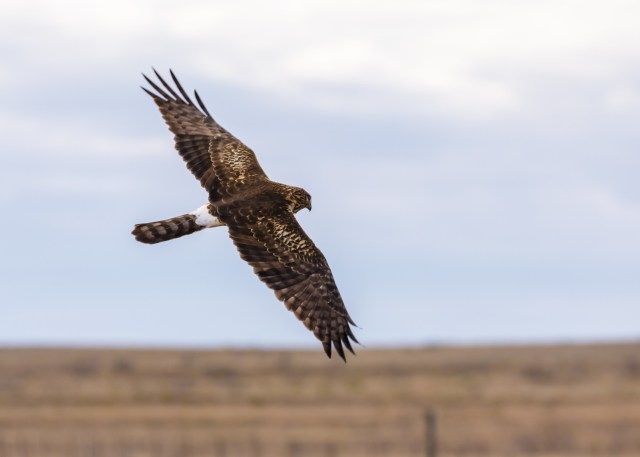
Our meadowlark dropped to the ground when a Northern Harrier cruised through the area, flying low and looking for prey. These raptors have a very distinctive white patch on the rump that helped us to identify them on the refuge and in nearby areas. They hunt near the ground, listening as well as watching for food such as rats, mice, birds, and the occasional small snake or lizard. As our meadowlark hunkered down under the grasses, the harrier sailed by and circled the area, at one point fixing us with a withering stare. He reminded us of why so many animals are cryptically colored, alert and fast, or take shelter in burrows in the ground. Harriers, owls, coyotes and other predators are a constant presence, weeding out the slow, the sick, and the unlucky. This constant dance between predator and prey added another dimension to what we took away from Muleshoe National Wildlife Refuge. It is a beautiful, wild place that seems larger than life, with a complex community of living things on the ground as well as above and below it.
Northern Harrier (photo by Meghan Cassidy)
It was a great trip and my notes, and especially Meghan’s photos, will be a memorable part of this project, which will take us to places all around the state.
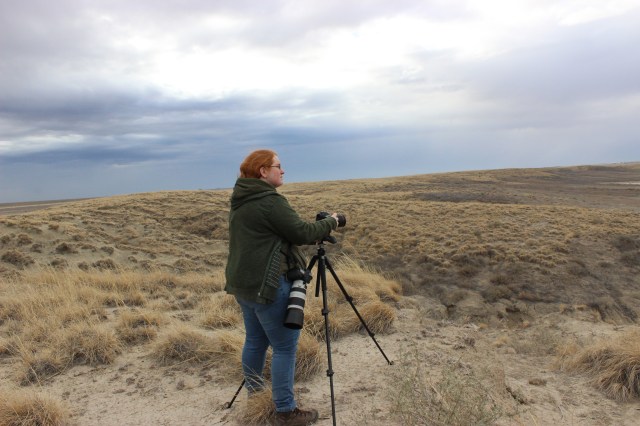
Meghan, photographing White Lake from a ridge (photo by the author)
This isn’t the usual sort of post for this blog. I’m looking through some of the literature about mindfulness, and I plan to post a few summaries of studies, at least for my own understanding of it. If you’d like to look at little more closely at mindfulness, please join me.
Shapiro, S.L., Carlson, L.E., Astin, J.A., & B. Freedman. 2006. Mechanisms of Mindfulness. Journal of Clinical Psychology, 62(3), 373-386.
This article reviewed the mechanisms by which mindfulness might work and proposed a model of mindfulness. Much of the research on mindfulness evaluates the effectiveness of interventions such as Mindfulness Based Stress Reduction, and shows that it can effectively treat psychological as well as physical symptoms. To examine how mindfulness works, the authors break the practice down into three “building blocks” of mindfulness:
Intention – the issue here is “why are you practicing mindfulness?” It could be for such purposes as self-regulation (e.g. to relieve a physical symptom), self-exploration, or self-liberation
Attention – observing one’s own moment-to-moment internal and external experience. It does not involve interpretation, but simply paying attention to the present experience.
Attitude – the qualities that one brings with them to paying attention. For example, is it cold and clinical or is it a friendly and compassionate presence? When one pays attention to their experience in an open, curious, and kind way, the result may be a capacity to not constantly strive for one kind of experience or push another kind away. The desired outcome is an acceptance of what is.
The authors suggest that intentionally attending to experience with openness and without judgment leads to a shift in perspective that they term “reperceiving.” Instead of being immersed in our life story, we can stand back and witness it from a little distance. This perspective changes the experience and makes us less likely to react automatically. The authors draw a parallel between this and the development of an ability, as a child grows older, to take the perspective of another person. We are no longer caught up in a subjective or self-centered view of the other person and can more accurately understand the other person’s world. Reperceiving strengthens a sort of “observing self” who can observe conscious experience without being fused with it or defined by it.
Some additional mechanisms or processes are described as following from reperceiving. One is self-regulation. Intentional, nonjudgmental attention to our experience allows us to connect with what is happening without having to react and avoid. Automatic and maladaptive responses may drop away if we can experience anxiety or pain from a little distance, seeing it as a temporary thing that will pass.
Reperceiving can help us be more purposeful about choosing what really is important to us. While we might have adopted values based on what our culture or family provided, mindful observations make it easier to consider what is truly meaningful for us, choosing values reflectively rather than reflexively.
Greater cognitive and behavioral flexibility may follow from our ability to see our experience clearly and observe our internal commentary about it. Our thoughts may become less automatic and, more objectively observing our experience, we have more choice over how we think about and respond to our circumstances.
Finally, reperceiving may allow for us to tolerate greater exposure to emotions, thoughts, or sensations that previously were experienced as intolerable. If we can remain still, so to speak, in the face of such experiences, their power over us diminishes. The benefits of such exposure, in terms of decreased anxiety and avoidance, are well-documented in research.






 Our Lives In Nature