Getting to Know Some Reptiles

… and at least one amphibian

My interest in nature has been dominated by reptiles and amphibians (herps) starting when I was nine or ten and the girl across the street invited me to come along and find garter snakes in Colorado. I was active in herpetological societies twenty-five years ago and I’ve been teaching incoming Master Naturalists about these animals for some years. I’m interested in the “big picture” of ecology and natural history, but herps are still an important focus.
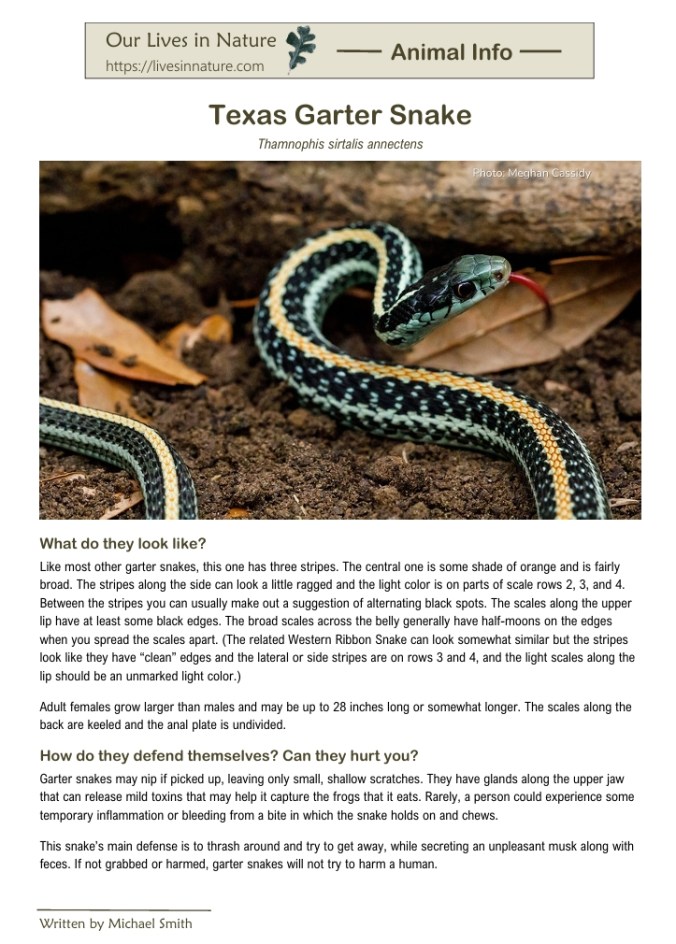
Herp conservation is very important to me. If you’d like to learn more and support some important work, please check out the Amphibian and Reptile Conservancy and the Orianne Society, among other organizations (such as Texas’ own Texas Turtles). I’ll be giving talks about reptile and amphibian conservation in Texas over the next few months, and while preparing, I’ve added some species profiles to the downloadable pdf files on my herpetology page.

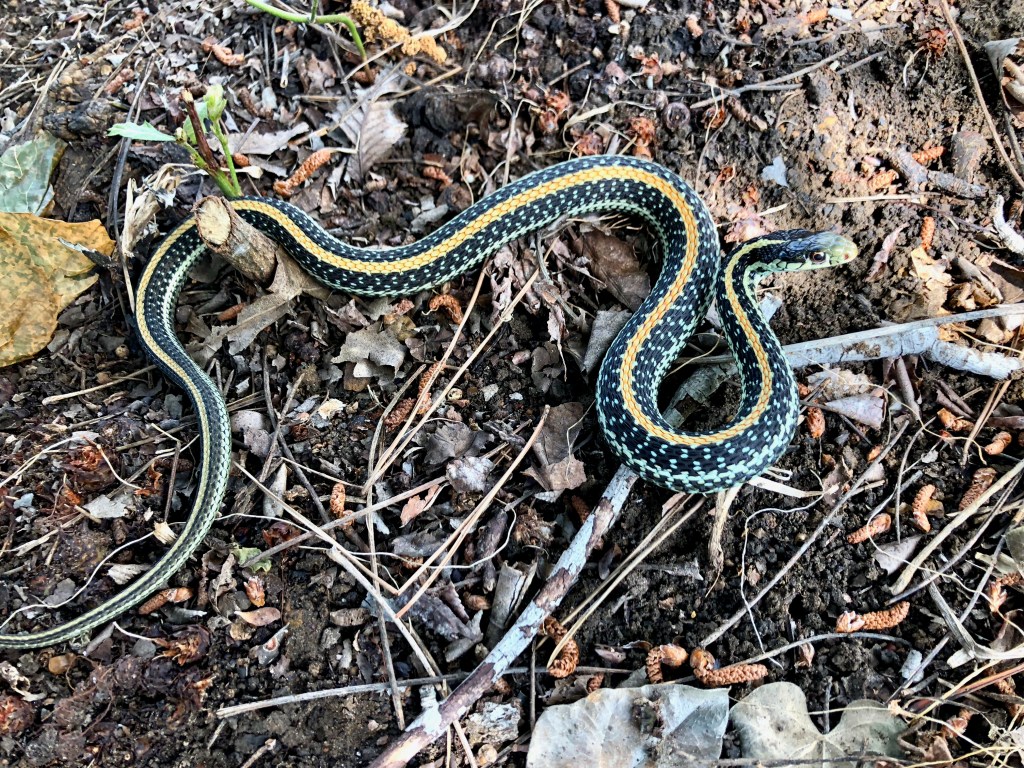
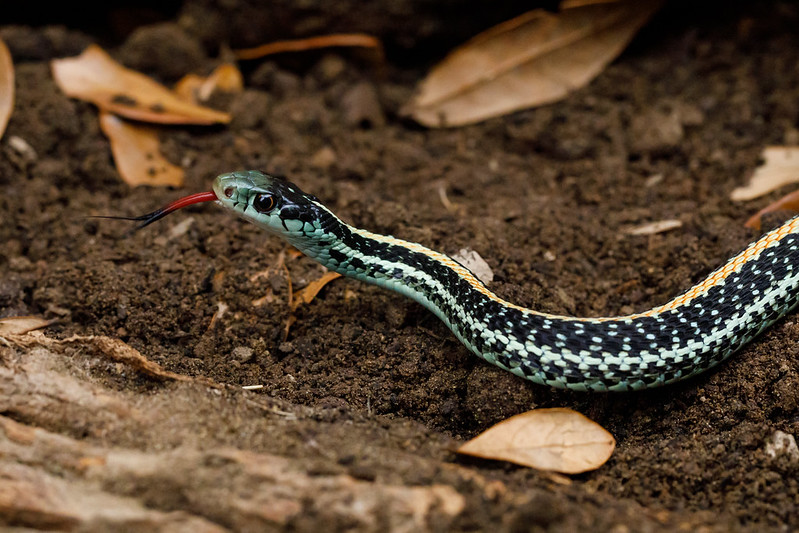
Among them is information about the Texas Garter Snake, a subspecies of the “Common” Garter Snake. Across the years, I have found a handful of Texas Garter Snakes, and they turn up occasionally on iNaturalist, but as far as I can tell they have never been common. There seemed to be particular spots or areas where they had viable populations, but even in those places a search for them was always hit-and-miss. That turned out to be the case in 2013 and 2014 when a group from UT Tyler started a project to investigate its genetics and preferred habitat. They did not find any, and had to rely on a few museum specimens in order to finish the project (published in The Southwestern Naturalist in 2019).
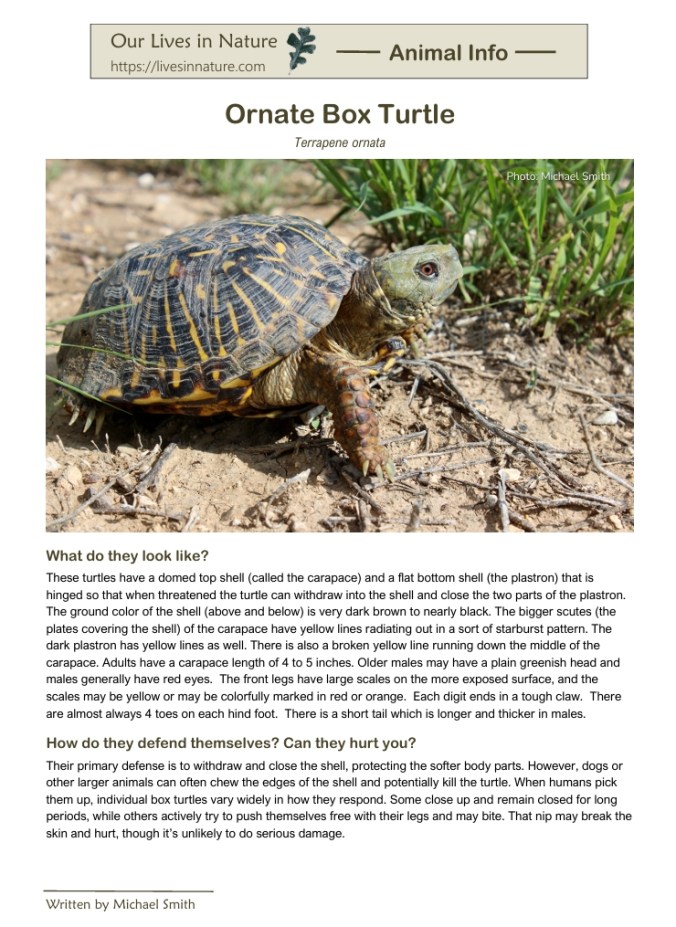
Another profile covers the Ornate Box Turtle. I have loved box turtles since I was a kid (and at least half of Texas would say the same thing, until they became uncommon enough that kids didn’t get many chances to see them). They have suffered from habitat loss and fragmentation, road mortality, and the unfortunate tendency of our species to want to collect and keep interesting and cute animals. In recent years, Texas protected box turtles from commercial collection. However, people still pick them up and take them home. Like turtles generally, their success depends on living long lives once they become adults. Collecting one is like running it over on the road – it is “dead” to the reproductive population of turtles.

And Texans of a certain age recall when the Texas Horned Lizard could be found in back yards and local parks. In the 1960s these places were often dotted with Harvester Ant colonies with a big bare circle of ground around the opening to the colony. These were the horned lizard’s food, and when people poisoned the ants (and later when the fire ants largely replaced them), there was nothing for horny toads to eat. Also in the 1960s, large numbers of these lizards were collected and shipped off to the pet trade where they inevitably died. But probably the biggest deal, according to Andy Gluesenkamp, was the loss and degradation of habitat. Native Texas prairies, with bunch grasses, open areas, ants, and the right combination of shelters and wildlife “neighbors,” were great for them. Monoculture pastures of non-native grasses, the increasing network of roads, the invasion of fire ants, and other factors have eliminated Texas Horned Lizards from many of the places where they used to be found. (Gluesenkamp led the San Antonio Zoo effort to captive breed and release young horned lizards in suitable habitat – an effort that is working.)

So far, the sole amphibian I’ve profiled is also one that biologists are concerned about. There is little real data concerning how Woodhouse’s Toad is doing, but it is the species that many of us used to see on spring and summer nights in North Texas. It has largely been replaced by the Gulf Coast Toad, but away from the cities there are places (like the LBJ National Grasslands) where Woodhouse’s Toad seems to be the predominate species. Overall, the species is considered secure, but are we sure? Wildlife agencies and universities have limited resources and cannot study everything. Everyday folks documenting what they see on iNaturalist help a great deal, but there are still enormous gaps in our knowledge of the status of most of our herps.

There are other species with these two-page downloadable pdf profiles, including the Texas (Western) Rat Snake, the Great Plains Rat Snake, the Long-nosed Snake, Rough Earth Snake, and Checkered Garter Snake. I hope you’ll use them to share with home schoolers, scout troops, or anyone else who would like them. I’d be happy if you’d like to leave a contribution, but if you can’t, that’s fine. And maybe leave me a note about anything else you’d like to see. Our venomous snakes are briefly summarized in my “Identification Guide to Venomous Snakes of North Central Texas,” found on the same page.
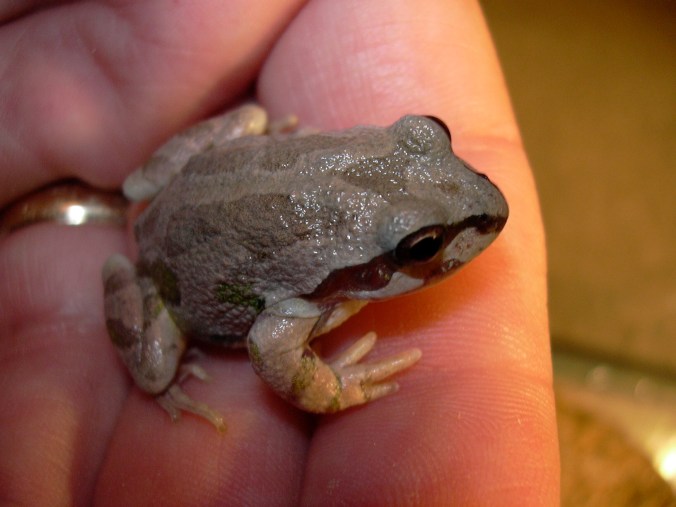
Celebrate – It’s Amphibian Week

This week, take a moment to remember the frogs, toads, and salamanders of North America. It’s Amphibian Week, started in 2020 by the Partners in Amphibian and Reptile Conservation (PARC) and partners such as Save the Frogs! These animals are important to the ecosystems in which they live, partly because predator species depend on them being so numerous (in places their biomass – total mass of amphibians – makes them a significant source of food to support the community). One way that they are important to us is how the calls of frogs and toads bring the nighttime to life in many places. The famous herpetologist Archie Carr said, “Frogs do for the night what birds do for the day: They give it a voice.” And amphibians are important just because; like other species, they have intrinsic importance.

Strecker’s Chorus Frog

To celebrate, here is some information about Texas amphibians, adapted from the pdf file you can find right here on my “herpetology” page. Here in North Texas it is expected to be rainy for part of this week, and the amphibians will appreciate that. Maybe you can get out to a wetland in the evening and listen for some frog and toad calls.
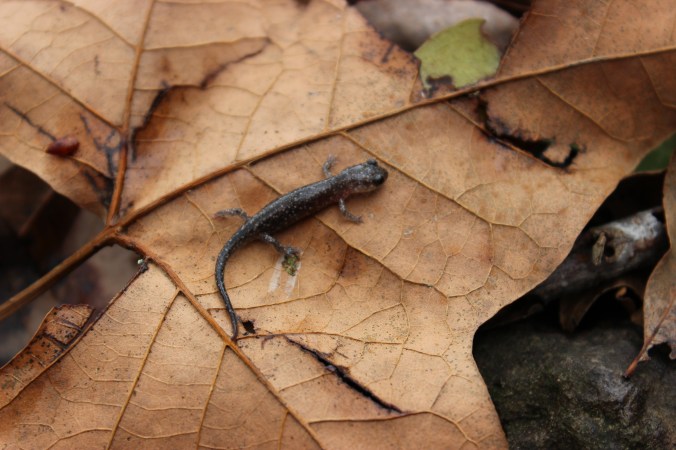
Amphibians include frogs, toads, salamanders, and caecilians. All of them are vertebrates that cannot generate their own body heat – that is, they are “cold blooded” or ectothermic. Amphibians have smooth, slimy, or warty skin which allows them to “drink” through the skin but also makes it easy for them to lose water by evaporation. They lay eggs without shells and almost all species hatch into an aquatic larval stage. One of the exceptions to that rule is the Slimy Salamander, which lays eggs in moist soil and leaves, and embryos develop into miniature adults before hatching. For other species, after growing and developing in ponds and streams, tadpoles and most larval salamanders change from aquatic, gill-breathing animals to animals that breathe air with lungs.
A very young Western Slimy Salamander from Williamson County

Frogs & Toads

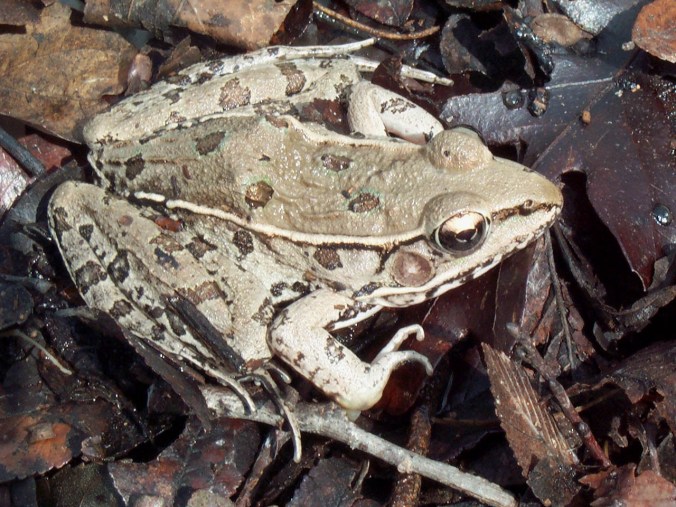
Toads have relatively dry, warty skin, shorter back legs compared to most frogs, and often live further from water than frogs. Most frogs, on the other hand, have slimy and fairly smooth skin and longer back legs – they can leap where toads only hop. Both frogs and toads are dependent on water or moisture and often live near the water’s edge or in places where there are moist refuges. Toads may live in fairly dry habitats like prairies (a few live in the desert). Frogs don’t have to stay right beside the water; at night in some places we might see leopard frogs or bullfrogs wandering some distance from the nearest creek or pond.

A leopard frog at Fort Worth Nature Center & Refuge

Frogs and toads have a “seat patch” of skin that easily absorbs water and that is how they drink! Many toxins can easily cross an amphibian’s skin, making many of them particularly sensitive to pollution. (Do not handle them if you have chemicals such as insect repellent on your hands.) On the other hand, frogs and toads secrete various toxins from their skin, which helps protect them from infections and in some cases may help protect against predators. Most frogs are completely safe to handle, and none will give you warts! However, do not rub your eyes or get your fingers in your mouth after handling them. The skin secretions of toads can result in a burning sensation if it gets in your eyes.

Woodhouse’s Toad

The males of the various species of frogs and toads “call” to females during breeding. This often takes place in the water of ponds and creeks, because when a female approaches a suitable male and they pair up, she will lay eggs in the water as the male fertilizes them. The calls of frogs and toads are a little like bird song, in that different species have different calls and an experienced listener can identify the species by listening to the call. A very good book with audio recordings of many calls, is The Frogs and Toads of North America, by Lang Elliott and others.

Many frog and toad species that used to be common have become harder to find or even disappeared. In many places, populations of frogs and toads are being monitored to see how they are doing.

Salamanders

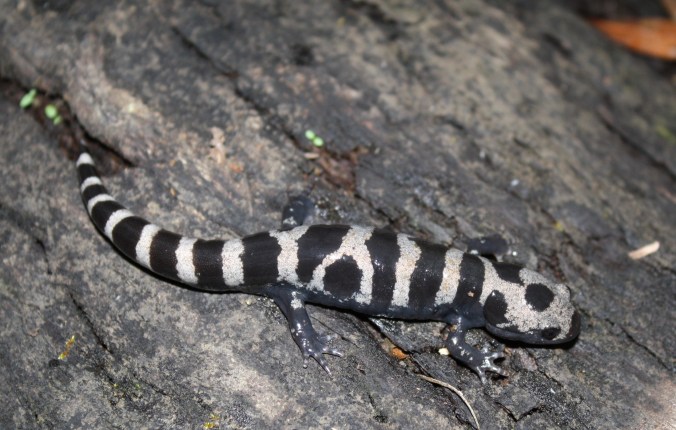
A Marbled Salamander from White Oak Creek WMA in northeast Texas

Many of them may look a little like lizards, but salamanders are not reptiles; they are amphibians. They have skin that may feel rubbery, slimy, or slightly rough, but they do not have scales and they can dry out easily. Like other amphibians, most of them start out as eggs laid in water. Instead of a shell, the egg has a clear membrane through which you can see the embryo developing. With a few exceptions like the slimy salamander mentioned above, here is what happens next: When the eggs hatch, the babies are not like adult salamanders, but are larvae that breathe in the water using gills. This is the salamander version of a tadpole. Later, most of them change into an air-breathing adult form (one group, the lungless salamanders, do not have lungs as adults). Some salamander species live entirely in the larval, aquatic form, and these are called “neotenic” salamanders. Neotenic salamanders are not a different kind of salamander, but the term “neotenic” simply describes the fact that the salamander did not change into an adult, air breathing form.

One group of salamanders, called “sirens,” always remain aquatic and do not develop hind limbs. They are long and eel-like. Another group that is always aquatic and whose members have a long body like an eel are the “amphiumas.” Some of these animals, like the “western lesser siren,” are relatively small. In contrast, some amphiumas can reach lengths of over three feet.

A Small-mouthed Salamander seen at Old Sabine Bottoms WMA in East Texas

Because they depend on healthy wetlands or other habitats that are shrinking because of things like development for human use or drought and climate change, salamanders are in trouble. Like frogs and toads, their skin is porous and they “drink” through their skin. This makes them particularly vulnerable to chemical pollutants in water. Overall, because of pollution, diseases, habitat loss and other reasons, amphibians are disappearing in many parts of the world. See organizations such as AmphibiaWeb for more information. You may also be interested in my book, The Wild Lives of Reptiles and Amphibians: A Young Herpetologist’s Guide, from Texas A&M University Press.

RIP, Tex

Nearly ten years ago, I was given a young Texas garter snake. A landowner in North Texas had picked him up on his land (where he reported seeing that subspecies regularly) and wanted verification of which kind he was seeing. I drove there with a friend and was delighted to hear that this farm seemed to be one of those little pockets where the Texas garter snake was doing OK. They have always been pretty hard to find, but some places are better than others. Texas Parks & Wildlife Department considers them to be “critically imperiled.”

Tex, back in 2018

I accepted this young one because it evidently would not be a noteworthy loss for that local population, and because he could be an ambassador for threatened Texas snakes. I’ve taken him to quite a few talks and presentations to new groups of Master Naturalists and to school or summer camp groups. Seeing Tex was a good way for people to learn how being a striped snake helps you escape by giving the appearance of being stationary – the stripe doesn’t seem to move – while you are slipping away. And of course he was a living example of an animal I said was in serious trouble and might disappear, for reasons that no one is sure about. It could involve things like habitat loss, habitats fragmented by roads, fire ants, and maybe other things.

In a study in the 2019 issue of Southwestern Naturalist, researchers looked at the genetic status of The Texas garter snake (Thamnophis sirtalis annectens) and two other related garter snakes that occur in Texas. They also looked at suitable habitat, finding that in Texas, where T. s. annectens does better than the other subspecies is in the area of the Cross Timbers, parts of the Blackland Prairie, and some of the Post Oak Savannah and down toward the coast. The study did not look at why it is imperiled.

I wrote about one of the times I took Tex to meet some kids at River Legacy Nature Center, when a girl had commented that she hoped one day they would be protected. On days like that I felt like Tex living in captivity (rather than living out his life on that farm) was worth it. Tex, of course, was silent on the matter.

But he was happy to nap under a piece of bark, cruise around the cage and eat the occasional mouse. His siblings and cousins in the wild were probably snacking on small frogs and earthworms, but most garter snakes can be convinced to eat thawed mice from the store. He grew and seemed to thrive, and living about ten years is not bad for a garter snake. (Their life span in the wild is assumed to be less than that, and sometimes in captivity they may live longer than ten years, but the evidence about their longevity is fairly spotty.)

And now he has died, I presume from something akin to “old age.” RIP, Tex. You charmed a lot of kids; a lot of Master Naturalists around here know your kind based on getting a look at you. I’ll miss you.

A Most Athletic Snake

The Western Coachwhip

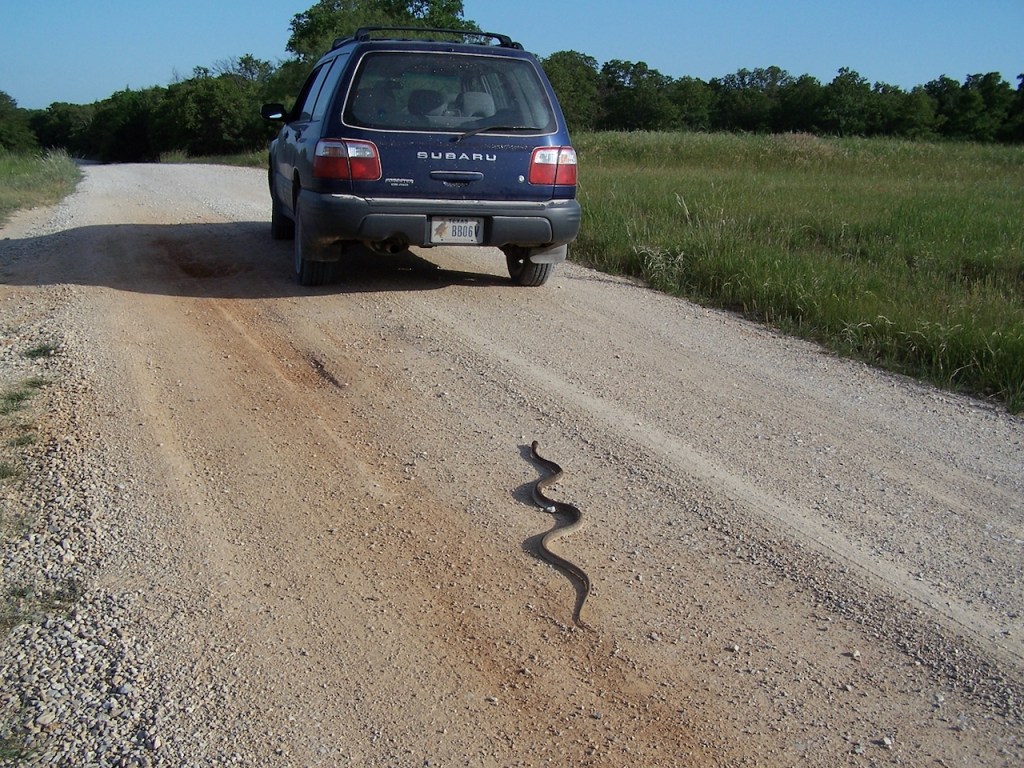
It has happened several times – driving out in the grasslands or desert, I pull up on a long, slender snake that sees me before I see it. Perhaps its head and neck periscope up a foot or more for a better look at me. If I get out and creep slowly toward it, the snake keeps a careful watch on my distance and speed. At some point I cross a line in the snake’s calculation of risk, and decides it is time to go. It bursts into agile and athletic motion that carries it unerringly around rocks and through brush piles. In my younger years I sometimes chased but rarely caught them. The only realistic opportunity to catch one was to surprise it, lifting a log or discarded piece of plywood and finding the snake hesitating for a moment.

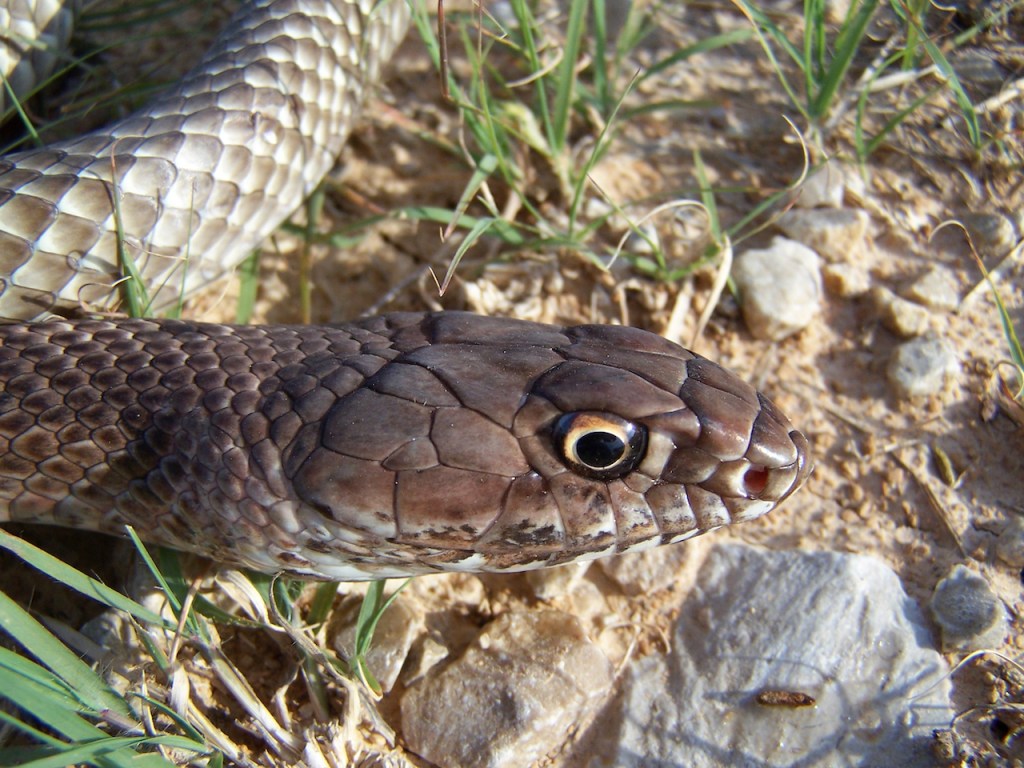
The western coachwhip seen in 2006 at LBJ National Grasslands

Occasionally I caught a coachwhip when it believed itself to be concealed or camouflaged. I once surprised one on a gravel road in the LBJ National Grasslands, and it quickly slipped off the road. I pulled over and investigated a grassy area where I last saw it and found four feet or so of tan scales blending very well in the dappled sunlight along the ground. I grabbed the snake and then worked to calm its thrashing body so that I could take a photograph. After a short time the snake was calm enough for me to put it on the ground, covering its head and restraining its body just enough so that it did not struggle. 

Then it tried a different strategy that suggested some form of death-feigning. Coachwhips have occasionally been described as feigning death to discourage an attacker from continuing whatever it is doing. After all, there is no need to attack a dead snake. This one went limp but turned its head and neck to the side. A hog-nosed snake will flip over in death-feigning, as if the only way to be properly dead is upside-down, and this snake seemed to be doing a much less dramatic version of “playing dead.” 

I posed the snake in a more normal position, took a couple of photos, and then encouraged it to be on its way. I positioned the snake in something closer to a straight line and backed away. In a moment it came back to itself and took off, crossing back across the road at typical coachwhip speed.

What are coachwhips?

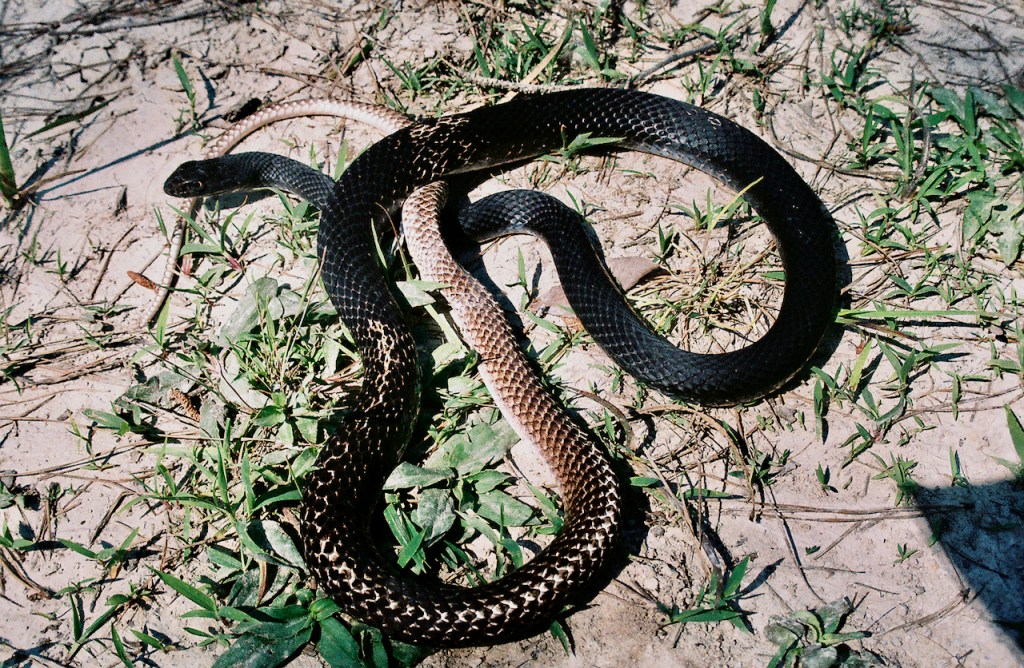
One or another species or subspecies of coachwhip is found all across the southern U.S. In the east, including in parts of east Texas, much or all of the eastern coachwhip’s body may be velvety black. In central and west Texas the subspecies is the western coachwhip, with light brown or tan colors, often with a darker head and neck that may be rusty brown. In parts of their range, some of these coachwhips may have a banded appearance, with long, broad bands of a little darker color alternating with broad lighter bands. In the Trans-Pecos region, some of the western coachwhips are pink or reddish. Traveling with friends, we found one in Big Bend National Park that propelled itself off the road nearly in a blur, and I described it as looking like a snake with the world’s worst sunburn. (We stopped, but never found the snake.) Western coachwhips usually reach four to five-and-a-half feet, sometimes longer. Coachwhips are related to racers and whipsnakes, all of which are active by day, visually alert, and very fast.

Eastern coachwhip seen in the Big Thicket region

The name “coachwhip” comes from the color of the dorsal scales. Each one is light-edged as it emerges from under the previous scale, then becomes darker until it is dark brown along its trailing edge. This highlights the edges of scales, and toward the tail it gives the appearance of a braided whip.

Where do they live and what do they eat?

Coachwhips are, even in East Texas, snakes you expect to see in patches of prairie, openings in woodlands, or rocky hillsides. In the rest of Texas, they are well-adapted to open arid or semi-arid regions where they take advantage of openings beneath rocks, rodent burrows, and such refuges. They are able climbers and may take refuge in shrubs or lower tree branches when escaping predators. Within the Chihuahuan Desert they are seen in dry arroyos and desert flats, with desert shrubs and clumps of cactus offering shelter, along with mammal burrows.

As witnessed recently by my friend Rosealin Delgado, they are able climbers and may take refuge in shrubs or lower tree branches when escaping predators. She was at the edge of a pond at Sheri Capehart Nature Preserve and saw one emerge from the water’s edge (where the snake may have been getting a drink), periscope up and take note of her, and then climb up in low trees. The snake watched her for the better part of ten minutes before she left.

The coachwhip’s diet can be quite varied, depending on the prey available where they live. They readily eat lizards, spotting them and chasing them down. In some places they are reported to sit at the base of plants such as mesquite and wait for prey such as a lizard to dart into the shade to cool down. Coachwhips will eat smaller snakes, and they may poke around in crevices or burrows where they may find and eat mice. Around bat caves, coachwhips sometimes find and eat bats that are injured or stranded on the ground. They eat large insects such as lubber grasshoppers.
Having no venom to subdue prey, and not using constriction to kill the mouse or lizard before eating it, the coachwhip relies on strong jaws and a strategy of pinning prey against the ground. After catching a lizard and holding onto it with sharp little recurved teeth and a powerful bite, the snake points its snout toward the ground and pushes its prey against rocks or soil to help prevent escape and then begin swallowing. In our book, Herping Texas, co-author Clint King described watching a western coachwhip catch a Great Plains skink and beat the lizard repeatedly against the ground. Some of this might have been to dislodge the lizard’s biting the snake in a counter-attack, but it also appeared to be to stun or disable the lizard before swallowing it.

Reproduction

Coachwhips mate in the spring, typically in April or May. Within a month, the female lays a clutch of eggs in some place where they will be protected from drying out or overheating, and hopefully where predators will not find them. Such a place might be an abandoned burrow or under a rotting log. By August or September, the brightly marked babies hatch, measuring 12 to 14 inches long according to Werler & Dixon (2000). 

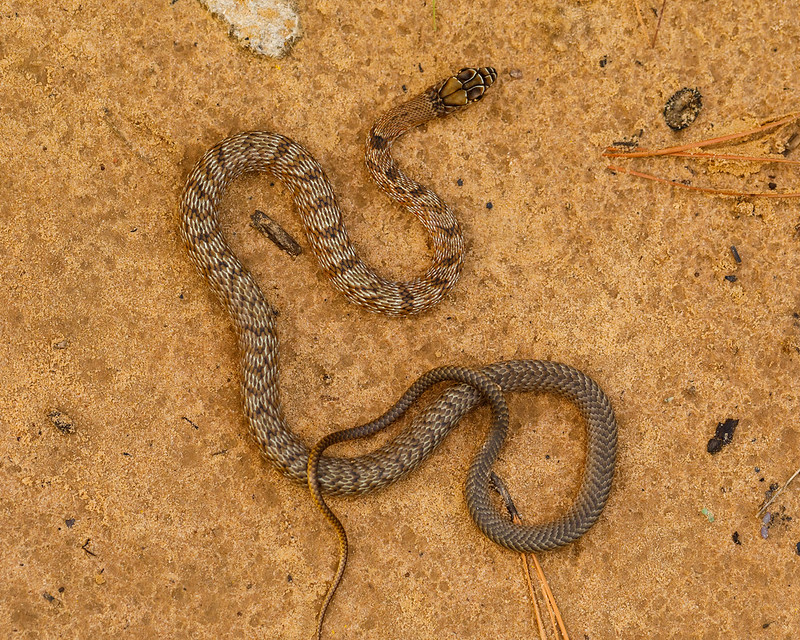
Juvenile western coachwhip found by Meghan (photo by Meghan Cassidy)

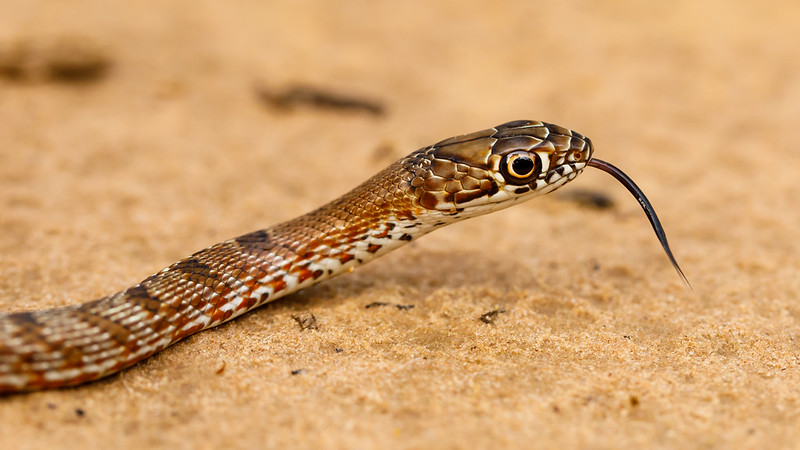
On a walk at LBJ National Grasslands in September of 2020, my friend Meghan Cassidy found a hatchling coachwhip and she took a number of beautiful photos of this little reptile. As is typical, its eyes were large (as befits an active, visual snake such as this) and it was slender and fast. Its coloration was bright, verging on orange along its neck. There were a number of thin crossbars of darker scales that would likely fade as the snake grew. I described our encounter with this snake in Mindfulness in Texas Nature.

The head and neck of the juvenile coachwhip (photo by Meghan Cassidy)

Human perspectives and tales

No matter what your grandpa told you, a coachwhip is not going to wrap around you and whip you, regardless of its name and appearance. It seems likely that those old stories might have begun when someone caught a coachwhip and its long body wrapped around the person’s arm and, as it thrashed and tried to escape, whipped its tail against its captor. 

Fewer people seem to have heard such stories, and we usually think of that as a good thing. After all, we don’t want people believing misinformation such as hoop snakes that roll down a hill and sting you, or milk snakes that will suck the milk from cows in a barn. But I worry that the disappearance of tall tales is not because people today are more savvy, but instead that they have so little contact with nature that there is no experience that would give birth to the tales. Stories about writhing balls or nests of cottonmouths arise when people see something and struggle to understand it, and they fill in missing details with fanciful explanations. 

So I hope that you and your friends and family will be out in the field enough that you notice coachwhips and other things in nature, and come up with stories to account for what you saw. Read and listen and learn what you can so that your stories are mostly based on accurate understanding. But I would gladly live in a culture that is connected to nature enough so that we have stories and legends about the natural world, such as the coyote as a mythical trickster or the snake that will whip you.


Smith, M. 2024. Mindfulness in Texas Nature. College Station: Texas A&M University Press.

Smith, M. & C. King. 2018. Herping Texas: The Quest for Reptiles and Amphibians. College Station: Texas A&M University Press.

Werler, J.E. & J.R. Dixon. 2000. Texas Snakes: Identification, Distribution, and Natural History. Austin: University of Texas Press.

Wild Lives at the Nature Center

On May 5th I started the latest round of The Wild Lives of Texas Reptiles & Amphibians, a four-part training that I offer with slides and discussion in class as well as time in the field. The idea is to dig down a little deeper about herp (reptile and amphibian) natural history, more than I’m able to when training incoming Master Naturalists. And the people participating get several sessions in the field, which is both fun and important when learning about how to find and interact with herps.

And so I got to meet several new people, one of them a 15-year-old who is new to all this and one a Master Naturalist in her 80s. They were all delightful. I covered some very practical issues like watching out for bull nettle and how wild snakes, including venomous species, usually respond when we encounter them. I also gave a quick overview of taxonomy and scientific names, though the discussion about why some of these names keep changing might have gotten a little thick – but it was brief.

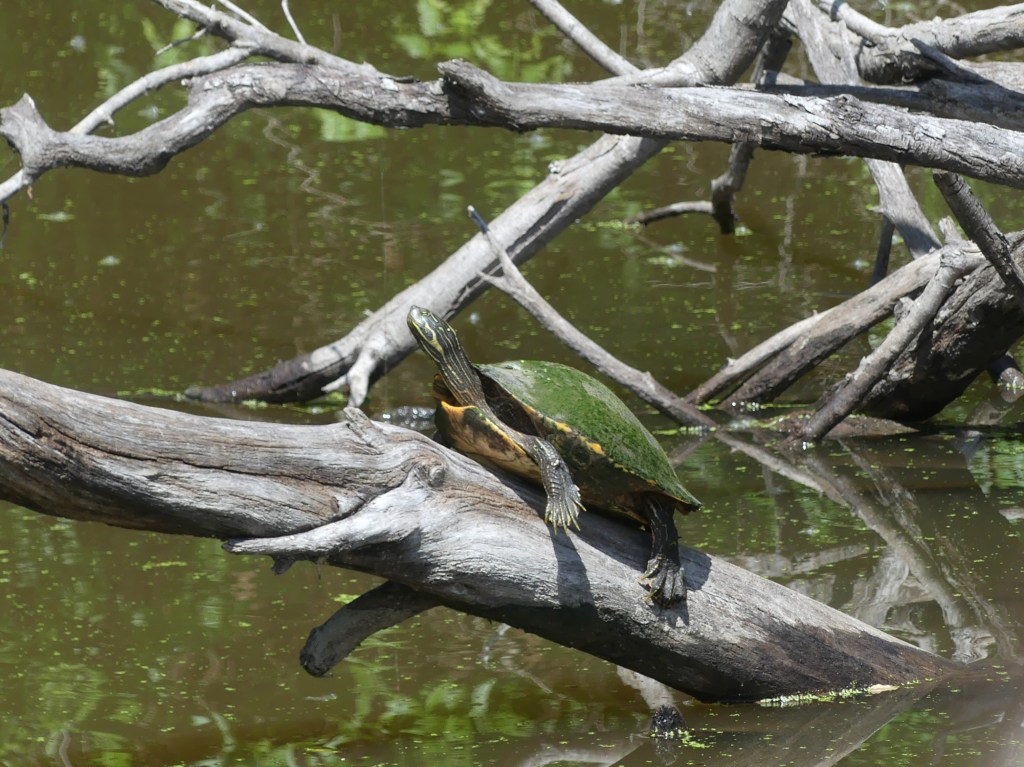
An eastern river cooter basking in the warm sunshine

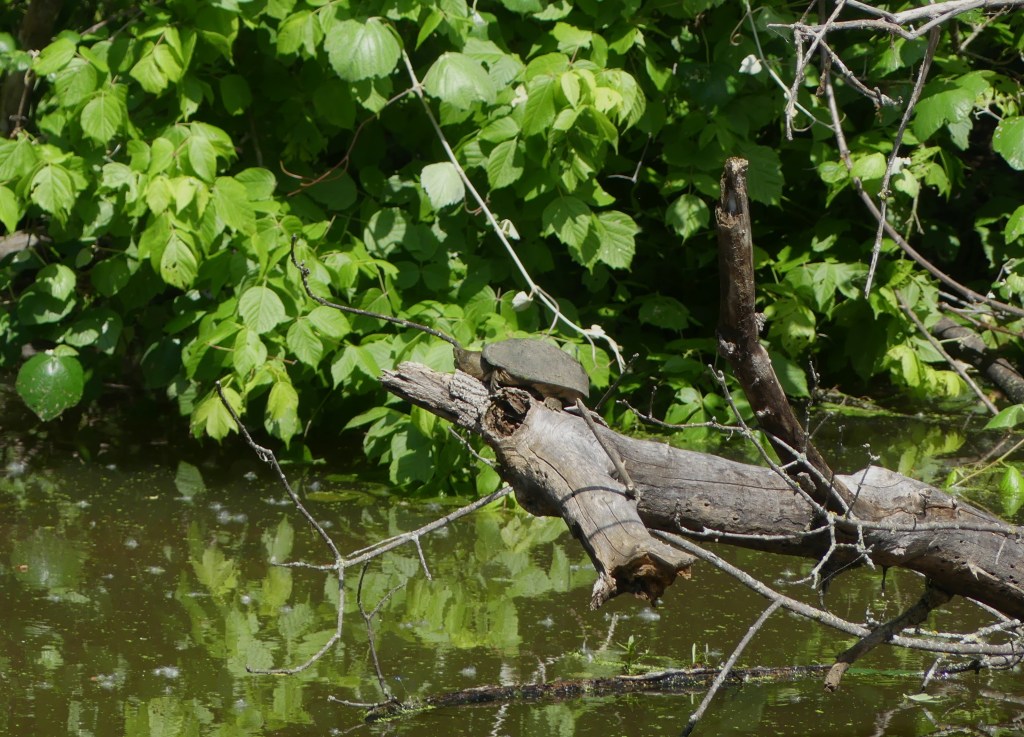
At 3:00 it was time to take a walk; the rain clouds had parted and it was a sunny and beautiful day at Fort Worth Nature Center & Refuge. We walked up the Cross Timbers trail along the Trinity River for a while, with the long, torpedo bodies of gar easily visible and the big scales and reddish fins of carp breaking the water’s surface. Our first herps were the turtles swimming or basking on branches of fallen trees. I am used to seeing more red-eared sliders, but today the river cooters were more common. 

Witches’ butter, a type of jelly fungus

Meanwhile our group of 8 or 9 people were captivated by everything around us. After all the recent rain, the fungi were proliferating. Sheryl told us about some of the mushrooms as well as the jelly fungi like witch’s butter and wood ear. Soon, Caleb found a little brown skink. Those words serve as the actual name of the lizard as well as a description of it; they’re small and have a broad, coppery-brown band down the back, edged with a darker brown band on each side. They are sometimes described as “elfin,” perhaps because they are woodland creatures that are sometimes glimpsed for a moment as they make their way through the leaf litter. 

Sara gently restrains the little brown skink so we can get a good look before releasing it

Across the river channel along the opposite bank, I spotted an American alligator that we estimated to be a bit more than five feet long. This one was half-submerged and presumably basking in the afternoon sunshine. Sometimes people are surprised that we have alligators in the DFW metroplex, thinking that they belong in the swamps of Louisiana or Florida. But the American alligator has made a significant recovery from the days when it was hunted to near-extinction. 

American alligator

Our ‘gators are generally found in secluded spots in or near the Trinity River. They are mostly shy around humans, though people on Lake Worth sometimes see them basking out in the open, seemingly without a care in the world. What I had shared with the group is that alligators should be admired from a distance (Texas Parks & Wildlife Dept. advises staying 30 feet away), and that alligators can run faster than we can for short distances. And yet, there are no records of people in Texas being killed by alligators and relatively few injuries. 

The razor-backed musk turtle

One of the turtles basking over the water was clearly not a cooter or slider, but my camera lens was not pulling in enough detail. Caleb took a look and said he thought it was a musk turtle, and with the head and neck more visible in his photo I agreed. It appears to be a razor-backed musk turtle, a small turtle with a carapace (top shell) a little like a peaked roof. Such turtles are on the menu for lots of other animals, including that alligator we had seen. As a result, they are pretty wary and I’m a little surprised that this one didn’t drop into the water before we could take a photo. 

Sheryl (right) investigates a cluster of wood ear fungus, swollen and rubbery from the recent rain

While I checked the local temperature and humidity (87.6F and 45%), Eleanor brought me the first snake, a rough earthsnake. These small snakes are found in leaf litter and under logs, as well as under boards or rocks in old fields and in gardens. In those places they find earthworms and small, soft-bodied insects that are their food. 

A pallid spiny softshell, pulled mostly out of the water to bask

Meanwhile we continued finding lots of caterpillars as well as a variety of spiders. When the trail led us away from the river and into the woodland there were little refuges to investigate, in the form of fallen branches and logs. Could we find a frog or toad under one? Alaina did spot a leopard frog and chased it but it was soon lost in vegetation. The best things to turn over are bigger pieces that offer a larger area of shelter. Those are the ones that might conceal a ribbonsnake or cottonmouth (I brought a snake hook to insure that nobody turned a log by sticking their fingers under it). 

I talked about the absence of small-mouthed salamanders in these places at the refuge. Intermittently flooded bottomlands are where I would expect them, and some persist along the Trinity River floodplain in Arlington. There are 93 observations in iNaturalist (55 of them just since the year 2020), all clustered in that area, but no observations are in the vicinity of Lake Worth and Fort Worth Nature Center & Refuge. Why would that be the case? What difference in microhabitats, predators, water quality, or something else would account for it? That would be an interesting puzzle to solve.

Everyone seemed to enjoy the walk and all that we found. This class is off to a great start, and I’ll post updates after future meetings. The next session is about amphibians, and we will look for frogs and toads around sunset and listen for frog calls. I think it will be magical!

The Bullsnake Can Be a Gentle Giant

Sometimes, however, it is not so gentle: 

“A sudden encounter with a large, angry bull snake in the wild can be an awesome, even frightening experience for the uninitiated. Almost everything about the reptile’s defensive behavior looks or sounds menacing.”

– John Werler and James Dixon, Texas Snakes
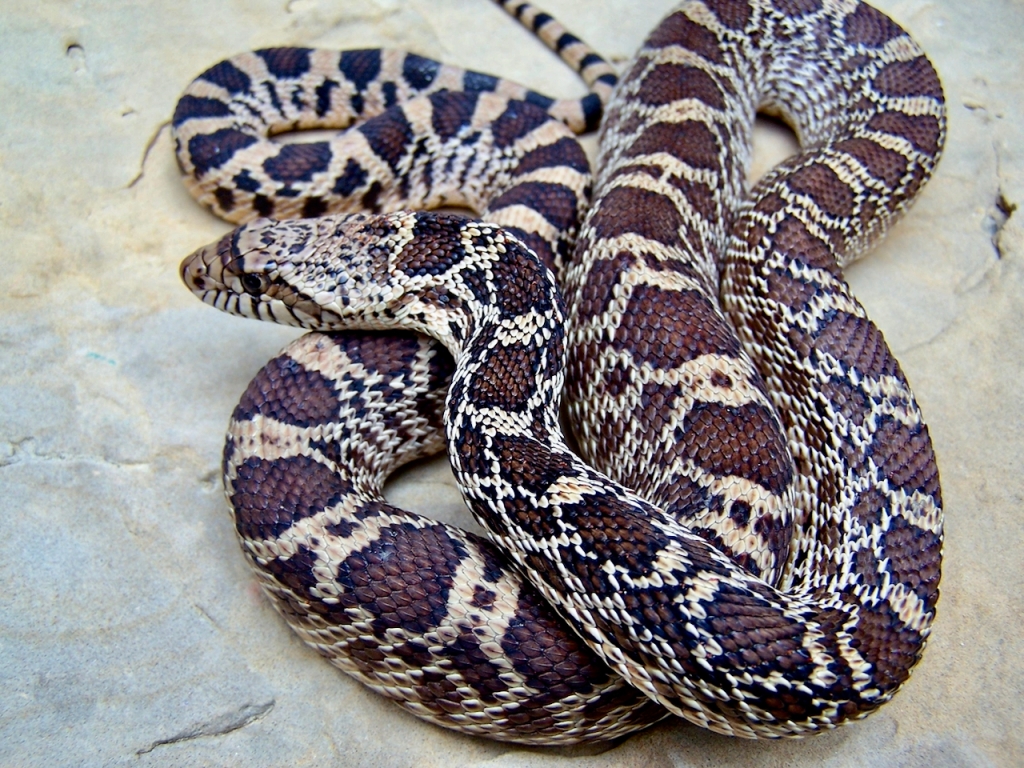
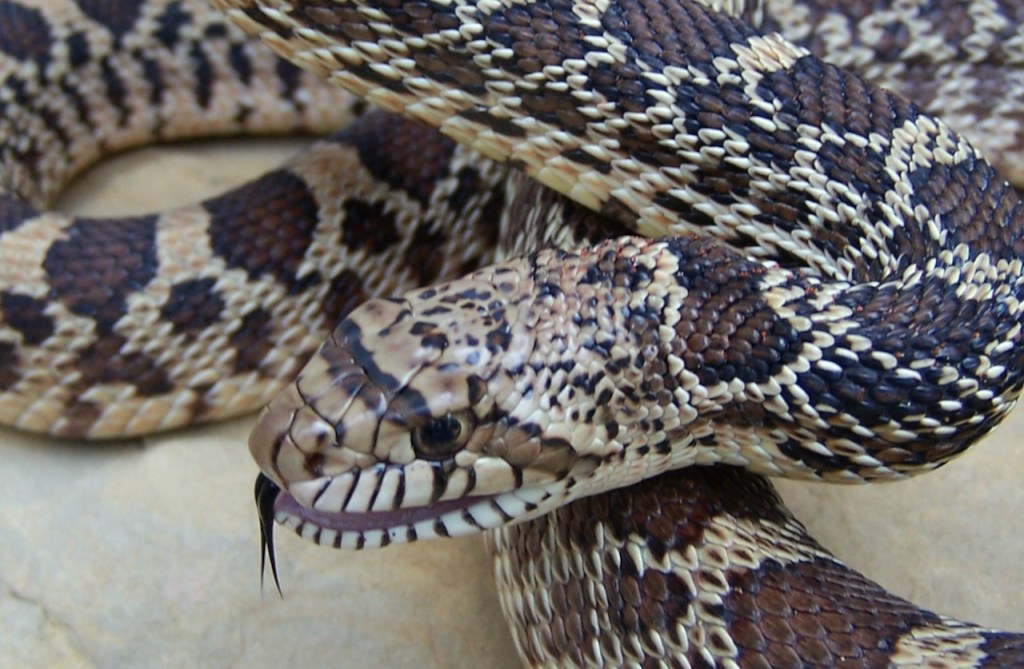
A defensive bullsnake from near Menard, TX. The vertical flap of tissue (epiglottis) can be seen toward the back of the mouth.

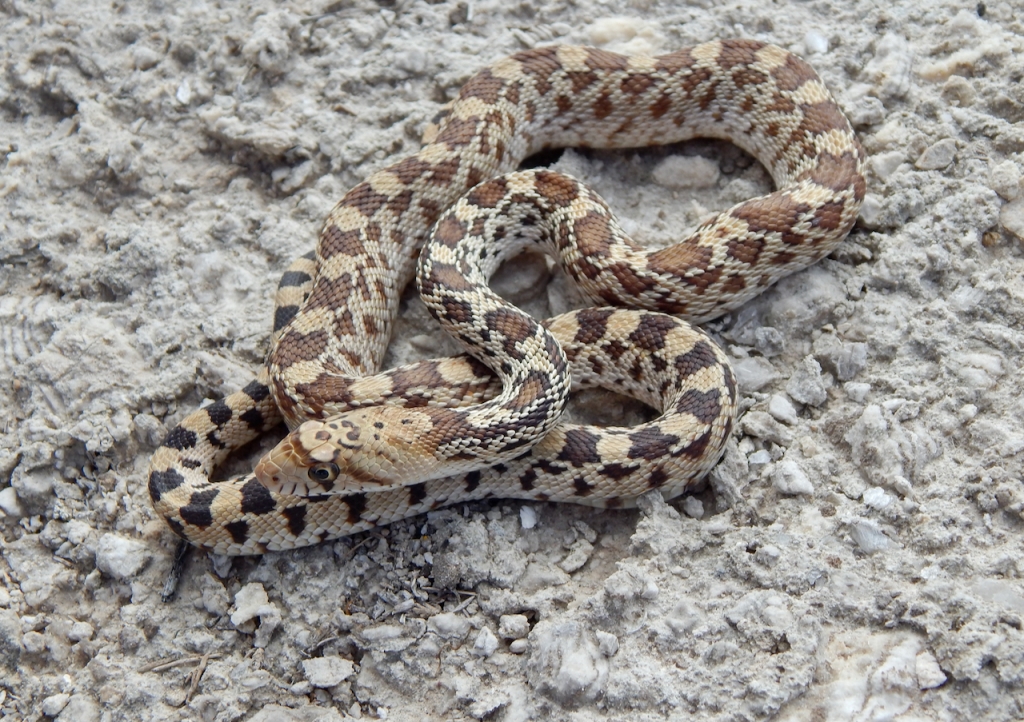
The bullsnake is a large snake, growing to lengths greater than five feet and occasionally approaching nine feet, according to Werler & Dixon. When threatened, this large snake generally pulls itself into a coil, vibrates its tail, and with head and neck held high and ready to strike, it hisses loudly. The snake’s mouth is open at least partly. A vertical flap of cartilage at the opening of the windpipe amplifies that hiss so that it is loud and has a little rattling quality, suggesting the high buzz of a defensive rattlesnake. 

If the source of threat is very close, the bullsnake will then strike at the offending animal or human with a dramatic hiss. Occasionally it is just a bluff; Clint King and I picked one up off a road one time to keep it from being hit by a car, and it hissed but never tried to bite. More often, bullsnakes are willing to bite. Their rows of sharp teeth leave nothing more than scratches, as the teeth are small and the snake has no venom.

A few bullsnakes have more timid or calm temperaments, especially those bred in captivity. Knowing how intimidating they can be when frightened, a calm bullsnake can seem like a gentle giant as its big, powerful body moves across your arms or shoulders. A snake like that is my favorite choice for educational presentations, hopefully adding to participants’ appreciation for native species.

A young bullsnake from near Weatherford, TX.

A bullsnake’s neck has dark brown rounded or irregular blotches which gradually become spaced further apart. There are dark blotches and spots on the side of the body as well, on a sandy or yellowish-brown ground color. Near the tail, the dorsal blotches become darker and the tail is nearly ringed by these dark blotches on a yellowish-tan ground color. The head is a light caramel or yellowish color with some dark freckles, and a darker brown band crosses the snout just in front of the eyes and runs diagonally through each eye and back toward the jaw line. Where most of our nonvenomous snakes have two prefrontal scales on the top of the head just in front of the eyes, the bullsnake (and the pine and gopher snakes) have four. 

The four prefrontal scales can be seen just at the front of that dark band across the head.

Let’s talk just for a moment about that name for the genus – Pituophis. Where does that name come from? A book from 1974, Snakes of the American West, claimed that this name translated to “phlegm serpent,” but this appears to be an error. I’ve seen a similar claim made in a self-published book on Amazon. I went looking for the real etymology of the word.

The second part of the genus (“-ophis”) means snake, but the first part derives from a Greek word for pine (“pitys”). An earlier synonym for the genus was spelled “Pityophis,” but you have to look through the research literature from many years ago to see that spelling. No matter how much the hiss sounds wet and rattling, it is not a “phlegm serpent.”

Where are they found?

The bullsnake is one of several species of Pituophis in the U.S. that range from coast to coast and from Canada to Mexico. In the eastern U.S., they are called pine snakes, and in the western U.S. they are gopher snakes. In the middle, reaching from northern Mexico up through central and west Texas, stretching out in the Plains states and up to southern Canada, is the bullsnake. 

In Texas, the bullsnake is found west of a line that runs approximately through the DFW metroplex down through San Antonio to around Victoria, according to Dixon. Around the Pecos River, it transitions into another subspecies, the Sonoran gophersnake. 

A juvenile Sonoran gophersnake (perhaps an intergrade with the bullsnake) from near the Guadalupe Mountains in Texas.

Natural history accounts of the bullsnake usually mention their preference for prairies and grasslands. A study from southwestern Wisconsin showed that they preferred bluffs with open spaces between trees and did not use closed canopy forest or agricultural lands (Kapfer and others, 2008). Werler & Dixon mention the bullsnake’s fondness for agricultural fields containing rodent prey. I don’t know how to reconcile the statements about agricultural lands.

What do they eat?

Most of the bullsnake’s diet is made up of small mammals such as mice, rats, gophers, and ground squirrels. They spend considerable time exploring burrows and tunnels to find their prey, according to Werler & Dixon. The snake is very well adapted for such behavior. The bones in the snout are more rigid than those of most snakes so that in sandy soil it can use its head to dig. The bullsnake’s skills as an excavator were described by Carpenter, who tested eight bullsnakes in an enclosure with sand substrate. The snakes generally began prodding the sand next to a stable object and began digging sand with sideways movements of the head. Then, the snake bent its head to the side to scoop loosened sand and move it away. A loop of the neck continued to push the sand backward. In further testing, bullsnakes were seen to excavate tunnels up to a meter long. Additionally, Carpenter examined whether bullsnakes would recognize pocket gopher mounds, and showed that these snakes actively explore and excavate pocket gopher burrows in attempt to eat the gophers. 

Once they locate a gopher or other prey animal, the bullsnake grabs and constricts it with powerful coils. What about rodents discovered in burrows? There may not be space to wrap around the rodent, and so the bullsnake uses a portion of its body to press the animal against the side of the burrow, ultimately having similar effect to constriction. 

Bullsnakes are also reported to be fond of eating eggs, raiding the nests of ducks and other birds. 

How do they reproduce? 

Bullsnakes mate “soon after they leave hibernation,” according to Werler & Dixon, in “late April or May” (page 235). A study by Iverson and others in the sandhills of Nebraska found courtship and mating to occur in May and egg-laying to occur in June or July. Bullsnakes lay very big eggs in protected, moist locations and they hatch around two months later. The babies are a little over a foot long. 

As our climate changes, winter dormancy may end earlier. Could this result in a shift in reproductive timing? And will hatchlings emerge into a hotter, drier environment here in Texas and find it difficult to thrive? I suppose we do not know. 

What conservation challenges do they face?

In the Iverson study in Nebraska mentioned above, the authors stated, “At the most intensive site of removal, where every bullsnake observed along a 1,100-m drift fence was removed or relocated for 8 consecutive years (Gimlet Lake), number of snakes captured during the same period each year did not decrease” (p. 59). That may be encouraging news about the potential for these snakes to withstand collection. It is not clear whether they can withstand other threats like habitat loss.

NatureServe shows the bullsnake as a species of “special concern” in Canada because of habitat loss and road mortality, while it is “secure” in the U.S. The International Union for Conservation of Nature (IUCN) considers bullsnakes and gophersnakes (Pituophis catenifer) a species of “least concern.”


Carpenter, C.C. 1982. The bullsnake as an excavator. Journal of Herpetology, 16(4), Pp. 394-401.

Dixon, J.R. 2013. Amphibians and Reptiles of Texas, 3rd Edition. College Station: Texas A&M University Press.

Iverson, J.B., Young, C.A., Akre, T.S.B., & C.M. Griffiths. 2012. Reproduction by Female Bullsnakes (Pituophis catenifer sayi) in the Nebraska Sandhills. Southwestern Naturalist, 57(1), 58-73.

Kapfer, J.M., J.R. Coggins and R. Hay. 2008. Spatial ecology and habitat selection of bullsnakes (Pituophis catenifer sayi) at the northern periphery of their geographic range. Copeia 2008(4), Pp. 815-826.

Shaw, C.E. & S. Campbell. 1974. Snakes of the American West. NY: Knopf.

Werler, J.E. & J.R. Dixon. 2000. Texas Snakes: Identification, Distribution, and Natural History. Austin: University of Texas Press.

The Speckled Kingsnake

“Well I’m a crawlin’ kingsnake

And I rule my den”

“Crawling Kingsnake,” John Lee Hooker (and The Doors & others)

Speckled kingsnake from southeast Texas

Even among people who don’t like snakes, kingsnakes get a certain respect and even liking. They are able to eat rattlesnakes and have considerable immunity to the venom, and some people assume that the kingsnake prefers to hunt them down. Most people recognize that the kingsnake is not venomous, and so they may grudgingly call it a “good” snake.

Kingsnakes constitute a big group, found across the U.S. from coast to coast. They are medium-sized to fairly big snakes with muscular bodies and relatively small heads. Here in Texas you can find the speckled kingsnake, the desert kingsnake, and the prairie kingsnake.

A fully grown speckled kingsnake may be three or four feet in length, but a few individuals reach greater lengths. Speckled kingsnakes are black or very dark brown with yellow to cream-colored speckles down their backs. As you travel across Texas from east to west, the speckled pattern gradually shades into the desert kingsnake’s pattern in which a series of dark blotches runs down the snake’s back. Those blotches interrupt the otherwise speckled pattern of the desert kingsnake. The scales are smooth and often give the snake a glossy appearance.

On the belly, the scales of speckled and desert kingsnakes may be yellow with black blotches or (especially in desert kingsnakes) mostly black with some areas of yellow.

Where are they found?

Speckled kingsnakes often choose habitat that is near water and has plenty of low vegetation and ground cover. Along the upper Texas coast, speckled kingsnakes may live in coastal prairie and on barrier islands near marshes, according to Werler & Dixon. In other parts of east and central Texas, they may be found in woodlands, prairies, and old fields as well as in the vicinity of marshes and other wetlands. In Arkansas, Plummer studied a population in an area that included irrigation ditches and levees, bottomland forest, and agricultural fields. The snakes mostly used shrubby areas on the levees and did not make use of agricultural areas. The kingsnakes were radio-tracked and when found they were usually concealed or underground (such as in an old mammal burrow).

What do they eat?

Speckled kingsnakes make use of a wide variety of prey, including small mammals, lizards and other snakes, frogs, reptile eggs, and the occasional bird. The kingsnake bites the prey to get hold of it and then wraps several coils around the animal’s body. Kingsnakes are powerful constrictors, and the pressure of those coils kills not just by making breathing impossible but apparently also by stopping circulation. Researchers studying boa constrictors found that constriction quickly and dramatically reduced blood flow and heart rate.

In at least one study, mice were the principal prey, but these kingsnakes are able to subdue and eat our native venomous snakes as well as nonvenomous ones. A snake that is as long as the kingsnake is swallowed and becomes kinked or folded in order to fit in the kingsnake’s lengthy stomach.

Other reports show that kingsnakes in this group are very fond of turtle eggs and have even been observed watching and waiting while a female turtle laid eggs (reported in Werler & Dixon).

How do they defend themselves?

These snakes cannot make an especially fast escape and they have no venom and only small, recurved teeth. Their best defense is to avoid being seen, and most of their time in spent concealed in low vegetation and leaf litter, under tree stumps or flat rocks, or underground. These places not only offer concealment, they are great places for them to look for prey. As temperature increases, speckled kingsnakes become more nocturnal.

If confronted or captured, however, speckled kingsnakes often pull back in a striking position and will bite, often hanging on and chewing with strong jaws. If grabbed, the snake thrashes and expels feces as well as a bad-smelling musk, making it an unpleasant experience for a human captor and maybe taking away from the appeal of the snake as a meal for a raccoon or coyote. It must be emphasized that for a human who discovers a speckled kingsnake and simply observes it, there is no danger whatsoever.

How are they related to other kingsnakes?

For years, speckled kingsnakes were part of a group called “common kingsnakes” that ranged across the southern U.S. from coast to coast. They are generally dark snakes with some sort of pattern – for example, black and white bands or stripes in California, the speckles of the desert and speckled kingsnakes, and a light chain-like pattern along the east coast. The snake was scientifically known as Lampropeltis getula, with different subspecies. The speckled subspecies was (or is) Lampropeltis getula holbrooki.

In recent years, researchers using genetic analysis proposed that these snakes are not all one species, and only the most eastern form is the species getula. The speckled kingsnake was said to be its own species, Lampropeltis holbrooki. The desert kingsnake is L. splendida.

Most readers will not want to go into the biology and genetics of these decisions, but let’s just say that not all biologists agree, and have pointed out flaws in the methodology used to split these snakes into their own species (such as relying too much on mitochondrial DNA rather than nuclear DNA and failing to consider how they are not reproductively distinct – where their ranges meet, they breed and produce intermediate forms). If you are interested, read the 2020 paper by David Hillis.

Speckled kingsnake seen at Anahuac National Wildlife Refuge on the Texas coast

How do they reproduce?

When male speckled kingsnakes search for females in the spring, they may engage in combat with other males. It is termed “combat” but it really does not result in harm to either snake; it is more like wrestling in which the dominant snake forces his opponent’s upper body to the ground. Kingsnakes mate in spring and females lay a clutch of eggs in early summer. Werler & Dixon report that there may be 2 to 17 eggs, laid in a moist location such as within rotting vegetation or in an abandoned burrow. Within 2 to 2.5 months, the eggs hatch. The babies are a little under a foot long and the speckles are initially fused across the back into squiggly crossbars.

What conservation problems do they face?

NatureServe rates the speckled kingsnake as “secure” in Texas. While habitat loss may reduce some populations, overall there are no major threats listed.

It is worth adding that as a group, our reptiles and amphibians are in serious trouble, with some species in greater decline than others. Several factors are serious threats to both reptiles and amphibians: habitat loss, pollution, climate change, invasive species, overcollection, and disease or parasitism, as described by Gibbons, et al.


Boback, S.M., McCann, K.J., Wood, K.A., McNeal, P.M., Blankenship, E.L., & C.F. Zwemer. 2015. Snake constriction rapidly induces circulatory arrest in rats. Journal of Experimental Biology, 218(14), 2279-2288.

Hillis, D.M. 2020. The detection and naming of geographic variation within species. Herpetological Review, 51(1), 52-56.

NatureServe Explorer. Speckled Kingsnake. https://explorer.natureserve.org/Taxon/ELEMENT_GLOBAL.2.1006745/Lampropeltis_holbrooki (accessed 3/24/24)

Plummer, M.V. 2010. Habitat Use and Movements of Kingsnakes (Lampropeltis getula holbrooki) in a Partially Abandoned and Reforested Agricultural Landscape. Herpetological Conservation and Biology 5(2), 214-222.

Werler, J.E. & J.R. Dixon. 2000. Texas Snakes: Identification, Distribution, and Natural History. Austin: University of Texas Press.

Learning More About Herps

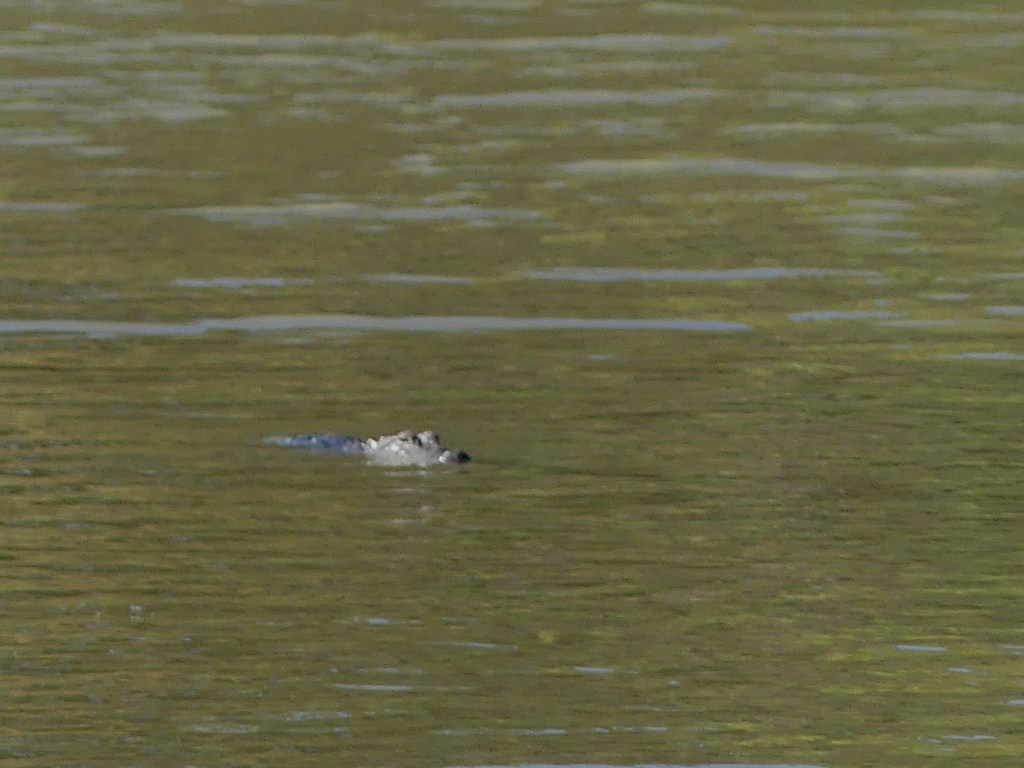
An American alligator (Alligator mississippiensis) seen by the group on our first field trip

It is fun to learn some of the details about the reptiles and amphibians that live in North Texas, getting a grasp of how they live in woodlands, marshes, and other places. It’s great when people get comfortable being around these animals and understand the conservation challenges they face. Those have been my goals as I’ve been teaching a great group of people about reptiles and amphibians (herps) and how to look for them in the field (herping).

Almost all the participants are Master Naturalists, so they start with a certain level of understanding about nature and wildlife. Because I teach incoming trainees for a couple of Master Naturalist chapters on the subject of herps, I had already met some of these folks. But two or three hours introducing herps seems like just scratching the surface. So I came up with a plan that involved four class sessions and several field sessions.

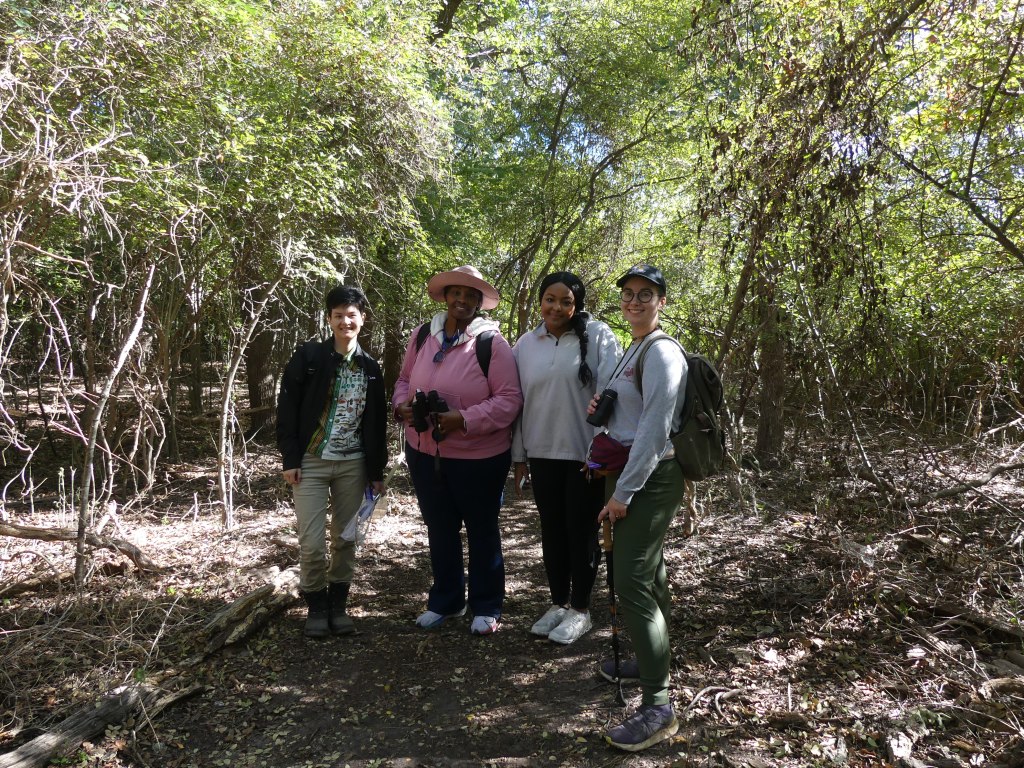
Alex, Kristina, Triniti, and Alaina

I have offered it in October and November as a sort of trial run. This is not exactly prime time for finding herps in North Texas, though we’re doing OK. We’re grateful to Fort Worth Nature Center & Refuge for offering facilities and time in the field. In the first session, after we talked about some basic concepts, Dr. Jared Wood (Natural Resource Manager at the refuge) shared some of his knowledge of the American alligator. He has been studying these reptiles in southeastern Oklahoma and will continue the nature center’s research on the alligators of Lake Worth.

We then headed for Greer Island to look for good herp habitat. While walking down the causeway, members of the group spotted a small American alligator cruising along a few hundred feet out in the water. What a wonderful follow-up to the discussion by Dr. Wood!

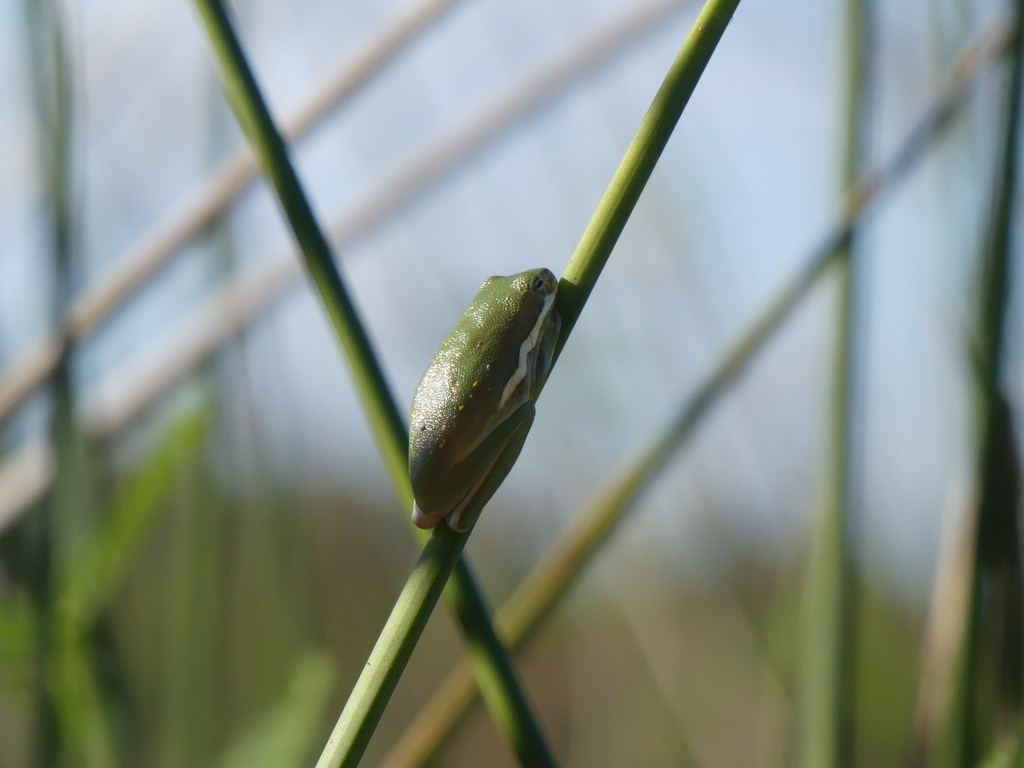
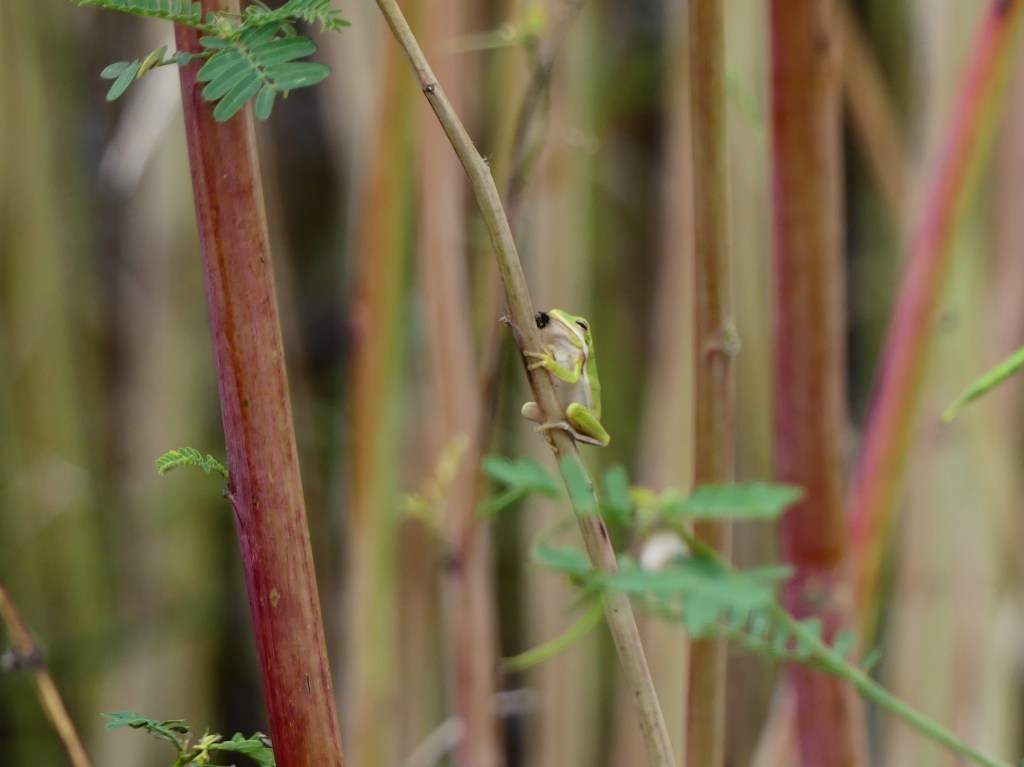
Green treefrog (Hyla cinerea)

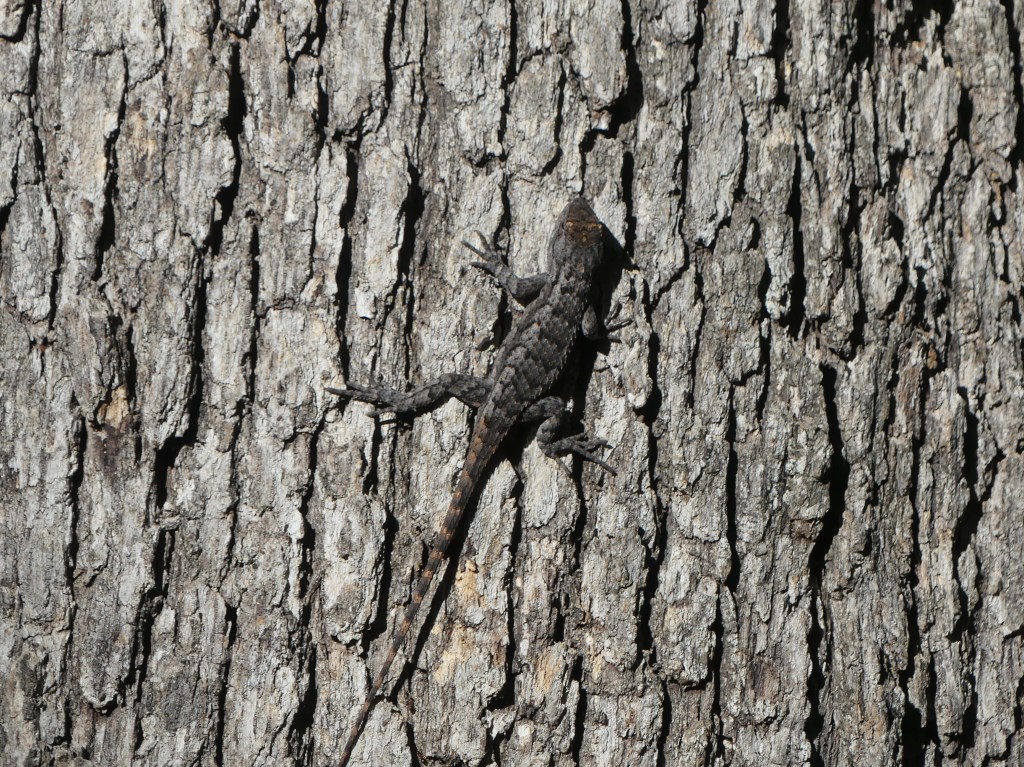
On the island, we wanted to see what we could find without damaging habitat or collecting anything. Our goal was to identify fallen logs that offered good refuge underneath and could be investigated without tearing them up. We also talked about what species would more likely be seen in spots like the water’s edge among tall reeds, or dense mid-story vegetation in the woodland. We did not really expect to see much on a cool October day, but these are very observant folks. We found a little brown skink, a green treefrog sleeping on a reed at the water’s edge, and a Texas spiny lizard before we were done.

Texas spiny lizard (Sceloporus olivaceus)

In our next session we focused on the amphibians of North Texas. We are fortunate to have a number of frogs and toads, and even a few salamanders (occasionally seen in a few locations). We talked about diet, drinking through the skin, secreting toxins through the skin that may confer some protection from infection as well as from some predators. We talked about frog calls and played audio samples of many of them. And then we headed out into the field.

The group, on their way to finding frogs and toads at the marsh

One of our goals was to practice the amphibian monitoring protocol that involves systematically listening for frog or toad calls, identifying for each species whether we heard a few individuals (isolated and non-overlapping calls, which would be Call Index = 1), a larger group (numerous overlapping calls but you can identify individuals calling, which is Call Index = 2), or a full chorus (lots of overlapping calls and individuals cannot be identified, Call Index = 3). The end of October was not the best time for frog breeding, so we were not surprised when we did not hear any calls.

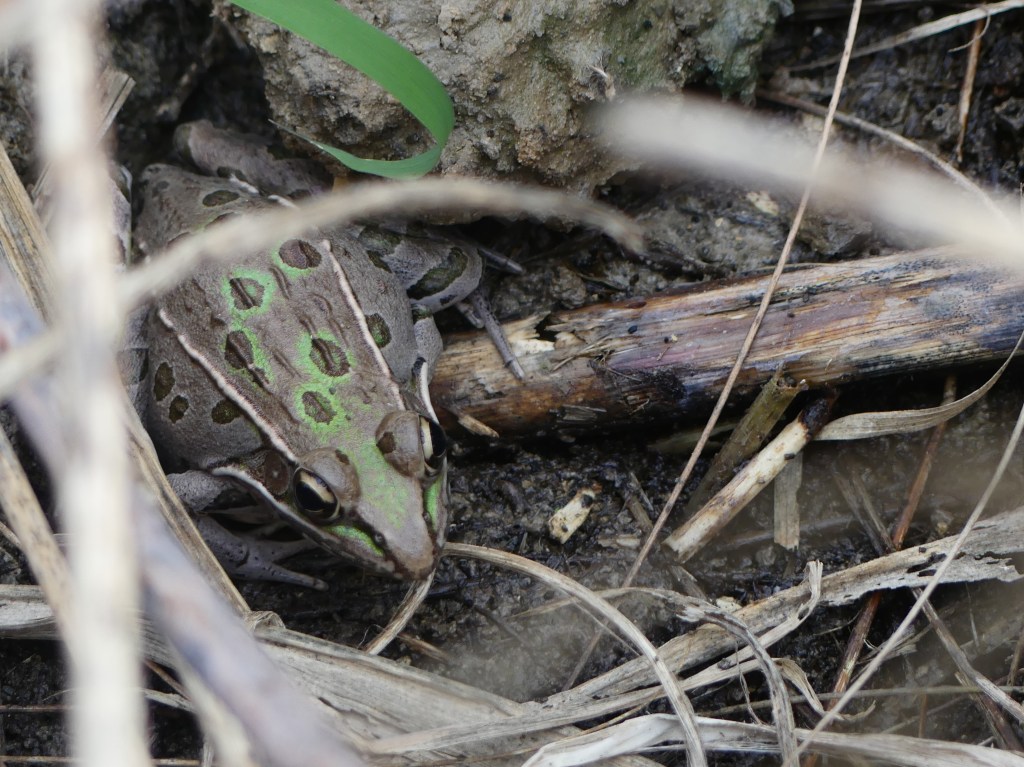
But earlier we had seen several species; they were present but not breeding. People in the group saw leopard frogs, and then we found a small green treefrog. As we watched, it spotted an insect, then jumped, caught it and gulped it down. More green treefrogs were seen, and Alex found a juvenile western ribbonsnake and a couple of cricket frogs. Sheryl found a Gulf Coast toad.

Young green treefrog, in the moment just after catching a “bug”

We’ll turn our attention to turtles next, and in the last session tackle lizards and snakes. To get some good field time for these last species, we may have to reconvene next spring when snakes and lizards are more active.

I’m having a great time getting to know this group of herpers and sharing what I know. They are showing me what good observers they are, and how willing to ignore some mosquitos as we sit in darkness, listening for frogs. Kristina held a snake for the very first time. Some of them are interested in volunteering in the nature center’s alligator research efforts. All of this is great news for reptiles and amphibians and for the broader natural world.

Leopard frog (Lithobates sp.)

“I Hope One Day They Will Be Protected”

Today I talked with a great group of kids at River Legacy Nature Center in Arlington. The twenty or so children were in a week-long “Hands-On Herpetology” class, having fun and learning about native reptiles and amphibians. I brought a few snakes and we talked about things like how they live as well as being safe when around them.

The trail approaching the River Legacy Living Science Center

One of the snakes I brought is a Texas garter snake. He has a dark background color and three light stripes, big inquisitive eyes and an active, athletic build. We talked about how snakes with stripes generally rely on speed – and a sort of optical illusion – to get away from predators. The thing is that when “Tex” or other striped snakes move, it’s hard to see their motion. If they had spots, it would be easy to see the spots move as the snake’s body slipped away. The stripes, however, seem to stay where they are, until the stripes converge on the narrowing tail and then the snake is gone. The predator may be left empty-handed.

There’s a tendency for people to think of garter snakes as common “garden snakes,” but in the case of Tex it just ain’t so. He’s a member of an uncommon subspecies of garter snake whose fate is not well understood. The Texas Parks & Wildlife Department considers the Texas garter snake to be critically imperiled. It appears never to have been actually common, but there were places here and there (particularly within prairie habitat) in which they might be found at times. A recent study noted that despite trying to find these snakes in the field in 2013 and 2014, researchers were not able to find any. Tex is a long-term captive donated to me years ago by a landowner in Hill County so that more people might see and understand Texas garter snakes.

The Texas garter snake (“Tex”) – photo by Meghan Cassidy

My discussion about this was much more brief with the kids, but they got it that this is a snake that may be disappearing. When I mentioned that they are not legally protected, a girl commented, “I hope one day they will be protected.” Me too. I hope one day we will understand the reasons for the snake’s decline in more specific ways that allow us to protect it. And I hope we continue to have children who, when they learn about a species that is in trouble, want to protect it.

We talked about being safe when out in the field where there could be venomous snakes, and I showed the kids a prairie kingsnake and the young bullsnake that was a big hit with kids in Dallas earlier this week. The kids asked good questions and they already knew a number of things from their week at River Legacy. But nothing quite equalled that girl’s comment. It was an offhand remark that revealed her empathy or her capacity to care about a unique, lovely little member of the natural community. It made my day.

More Children in the Woods

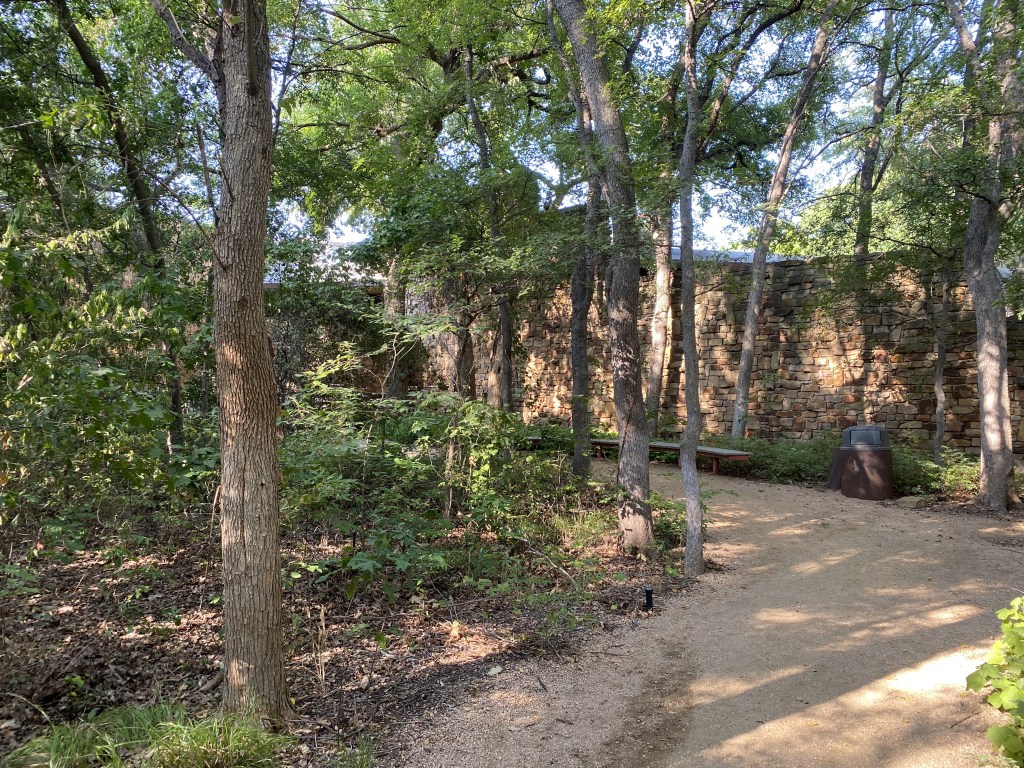
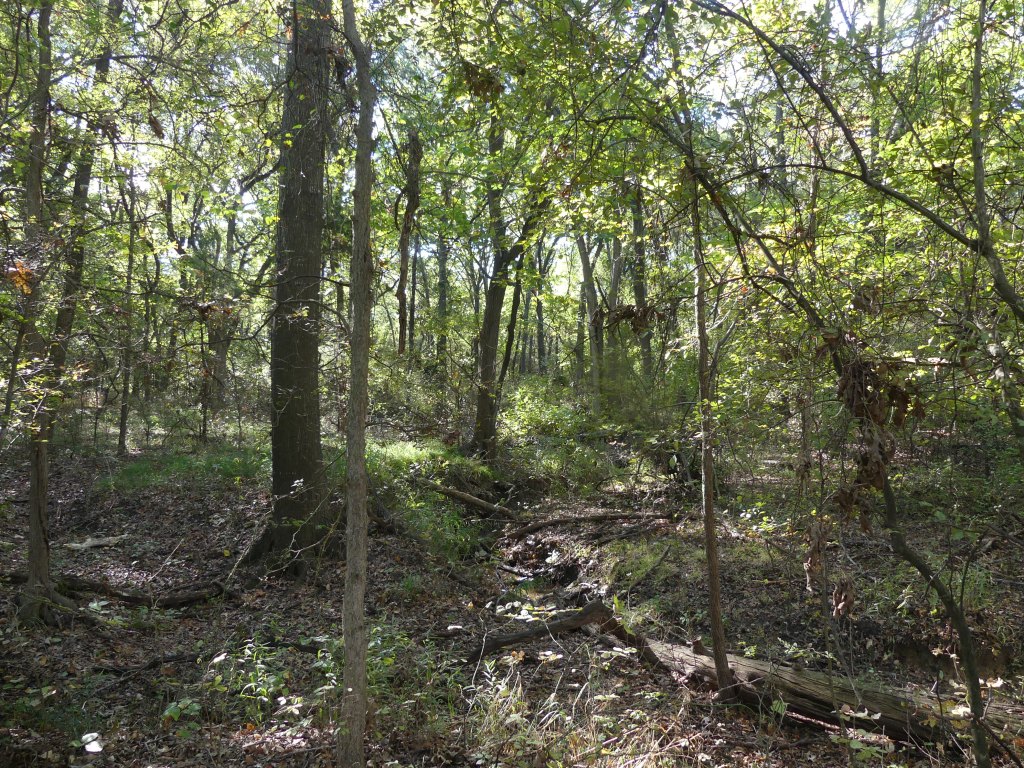
Children should walk in the woods, often. They should be able to do so fearlessly, knowing how to explore safely, with wonder and confidence. That doesn’t happen enough for kids growing up in urban areas. Recently, I was asked to talk with a group of kids at TR Hoover Community Development Center in Dallas. Despite living near the Great Trinity Forest, I was told that a concern about the presence of snakes kept many of the kids from exploring the woods. Volunteers from Master Naturalist programs thought I could help the kids understand snakes in a more realistic way. I was eager to try to help with that.

There are lots of possible reasons that urban kids might not visit the woods. There can be the fear that dangers lurk in the woods. Some of that can be realistic, and some not so much. When I asked about their worries, one of the children mentioned wolves. I could reassure her that there would be no wolves, but some of the wildlife might potentially be dangerous. Surprise close encounters with feral hogs, for example, or a copperhead half-hidden in the leaves. Kids need to know about watching where you are going and knowing what to pay attention to.

A young copperhead

If they haven’t developed the skills that can make a walk in the woods full of delightful discoveries and minimal risk, it would not be surprising. In cities and suburbs, children play inside most of the time, and a lot of that time is spent in front of a screen of some kind. The American Academy of Child & Adolescent Psychiatry reports that elementary school-aged kids spend four to six hours a day in front of games, TV, tablets and phones, and the number is even higher for high school kids.

In 2005, Richard Louv published his book Last Child in the Woods, introducing the term “nature-deficit disorder.” It wasn’t a formal disorder, just a convenient shorthand for the way children – and the rest of us – are becoming estranged from nature. In the years following the book’s publication, a lot has been done to try to address that widening gulf between children and nature. I hope to contribute as much as I can to bringing us back together.

I talked with the kids at TR Hoover about what makes a forest and that we need all the “ingredients” in order for it to be a real forest. I said that most of the snakes they would find would be harmless, but that they should not count on that. The rules I suggested that they follow were:

  • Your EYES go first before your hands or feet
  • Don’t touch or pick up an animal when you aren’t sure what it is – no guessing!
  • If you see a venomous snake – walk away

In other words, never put your hands or feet somewhere until you know what is there. And don’t be quick to touch (I worry that a child will become overconfident and assume that they know something is harmless when it is not). And last, when you see what may be a venomous snake in the wild, there’s no need for panic and certainly no need to kill it. Sometimes a person has a well-intentioned but mistaken belief that they will make nature safer for the next visitor by killing a snake. They endanger themselves when they come in close contact and make the snake panicked and defensive. Killing the snake only opens up a place for another snake to fill the gap left by the dead one.

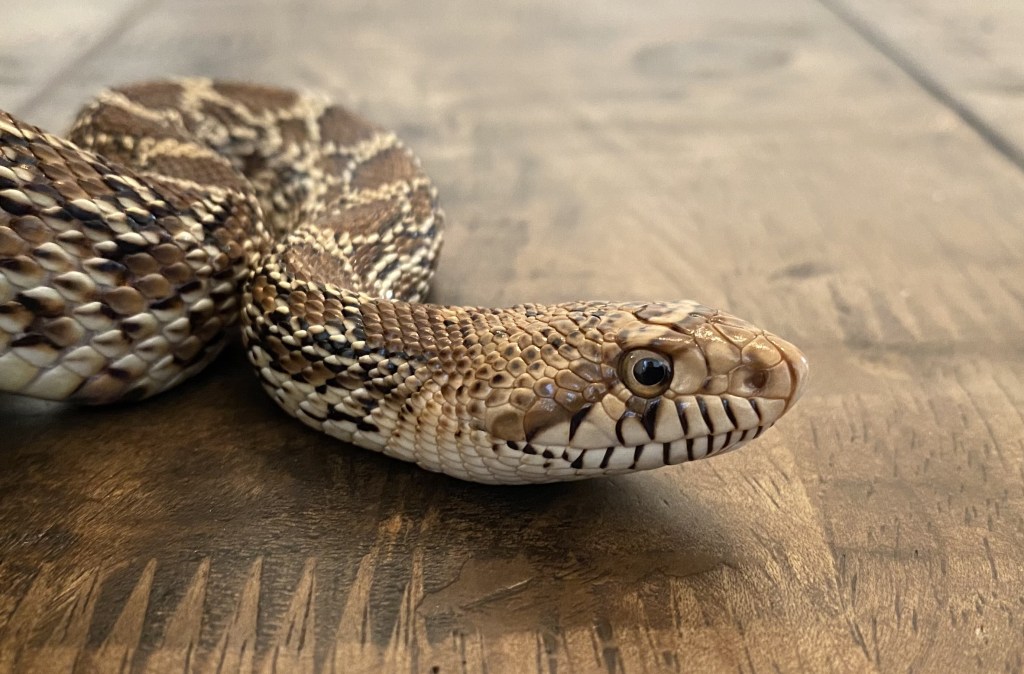
The kids loved the young bull snake I brought with me. She is a gentle example of one of our biggest native Texas snakes, and most of the children wanted to touch her. I would have gladly allowed this except that having thirty kids touch you (and perhaps a few try to grab you) is pretty stressful for a snake. Toward the end, I brought out a Texas garter snake, a subspecies that Texas Parks & Wildlife Department considers endangered in our state. His three pretty stripes and graceful body charmed the kids and the adults in the room.

The young bullsnake

I hope these kids are more comfortable and more prepared to get out there and safely explore the woods. I loved their questions and their energy, and would love to see them out there walking on a trail and discovering all kinds of wonderful things in the woods.