Connection and Compassion With Lives Unlike Ours

An article at a UC Berkeley website reports that “We are currently losing species hundreds or thousands of times faster than normal background extinction rates. If this continues, Earth’s biodiversity will plummet.” And biodiversity is a big deal, supporting the healthy functioning of the Earth. Animals, plants, bacteria, fungi, bryophytes – all these lives are interrelated, creating complex systems that keep the Earth going. The way the survival of every species is related to the well-being of the rest makes ecosystems resemble very complicated jenga games. You can remove a few pieces and the structure still stands, but it gets progressively more unstable. It could reach a tipping point in which further species loss brings whole ecosystems down.

Playing Jenga. Photo by Ron Lach on Pexels.com

Slowing the rates of extinction and leaving ecosystems in greater health will depend on us. Among the things we can do is to recognize which species are in trouble and take actions to conserve them. How do we encourage those things? How do we get enough people to care what happens so that they help fund conservation efforts and agree to limit some of the extraction and development so that species can survive?

An important insight from Senegalese conservationist Baba Dioum is:

“In the end we will conserve only what we love, we will love only what we understand, and we will understand only what we are taught.”

We conserve what we love. And it is easier for us to love some species than others. Part of our biological inheritance is that we are drawn to such things as big, expressive eyes, soft sounds and soft touch. And so we want to pick up and cuddle babies, we make cooing noises back to them and describe them as cute. (I don’t want to reduce the love of babies and children solely to genetic wiring, but the wiring helps.) And that response is usually extended at least a little toward cute puppies and kittens. And to baby tigers and bears, wolves and other furry, expressive animals.

Animals with strange faces, fixed expressions, and unusual body forms don’t pull us in so much, unless they are beautiful to look at or hear. A Monarch butterfly doesn’t have a face a human mother would love, but its beautiful wings and flight win our affection. Bird faces are less expressive than those of puppies, but many of us associate wings and flight with such spiritually uplifting things as heaven and angels. And there’s the beauty of their feathers and songs as well.

Reptiles and amphibians are a harder sell. For most people, they are among the less-charismatic animals to worry about and go out of our way to protect. In a world of soft and furry animals like ocelots and wolves with their expressive faces, can turtles or frogs pull at our hearts? Could the handsome colors and patterns of a Louisiana Pinesnake have a place in our affections alongside the lovely feathers of a Golden-cheeked Warbler? Could the nighttime calls of a Gray Treefrog have a place alongside the songs of Bewick’s Wren? For me, the answers are all “yes.” Part of the wonder of the natural world, and a key to its magic, is the diversity of forms, sounds, colors, and lives. Everything belongs. It’s the natural world’s equivalent of the way some of us talk about human inclusion: “Y’all means all.”
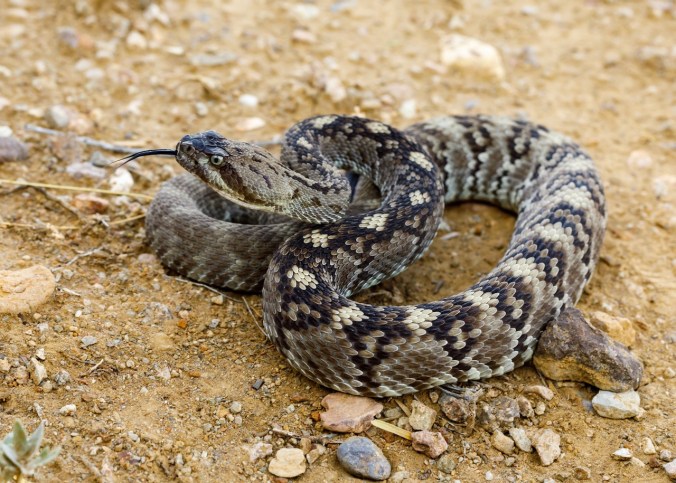
A black-tailed rattlesnake, whose very different face and body form, not to mention being venomous, might make it harder to see its beauty (photo by Meghan Cassidy)

It is important to consider why all of this matters, and why “y’all” should be interpreted so broadly. Everything matters because of that ecosystem jenga game mentioned earlier. And what about the tangible benefits that many species provide for us?

We are accustomed to environmentalists citing the many ecosystem services that various species provide, including cleansing the water and air, providing food, controlling agricultural pests and pollinating crops, breaking down the tissues of things after they die and returning nutrients to the soil, making new medicines possible, and so on. I’m grateful for all those ecosystem services – glad that the Earth and all those living things take care of us. The problem is when we take and do not give back, when we place ourselves at the center of everything. Believing that everything revolves around us is part of how the Earth got into so much trouble. We matter; humans are a part of all that glorious biodiversity, but the rest of the Earth matters, too, even when we don’t seem to get anything out of it.

The old story tells us that the Earth was given to us to use as we wish. That story led most of us into a relationship with the world in which we are the shopper and the Earth is the store as well as the sewer. We are the owners and the planet is our house, to be remade as we would like it. But there are other stories, other wisdom. We might find truth in the ones saying that all those other lives are our brothers and sisters, that we are all related such that when we treat others with respect and affection, we get a great deal in return. In that story, told by many Indigenous cultures, the world operates based on reciprocity and love, and when that breaks down, things fall apart. You can find a beautiful exploration of those ideas in Robin Wall Kimmerer’s recent book, The Serviceberry: Abundance and Reciprocity in the Natural World.

Those beloved, despised, ignored reptiles and amphibians provide beauty, pest control, medicines, and cultural meaning – and regardless of what they provide for us they have value. They are members and sometimes key players in communities of plants and animals. The great ecologist Aldo Leopold taught us that none of the members of ecosystems can be discarded:

“If the land mechanism as a whole is good, then every part is good, whether we understand it or not. If the biota, in the course of aeons, has built something we like but do not understand, then who but a fool would discard seemingly useless parts?” – Aldo Leopold, Round River

For those who see the world through a spiritual or religious lens, the quote carries the same wisdom. It changes only how we name the creator; substitute “God” or “Great Spirit” for “biota,” and discarding the parts still seems foolish and arrogant.

So if we conserve what we love, and we love what we understand, how do we bring about that understanding? It’s through experience and information, the teaching that Dioum mentioned. The more time I spend with rattlesnakes, for example, the more I am able to notice how they move through the world without malice (though their bite is dangerous if threatened), but rather with curiosity and skill. We increasingly read researchers’ accounts of problem-solving ability and maternal care. In Tracks and Shadows, herpetologist Harry Greene reports on observations of baby rattlesnakes staying with their mother, basking together, and retreating behind her if disturbed. Then, after their first shed skin, the babies disperse and mother finally has a chance to hunt for a meal (Pp.165-166). With information such as this together with my own field experience, I have plenty of respect for and caution around these animals, and also considerable affection.

It is not necessary to seek encounters with rattlesnakes or read extensively about them in order to support their continued existence. But some level of familiarity, some acquaintance with wildlife and nature is needed. The more we understand the lives around us and the places they depend on, perhaps the more we will understand the importance of the whole thing. We need to hear the stories and hopefully have firsthand experience with some of the hard-to-love, non-charismatic wildlife, showing us that they, too, have some of the qualities that stir our compassion and empathy.
Shifting Baseline Syndrome

Each generation of us takes a snapshot in time of the natural surroundings in which we live. What we experience is what is – for us – normal, and it feels like how things have always been. For those growing up in the last twenty years, road trips are not troubled to any great extent by bugs on the car windshield. You might assume that it has always been that way. Your grandpa has a picture from when he was a child, holding up a spikey little horny toad, the only one you’ve ever seen. Summers may involve outdoor fun some of the time, but for part of the summer the baking, searing heat is a gauntlet you run, from one air-conditioned place to the next. That’s just Texas, right? The night sky is hazy and yellowed, with a few stars, and the magic of fireflies twinkling on a summer night can be found in a child’s picture book, but not out your back door. The sound of airplanes, trucks, highways, and air conditioners is so ever-present that you barely notice, but if it all fell silent you might ask, “what’s wrong?” All of this is normal for twenty-year-old you.

If you have paid attention to conditions as you grew up, then when summers get hotter, nights lighter, every place noisier, and wildlife more missing in action, you will notice because it is “different from how it used to be.” Just like when those of us who grew up in the middle of the last century noticed how a quieter world got noisier, dark skies gray with stars less visible, summers became dangerously hot, and so on. Our world became the next generation’s world, and for that generation it was a new normal.

The way a changed world becomes the new normal for a new generation is described as “shifting baseline syndrome.” It was first described as it pertained to fisheries, where people with longer experience noticed declines while younger folks did not. As defined in a 2018 article in Frontiers in Ecology and the Environment, this is “a gradual change in the accepted norms for the condition of the natural environment due to a lack of human experience, memory and/or knowledge of its past condition.”

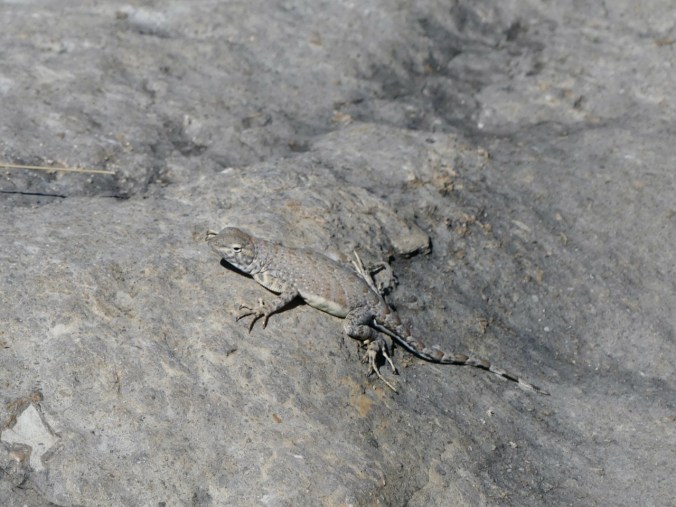
My baseline, what I considered normal in the 1950s-1960s, included lots of box turtles after summer rains and lots of small massasauga rattlesnakes at sunset on the road west of Benbrook. I explored a large creek throughout the summer, often feeling hot but never fearing heat stroke. Each visit to the creek included ribbon snakes, probably a couple of species of water snakes, and numerous other wildlife species. Spotted Whiptail lizards nervously poked around in exposed rocky areas. Baby softshell turtles turned up at the end of summer, and pale gray Greater Earless Lizards scampered over limestone rocks of the same color.

A Greater Earless Lizard, in a spot in Central Texas

I still visit that creek occasionally, and if eleven-year-old Elijah is with me, his perception of normal for Mary’s Creek will include almost none of these animals. His baseline perception of normal is mosquitofish and some shiners in the water, dragonflies here and there, a few spiders, and the occasional appearance of a cooter or slider turtle. That, for him, is the richness of Mary’s Creek.

That creek is a microcosm of the bigger world in which so much is getting lost. And losses in nature are among the many worries of the world. Our attention and energy can hardly keep up, and we are even more likely to be slowed in our conservation efforts if we don’t even know what we once had. If we could imagine the diversity and richness of an earlier time, clear water and air, the peace of a quiet day and the depth and mystery of a dark, starry night, perhaps we would fight twice as hard for those things. And that is a good reason for us to seek out the quiet places that remain, the places with dark skies, and locations that retain more wildness and richness, to know that more places in the world could (within the limits of a damaged climate) be that way once again. If we could rein in our development and extraction and be able to say, “enough, I don’t need more than this.” If we could walk humbly through the world and be members – not rulers – of it.

Shifting Baseline Syndrome is worsened by our retreat from nature. When children don’t play outside, when they, like their parents, spend their time indoors, and when birds and plants and wild places are strange and foreign to them. The child grows up and the young person matures with even less appreciation for what is lost over time.

Those who study this syndrome say that what is needed is more good data and more people involved in nature. Good data helps establish what we have, so we know when we are losing it. And when more people spend time in nature, learn to recognize various living things and more accurately see what we have around us, then future degradation will seem less normal and less acceptable. That is certainly a recommendation for community science and tools like iNaturalist that facilitate both of those things.

I’ll soon be planning to lead another “Know Your Nature Neighbors” walk at Sheri Capehart Nature Preserve in Arlington. Want to come along?

“No Direction Home”

(I recently wrote this over at Substack – yes, I’m still struggling with where to land – but I felt the post ought to be here, too, because of its importance. I hope you will read and go to the Federal Register site and comment. Thanks.)

Suppose a group of people came to your house and stole the roof from over your head. “What??!” you might protest, but they tell you they needed the shingles. Shortly after, a crew plows up the easement in front of your house, and water shoots up from the broken pipes, then subsides to a trickle. Eventually you sit in your house, unharmed, but with no protection from the elements and no water. The police tell you that you have no recourse, because none of these people physically hurt you.

That is what the Trump regime plans to do to species protected under the Endangered Species Act. A proposed rule would re-define “harm” to only mean “taking” a protected plant or animal. Changing or degrading its habitat would not fall under the definition of harm. Only such things as trapping or killing the animal, or digging up an endangered plant, would qualify as “harm.”

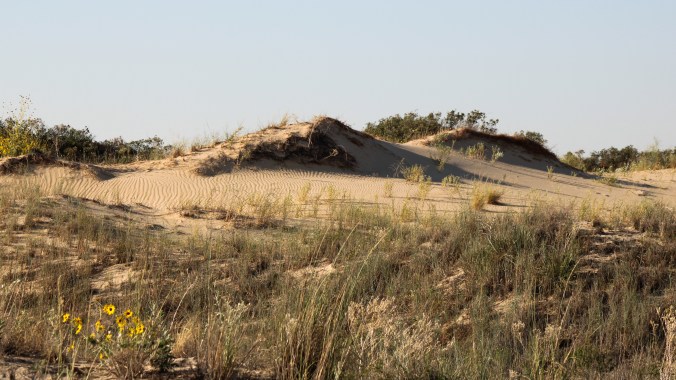
Sand dune/shinnery oak habitat in Monahans Sandhills State Park

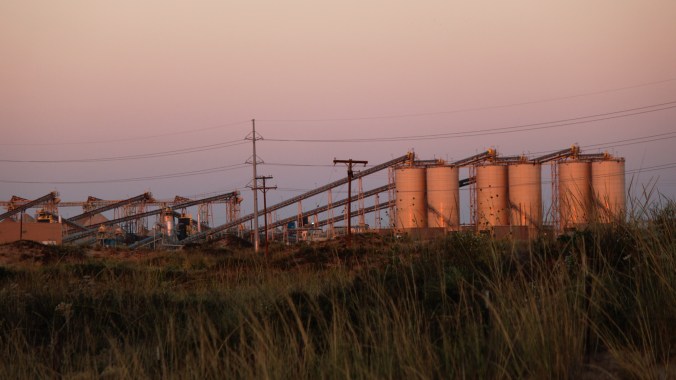
The beneficiaries of this, of course, are extractive industries. Loggers can log and the spotted owls just have to deal with it, because if nobody is shooting owls out of the sky, no harm done. In the Permian Basin of Texas, industries can go on mining sand for fracking, and the Dunes Sagebrush Lizard will have to learn to live on caliche roads and patches of remaining bare sand. I visited the area last year, writing about the Dunes Sagebrush Lizard for Green Source DFW. Researchers have found that this lizard requires very specific habitat that includes sand dunes and a low, shrubby oak species called shinnery oak. If you remove that habitat, the species cannot survive.

Over a year ago, the U.S. Fish and Wildlife Service listed the Dunes Sagebrush Lizard as endangered, but a loophole in the law allowed them to defer setting aside any habitat for it. (The Monahans Sandhills State Park provides some good habitat, but the whole park is only 3,840 acres.) The land in Texas west of Midland and Odessa is like a big outdoor industrial park crisscrossed with roads and sand trucks, sand mining sites in the spotty areas where dunes are found, drilling sites and the network of caliche roads connecting them. A lizard could look around in most places out there and see no direction home.

Sand mining operation near Kermit, TX

So, back to our analogy, if you were an endangered species, industry could come steal your roof, dig up your water pipes, and leave you with no food, water, or shelter, and according to the current regime you would be completely unharmed. To further quote Bob Dylan, “How does it feel?”

From a conservation biology perspective, it’s fair to say that all species depend on certain conditions to survive. The more they are habitat specialists, the narrower the range of conditions that they need in order to survive. That is, if they are adapted to very specialized diets or ways of living, they can’t just decide to be more flexible and live outside those requirements. The Dunes Sagebrush Lizard did not just decide it liked sand dunes and shinnery oak and would be annoyed if they couldn’t get them. Over a long span of time, generations of these lizards survived by making use of that habitat and only that one.

Regarding this proposed rule change, you can submit a public comment before May 19th here. I really hope that you will. With the Musk-Trump regime, it is too easy to conclude that since they don’t care what we think, it’s a waste of time. But that’s not quite true. They don’t care unless we speak up in large numbers, signifying a big wave of opposition that they cannot ignore. Enough of us, acting together and persistently, might still have an impact.

Also, giving up on telling them what we think reminds me of the first of Timothy Snyder’s lessons for resisting tyranny: do not obey in advance. Staying quiet teaches them the extent of their power, and it is also a kind of signal to our neighbors and friends that there is no point in resisting.

There are over 1,300 species federally listed as threatened or endangered under the Endangered Species Act, and a number of them occur in Texas (including the Ocelot, Mexican Long-nosed Bat, Golden-cheeked Warbler, Red-cockaded Woodpecker, Louisiana Pinesnake, Salado Springs Salamander, Comal Springs Riffle Beetle, Hinckley’s oak, Neches River Rose-mallow, and many more). I hope we won’t leave them “on their own, like a complete unknown.”

(Apologies to Bob Dylan’s “Like a Rolling Stone”)

Elegies for Animals

Our responses to losses and extinction of our fellow creatures should reflect our complete selves, not just what we make of the losses intellectually but also how they resonate in our hearts and souls. When a species is gone, it should pull from us something beyond what is measured in statistics. Birds do that, as you can hear in the magnificent elegy by Christopher Tin, called The Lost Birds. It’s a collection, a heartbreaking instrumental theme memorializing the Passenger Pigeon (“Flocks a Mile Wide”) and songs, some with original lyrics and some drawing on others’ poems such as “Hope is the Thing with Feathers.” Those lost birds, our distant relatives, deserve memorials such as this.

Of course, it’s not just birds. Many of our other animal relatives are disappearing, and some of them have eloquent advocates. Wolves have passionate defenders, and even the Monarch butterfly inspires legions of helpers planting milkweed for their caterpillars. 

Amphibians and reptiles have captured my interest and affection all my life. A great many are declining, and the loss of many amphibians has been deemed an extinction “crisis.” At least, it’s a crisis as seen by herpetologists and some others. Turtles are disappearing, too, along with many reptile species. 

You can see where I am headed. No elegies for the disappearing Louisiana Pine Snake or the Yangtze Giant Softshell Turtle. Our culture does not elevate them in that way. The flight of birds symbolizes freedom for us. Our cultural stories equate birds with hope; a dove with an olive branch signifies peace, and those feathered wings remind us of angels. The snake, in Western culture, brings up temptation, fall from grace, and being condemned to crawl on the belly. We have to look elsewhere, like Asia or Indigenous Americans to find some positive cultural meanings.

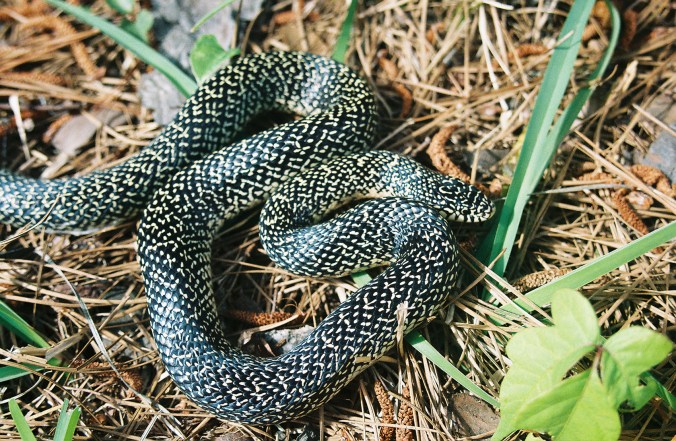
Speckled kingsnake

My point is not a resentment of birds, just a wish that we could do for other animals what we’ve done for birds. I wish we had stories and images in our culture that found more positive inspiration and affection for the animals without beautiful songs and wings, with no soft fur or expressive eyes. It would make it easier for us to find room for them in the family of living things. It might give a little boost to our willingness to go out of our way to conserve them, and maybe we would need fewer elegies.