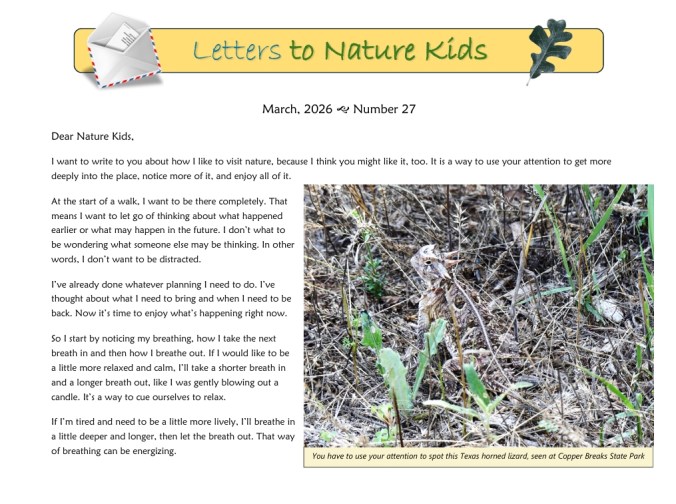
The latest of the “Letters to Nature Kids” is about how I like to use my attention when taking a walk in nature. It describes noticing your breathing and then imagining that your attention is like a light that you can turn toward one thing and another.
I wrote, “When you are outside, try imagining that your attention is a light that you can shine on one thing or another. Put the light on a tree and keep it there for a count of five (or more). Then turn the light toward something nearby and count how long you can keep your attention there.”
This is borrowed from mindfulness, though I’m not trying to teach meditation in this letter. I just want to share some ways to really notice and enjoy things and help strengthen the ability to pay attention.
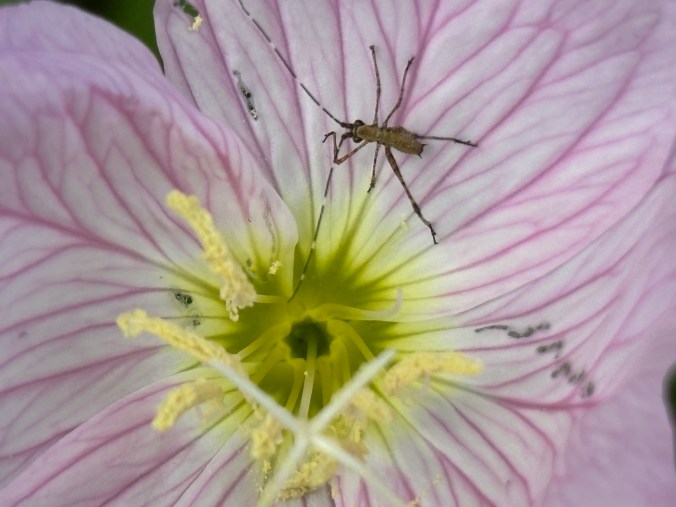
In the letter, I wrote, “You start narrowing your attention – your flashlight – to a particular flower that has something in it. The flashlight beam gets so narrow that you have to get down near the flower to focus attention that much. The insect is a tiny baby form of a katydid, and look at those black-and-white antennae! Keep the focused light of your attention there a little longer.” The point is to be able to direct our attention purposefully and stay with something long enough to really explore it, like the colors and structure of that primrose flower.
If you know someone who might be interested in this, please share it. Letters to Nature Kids is always a free download (there’s a donation button in the right column of the website for anyone who feels inclined). You can browse all those 25+ letters on the Letters to You page.
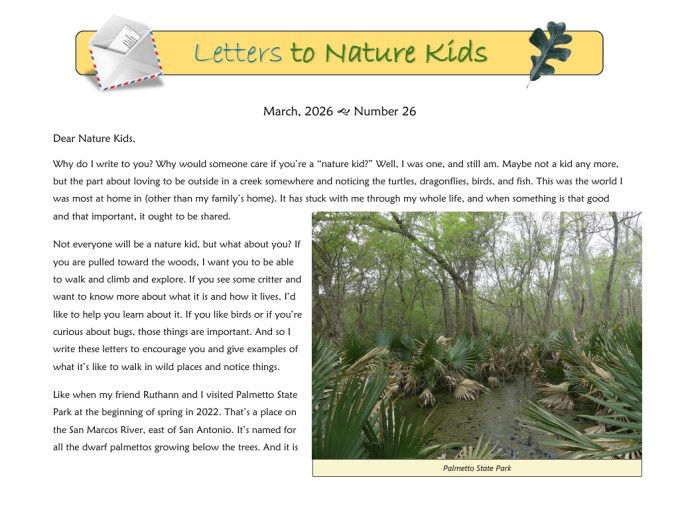
You may recall that I write periodically to “nature kids.” It’s a free pdf download from the Letters To You page, written for older kids and teens who are drawn to wild places and the things that live there.
This time I included a bit about why I write these letters. Some of it is about sharing places and experiences that may encourage young people to go see preserves, parks, and such places themselves. As an example, I talked about Ruthann’s and my trip to Palmetto State Park in 2022. (I also blogged about it here.)
If you know any kids who would be interested in this current letter, please share it with them (in print or via a link). I mentioned that I’m currently writing about nature kids in several articles for Green Source Texas and noted that – with parent permission – I very much would like to talk with a couple of serious nature kids. And thanks!
I have experimented with writing letters to you, because I want to communicate about nature and I love the idea of doing so in a personal way. I started with Letters to Nature Kids, which are short and informal “letters” about being out somewhere, or about how nature experience is related to gratitude or coping with fear, and so on.
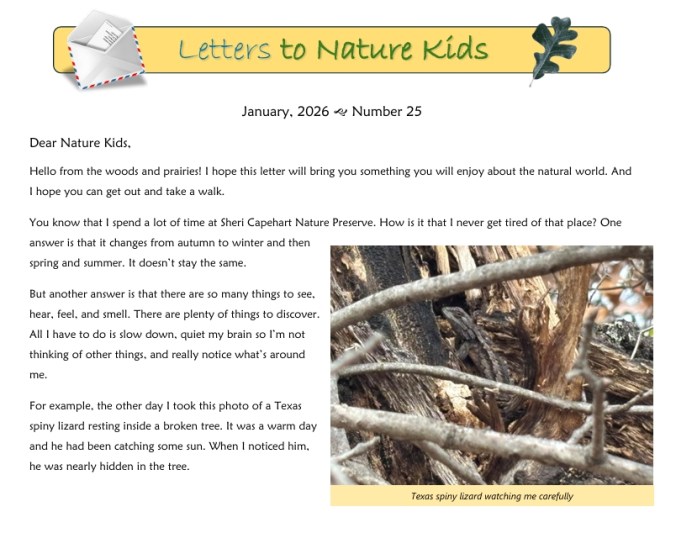
This latest one has to do with all the small wonders we can notice when out for a winter’s walk. Finding a half-hidden lizard or noticing a tiny shell and tracking its identity down (it was a Texas liptooth) make a walk fascinating, even when the discoveries aren’t very dramatic. Being able to notice and appreciate small things is a valuable skill, and the letter is an attempt to show that this is true.
I notice that these letters get downloaded fairly regularly, but I rarely hear from anyone about them. That makes the whole thing very experimental – writing for the reader who I imagine might read it but not really knowing how a reader felt about it. If you wanted to bring the whole idea of a letter closer to reality, you could write back to me. One way would be to use the contact page here, or there is an email address at the end of the letter. Then we would be having something closer to a conversation, and I would be very grateful for that.
But if not, it’s OK. My hope is that the letter gets read, and that it gets the reader thinking about things and wanting to get outside for a walk.
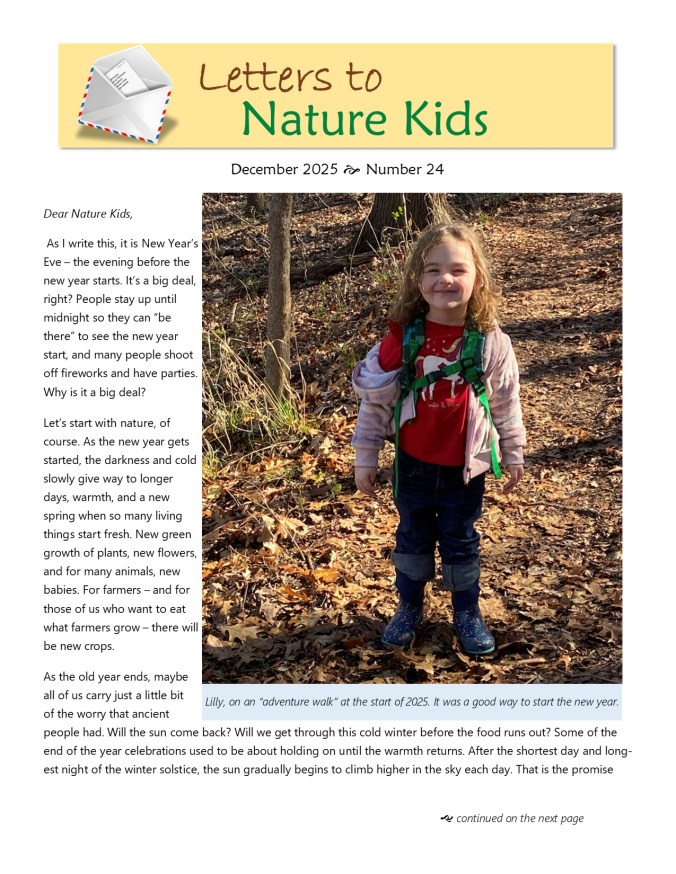
Happy New Year everyone! Thinking about what we do to mark New Year’s Eve and where it comes from, I’ve written a new Letter to Nature Kids. I hope you will have a look and share it with any kids who might want to have a look. (When you click the link it will download as a pdf)
Have a safe and happy New Year’s Eve. May we all have a good 2026; may the light return figuratively as well as literally.
This week I met several groups of kids in a little patch of wildness at their school, looking for the various ways that plants make seeds, or, with younger ones, playing a game of “Food Chain” (no one was eaten, even during the wild rumpus). The kids know the place well, and many of them have explored the Ranger Circle, the Dark Forest, Maria’s Meadow, and other spots many times over several years at the private school.
The climbing tree – a juniper with well-worn limbs perfect for climbing
My role is to channel some of their energy into new forms of discovery and understanding of what lives there. I can be a counterweight to a child’s fantasy about “poisonous” spiders or aggressive snakes, trying to replace such ideas with realistic caution and a sense that, overall, nature here is a safe place. I can invite them to think in new ways about animals in nature.
For example, the third and fourth graders know a lot of animals, but their knowledge of what the animal eats – and in turn what eats it – is limited. And so, in the “Food Chain” game, when we name one of the animals that the kids have seen there, a child who can name that critter’s predator or prey comes over to the “naturalist’s corner” and we ask about the next animal, until all the kids have come over to the naturalist’s corner.
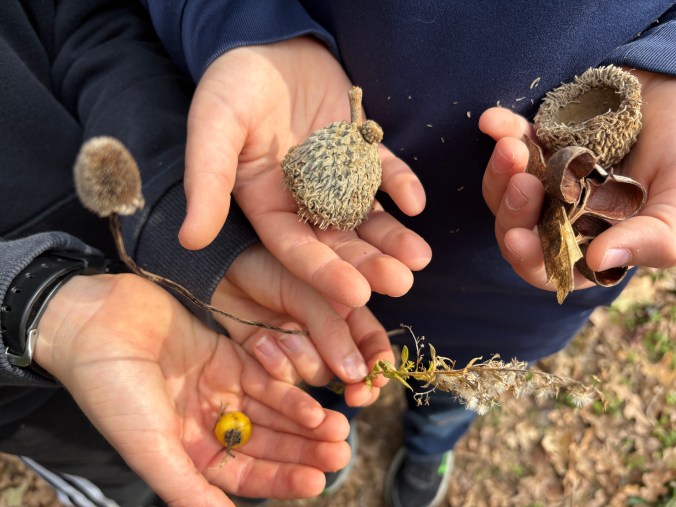
But running around and exploring is part of it. When I sent the older kids out in groups of three or four, they sprang into the woods and fields as if shot from a slingshot. They scoured the place and came up with lots of wonderful examples of seeds. There were huge bur oak acorns with the stiff, curly fringe around the acorn cup. They found the small, dried pods of the partridge pea that was flowering just a couple of months ago. They noticed all the yellow, fleshy berries of horse nettle that we had talked about on an earlier outing. Yes, they look a little like tiny tomatoes, and they are even related (but poisonous). There were mimosa pods and the dark blue berries of privet, and I mentioned how invasive and destructive privet is in a place like this. They found seed heads of Indian grass and a couple of other grasses. One girl brought a sprig of juniper, so I mentioned that this species has separate male and female trees (and the sprig with the yellowish tips was from a male plant).
The kids found acorns, berries, dried flowers, a buckeye pod, and other things
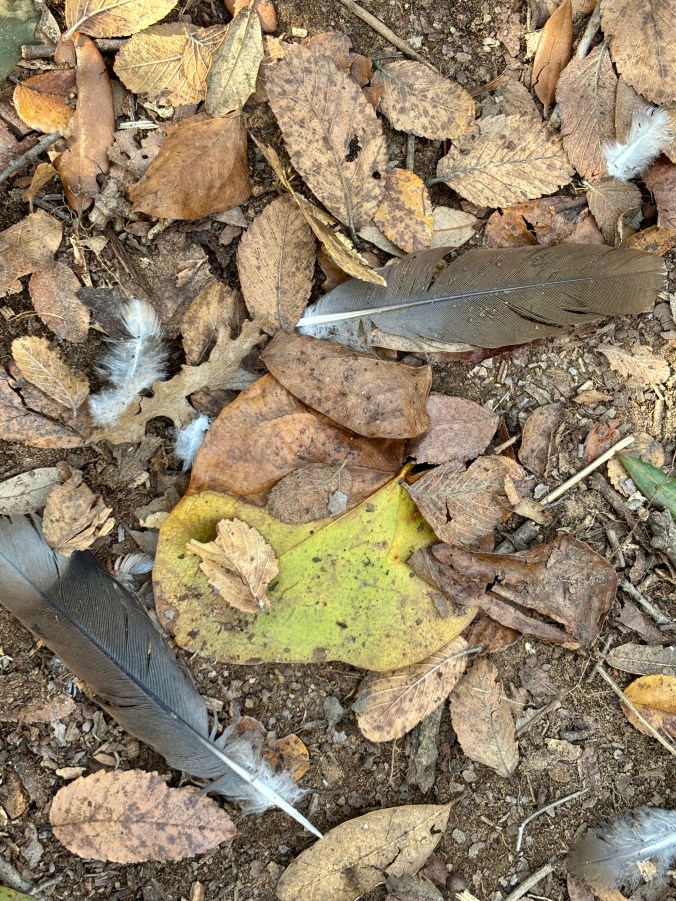
The younger kids were ready to run well before I was able to tell them what they should do. They would have been delighted to simply run. There was a lot of “wait, sit back down – no, you’ve got to stay with your group.” The instructions were as short as I could make them. “This group goes to this area, your group goes this way … and look for animals or signs that the animal was there, like a bird nest.” Then I sent them out. I might as well have said, “Let the wild rumpus start.” And kids started coming to me in excitement, “We found a bird nest! Also a beaver nest!” I had to see what this last really was, and they led me to some piled up brush someone had cut. That’s fine; the important thing was excitement about finding things. A spider web. A hole or burrow of some kind (armadillos had been digging in various spots). A dragonfly.
If you’re looking for evidence of animals, you might find these
The trick which I do not claim to have mastered is to allow and even join a bit of wild rumpus while keeping things structured enough to accomplish what we set out to do. Some kids are quieter and are already locked in on the goal, and usually they bring a good bit of knowledge to the activity. For other kids, nature study is not on their “to do” list, but running and discharging energy is. I think that we won’t get anywhere without some kind of curiosity and joy, so I would never turn any of this into “nature boot camp.” Working with groups of kids gives me additional appreciation for what teachers do (and they do it every day, not occasionally as a volunteer).
But it’s great to hear a kid say they look forward to these outings, or ask hopefully if we’re going to “play that game again” (from last month, an activity drawn from Joseph Cornell’s book, Sharing Nature).

 Our Lives In Nature