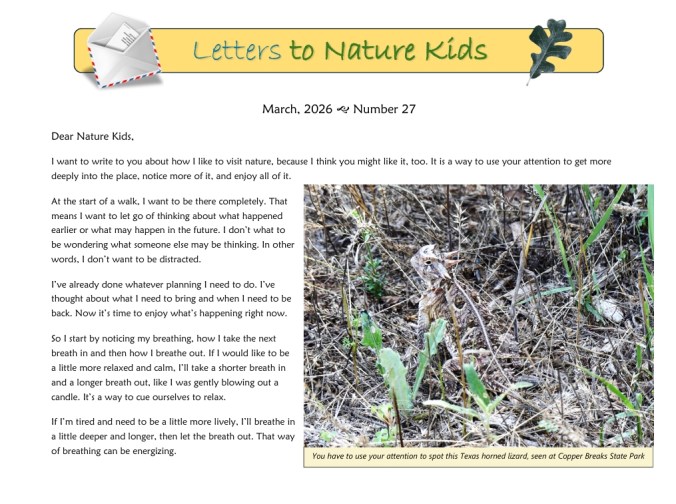
The latest of the “Letters to Nature Kids” is about how I like to use my attention when taking a walk in nature. It describes noticing your breathing and then imagining that your attention is like a light that you can turn toward one thing and another.
I wrote, “When you are outside, try imagining that your attention is a light that you can shine on one thing or another. Put the light on a tree and keep it there for a count of five (or more). Then turn the light toward something nearby and count how long you can keep your attention there.”
This is borrowed from mindfulness, though I’m not trying to teach meditation in this letter. I just want to share some ways to really notice and enjoy things and help strengthen the ability to pay attention.
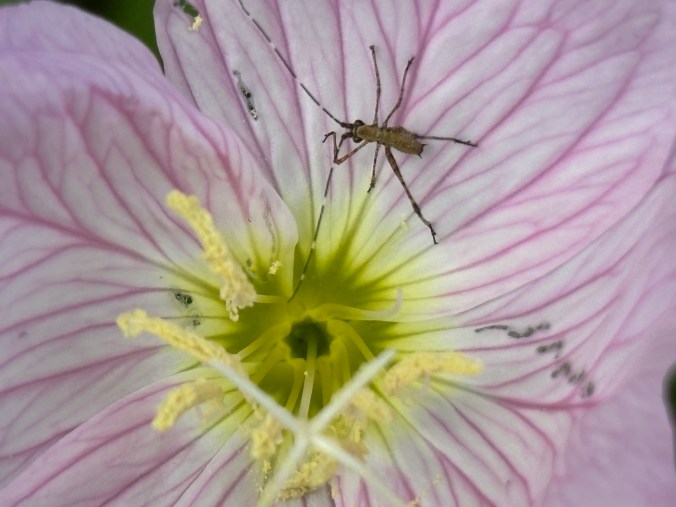
In the letter, I wrote, “You start narrowing your attention – your flashlight – to a particular flower that has something in it. The flashlight beam gets so narrow that you have to get down near the flower to focus attention that much. The insect is a tiny baby form of a katydid, and look at those black-and-white antennae! Keep the focused light of your attention there a little longer.” The point is to be able to direct our attention purposefully and stay with something long enough to really explore it, like the colors and structure of that primrose flower.
If you know someone who might be interested in this, please share it. Letters to Nature Kids is always a free download (there’s a donation button in the right column of the website for anyone who feels inclined). You can browse all those 25+ letters on the Letters to You page.
18 March 2026 – Fort Worth Nature Center & Refuge 12:10-2:16pm
Along the Canyon Ridge Trail, Lone Point and the surrounding area is a favorite. The rocky remains of the old CCC structure are atop the ridge with limestone, yucca, and live oak. Today I started my walk from below the ridge, near the lakeshore, where a pair of tufted titmice were hopping around in understory and low tree branches.
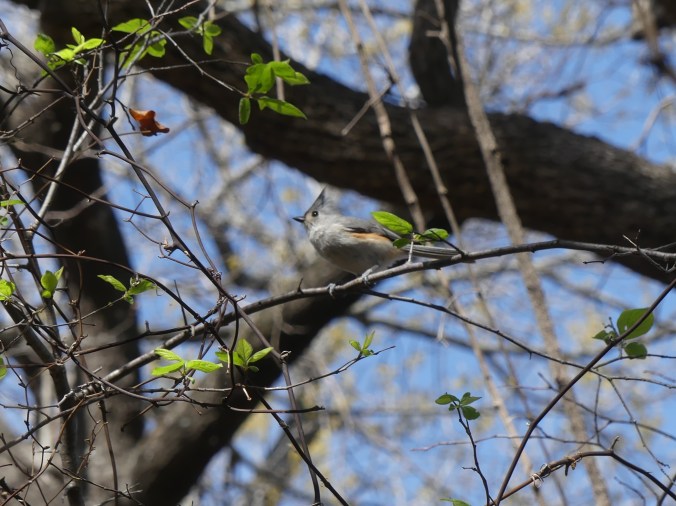
Tufted titmouse
On the way up to the ridge, there were lots of bird calls in the woodland. Merlin identified the calls of red-shouldered hawk, tufted titmouse, white-eyed vireo, Carolina wren, red-bellied woodpecker, and northern cardinal. Once I reached the ridge, there was also blue jay, red-winged blackbird, and ruby-crowned kinglet.
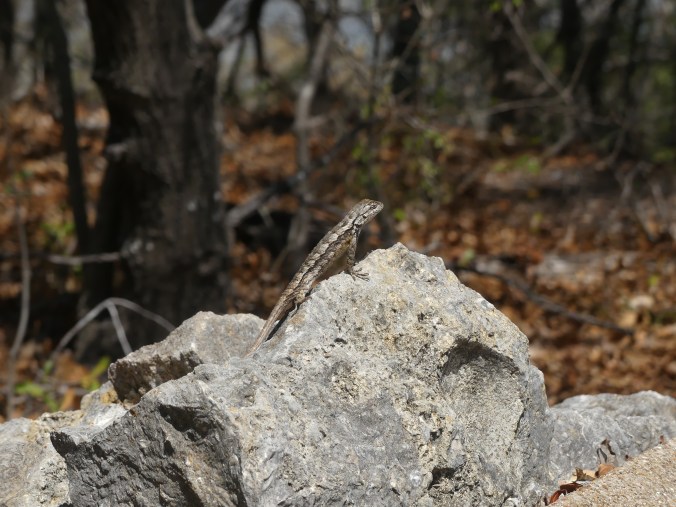
Right away I saw a young Texas spiny lizard who ducked under the old concrete picnic table. I would see the same lizard on my way out, and a couple of others elsewhere on the ridge. Just one more way in which spring seems already to be going strong.
The ridge top
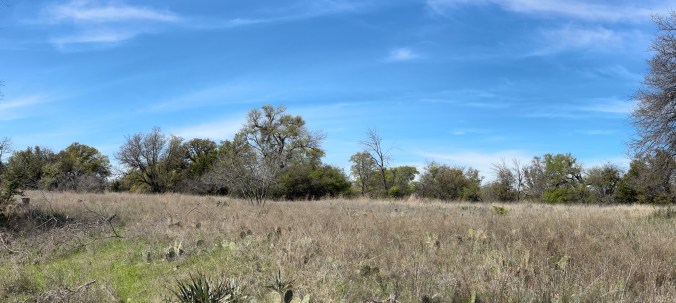
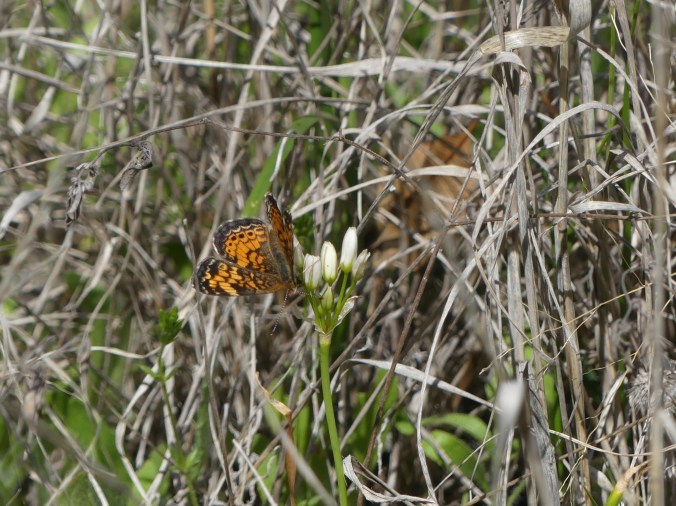
The top of the ridge is a limestone-based savanna with live oak, pale leaf yucca, and prickly pear. Butterflies were active, including sulphurs, goatweed leafwings, and a little crescent visiting what appeared to be crow poison beginning to flower.
Crescent butterfly
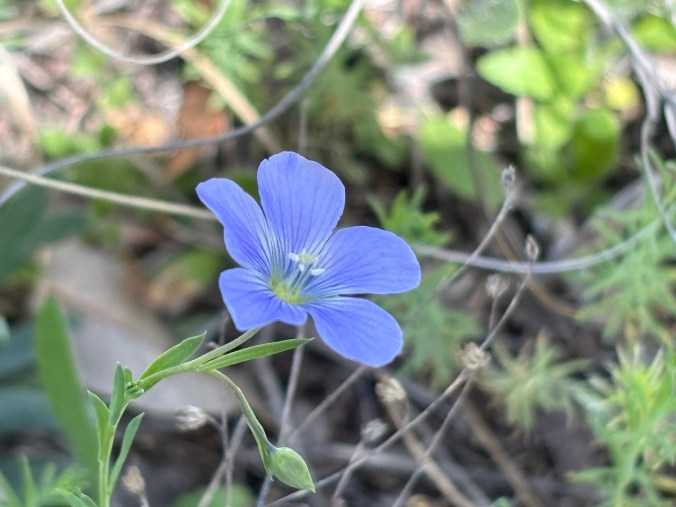
There are not a lot of flowers yet, but a small blue flower caught my eye along the trail. It was meadow flax, according to iNaturalist, an annual with either white or blue flowers. It’s new to me, but with my limited knowledge that’s not saying much.
Meadow flax
Back at the Lone Point structure, I sat for a while and noticed that Texas spiny lizard I had seen earlier. She or he was back at the top of the toppled stone picnic table, basking and reminding me just a little bit of the collared lizards I’ve seen playing king-of-the-hill on boulders at Palo Duro Canyon. Very impressive, little lizard – and thanks for sharing a bit of your afternoon with me.
15 March 2026 – Sheri Capehart Nature Preserve 1:55-3:10pm.
A quick walk on a windy day, as the mid-80s warmth prepared to tumble back into winter for brief reminder that winter has a few more things to say. It was constantly breezy, and then the wind would gust and send the crowns of trees into a spasm of bend-and-rebound. Up close, the upper trunks and branches moved and yet were rigid, a contest between strength and pliability. From further away, the crowns of trees seemed to dance and bow to each other.
Once or twice, strength and rigidity failed and branches snapped or trunks fractured. I did not witness this and did not want to, especially not while standing below the tree. I kept an eye out for crowns that had not sprouted leaves, trees that might be dead or weakened, without the flexibility to remain standing.
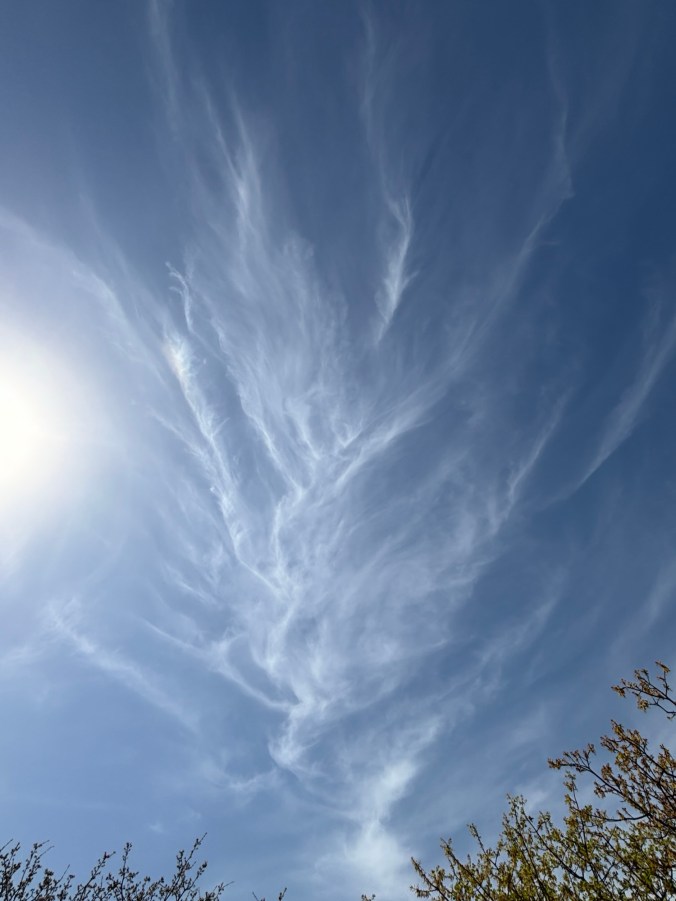
Fingers of wispy cloud
At the bluff, I lay back and looked at the blue sky whose currents above me were invisible. When we cannot see the torrents of wind or the languid movement of air on a calm day, we may forget that the atmosphere above is like the water below us. It may slide overhead like a big, lazy river or it may rush along like a mountain stream, shoving and rearranging whatever it touches. As I lay there, streaks of wispy cloud were blown in from the west, looking like fingers reaching toward us. Soon the whole hand was above us, and so I imagined the upper winds were speeding along like those at ground level.
As I walked down the south face of the hill I thought about how little activity I had seen. Even the dragonflies’ flight was no match for this wind, and the couple of birds I saw in flight were really struggling. When the wind is blowing like this, the butterflies are grounded. Even the honeybees barely ventured out of their tree.
Wind dance
For a human, it was a good time to take a walk and feel the power of the air when it is really moving. In some places those wind currents are causing trouble and damage to other people, and I wish that was not happening. Where I walked, it was no more than what the woodlands are adapted to (mostly) withstand every spring.
Yesterday I spent an hour and a half at Sheri Capehart Nature Preserve on a spring afternoon full of wonderful things. I wrote the following at the Friends of Sheri Capehart Nature Preserve blog, and I hope you’ll go visit there. But meanwhile I have reproduced it below.
March 13, 2026 – Clear sky, breezy, and temperature in the mid-70s at 3:00pm.
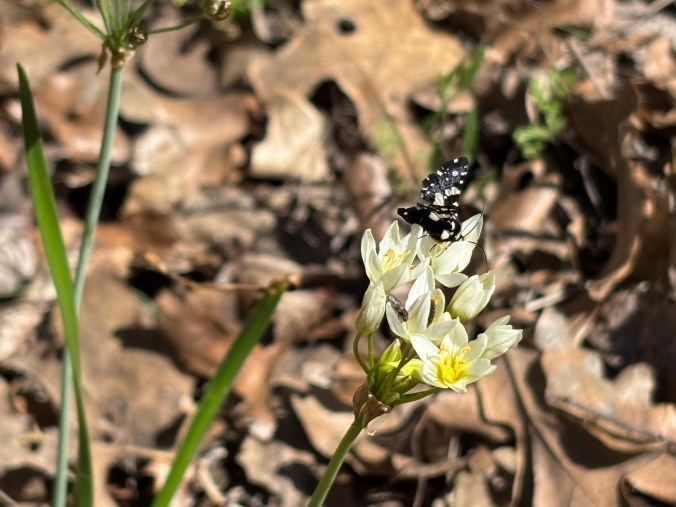
I’m starting to think of spring as beginning when March arrives, as opposed to the more official date of March 20th. Trees are leafing out and flowers are popping up like the delightful crowpoison, which grows from a bulb and looks a little like wild onion but is not. The Lady Bird Johnson Wildflower Center says, “Some references list this species as poisonous to humans. The jury is still out about its toxicity to crows.” That part about toxicity to crows sounds a little tongue-in-cheek, but it makes for a fascinating name for the plant.
A mournful thyris visiting a cluster of crowpoison flowers
The flowers were visited by several small mournful thyris moths. These are black-and-white moths that fly during the day early in the year and reportedly just for a few weeks. It’s another species with a name that makes me want to find the story, but so far I have not found a reason for it to be mournful. Even its species name makes me curious (Pseudothyris sepulchralis, where “sepulchralis” seems to refer to a sepulchre, that is, a tomb carved in rock).
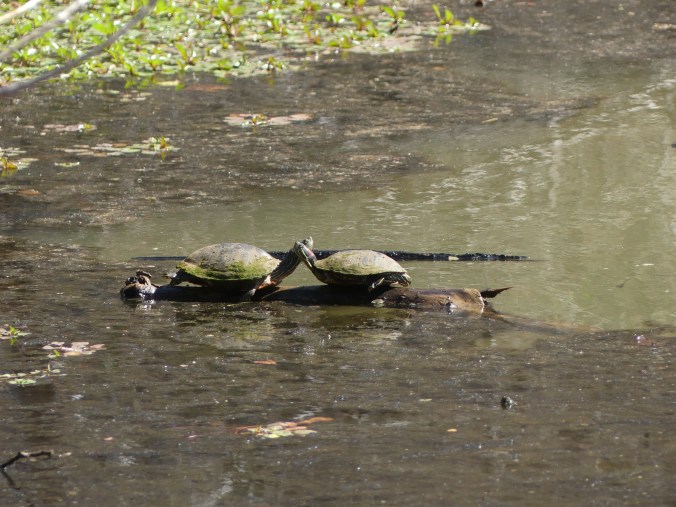
Two red-eared sliders sharing a log
Meanwhile at the north pond, dragonflies were flying and turtles were basking in sunshine, including a pair of red-eared-sliders sharing a small branch of wood at the water’s surface. Those pond turtles are active even on warmer winter days, but spring sunshine makes them seem very content – though that is a perception from a human point of view that could be completely off-base.
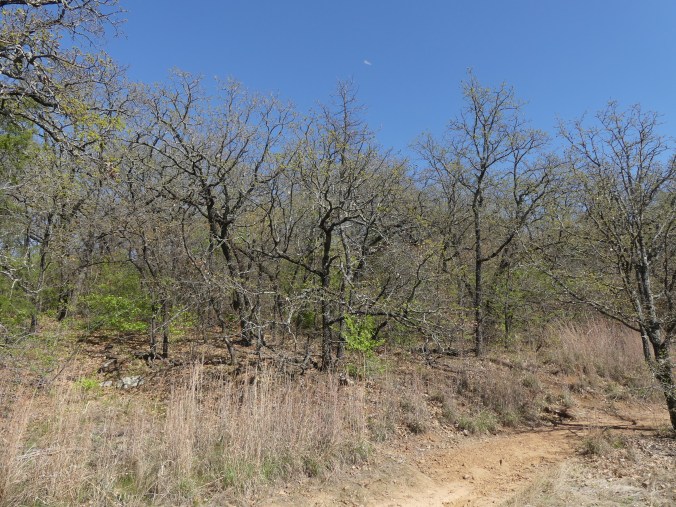
Trees with new leaves growing
I tried to capture the overall look of the woodland in a photo that, seen on a phone’s little screen, is probably very plain. But the crowns of trees are covered in a sort of mist of pale green, the budding of new leaves and the catkins of the oaks. I checked to be sure of the details because I’m not a botanist or even a knowledgeable plant person, but catkins are the dangling strings of the male flowers of oaks. They will be releasing the yellow pollen that coats your windshields, sidewalks, and noses in the coming weeks. And with any luck, they find their way to the female flowers on the oak trees, which are much less conspicuous.
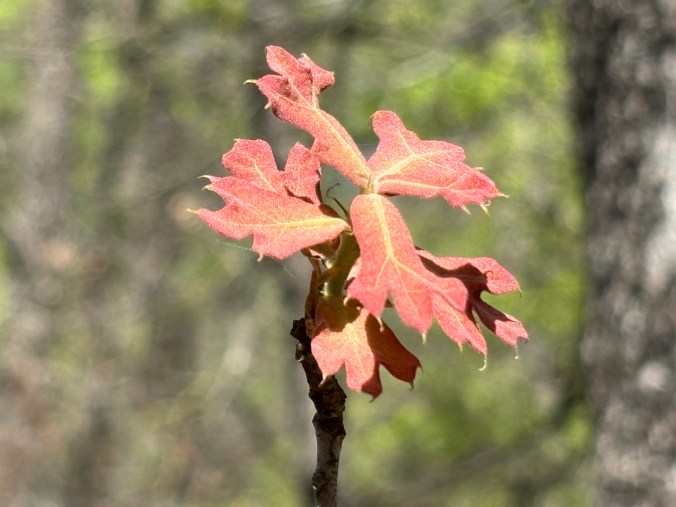
New blackjack leaves – notice the spines at the end of each leaf lobe
The other thing that always seems wonderful to me is how the blackjack oak leaves come in as little red leaves, then turn such a wonderful deep green later on, and next autumn may once again be red – or yellow or some combination – before dropping to the ground.
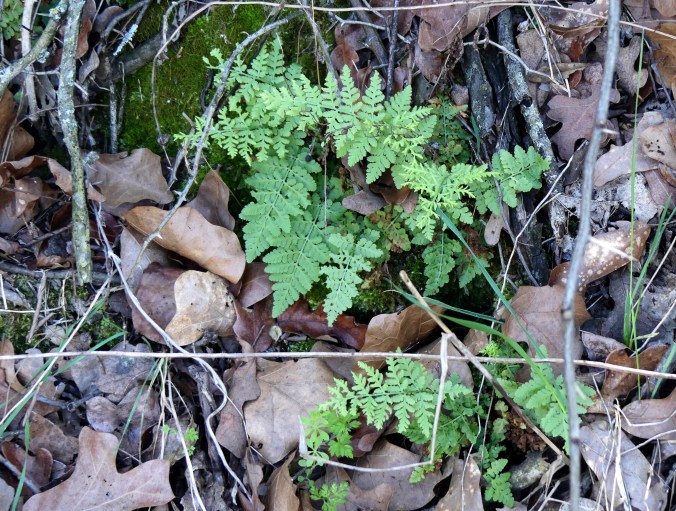
Blunt woodsia growing in a protected spot along with some moss
Along the north side of the woodland, where it meets the patch of prairie, there are shaded spots and little embankments where the land moves up toward the top of the hill. In one of those shaded places I saw a fern that you can find around the hillside and up toward the bluff. It is the blunt woodsia, also called by a couple of other common names like blunt-lobed woodsia. Finding these little ferns, or the various mosses or even liverworts, brings you to a different perspective, like looking at tiny worlds existing in the shaded places in the preserve where moisture is not too scarce.
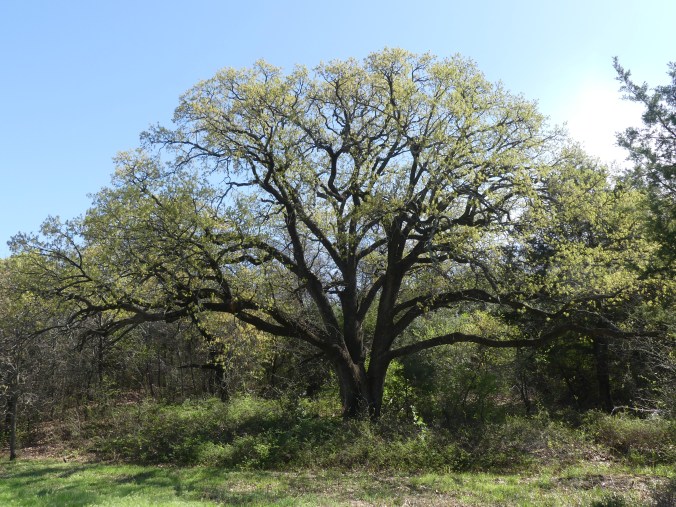
The grand old post oak designated as the Caddo oak, after the Caddo people who once lived in the area
I walked by the Caddo oak, a huge post oak designated as a historic tree by the Texas Historic Tree Coalition, and its crown is speckled with new green leaves, just as it has done every year for roughly 200 years.
Nearby, I watched a medium to large bird sail through trees and across a part of the north prairie, disappearing into understory and trees to the west. I immediately thought of the northern harrier, a graceful hawk that tends to hunt on the wing, flying low and listening for rodent movement. This bird had the right shape and the kind of flight I would expect with a harrier, and I saw that this brownish bird had some white markings but I could not spot the white band that should go across the base of the tail. So I just don’t know. I noticed that Brent Franklin saw one here at the preserve in 2018, which helps make it plausible, but of course doesn’t confirm my observation today.
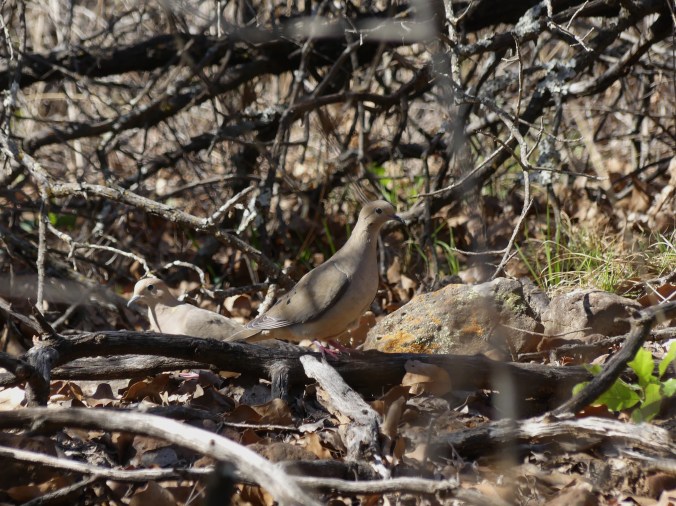
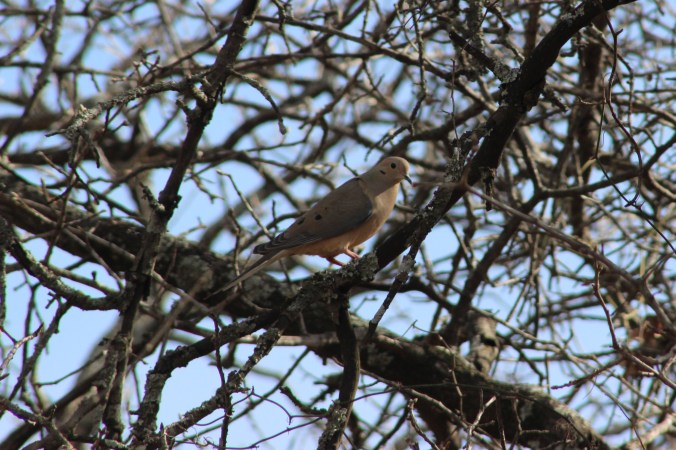
Mourning doves
Walking around the blue loop, I saw a couple of mourning doves near the boulder trail. They were behind a sort of thicket and did not seem perturbed by me and my camera about twenty feet away. They were probably foraging for seeds along the ground.
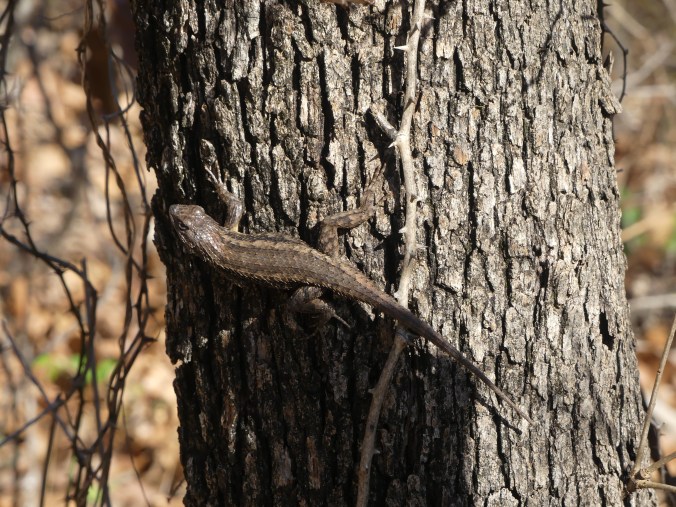
Texas spiny lizard, watching me carefully
On the way down the south-facing hill, glint of reflected sunlight caught my eye. It turned out to be reflected off the back of a male Texas spiny lizard clinging to a small tree trunk. He eyed me in that way that these common lizards do, making his best guess about whether to remain motionless and hopefully unseen, or quickly scurry around to the other side of the trunk. After I took a photo as I moved around him slowly and hoped not to scare him, he quickly scooted around the trunk and out of sight.
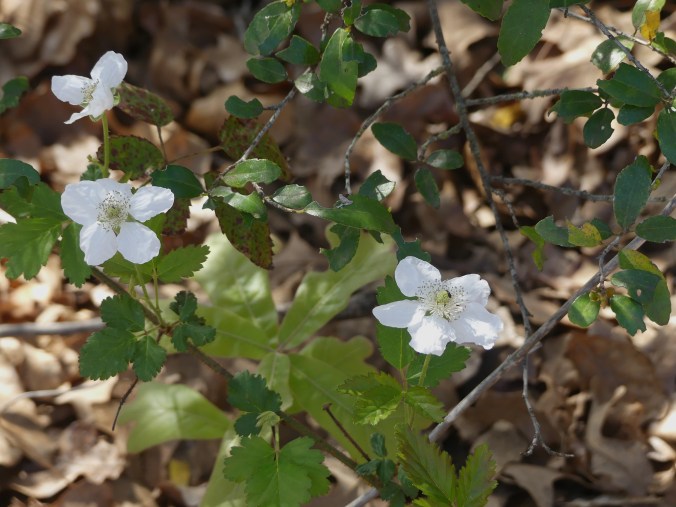
It was certainly a walk full of wonderful things today. Everywhere I went there was butterfly and moth activity, either more of the mournful thyris moths or else goatweed leafwings, sulphurs, or a swallowtail or two. And the southern dewberries are blooming with those beautiful white flowers.
Southern dewberry, which will feed birds and other wildlife later in the year
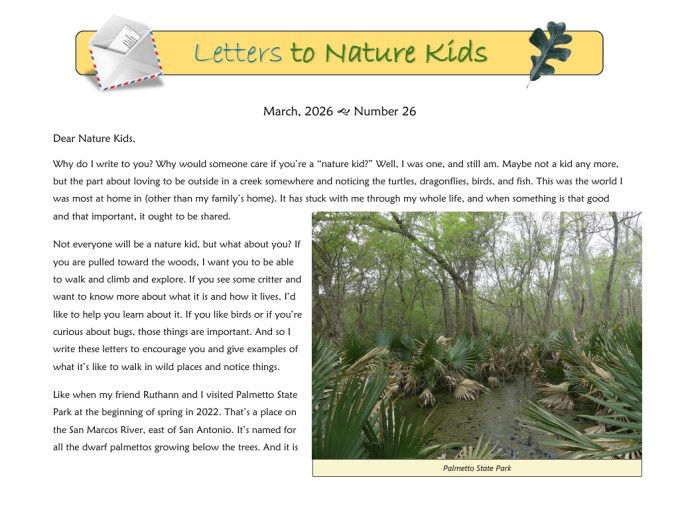
You may recall that I write periodically to “nature kids.” It’s a free pdf download from the Letters To You page, written for older kids and teens who are drawn to wild places and the things that live there.
This time I included a bit about why I write these letters. Some of it is about sharing places and experiences that may encourage young people to go see preserves, parks, and such places themselves. As an example, I talked about Ruthann’s and my trip to Palmetto State Park in 2022. (I also blogged about it here.)
If you know any kids who would be interested in this current letter, please share it with them (in print or via a link). I mentioned that I’m currently writing about nature kids in several articles for Green Source Texas and noted that – with parent permission – I very much would like to talk with a couple of serious nature kids. And thanks!
Climbing to the top of the hill, I pass some friends I see often when I walk this trail. They aren’t people, they are other-than-human relatives like the bees in the bee tree. And the tree with the hole at the bottom like a window into a shelter where a woodland sprite might live. The blue jays hollering at each other like schoolboys, and on really warm days, the Texas spiny lizard hanging on to a tree trunk watching for an insect to eat.
Many Native American cultures see the rocks, waters, trees, and wildlife as our relatives, and many of the rest of us are beginning to understand that wisdom.
From year to year I can count on these friends. No matter how crazy the world gets, they are nearby, doing what they do. It is never boring. That is partly because each season is different. The winter woodland is full of bare branches and beautiful brown colors of the leaf litter on the ground, with the calls of crows and songs of cardinals. It’s the deep blue water of the pond, with sparkling ripples from the winter breeze.
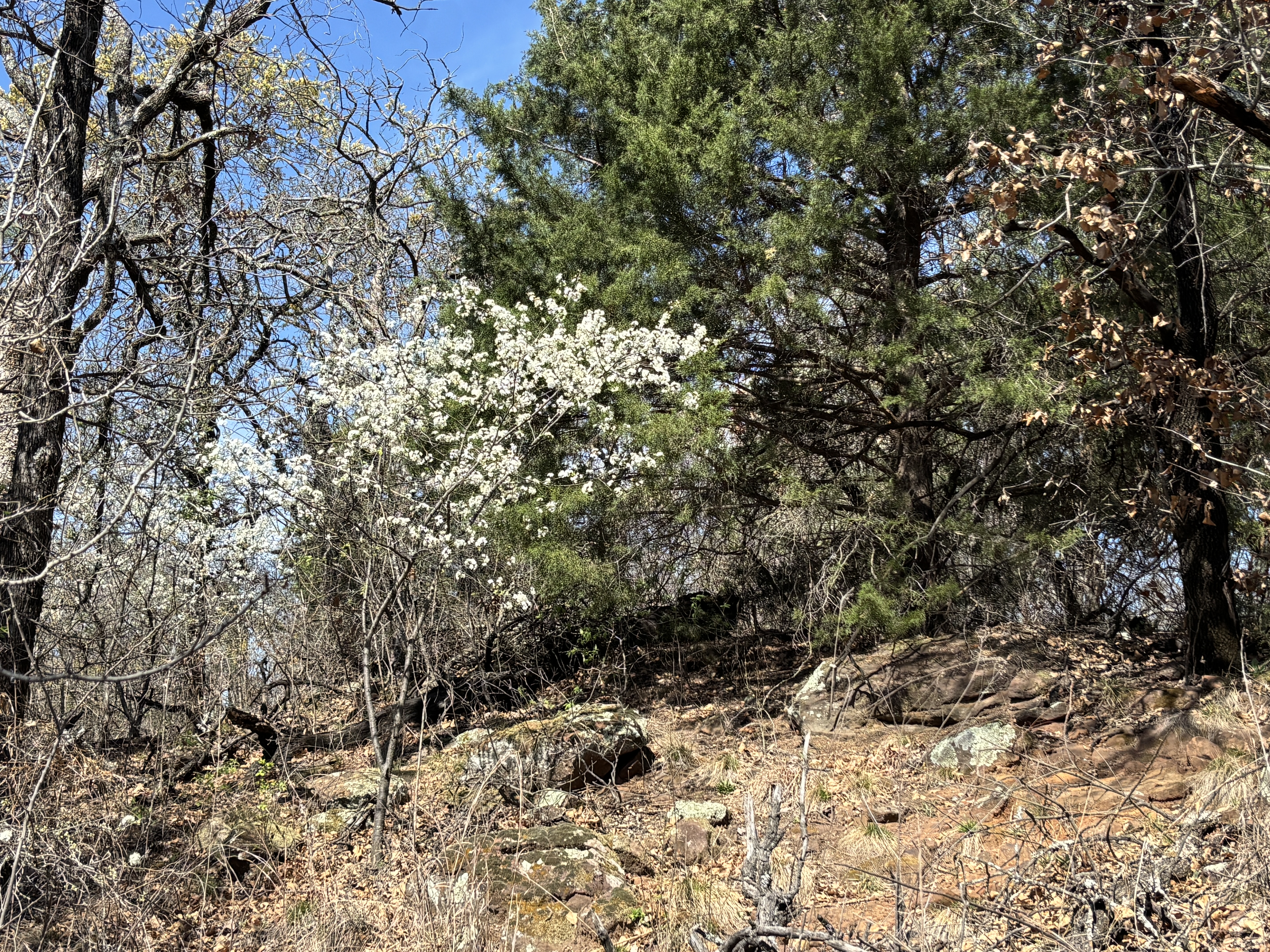
Flowering plum and juniper on a hillside
In spring, the angle of sunlight changes and the branches and twigs swell with leaf buds. Plum trees bloom and later, flowers like spiderwort, spotted beebalm, and toadflax cover the soft, sandy soil. The air is sweet, and the night comes alive with frog calls.
It keeps on like that in every season. The peak time for one thing ends, and a new thing begins, like a kaleidoscope in which each turn of the season brings a new pattern and new colors, and each one is beautiful.
The place is never boring, even after visiting it for twelve years. I walk past the same oak trees, say hello to the same Glen Rose yuccas, and I might see some of the same crows (I can’t tell individual crows, but they’re observant and smart, and they can recognize individual humans). It’s a comforting stability, with old friends and places that won’t disappear.
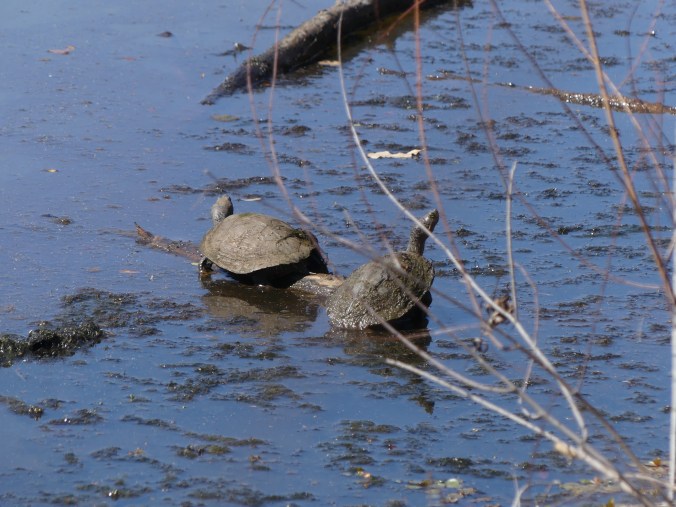
Red-eared sliders
I think that sometimes when we are restless and need some new diversion, some new thing happening or new stuff to buy, it’s because we are anxious or feeling low even if we are not aware of it. We want to maintain this distraction from our distress, and if we don’t get it, we call that boredom. It’s like we’re careening downhill in a moving vehicle trying to dodge random crises, and we want something to take our minds off the fear and not fall into despair.
Something that I think helps is to find islands and refuges of stability. That could be friends and family who provide companionship, steadiness, judgment, love, and support no matter what. It might be found in works of music. And I think places in nature can give us a sense that the world contains goodness and that some good things will not abandon us or be taken away.
In nature there are many places we can get to know and count on. A creek does not pretend to be someone they are not, and a prairie will not “ghost” you. The woods will not assail you with news of conflict and violence, and the pond will gladly let you be still and watch the shimmering reflections of trees as the breeze kisses the water’s surface.
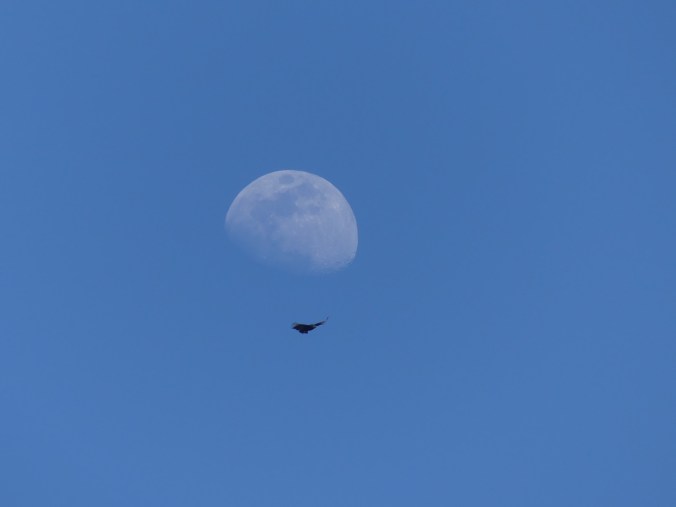
A black vulture and the moon
When you go there and stand among the trees or sit beside the water, it helps to be there fully, mind and body. If we can’t let go of the worries about tomorrow or the discomfort of something that happened in the past, we will barely be awake to the woods and ponds. That’s where mindfulness comes in. By paying attention to breathing, we bring ourselves into the present, and by noticing our thoughts and feelings, we can release them and not be caught up in them. And as we stay in the present, accepting whatever is happening without wanting to change it or add to it, those moments can be wonderful. They can be healing.
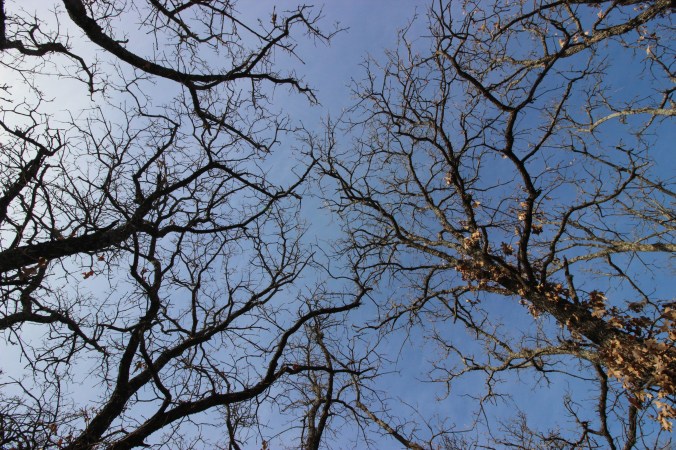
Some notes from my walk on March 3rd: “Walking around the crown of the hill, I got a look – from 30 or so feet away – at a roadrunner who looked at me warily and then ran on along the trail. There are butterflies, the bee tree is busy, and at least some oaks are starting to leaf out. Lying under bare oak branches and a blue sky with wispy clouds, at least twice I felt the tiniest sensation of a droplet on my face, and there is a very small drop, crystal clear, on my glasses. I suppose it might be rising sap released where buds are starting?”
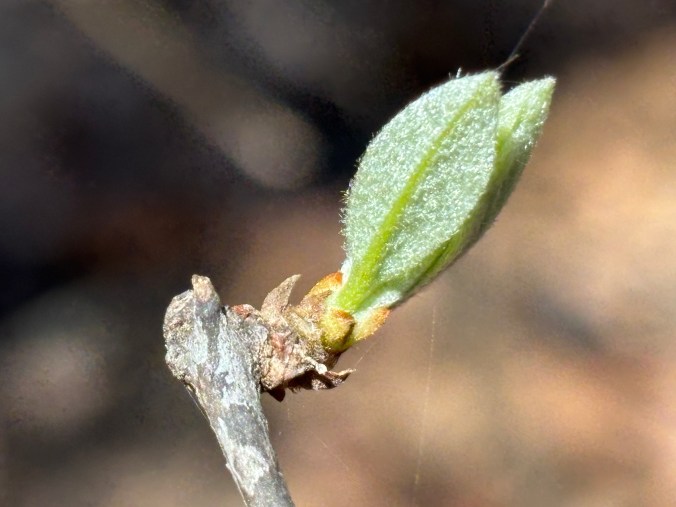
Newest leaves in spring
Each season is a deepening relationship with this preserve and all that lives there. I hope that you have such a place, whether it’s a National Grassland with thousands of acres or a little patch of wildness in a city park. Get to know it, let it seep into your bones so that you’re like family to each other. Bring your human family, too, and get to know each other.
I read a post from Diana Butler Bass about the wilderness, saying she hated it. My impulse was to go on to something else, because someone who hates wilderness could not have anything meaningful to say to me, right? Bass is a Christian writer (I would say among the progressive Christians) and she was writing in part about the temptations of Jesus after spending 40 days in the desert. But she was particularly interested in the wilderness as a liminal space, an in-between transitional borderland that may feel so unfamiliar as to be disorienting or frightening.
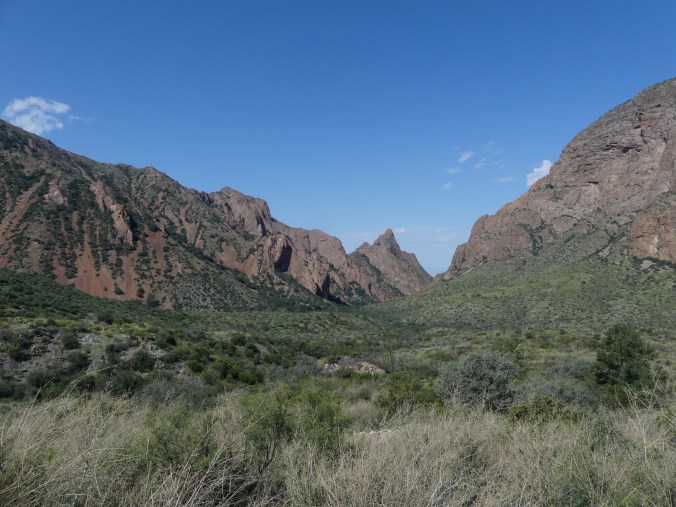
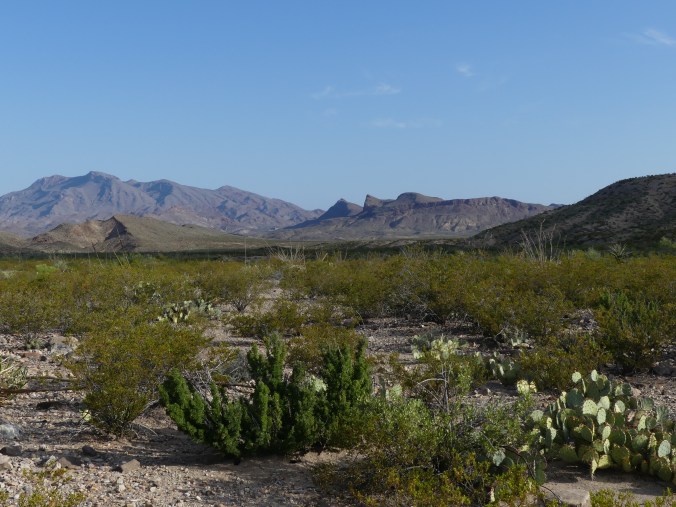
Most of my experience with the wilderness has been in the Big Bend region of Texas, with deserts and mountains relatively untamed by modern humans. Yes, there are roads and visitor centers, but not many. Yes, the Basin is a tourist destination with a resort and hiking trails up into the Chisos Mountains. But in the Big Bend it is easy to get to a place where you are unlikely to encounter anyone, it is quiet, and smartphones are mute and useless for a time. How can you hate it?
Big Bend National Park, the Basin
I admit that the prospect of spending 40 days there with no car and no easy source of water or food makes me uneasy. But in my mind those are just practical considerations; being in that wilderness is something that otherwise sounds wonderful. But I think I understand where Bass is coming from with her talk of it being a liminal place. She says,
The wilderness is an encounter with what is otherwise unknowable. We contend with that which the cozy and familiar obscures. … And there is no wilderness without danger. There is no liminal space without danger. This is the fearsome holy, the unsettling sacred. – Diana Butler Bass
The “fearsome holy” and “unsettling sacred” sound to me like ways of talking about awe. That emotion – awe – involves being taken out of that familiar perception of “having it together” and knowing what’s going on. We generally think of awe as a good experience when confronted with things like beauty or moral courage. The psychologist Dacher Keltner, in his wonderful book about awe, defines in this way:
Awe is the feeling of being in the presence of something vast that transcends your current understanding of the world. – Dacher Keltner, Awe, p. 7
Bass talks about the wilderness opening us up to whatever “the cozy and familiar obscures.” After you strip those things away, what then? She recalled sitting in Wyoming among petroglyphs and thinking about the people who, over a thousand years ago, went into the wilderness. Perhaps they had visions, or maybe, out there with only themselves, they had spiritual experiences that cut to the heart of who they were and what they would do if tempted to be someone they were not. Was their belief or their identity tested by an impulse to throw themselves down from the mountaintop? Was this a place of testing, discovering the strength or limit of who they were and what they believed?
I’ve been to the Big Bend plenty of times, and experienced awe frequently. Not necessarily a primal testing of who I am or what I believe, but the stripping away of the cozy and familiar so that you feel yourself in some more essential way, and you might reconsider how you fit within that vast, beautiful space.
In Mindfulness in Texas Nature, I wrote about places where we can look for miles without seeing houses and cars:
…places where, when we look around us, we do not see a mirror reflecting ourselves. I think there should be places where we are able to say, “This is what nature is like if we leave it alone.” When almost every place reflects back something about ourselves, does that foster an unhealthy self-preoccupation? We are estranged from, and many of us are a little afraid of, truly wild places. – p.123
I wish we could, all of us, come to love wilderness and vow to protect it for each other and for its own sake. Wilderness as a liminal space, a place that brings us back to our essential selves, where we can experience awe or even some dislocation as we get a perspective about who we are and maybe where we want to go with ourselves.
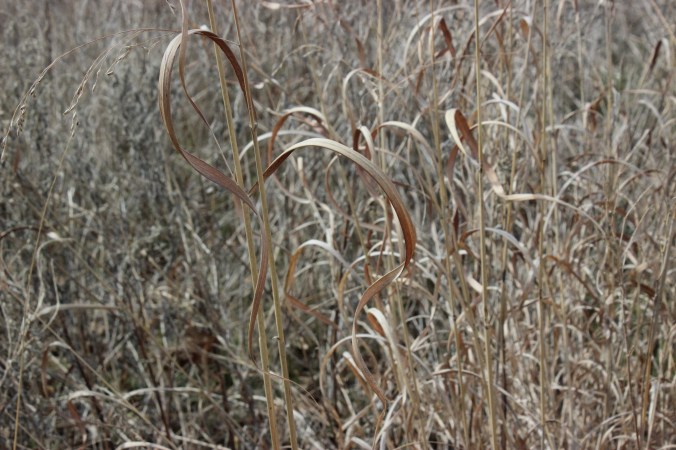
I shared part of a weirdly warm winter afternoon at Sheri Capehart Nature Preserve with a wading bird who was hunting fish in the pond. As usual, on the way to the pond I found strange and beautiful shapes in the winter grasses and forbs*.
Winter highlights some of the graceful and interesting shapes that we can find in plants. For example, the leaves of switchgrass remind me of curled ribbons. Many of them arc downward in graceful twists. The Lady Bird Johnson Wildflower Center describes switchgrass as one of the primary native grasses of the tallgrass prairie, growing an amazing three to ten feet. You can get a sense of that at Fort Worth Nature Center and Refuge. There are places within the demonstration prairie where the fine, slender seedheads of switchgrass tower overhead.
Curling leaves of switchgrass
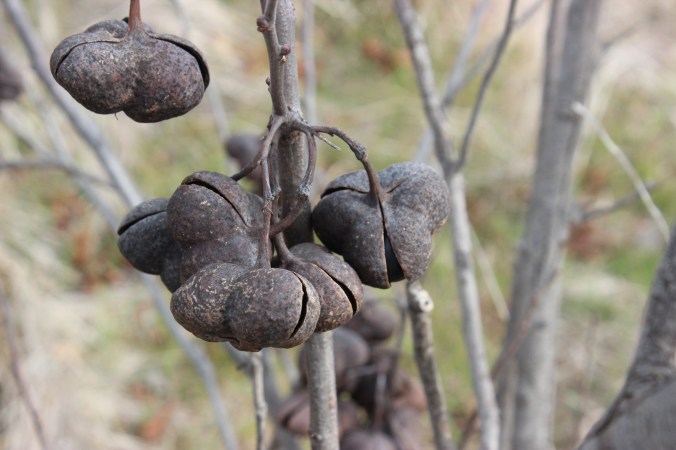
I also saw one of the Mexican buckeyes that grows on the preserve. The trees are typically small and are recognizable in winter by their clusters of big, three-lobed seed pods. By now the pods have cracked and the toxic seeds the size of small marbles are still inside. Parts of the plant may be toxic, but the clusters of pink flowers that will emerge in a month or so are beautiful.
Seed pods of Mexican buckeye
It is a short walk to the south pond, but these things hijack my attention and so the walk takes some time – and it is time well-spent.
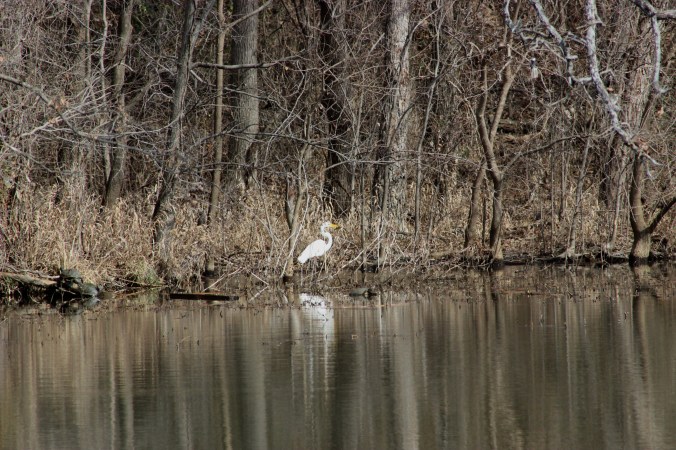
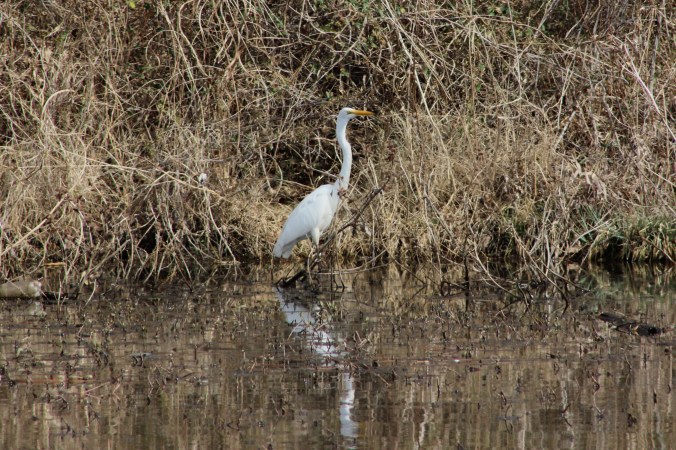
The great egret was wading the pond when I arrived, searching in the water for small fish or the bigger invertebrates that live there. Spotting me, he (or she) flew a little further away and continued his fishing. What an amazing bird! The great egret spends time in shallow water, mud, and algae while remaining white as snow. The bird moves forward in the most deliberate, stealthy way, with those yellow eyes watching and a bill like a long, yellow dagger ready to stab into the water, propelled by an impossibly long neck.
Great egret with a sunfish held in its bill
Sometimes the egret was motionless, a bright white ghost seen through dried yellow and brown reeds and brush. And then he moved like an apparition, lifting one black leg and taking a step, and then the other, soundlessly gliding across the shallows. Without warning the yellow dagger stabbed into the water and brought out a small sunfish.
If you have noticed sunfish, you have seen that there is a dorsal fin on top of the fish, and that fin starts with a series of tough, sharp spines. When caught, that fin is pulled forward so that it is erect, hard and sharp. The fish itself is tall, not bullet-shaped, so that it is painful to imagine swallowing one. But that is what great egrets do.
There was a minute or so in which the bird’s neck twitched, perhaps as the fish struggled going down or as that long neck tried to shift the fish to a more comfortable position. I figured that the egret had been able to get the fish into a head-first position in its mouth, because any other way seemed so much more difficult.
The great egret
And then the egret resumed that patient, slow strategy of fishing, moving like a ghost into some emergent vegetation and remaining motionless.
It was time to walk up the hill to visit all the familiar spots, the oaks and “toothache” trees, the bee tree, and all the rest. At the base of the hill a mourning dove walked the trail and then flew up into a tree. He called that familiar, soft call: “oo-woo-oo” followed by “oo-oo.” The notes sound as though they might be made by an alto recorder, that wooden, flute-like instrument you hear in some baroque and renaissance music.
Mourning dove
The call is very musical and we usually hear it as lonely or mournful, and so the bird is called a “mourning” dove. If we heard those notes from a human voice, low and soft, dropping a little, most of us would hear some sadness and loss. That is how our brains are tuned to recognize emotion in voices, but it’s good to be aware that it reflects our brains, not a dove’s brain. Perhaps the bird is saying, “hey, let’s hang out together, maybe get a pizza.” We can still be moved by hearing mourning doves at sunset, imaging a lonely voice in the gathering darkness singing about the weight on its soul. I’m sure the doves don’t mind.
From the top of the hill, one trail threads past some boulders on its way down, and I sat for a while soaking in the low sunlight reflected off sandstone, bare trees, and dried grasses and forbs. I will miss this quality of light as spring arrives and the sun stays higher in the sky. I also noticed another smaller trail that disappeared under the trees and low juniper branches. And I imagined other lives in other bodies using that trail, the raccoons or the occasional fox or rabbit who wander this place, mostly when the people go home.
The little trail beneath the tree
I wonder what they think of the big people who share this space with them, who seem not to hunt, not to fear predators, but just move among the trees and prairie patches. Some jog, some walk their dogs (triggering wariness and fear among the animals that live here), and some go from flower to tree, from dragonfly to moss, stone to bird, as if they cannot get enough of this patch of creation. “Oh hi, rabbit – I see you watching me. Thank you for being part of this place.”
So that was another day wandering this little patch of creation for a while, having the privilege of sharing the pond with the egret and seeing some of the beautiful shapes and forms of plants in winter. It never becomes repetitive, and hopefully these words and photos convey some of that freshness and beauty.
* That word, “forb,” is not one that most of us easily recognize. Nature folks may know it, and certainly botanists would know it. According to Etymology World Online, forb comes from the Old Norse word “forbær”, which meant a fodder plant. Back then it referred to any of the plants used for animal feed, but later it came to mean a herbaceous plant other than grasses and sedges.
I wrote about ice at the local preserve and ICE as a source of fear for us all. I hope you will follow the link over to Substack and have a look. I wrote, “Yesterday I visited my old friend, the Sheri Capehart Nature Preserve. I do it all the time, but this was my first outing after several days with temperatures below freezing and several inches of sleet and some snow on the ground. That was outside; inside, my heart was buried under another sort of ice after weeks of abuse, murder, and lies in Minneapolis.”
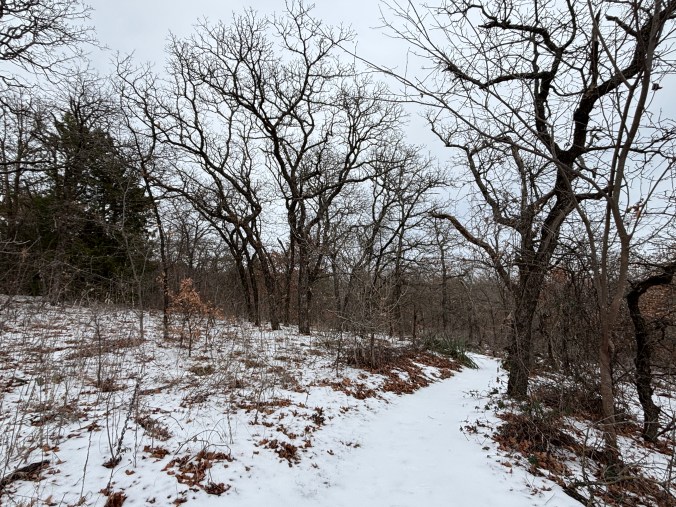
It was beautiful at the preserve and I thought about how being there was like “looking away from the abyss.” I said, “I looked away and walked up that lovely hillside to the bluff at the top. When the ground is covered with snow (or in this case, fine sleet), the woods are opened up and the contours of the landscape made obvious. Against the white background, the trunks and branches of oaks form a sort of stark, jagged, and detailed calligraphy, the script of the woodland revealed.”
I hope you’ll give it a read and have a look at some of the photos.
I wrote this on Substack, before the murder of Alex Pretti in Minneapolis. That murder intensifies what I express below, but it also compels me to recall how important it is to hold on to each other. Faith in our government is broken, and we have to find ways to support each other while we also try to keep hold of who we are individually.
We each have an identity, a sense of who we are. It is made up of such things as what we value, what we love, what we choose to do and aspire to. My sense of myself is being inundated lately with outrage, loss, and worry. Our country is turning into something cruel, corrupt, and crazy, and it affects many of us profoundly. But I don’t want to lose myself in outrage and worry; that can’t become who I am, or who my community members are.
The answer cannot be to give up, to stop doing what we can to fight back. I have been a part of several public protests last year and the beginning of this one. I make comments in social media, because it may be a source of mutual support among my acquaintances and occasionally an actual exchange of ideas. I even still contact my political representatives – even if that is like writing a note and throwing it into the fireplace. None of these things feels like enough, nor do many of them feel effective, and that sense of near-helplessness probably affects a lot of us.
I know from my psychology training and from living more than 70 years what a pervasive sense of anxiety, helplessness, and anger will do, especially if they become chronic. Such things as depression, withdrawal, and retreat into distracting rituals, or worse than those may happen. And then what happens to my self, the part of me that cares for family and friends, loves nature and finds joy and rejuvenation there, finds essential truths in religion, literature, and music? These things could be overwhelmed and pushed away from the center toward the edges. That makes room for the worry, rumination, anger, helplessness and loss that cannot fully coexist with the rest of who I am.
And such things cannot really coexist with who you are. I’m thinking about the majority of us, I’m pretty sure, because polling data show tremendous dissatisfaction among most of us, and millions of us have taken the time to march and hold signs saying that the current situation is unacceptable. I worry for all of us, that we might lose a part of ourselves as this national emergency drags on, becoming a chronic trauma.
People at other times in history have borne trauma, and compared to some of them our situation might seem mild. We are not spending day after day in bomb shelters like the London blitzkrieg (or something similar in parts of Ukraine today). We are not suffering widespread famine like the Great Famine in Ireland in the 1800s (or in Gaza today). But we should understand that worse trauma elsewhere does not make ours negligible.
We are in this situation and we have to see it through. We cannot wish it away. And it will take a toll on us, especially for those in Minneapolis as communities try to take care of each other at substantial personal risk. And perhaps now in Maine, and tomorrow in other places as ICE swarms into other cities. Increasingly, people talk about the potential that the country might pull itself apart. And there is the dissolution of the world as we knew it, with allies pulling away from a rogue U.S. and the potential for war increasing. It was easier, a decade ago, to dismiss all this as naive and alarmist, but in the years that followed, much of what we warned about has come true.
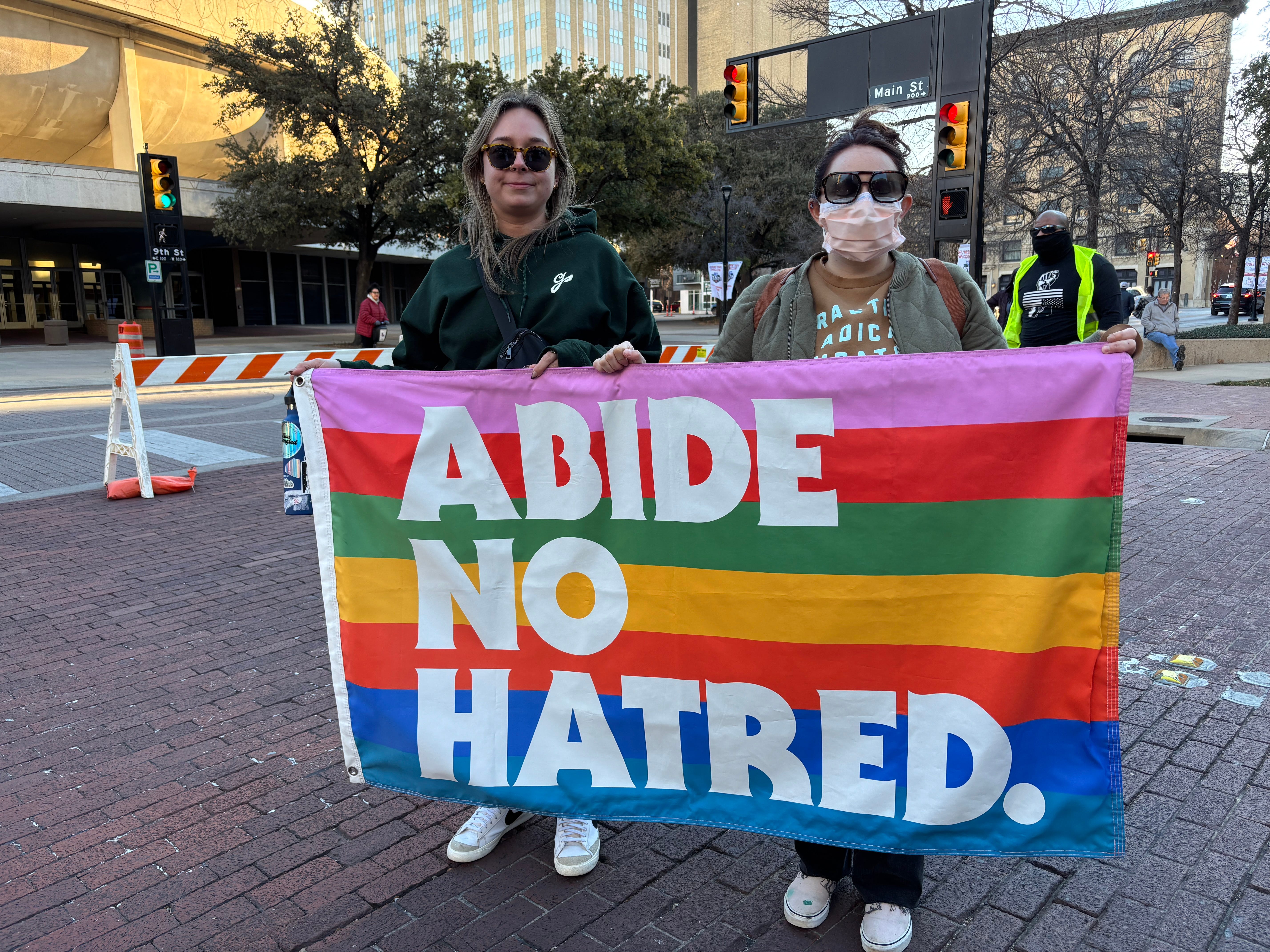
ICE Out of Fort Worth, 1/10/26 (participants agreed to be photographed)
Holding on to ourselves is important during an extended crisis like this. When doom scrolling or ruminating about these problems, I can work on coming back to the “center” of who I am. If I feel lost or numb, the thing to do is to come back to myself. Find a way to step out of what is pulling at me and remember who I am.
Wendell Berry describes this sort of thing in The Peace of Wild Things. He writes about what he does “when despair for the world grows in me.” He goes into nature, “where the wood drake rests in his beauty on the water.” He joins the birds, who are free from worrying about what will happen tomorrow, or in the next hour; they live in the present. And he is aware of the stars and their light, maybe not visible now, but their light will come. Such things free him.
Mindfulness offers a way to step away even if there is no physical refuge, no pond or tree or quiet room where we can go. The practice of mindfulness can give us an ability to let go of things and come back to the present moment with a greater acceptance, even when there is suffering in the present.
This is necessary in order for us to respond to the crisis in some sort of effective way. Taking care of ourselves – holding on to who we are – must happen in order for us to take care of each other the best we can and do whatever else will help. We know what happens when someone becomes saturated with fear or anger, or descends into numbness. That is not how we get through this.
When we feel lost, we work to bring ourselves back. That may be easier when we have a clearer picture of who we really are. Reading and reflecting on the items below might be helpful for that self-knowledge. I hope so.
How I spend my time in work, play, and with others
What I value and want to see happen in myself and for others
How I tend to understand others’ motives and reasons for what they do
How I cope with challenges, and how I recognize blessings
What gives purpose and meaning to the world – where I think it comes from
Who helps sustain me, and how I give back
Are there places that sustain me, and can they be re-visited
 Our Lives In Nature