Each generation of us takes a snapshot in time of the natural surroundings in which we live. What we experience is what is – for us – normal, and it feels like how things have always been. For those growing up in the last twenty years, road trips are not troubled to any great extent by bugs on the car windshield. You might assume that it has always been that way. Your grandpa has a picture from when he was a child, holding up a spikey little horny toad, the only one you’ve ever seen. Summers may involve outdoor fun some of the time, but for part of the summer the baking, searing heat is a gauntlet you run, from one air-conditioned place to the next. That’s just Texas, right? The night sky is hazy and yellowed, with a few stars, and the magic of fireflies twinkling on a summer night can be found in a child’s picture book, but not out your back door. The sound of airplanes, trucks, highways, and air conditioners is so ever-present that you barely notice, but if it all fell silent you might ask, “what’s wrong?” All of this is normal for twenty-year-old you.
If you have paid attention to conditions as you grew up, then when summers get hotter, nights lighter, every place noisier, and wildlife more missing in action, you will notice because it is “different from how it used to be.” Just like when those of us who grew up in the middle of the last century noticed how a quieter world got noisier, dark skies gray with stars less visible, summers became dangerously hot, and so on. Our world became the next generation’s world, and for that generation it was a new normal.
The way a changed world becomes the new normal for a new generation is described as “shifting baseline syndrome.” It was first described as it pertained to fisheries, where people with longer experience noticed declines while younger folks did not. As defined in a 2018 article in Frontiers in Ecology and the Environment, this is “a gradual change in the accepted norms for the condition of the natural environment due to a lack of human experience, memory and/or knowledge of its past condition.”
My baseline, what I considered normal in the 1950s-1960s, included lots of box turtles after summer rains and lots of small massasauga rattlesnakes at sunset on the road west of Benbrook. I explored a large creek throughout the summer, often feeling hot but never fearing heat stroke. Each visit to the creek included ribbon snakes, probably a couple of species of water snakes, and numerous other wildlife species. Spotted Whiptail lizards nervously poked around in exposed rocky areas. Baby softshell turtles turned up at the end of summer, and pale gray Greater Earless Lizards scampered over limestone rocks of the same color.
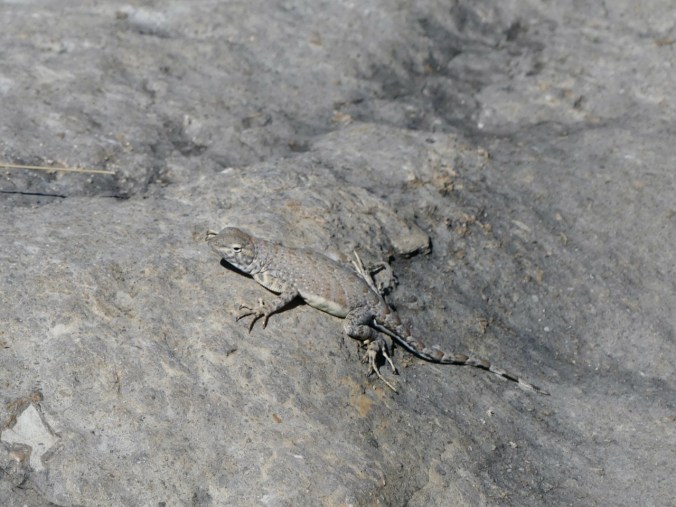
I still visit that creek occasionally, and if eleven-year-old Elijah is with me, his perception of normal for Mary’s Creek will include almost none of these animals. His baseline perception of normal is mosquitofish and some shiners in the water, dragonflies here and there, a few spiders, and the occasional appearance of a cooter or slider turtle. That, for him, is the richness of Mary’s Creek.
That creek is a microcosm of the bigger world in which so much is getting lost. And losses in nature are among the many worries of the world. Our attention and energy can hardly keep up, and we are even more likely to be slowed in our conservation efforts if we don’t even know what we once had. If we could imagine the diversity and richness of an earlier time, clear water and air, the peace of a quiet day and the depth and mystery of a dark, starry night, perhaps we would fight twice as hard for those things. And that is a good reason for us to seek out the quiet places that remain, the places with dark skies, and locations that retain more wildness and richness, to know that more places in the world could (within the limits of a damaged climate) be that way once again. If we could rein in our development and extraction and be able to say, “enough, I don’t need more than this.” If we could walk humbly through the world and be members – not rulers – of it.
Shifting Baseline Syndrome is worsened by our retreat from nature. When children don’t play outside, when they, like their parents, spend their time indoors, and when birds and plants and wild places are strange and foreign to them. The child grows up and the young person matures with even less appreciation for what is lost over time.
Those who study this syndrome say that what is needed is more good data and more people involved in nature. Good data helps establish what we have, so we know when we are losing it. And when more people spend time in nature, learn to recognize various living things and more accurately see what we have around us, then future degradation will seem less normal and less acceptable. That is certainly a recommendation for community science and tools like iNaturalist that facilitate both of those things.
I’ll soon be planning to lead another “Know Your Nature Neighbors” walk at Sheri Capehart Nature Preserve in Arlington. Want to come along?
Discover more from Our Lives In Nature
Subscribe to get the latest posts sent to your email.
 Our Lives In Nature
Rachel Carson warned us. Glad to put a name to it, the Shifting Baseline Syndrome. I try to tell folks this all the time about the decline of so many creatures. And not just the kids, but adults that are just learning to get out into nature. Ok maybe anyone that will listen. The bison and passenger pigeons is what I had heard about growing up. So much has been lost in just the last twenty years. So sad. 😦 Thanks Michael for spreading the word!
LikeLiked by 1 person
Thanks for sharing your thoughts. The loss of so many things, as you said, is very hard. We’ll keep working on it.
LikeLike