I think about what we are all going through right now, and I wonder what would help. I bet we could make a list, right? One of the things on such a list might be mindfulness. It offers a way of seeing things with fresh eyes and a deep way of experiencing the beauty and wonder around us. Also, it is a practice that involves letting go of our restless intensity and fostering patience and acceptance. It is associated with trust, compassion, empathy and kindness. Those are qualities that are not just in short supply but are being discouraged by some people in the mistaken idea that they are weak.
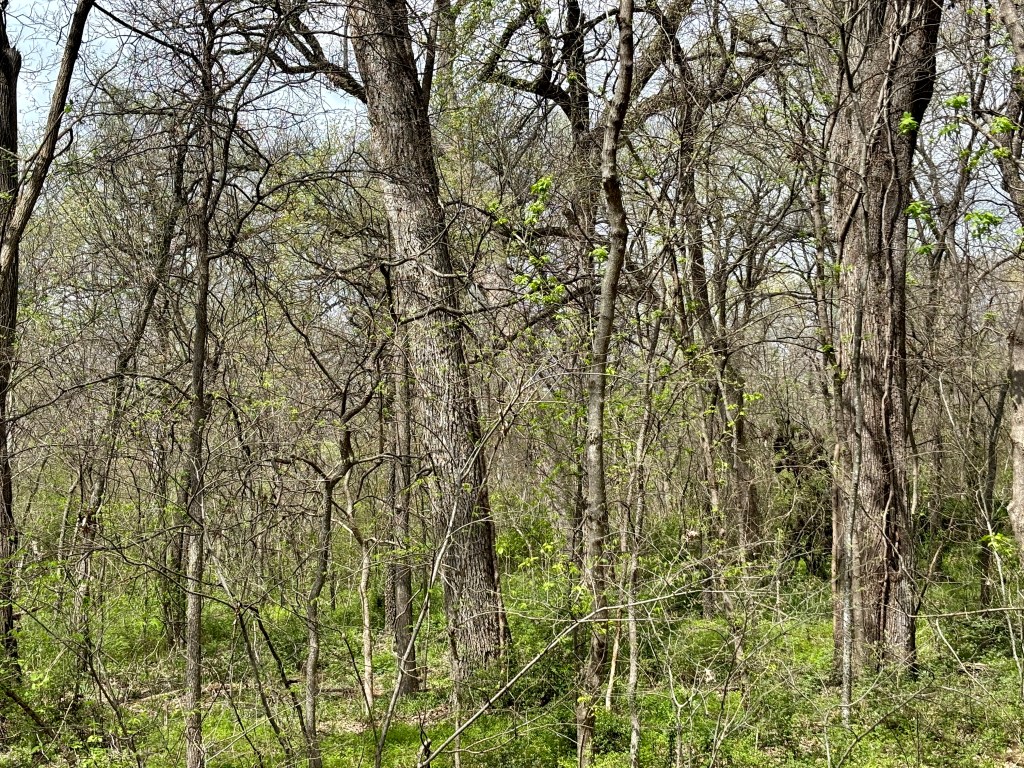
Sunday afternoon, March 23rd, I led a group in a mindfulness-based walk through part of the Spring Creek Forest Preserve in Garland. It was a good day to see things with fresh eyes and let go of some restlessness. The day was warm with low puffy clouds and that feeling – a sort of “softness” – that comes on more humid days in spring. The walk was a follow-up to a talk I had given for the Preservation Society for Spring Creek Forest about three weeks before, talking about mindfulness in nature.
In the talk, I described mindfulness as a special way of paying attention to our experience in the present moment and accepting whatever that experience brings. I said that it is a meditation technique that can be practiced on a walk in the woods, informally. That’s what we would do on the 23rd. We would take a walk without our usual activities of taking photos and uploading them to iNaturalist or chatting, or being lost in thought.
At the beginning of the walk, the fifteen or so people gathered and I mentioned some of the basics of mindfulness, including some of the qualities and emotions that tend to emerge from the practice. One of those is stillness, which does not mean you would sit still all the time. Instead, it is a lack of restlessness, impatience, and wanting the next thing. It is a sense of quiet and calm, even while you are walking. And a related quality – patience, allowing things to come about in their own time and accepting that things take time. Not that we cannot or should not act to bring things about, but we don’t need to struggle against the timetable if it is different than we would prefer.
There are times when I am restless or impatient, but when I am able to have that sense of stillness and patience, it is very freeing. And it is not hard to imagine how our lives would be better if all of us experienced more of those things.
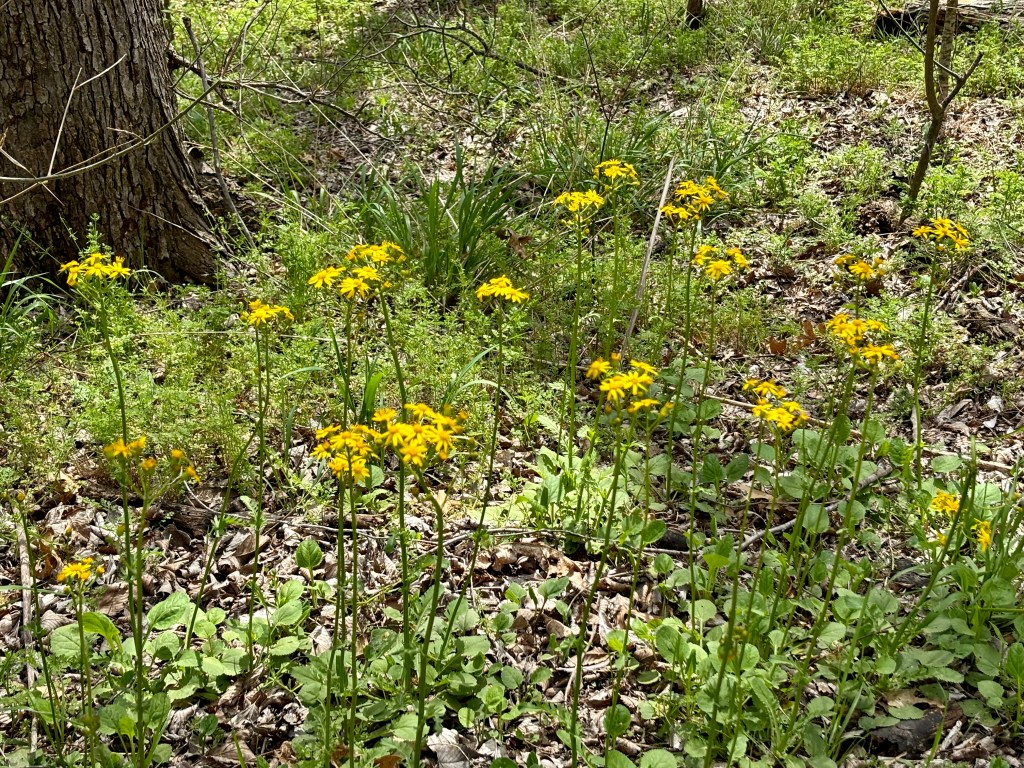
During the walk we talked about “beginner’s mind,” when we experience something as if for the first time, with the vividness and newness that can happen at such times. The more we are in the present moment, the more we step away from past experiences and preconceptions about what is in front of us. We see something with the mind of a beginner.
Mindfulness is also associated with compassion and empathy. Imagine the compassion that would result if everyone put aside more of their judgment about bad or good, lazy, malicious, and so on. We quickly think of people in this context, but we’ll keep it in the realm of nature for a moment. Perhaps there is a copperhead in the woods, and we know that this snake is venomous and capable of sending us to the hospital. With that sense of stillness and patience, we watch it from several feet away, noticing the beautiful earth tones with shades of reddish-orange. The snake remains perfectly still in our presence (unless we get too close or step on it) and is non-aggressive. We might know that the snake’s venom is primarily an adaptation for subduing the animals it eats. I think we would see the copperhead as something to be respected and even appreciated, while being very careful around it. Our compassion would mean we would not want it to suffer by starving or being defenseless, just as we do not want to suffer if we accidentally touched it and were bitten.
At a place where the trail reached the creek, we stopped and spent a couple of minutes with eyes closed or looking down so that our other senses would be more prominent. People later commented about listening to the sound of water flowing in the creek and the songs of birds in the woods. There was also the feeling of sun and a light breeze on our skin. We talked about the smell of spring, even though our vocabularies struggle to describe what we are sensing, the new green growth and what one person labeled as “herbaceous” (like the small plants emerging from the woodland floor). Noticing such things, along with touch and the sensations coming from how we are supported by the earth as we sit, walk, or stand, made our time richer.

There is a lot more, but you should go and experience it for yourself. Emerging from the woods into a pocket prairie with butterflies, the beehive in a hollow tree, the leaves of trout lilies with their speckled or spattered appearance, and the scattered expanse of the small, white flowers of crow poison dotting the forest floor. If you go, take a little time for stillness and for being in the present moment.
Discover more from Our Lives In Nature
Subscribe to get the latest posts sent to your email.
 Our Lives In Nature