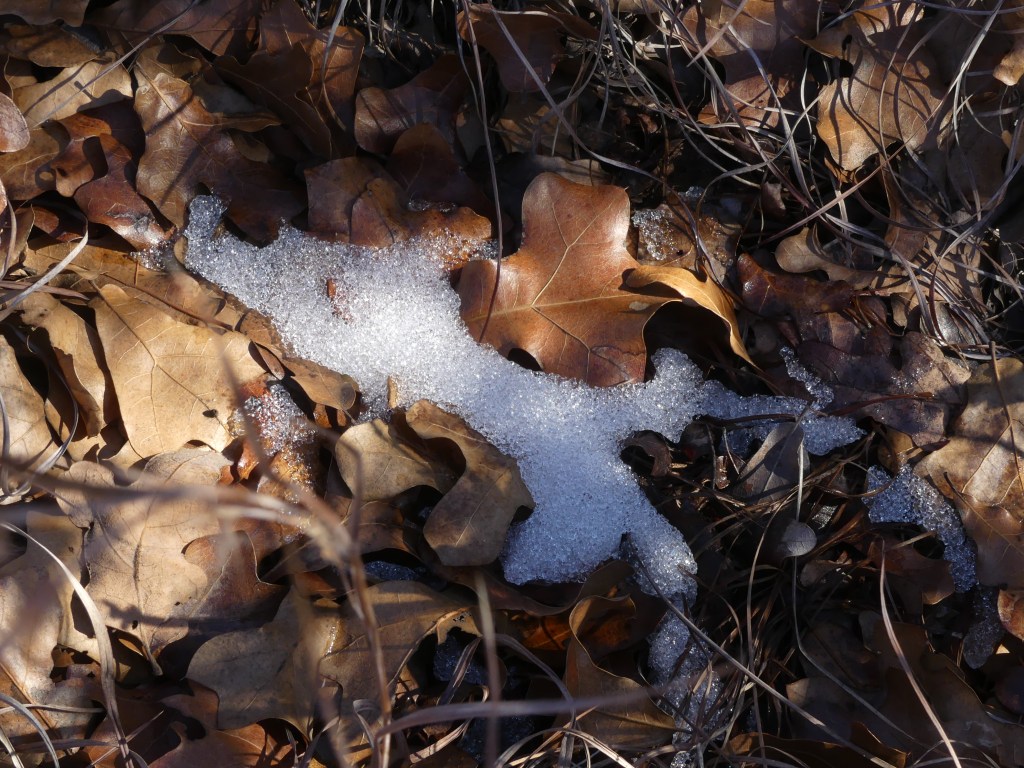
An hour’s walk at Sheri Capehart Nature Preserve provided a few impressions of winter here in North Texas. We had sleet and snow three days ago. We laugh at ourselves about how we overreact to snow and ice although occasionally, like in February of 2021, it becomes deadly serious. Mostly we get a brief taste of snow and it seems to us that we’ve had a brush with glaciers and blizzards and we know the depths of winter.
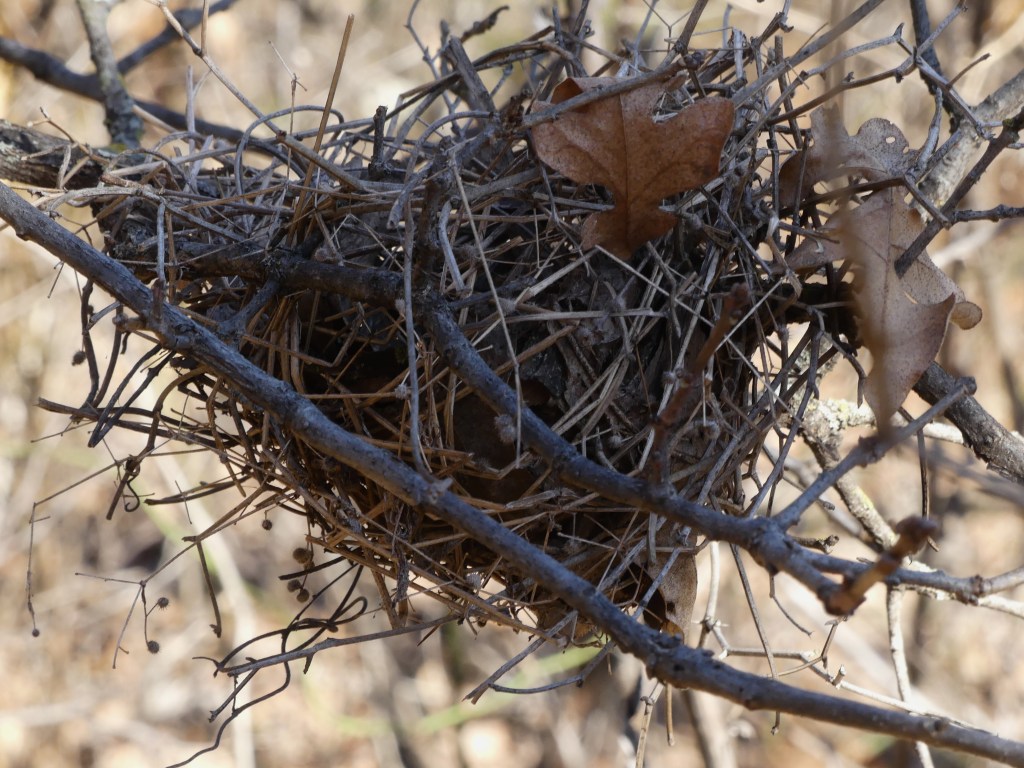
It is always a delight to find a bird’s nest, even the loose arrangement of twigs and grasses I found today. When winter leaves the trees mostly bare, old bird nests are sometimes exposed even very close to the trail. Some time last year this would have been a concealed refuge where eggs could hatch and baby birds grow and, after a while, fledge. I’m drawn to these relics of avian architecture. The birds weave and knit with such skill, and find ways to incorporate so many materials – lichen, moss, hair – so that I’m reminded of woodland faeries. And yet I don’t know why I should go to myths and stories when the birds are miracle enough.
Maybe another reason to be drawn to birds’ nests is how they resonate with our own efforts to bring a new generation into the world. The birds prepare and so do we; once the young hatch they are constantly busy feeding them, and we can relate to that. The young of both species go through an ungainly adolescence, partly feathered and awkward. And learning to fly is stressful, but our hopes are pinned on that day when they fledge and fly off into the world successfully. I hope that the ragged nest I saw today has such a story attached to it.
Wherever those birds are now, apparently it was not at the preserve, or maybe an hour in mid afternoon wasn’t the best time to see and hear them. The sounds today came from the surrounding traffic. Neither my ears (with high mileage and wear, not the most sensitive instruments) nor the Merlin app detected any.
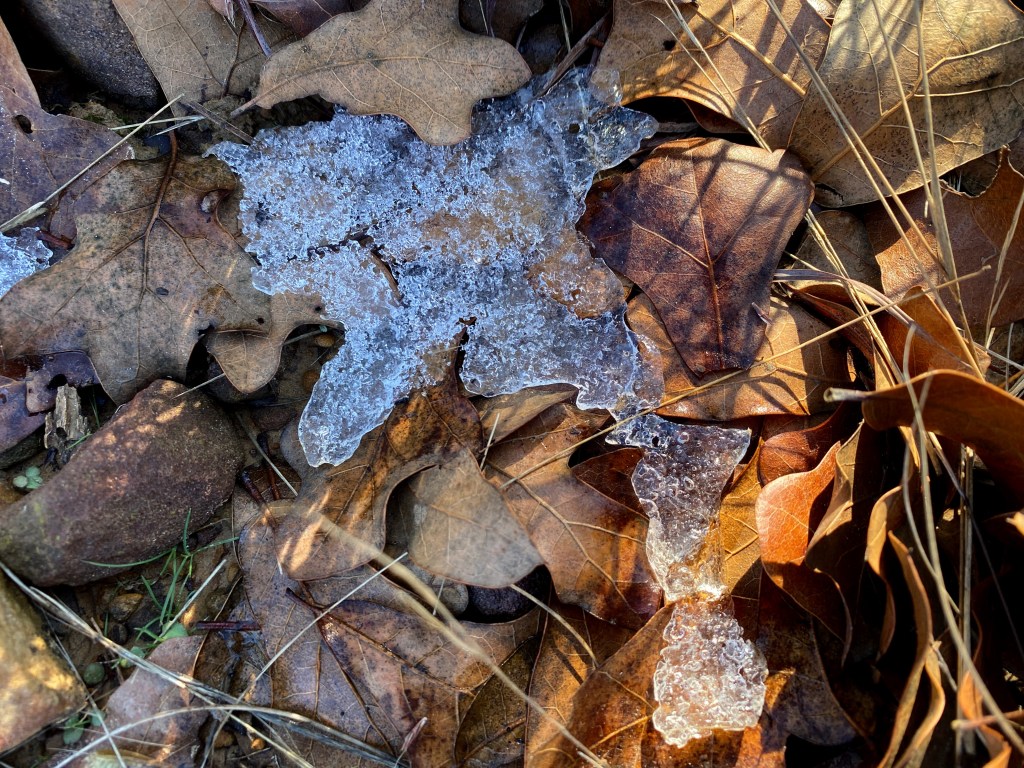
My eyes saw the remnant ice and my skin felt the cold, not that friends and family in Minnesota, Illinois, and Colorado would agree that it was really cold. My thermometer, placed in the shade while I wrote in my journal, dropped degree by gradual degree until reaching 55.5F. Not exactly the arctic.
But at some point during the walk through bright sunshine and shadow, past little patches of remnant snow, I had a momentary recollection of being a kid outside in a Colorado winter, with a cold breeze stinging my skin a little. Up there, at the end of the 1950s I remember two- and three-foot snowfall and I also remember how bright a winter day can be, especially when reflected off of all that snow.
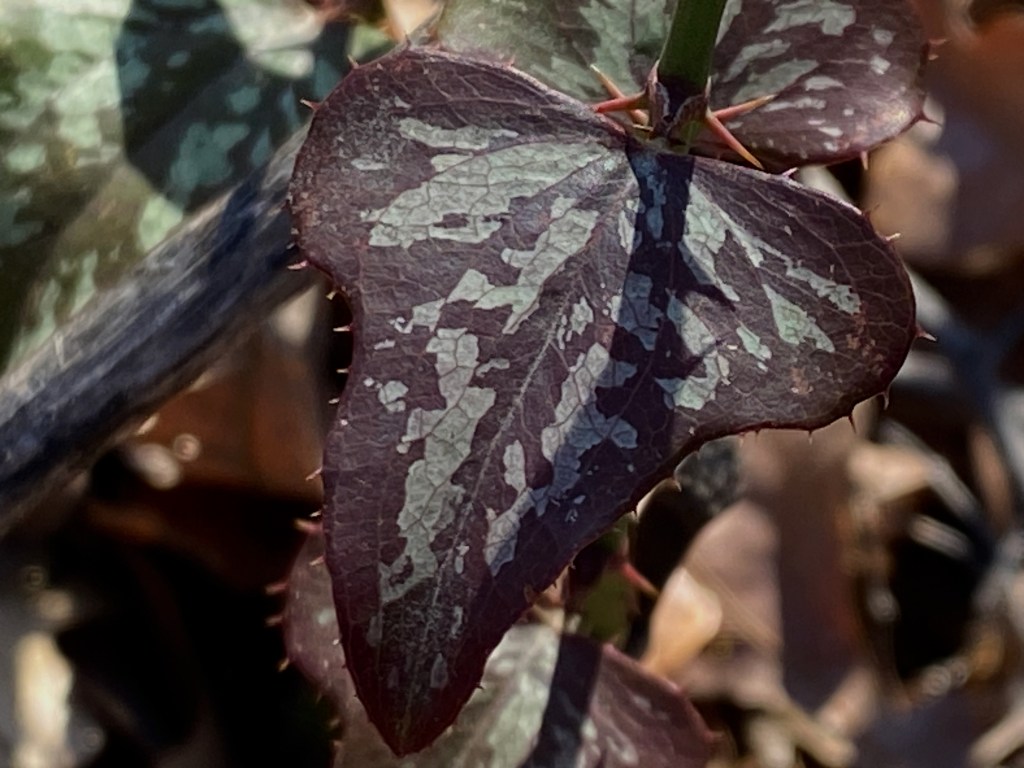
There was one more small thing. Greenbrier is a thorny vine that grows commonly on the preserve, and the name I’ve heard for this one is “saw greenbrier.” While I haven’t seen an explanation, I’ve thought that the name might refer to the little spines all along the leaf edges, like a saw blade (but perhaps it’s something else).
Greenbrier leaves are usually mottled, and in winter the leaf may become dark and purplish while the mottled areas remain green. It occurred to me that each leaf was a small bit of abstract art, and that we could let our imaginations go and see if the patterns suggest something, sort of like Rorschach ink blots. Go ahead, see what comes to you when you look at the pattern. I love the way it splatters out from the central vein.
Just an hour in a place that offers wonder after wonder, in all seasons.
Discover more from Our Lives In Nature
Subscribe to get the latest posts sent to your email.
 Our Lives In Nature