Nearly ten years ago, I was given a young Texas garter snake. A landowner in North Texas had picked him up on his land (where he reported seeing that subspecies regularly) and wanted verification of which kind he was seeing. I drove there with a friend and was delighted to hear that this farm seemed to be one of those little pockets where the Texas garter snake was doing OK. They have always been pretty hard to find, but some places are better than others. Texas Parks & Wildlife Department considers them to be “critically imperiled.”
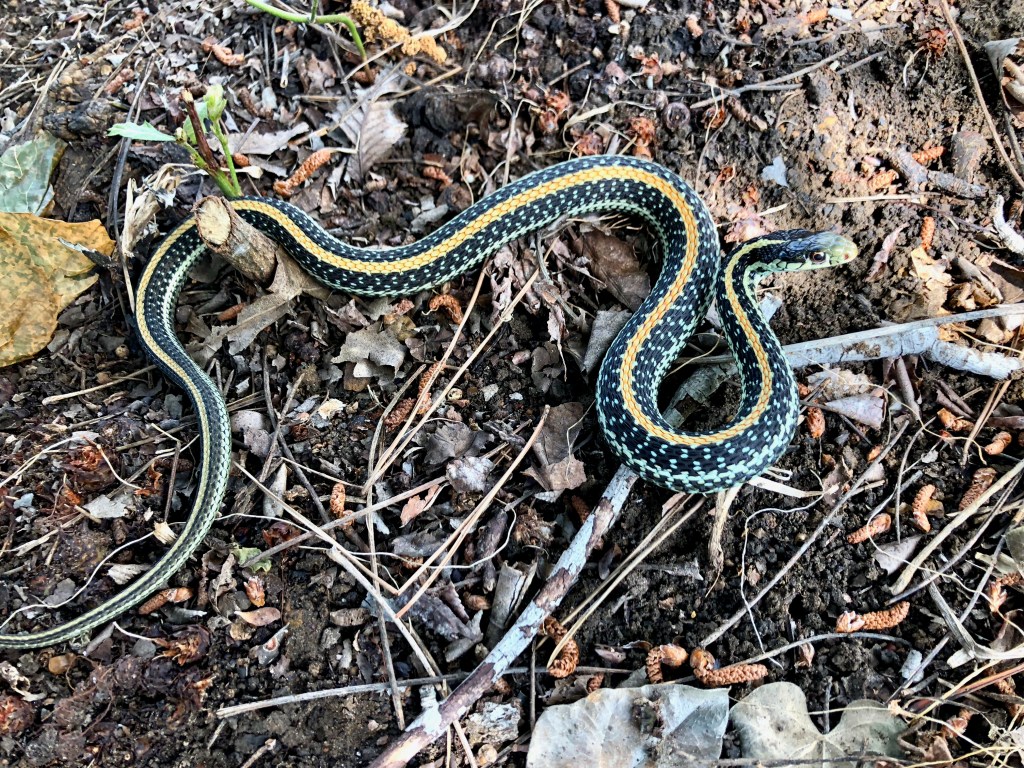
I accepted this young one because it evidently would not be a noteworthy loss for that local population, and because he could be an ambassador for threatened Texas snakes. I’ve taken him to quite a few talks and presentations to new groups of Master Naturalists and to school or summer camp groups. Seeing Tex was a good way for people to learn how being a striped snake helps you escape by giving the appearance of being stationary – the stripe doesn’t seem to move – while you are slipping away. And of course he was a living example of an animal I said was in serious trouble and might disappear, for reasons that no one is sure about. It could involve things like habitat loss, habitats fragmented by roads, fire ants, and maybe other things.
In a study in the 2019 issue of Southwestern Naturalist, researchers looked at the genetic status of The Texas garter snake (Thamnophis sirtalis annectens) and two other related garter snakes that occur in Texas. They also looked at suitable habitat, finding that in Texas, where T. s. annectens does better than the other subspecies is in the area of the Cross Timbers, parts of the Blackland Prairie, and some of the Post Oak Savannah and down toward the coast. The study did not look at why it is imperiled.
I wrote about one of the times I took Tex to meet some kids at River Legacy Nature Center, when a girl had commented that she hoped one day they would be protected. On days like that I felt like Tex living in captivity (rather than living out his life on that farm) was worth it. Tex, of course, was silent on the matter.
But he was happy to nap under a piece of bark, cruise around the cage and eat the occasional mouse. His siblings and cousins in the wild were probably snacking on small frogs and earthworms, but most garter snakes can be convinced to eat thawed mice from the store. He grew and seemed to thrive, and living about ten years is not bad for a garter snake. (Their life span in the wild is assumed to be less than that, and sometimes in captivity they may live longer than ten years, but the evidence about their longevity is fairly spotty.)
And now he has died, I presume from something akin to “old age.” RIP, Tex. You charmed a lot of kids; a lot of Master Naturalists around here know your kind based on getting a look at you. I’ll miss you.
Discover more from Our Lives In Nature
Subscribe to get the latest posts sent to your email.
 Our Lives In Nature
Thank you for sharing Tex with us, Michael. I think I saw him last
LikeLiked by 1 person
Pingback: Getting to Know Some Reptiles | Our Lives In Nature