The Western Coachwhip
It has happened several times – driving out in the grasslands or desert, I pull up on a long, slender snake that sees me before I see it. Perhaps its head and neck periscope up a foot or more for a better look at me. If I get out and creep slowly toward it, the snake keeps a careful watch on my distance and speed. At some point I cross a line in the snake’s calculation of risk, and decides it is time to go. It bursts into agile and athletic motion that carries it unerringly around rocks and through brush piles. In my younger years I sometimes chased but rarely caught them. The only realistic opportunity to catch one was to surprise it, lifting a log or discarded piece of plywood and finding the snake hesitating for a moment.

Occasionally I caught a coachwhip when it believed itself to be concealed or camouflaged. I once surprised one on a gravel road in the LBJ National Grasslands, and it quickly slipped off the road. I pulled over and investigated a grassy area where I last saw it and found four feet or so of tan scales blending very well in the dappled sunlight along the ground. I grabbed the snake and then worked to calm its thrashing body so that I could take a photograph. After a short time the snake was calm enough for me to put it on the ground, covering its head and restraining its body just enough so that it did not struggle.
Then it tried a different strategy that suggested some form of death-feigning. Coachwhips have occasionally been described as feigning death to discourage an attacker from continuing whatever it is doing. After all, there is no need to attack a dead snake. This one went limp but turned its head and neck to the side. A hog-nosed snake will flip over in death-feigning, as if the only way to be properly dead is upside-down, and this snake seemed to be doing a much less dramatic version of “playing dead.”
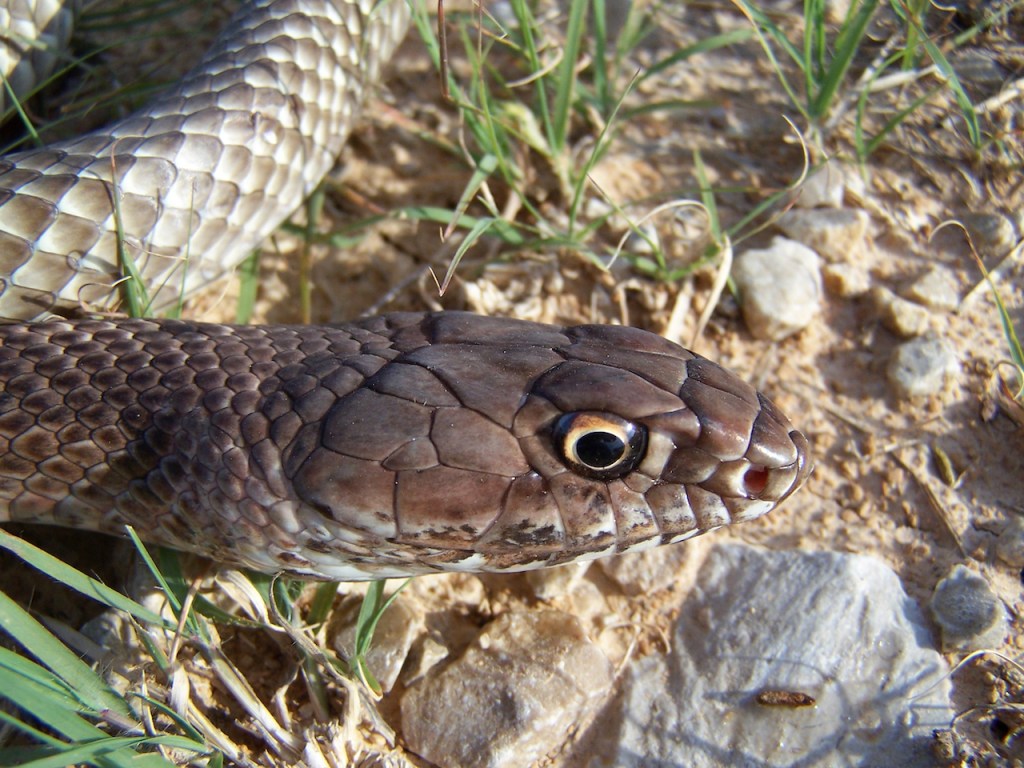
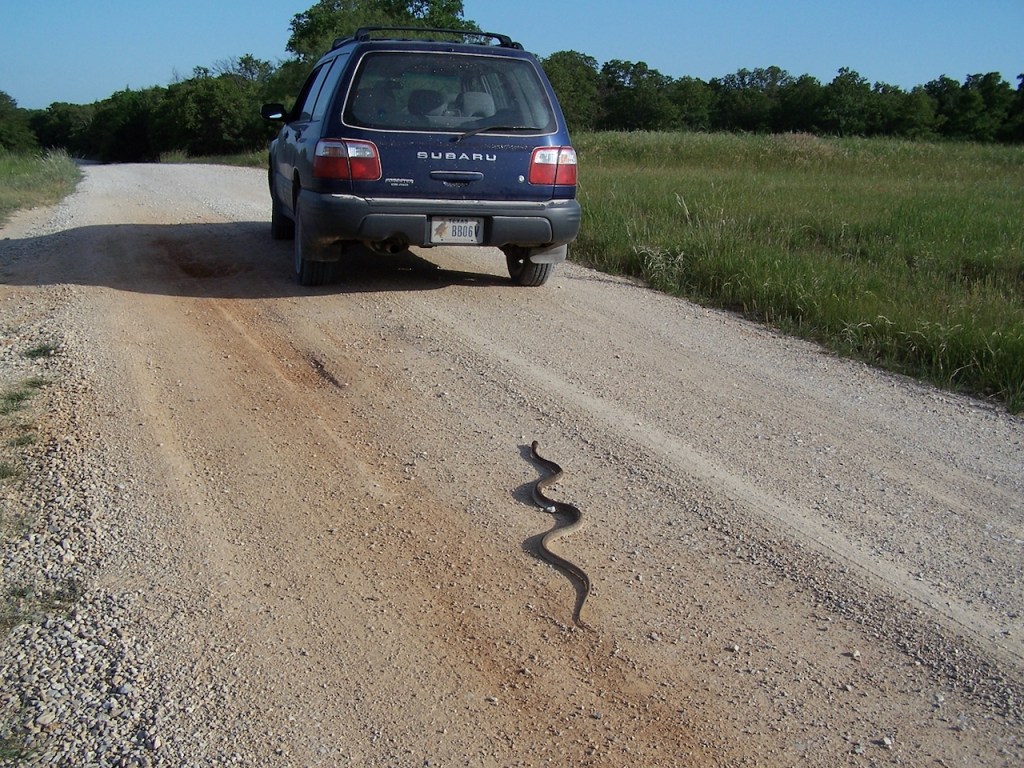
I posed the snake in a more normal position, took a couple of photos, and then encouraged it to be on its way. I positioned the snake in something closer to a straight line and backed away. In a moment it came back to itself and took off, crossing back across the road at typical coachwhip speed.
What are coachwhips?
One or another species or subspecies of coachwhip is found all across the southern U.S. In the east, including in parts of east Texas, much or all of the eastern coachwhip’s body may be velvety black. In central and west Texas the subspecies is the western coachwhip, with light brown or tan colors, often with a darker head and neck that may be rusty brown. In parts of their range, some of these coachwhips may have a banded appearance, with long, broad bands of a little darker color alternating with broad lighter bands. In the Trans-Pecos region, some of the western coachwhips are pink or reddish. Traveling with friends, we found one in Big Bend National Park that propelled itself off the road nearly in a blur, and I described it as looking like a snake with the world’s worst sunburn. (We stopped, but never found the snake.) Western coachwhips usually reach four to five-and-a-half feet, sometimes longer. Coachwhips are related to racers and whipsnakes, all of which are active by day, visually alert, and very fast.
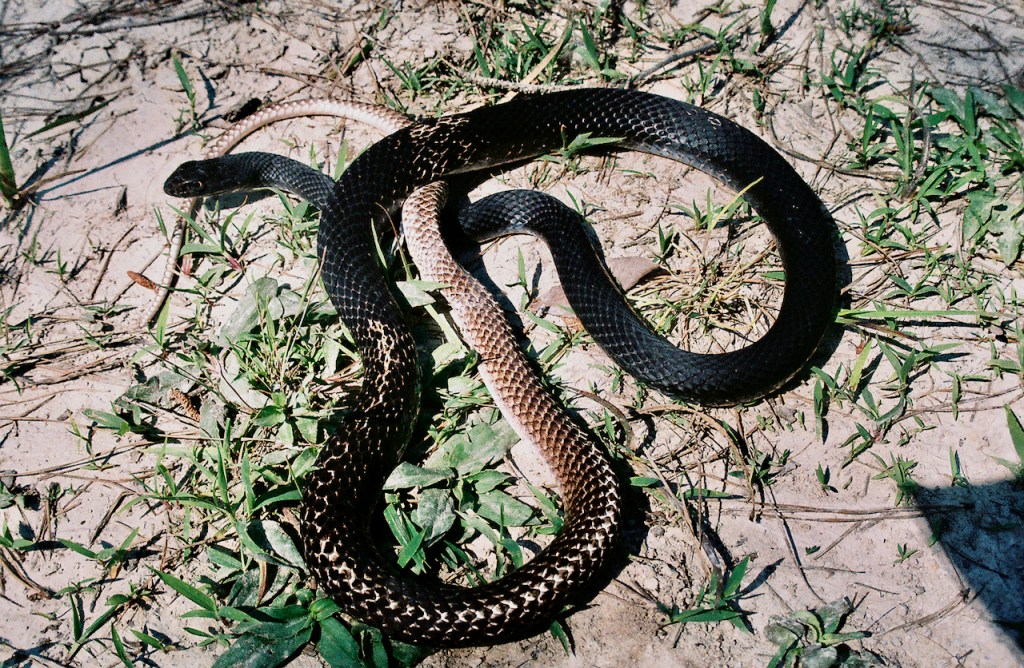
The name “coachwhip” comes from the color of the dorsal scales. Each one is light-edged as it emerges from under the previous scale, then becomes darker until it is dark brown along its trailing edge. This highlights the edges of scales, and toward the tail it gives the appearance of a braided whip.
Where do they live and what do they eat?
Coachwhips are, even in East Texas, snakes you expect to see in patches of prairie, openings in woodlands, or rocky hillsides. In the rest of Texas, they are well-adapted to open arid or semi-arid regions where they take advantage of openings beneath rocks, rodent burrows, and such refuges. They are able climbers and may take refuge in shrubs or lower tree branches when escaping predators. Within the Chihuahuan Desert they are seen in dry arroyos and desert flats, with desert shrubs and clumps of cactus offering shelter, along with mammal burrows.
As witnessed recently by my friend Rosealin Delgado, they are able climbers and may take refuge in shrubs or lower tree branches when escaping predators. She was at the edge of a pond at Sheri Capehart Nature Preserve and saw one emerge from the water’s edge (where the snake may have been getting a drink), periscope up and take note of her, and then climb up in low trees. The snake watched her for the better part of ten minutes before she left.
The coachwhip’s diet can be quite varied, depending on the prey available where they live. They readily eat lizards, spotting them and chasing them down. In some places they are reported to sit at the base of plants such as mesquite and wait for prey such as a lizard to dart into the shade to cool down. Coachwhips will eat smaller snakes, and they may poke around in crevices or burrows where they may find and eat mice. Around bat caves, coachwhips sometimes find and eat bats that are injured or stranded on the ground. They eat large insects such as lubber grasshoppers.
Having no venom to subdue prey, and not using constriction to kill the mouse or lizard before eating it, the coachwhip relies on strong jaws and a strategy of pinning prey against the ground. After catching a lizard and holding onto it with sharp little recurved teeth and a powerful bite, the snake points its snout toward the ground and pushes its prey against rocks or soil to help prevent escape and then begin swallowing. In our book, Herping Texas, co-author Clint King described watching a western coachwhip catch a Great Plains skink and beat the lizard repeatedly against the ground. Some of this might have been to dislodge the lizard’s biting the snake in a counter-attack, but it also appeared to be to stun or disable the lizard before swallowing it.
Reproduction
Coachwhips mate in the spring, typically in April or May. Within a month, the female lays a clutch of eggs in some place where they will be protected from drying out or overheating, and hopefully where predators will not find them. Such a place might be an abandoned burrow or under a rotting log. By August or September, the brightly marked babies hatch, measuring 12 to 14 inches long according to Werler & Dixon (2000).
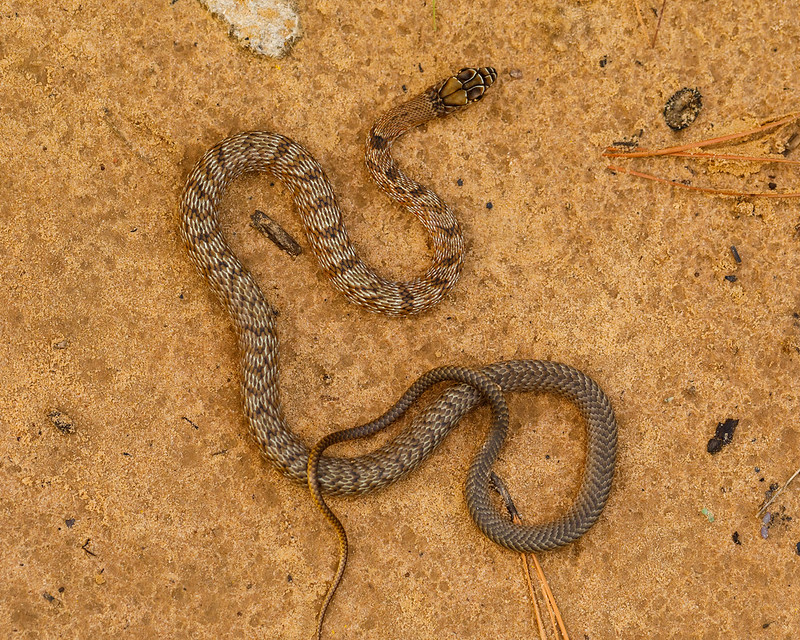
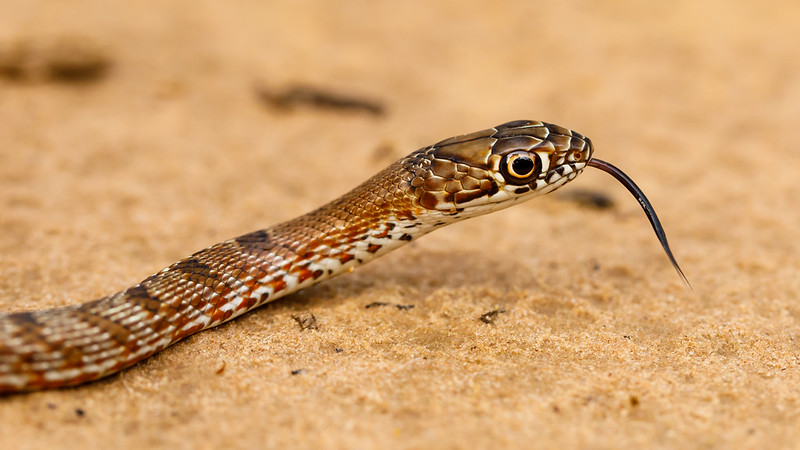
On a walk at LBJ National Grasslands in September of 2020, my friend Meghan Cassidy found a hatchling coachwhip and she took a number of beautiful photos of this little reptile. As is typical, its eyes were large (as befits an active, visual snake such as this) and it was slender and fast. Its coloration was bright, verging on orange along its neck. There were a number of thin crossbars of darker scales that would likely fade as the snake grew. I described our encounter with this snake in Mindfulness in Texas Nature.
Human perspectives and tales
No matter what your grandpa told you, a coachwhip is not going to wrap around you and whip you, regardless of its name and appearance. It seems likely that those old stories might have begun when someone caught a coachwhip and its long body wrapped around the person’s arm and, as it thrashed and tried to escape, whipped its tail against its captor.
Fewer people seem to have heard such stories, and we usually think of that as a good thing. After all, we don’t want people believing misinformation such as hoop snakes that roll down a hill and sting you, or milk snakes that will suck the milk from cows in a barn. But I worry that the disappearance of tall tales is not because people today are more savvy, but instead that they have so little contact with nature that there is no experience that would give birth to the tales. Stories about writhing balls or nests of cottonmouths arise when people see something and struggle to understand it, and they fill in missing details with fanciful explanations.
So I hope that you and your friends and family will be out in the field enough that you notice coachwhips and other things in nature, and come up with stories to account for what you saw. Read and listen and learn what you can so that your stories are mostly based on accurate understanding. But I would gladly live in a culture that is connected to nature enough so that we have stories and legends about the natural world, such as the coyote as a mythical trickster or the snake that will whip you.
Smith, M. 2024. Mindfulness in Texas Nature. College Station: Texas A&M University Press.
Smith, M. & C. King. 2018. Herping Texas: The Quest for Reptiles and Amphibians. College Station: Texas A&M University Press.
Werler, J.E. & J.R. Dixon. 2000. Texas Snakes: Identification, Distribution, and Natural History. Austin: University of Texas Press.
Discover more from Our Lives In Nature
Subscribe to get the latest posts sent to your email.
 Our Lives In Nature