The Undertaker’s Community Picnic

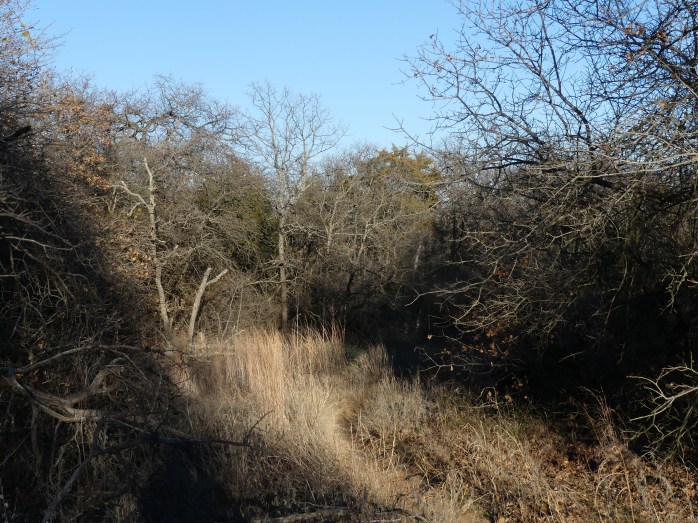
It was Monday afternoon, February 8th. The hours of broken clouds and sunshine were ticking away, and I made it to Fort Worth Nature Center & Refuge around 3:00pm. Faced with an array of good spots to choose from, I decided to walk the Cross Timbers Trail, which initially tracks the Trinity River before breaking away back into the woodland. I crossed the little bridge where the marsh reaches the river and kept going north. 
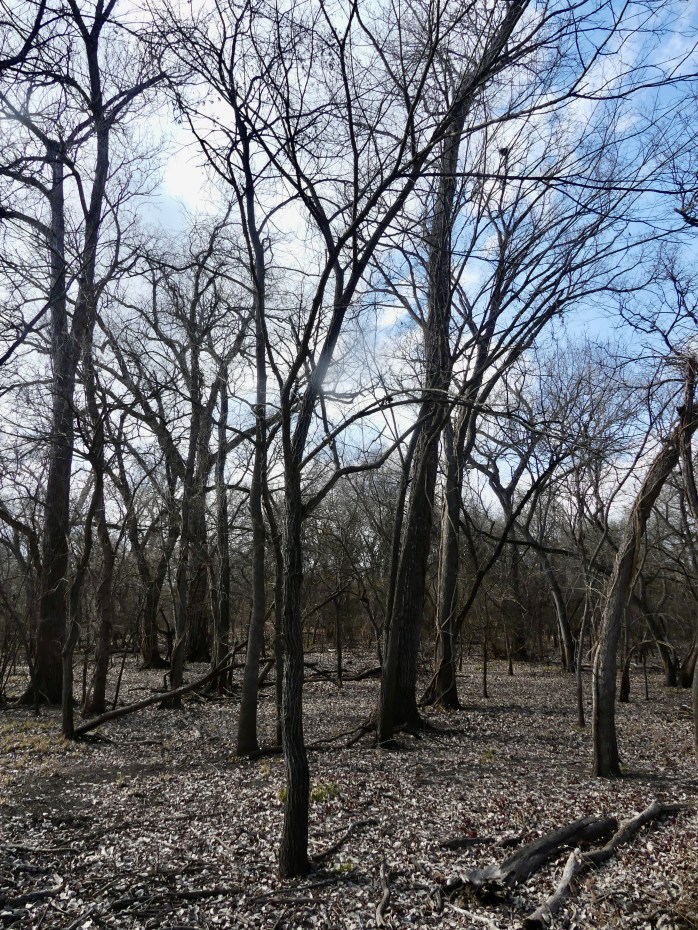
Bottomland at the refuge

Along this stretch of river, the trail is at the top of a small levee, with some bottomland habitat to the west. Some of the huge Cottonwood and other trees are wrapped in climbing vines as big as your arm, crisscrossing the trunk and reaching high into the tree canopy to claim their share of sunlight. On the other side of the trail is the river, with forest beyond it. 

The east bank of the river was the site of a community picnic. Some of the participants watched from up in the trees while others shared the bounty on the ground. All were arrayed in black, a solemn picnic resembling a funeral gathering. Two of the black figures on the ground were focused on a small patch of two-toned fur that might have been the last earthly remains of a raccoon. This was a gathering in which the undertakers eat the dead. 
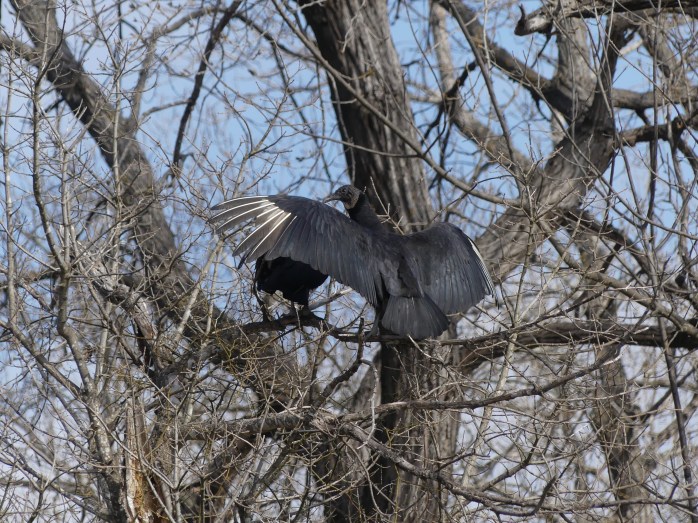
Black Vulture, warming its wings in the sun

These were Black Vultures, and they almost completely live up to their name. Even their bare heads are black, unlike the red heads of the slightly larger Turkey Vultures. A couple of the birds in today’s gathering stretched their wings to their full three- or four-foot reach, gathering the sun’s warmth. Those outstretched wings revealed six slightly dark-edged white feathers at the end of each wing, those first primary feathers like pale fingertips on a black bird. You can see them in flight, like a vague white spot on each black wing.
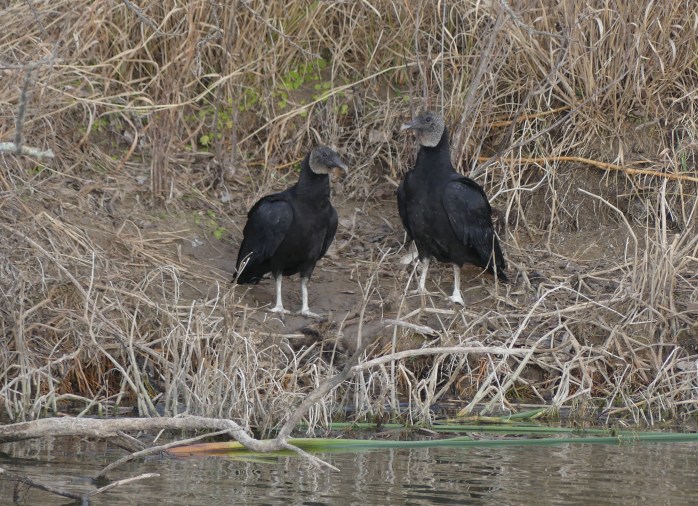
These are said to be very social birds, staying with mates for years and taking care of young for months after they fledge. They roost in community groups and those who have not found food can follow roost mates back to carrion. To quote Bruce Springsteen, “We take care of our own.” It’s family values with an aggressive tribal streak, as groups of Black Vultures are said to descend on a carcass and drive the Turkey Vultures back while they eat their fill. 

I walked on down the trail, seeing plenty of other birds. American Robins were searching for food on the woodland floor and flying up to low perches as I walked through. I could hear calls of Northern Cardinals periodically as males gear up for the coming spring. 

More bottomland

As the trail turned away from the river, it bordered a low area where water can drain toward the river, although at present it is all but dry. On the other side the land rises into Cross Timbers woodland. At the edge of the trail, two trees grew together in what looked like an embrace, one a Hackberry and the other a different kind of tree. They were entwined and seemed to be physically connected, two joined into one. 

The trees’ embrace

I soon had to turn around in order to get back before the refuge closed, and the clouds seemed a little heavier. Along the river, the late afternoon sun was shining so as to light up the bigger trees from a low angle. At one magical point, the sunlight made the top branches of the tallest trees glow, and against the darker blue-gray of the clouds behind them, those small curving branches were like silver filigree against the sky. The clouds shifted, obscuring the sun and the moment was gone. The experience stuck with me, one of thousands of such moments at this wonderful place.
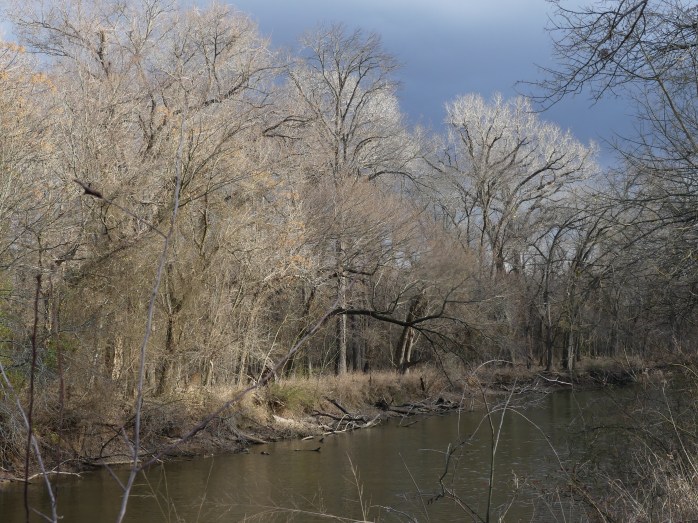
A moment of sunshine

As I passed the site of the picnic, a few of the undertakers remained. I suppose virtually all of the banquet was gone, or at least I could see little of it. The vultures had done their job well, helping to return the dead back to the soil from which they came. 

the Acrobatic Flight of “Butter-Butts”

Yellow-rumped Warbler in Dallas County (photo by Meghan Cassidy)

Yesterday was sunny and clear, and Southwest Nature Preserve was the right place to take a walk. Its 52 acres are hemmed in by a major freeway and suburban development, and many visitors walk its trails and drop fishing lines into its waters. Despite all that, it’s a pretty resilient little remainder of the oak woodlands and sandstone that are the calling cards of the Eastern Cross Timbers.

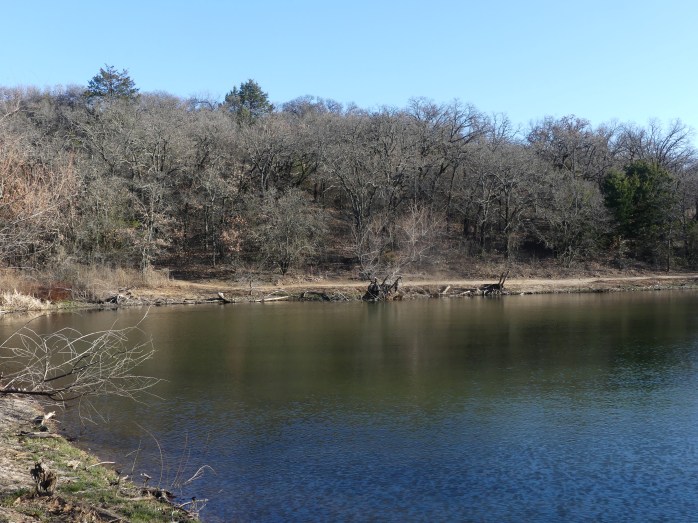
There’s something about winter-bare oak woodlands, with the sun shining through branches and lighting up the layer of leaves on the ground. And ponds, with clear water shading into a deeper gloom with aquatic plants and the waterlogged wood of fallen branches, hidden in the dark. Depending on where you stand, the pond’s surface may be a sapphire reflection of sunlight, and the surface may have shifting rough patches where cold winter breezes blow across it. Southwest Nature Preserve has those things. 

The north pond

It also has birds, and this winter there have been a lot of them. I have paid better attention, or this has been a season with good bird numbers and diversity, or both. And as a result, I’ve learned more about them this year, although I’m no expert. I’m also better able to put aside the old herpetologist’s habit of active searching. Instead of staying on the move, I can sit and blend in with the habitat for a while. Mindfulness and advancing age have helped with that.

I visited the smallest pond, expecting a little dried mud bowl because of the very dry conditions. Instead, it had several inches of clear water. As I watched, several small nondescript birds took turns flying out over the water. Often one of them would fly into the breeze and momentarily be held there, fifteen feet above the water, until it turned and in a ball of wind-splayed feathers it was pushed back to a nearby tree. 

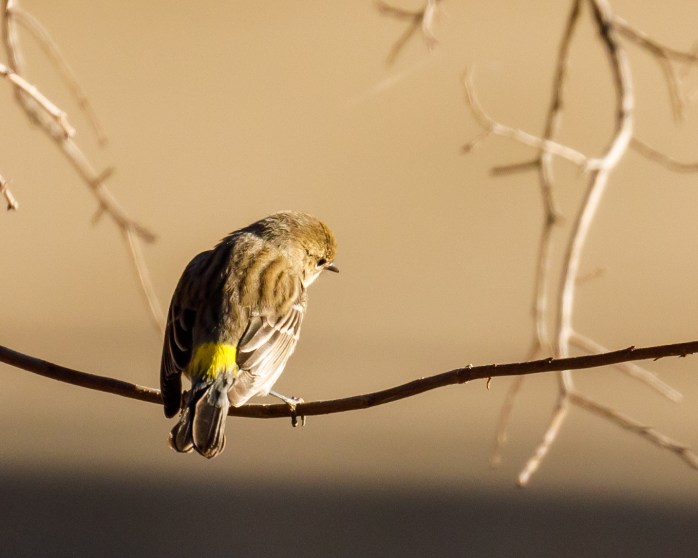
I sat on the banks of the pond for a while, watching these birds and listening to their calls back and forth: a single “cheet” repeated frequently. In my binoculars I would see gray-brown on the head and wings, with white and dark wing bars, and then that little patch of yellow on the side of the body. When one perched on a nearby twig, the binoculars showed a highlighter-yellow patch of feathers on the rump, more than justifying the name “butter-butt” that some birders give them. More properly, they are Yellow-rumped Warblers.

Yellow-rumped Warbler half-hidden in vegetation

As I watched, my naturalist’s reasoning suspected that they were catching insects too small for me to see. I imagined them to be having fun, as if their forays out over the water might start with a call to their neighbor to “watch this!” Sometimes they found a place to perch very close to the surface of the pond, but mostly they flew out above the water and returned to the winter-dry stalks of vegetation or up into the branches of an oak. A later check with some birding sources, including Cornell’s All About Birds site, seemed to confirm that their flight would have been in pursuit of insects. I don’t think this negates my suspicion that they were enjoying themselves.

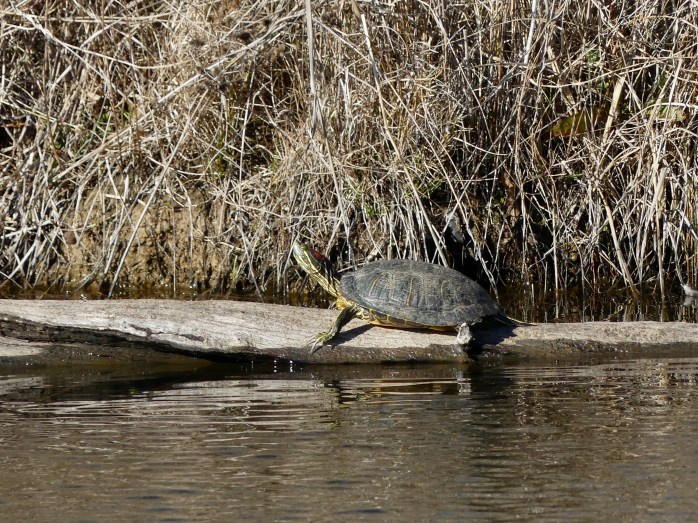
Red-eared Slider, basking at one of the ponds

There were other things to see on this sunny afternoon. In an adjacent pond, a male Red-eared Slider was basking on a log at the water’s edge, across from the fishing pier that extends out over part of the pond. He was unconcerned about my photographing him. In warmer circumstances, these turtles are shy and quick to drop into the water, but this guy was unwilling to give up the bright sunshine of a cool winter day.

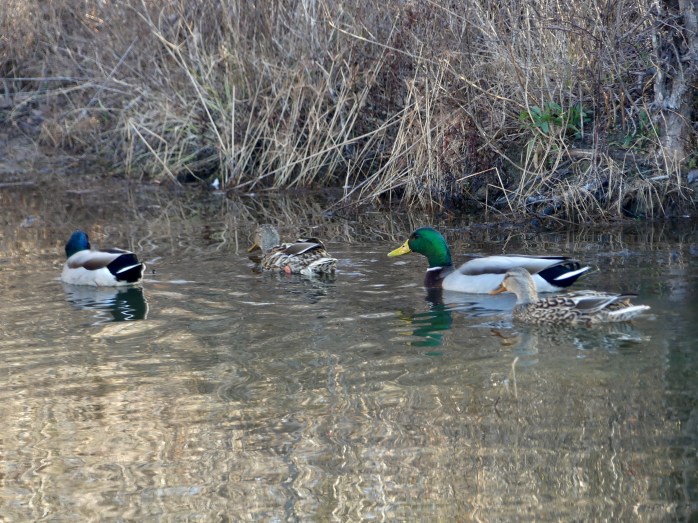
Mallards

Nearby, a couple of pairs of Mallards were cruising across the surface of a small pool, periodically going “tail-up” to dabble through the material along the bottom and extract whatever was good to eat. In contrast, there was no activity on the surface of the north pond, which often has its share of ducks and turtles. Today not even the cricket frogs were out, despite plenty of sunshine along the northeast banks of the pond.

It was a good day to wander along the ponds of the preserve and up over the ridge and through the woods. I learned more about its birds today and got to visit with the willows and oaks and pay my respects to the boulders and grasses. 

Late afternoon on the trail