Passing the Creek Along to a New Generation

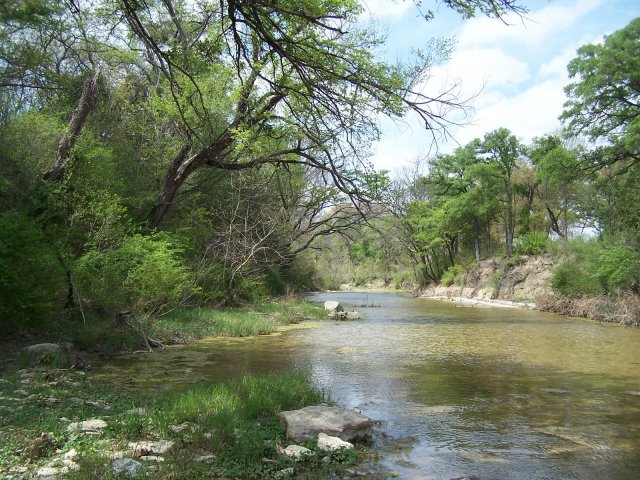
In about 1962 or ’63 I was given a gift that lasts a lifetime. I was introduced to a certain creek in western Tarrant County with clear running water rippling over white limestone and gathering in shaded pools. In deeper, still water the sunfish guarded their nests and hid in shadows. At about twelve years old, I would spend entire days there, chasing chalk-white earless lizards over jumbled limestone rocks and plunging into the water to catch the nonvenomous watersnakes that were common at the creek. With a friend or two, I’d wander the fields along the creek and sit where the grass and soil ended and the creek flowed twenty or thirty feet below us, watching turtles basking in the sun. It’s hard to imagine a more carefree existence than spending a day discovering the life of that creek.

I brought home mosquitofish, a surface-feeding little fish looking like a guppy without the fancy tail. Their blue iridescence, seen only with light at certain angles, is subtle but definitely caught my imagination. I was also drawn to the blackstripe topminnow, another surface-feeding fish like a little torpedo with a thick black line down its side.

The snakes, however, were the real prize. I was already hooked on gartersnakes, but the creek was home to incredibly graceful ribbonsnakes, seeming to trace calligraphy over the water as they swam. The bright orange and cream-colored stripes glowed in the sunlight when one of those slender little snakes swam across the water and traced its way through the streamside vegetation.
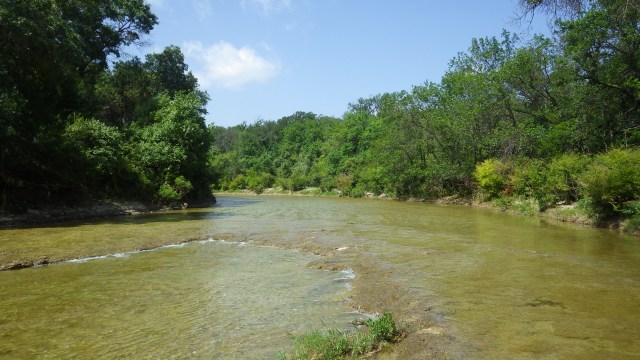
The creek was a place I returned to over and over. I walked it in summer heat when drought stopped the water’s flow and turned the pools into algae-choked saunas of warm water. I walked it in late fall when the water was almost too cold to wade, and flowed over yellow, brown, and rust-colored layers of dropped leaves. In the winter, I kept visiting even though most reptiles and amphibians were dormant in burrows and crevices. Cricket frogs, however, were out on almost any sunny day that gave them a chance to bask and hunt whatever tiny invertebrates were out and about. Fish didn’t seem to mind the winter’s chill and I could observe them while threading my way along limestone shelves and earthen embankments, trying not to step in the cold water.

Going to college spaced my visits out more but did not stop them. When we lived in Houston, work and distance kept me away. However, when we moved back to Arlington, I found times to visit. The creeping expansion of Fort Worth required that I enter the creek further out. Gradually, the city was gnawing away at my creek, as more land was sold to developers who turned perfectly good nature into bricks, concrete, and turf grass.

Casey examining a Red-eared Slider at the creek

This isn’t the story of the loss of the creek, however. It is the story of sharing it and passing it along to new generations. The connection I formed with the creek was forged in childhood, while spending day after day there when school was out for the summer, exploring and discovering as if that time would never end. Maybe it never did end, at least for that place as I internalized it and made it an important part of who I am. I have taken friends to that creek many times over the years. Most of them share a sense that this is a special place, and I hope that they return or else find some place to make theirs. It is too late for the adults to form the same kind of connection that I have with the creek. I am pretty sure that such a bond happens only during childhood, when a place seems to be what people call “larger than life.” What I really mean is “as large as life,” completely occupying that wide open space we give it when we live in it regularly and get to know it intimately. As we become adults, that space narrows; by then we have spent our lives in a lot of places, often in brief and fragmented chunks, making use of places in utilitarian ways. Usually there is little room left in which we can open ourselves to some beautiful place and live in it, getting to know its little mysteries and its seasons in an unhurried way.
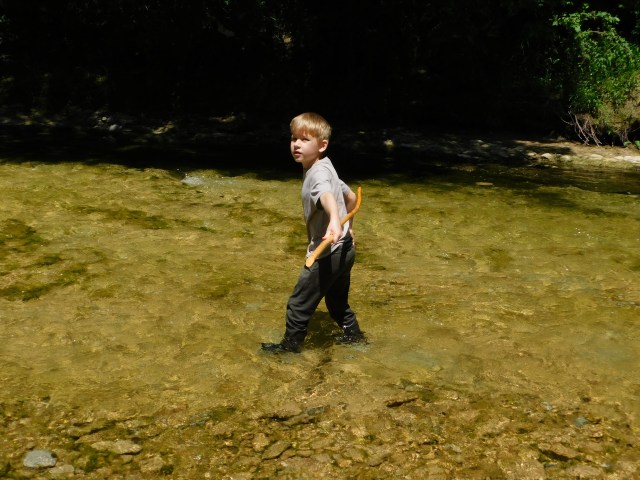
Elijah at the creek

I recently took Elijah for a little exploring at the creek. He is in many ways a grandson. I saw him on the day he was born and have watched him grow into a wonderful six-year-old who has been on many walks in nature preserves with his parents and me. I dedicated my forthcoming book to him and to an old mentor of mine, once again mindful of how a love of the natural world is passed along from one generation to the next. And on the day of the walk at the creek, it was just Elijah and me. We were prepared with a net and walking sticks. When wading the creek, the stick becomes a third leg to help balance on algae-coated limestone, and while the old man didn’t fall, Elijah did get a couple of soakings.
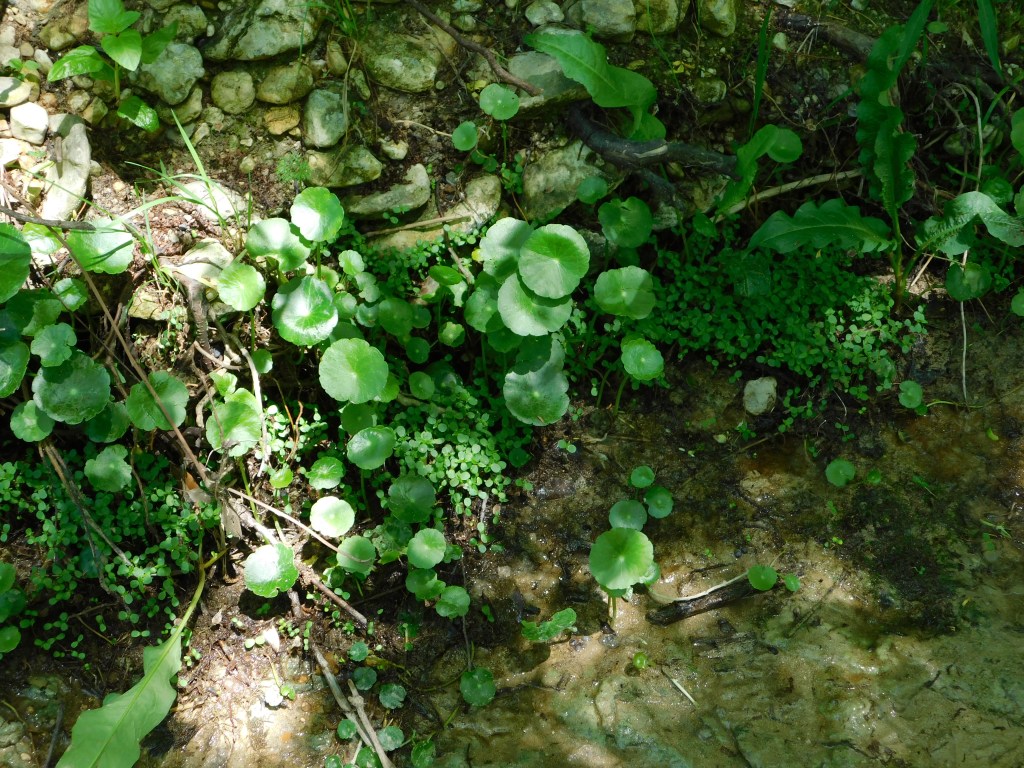
Water pennywort

Along a part of one side of the creek, in dappled shade, I saw some water pennyworts like parasols on thin little stems. I called Elijah over, saying “Look, they’re like little umbrellas.” At the time, I didn’t know what name to call them when Elijah asked. They were just some kind of pennywort. After another question or two, we moved on. He was on a Pokemon jag so that the dragonflies sailing on the sun-warmed air were “dragonfly-Pokemon,” and the turtles we looked for would have been “turtle-Pokemon.” We did find fish, all of which were too fast for our net. The group of shiners swimming close to the bottom scattered in front of the net, and the sunfish scooted out of reach with a flick of its caudal fin. We saw a small bass as well, but it was getting nowhere near the net.
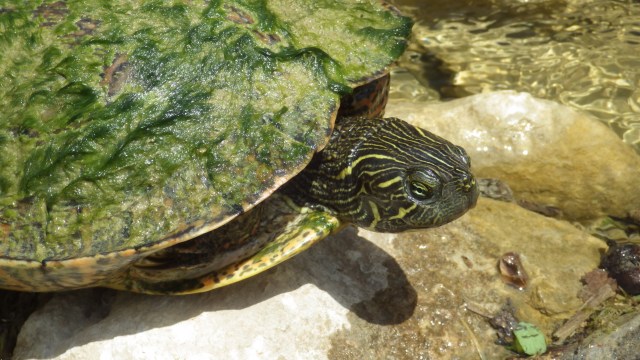
A turtle-Pokemon?

We had to decide whether to walk into an area where the water was forced into a small channel and ran swiftly – the equivalent of whitewater for the creek. I let him test his strength without getting into the biggest and fastest part and being pulled down. It’s good to get just enough real-life lesson about the power of moving water so that you know when it’s safe to wade and when it will drag you into the current.

After our explore was done and we were back at the car, Elijah asked how I knew so much about nature. I explained that I had been doing it for a lot of years, had read many books, and had hung out with people who knew a lot, just as he was doing with me today. He told me, “When I’m older and I can read better, we will find things and I’ll look them up in the books and we’ll know which plant we saw.” Such a beautiful dream only comes along once in a great while, and I would gladly see it come true. Elijah, you’ve got a deal. I promise. If I can give you the gift of this creek, or a woods or prairie somewhere, I will surely do it.

Finding a Box Turtle

(I wrote this in The Great Rattlesnake Highway blog, several years ago. I thought it was worth bringing over here before I finally retire the other blog.)

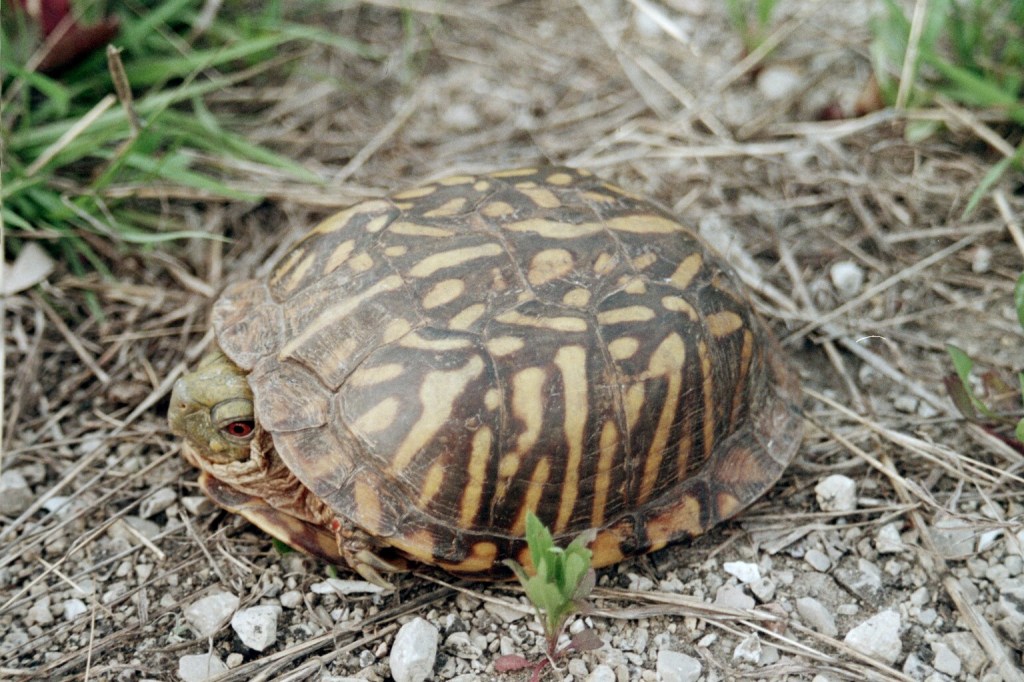
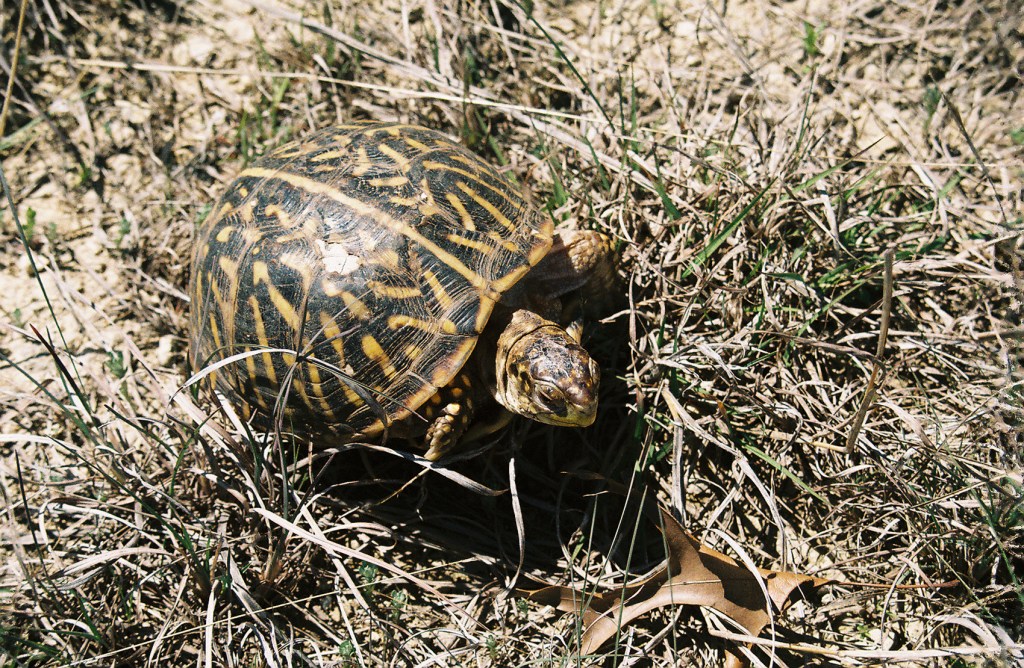
Another Ornate Box Turtle, this one a female

In May of the year 2000, Steve Campbell and I found a box turtle on our way to the LBJ National Grasslands, north of Decatur. It was an old male that had probably walked the fields and fencerows for twenty or perhaps thirty years or more. These ornate box turtles, with their yellow streaks on a compact, dark shell, used to be a common sight in the western cross timbers north and west of Fort Worth. In the last fifty years they’ve become increasingly uncommon in most of the places where they are found. So Steve and I were faced with a problem: what do you do with a turtle found just past someone’s driveway, on a busy farm road at the outskirts of a small but growing city?

Taking it home was never an option for us to consider. The box turtles that are left in the wild need to stay there, because the species depends on adults living a long time and continuing to reproduce, in order to have a chance of surviving. That individual turtle might have done fine if we had collected him; both Steve and I understood its need for a varied diet, an outdoor enclosure with access to direct sunlight as well as water and refuge, and such things. However, once picked up and taken home, it is dead to the population of box turtles. It might as well have been run over, as far as the impact on the box turtle population is concerned. We would like future generations to be able to see box turtles in the wild, and so we were not going to take that turtle out of the population.

A male Ornate Box Turtle, seen in Grand Prairie, Texas

Perhaps one way to keep the turtle in the population would be to take it far down a side road, away from traffic, and release it in a meadow near a pond – how does that sound? It used to sound great to me, but it can only sound good if we ignore something pretty important about box turtle behavior. If I was picked up and taken far from home, placed on an unfamiliar street surrounded by strangers, I would set out to try to find home. It probably would not matter that the neighborhood might not look so bad, I would want to find the place I know. I would want to go home. It is similar with box turtles. I do not want to anthropomorphize, trying to make box turtles just like people. However, these turtles do learn and remember important landmarks, and as they grow up, they generally establish a “home range.” This is an area that the turtle uses for day-to-day activities, in the same patch of woods or the same meadow, for most or all of the year.  In North American Box Turtles: A Natural History, C. Kenneth Dodd reports that while it is an area of variable size, often it is about the size of a couple of football fields. While some box turtles are transients, most stay within a small area over the course of years. And if moved out of this home range, they generally try to find their way back.

This tendency toward “homing” has plagued efforts to re-populate areas from which box turtles have declined. It also makes it hard to know what to do with box turtles found on city streets or other places where they cannot stay. If you take them to some new place, even an apparently good place, they may wander off. This is generally true of many reptile species – they know where they live and they don’t do well when released far from home. The mortality rate among relocated reptiles is high, presumably from wandering into danger or failing to settle down and find adequate shelter and food.

In a study published last year in Herpetological Conservation & Biology, J. Alan Sosa and Gad Perry reported on their work releasing adult, juvenile, and hatchling ornate box turtles in the Lubbock area. The turtles came from a wildlife rehabilitation facility, where they were brought after being hurt or found in areas that were obviously unsuitable for them. The researchers relocated only healthy turtles, placing them in a variety of locations. Some were released in suburban back yards, others in small undeveloped areas within the city limits, and still others were released on ranchland outside the city. Their whereabouts were tracked using radio transmitters glued to their shells. They found that only 24% of the adult turtles remained in the area where they were released, regardless of what which area it was. There were better results with juveniles and hatchlings, but even then, only 40% of them remained in the area.

And so, if we had taken our ornate box turtle to some place we considered safer and better, it is likely that the outcome for the turtle would be bad, with the turtle failing to settle down and “make a living” in a new place. Imagine how this applies to all the turtles that well-intentioned people take some place and let go, thinking that they’ve done the turtle a favor or helped boost the local population of turtles. And yet, it’s hard to know the right thing to do when you find a box turtle in a suburban neighborhood, in imminent danger from traffic, dogs, pesticides, and many other hazards. Our box turtle’s circumstances were a little better. It was at the edge of a small town, with open fields across the road.

We did about the only thing that our knowledge of box turtle natural history and our commitment to conservation left for us to do. We took the turtle across the road and released it in the nearby field. I thought about the chances that this turtle could go on living in this same patch of grassland, near a line of trees and a little creek, where it probably grew up. It had been lucky enough to survive all these years and not been run over by a car, or collected and put in some dirty aquarium in somebody’s house. Maybe that turtle is still roaming around on the outskirts of Decatur, eating dewberries and grasshoppers, and getting a good soak in the puddles after it rains. Maybe he ran across a female box turtle and together they generated one more clutch of eggs, from which one hatchling (if it was lucky) would survive to adulthood to carry on the species.

100_0142
An ornate box turtle seen at LBJ Grasslands on a different occasion – I made sure it got across the road and watched it walk out into the grasslands

On the other hand, I don’t know if that turtle wandered back out on the road the next day, possibly to be run over. There is no way for me to know, but I am sure we made the right decision on that day, sixteen years ago. Over the years since then, I have wandered the LBJ Grasslands many times, but have only seen  two or three other box turtles. We need to keep those turtles out there, alive and at home.